Presbyterian
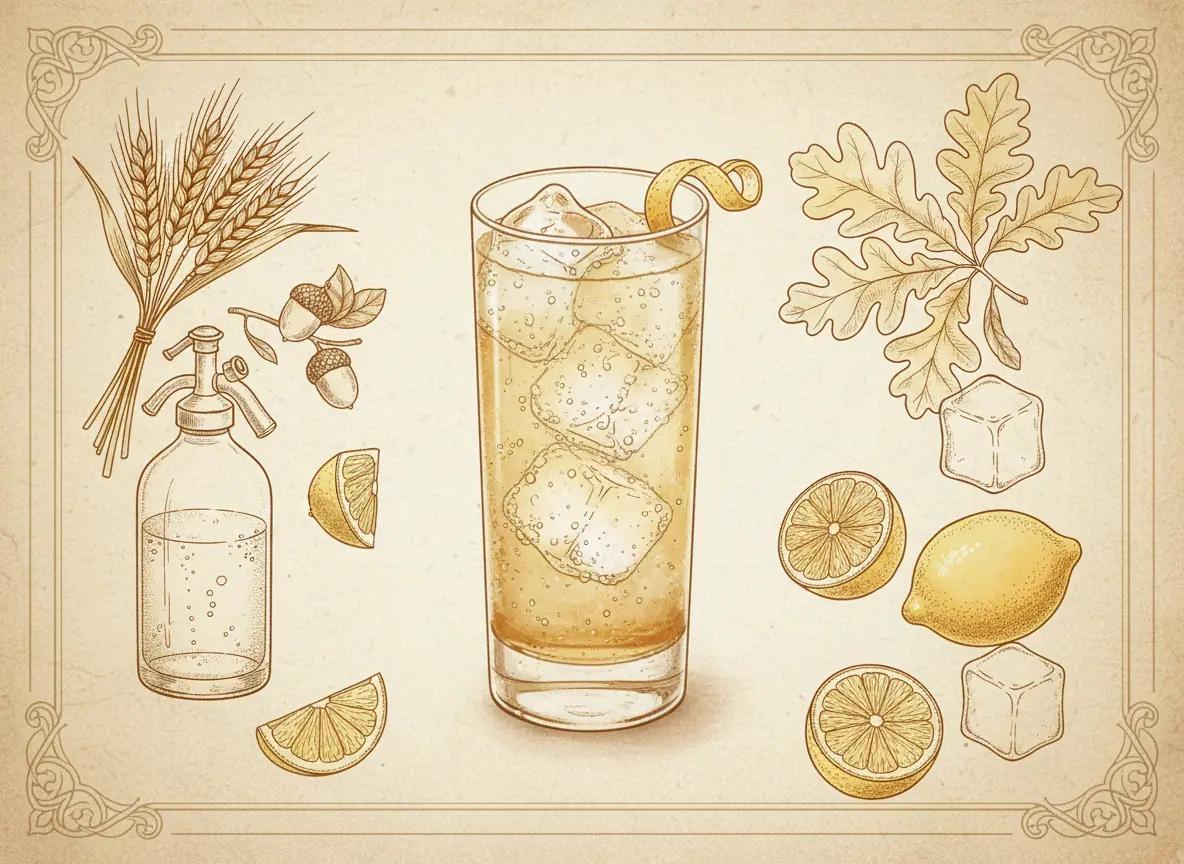
A Presbyterian is 50ml of rye whiskey over ice in a highball glass, topped with 60ml each of ginger ale and soda water poured in together, stirred once and finished with a lemon twist. About 2.0 UK units. The split top is the recipe. Ginger ale on its own makes a sweet whisky and ginger; soda on its own makes a plain highball. Half and half keeps the ginger as a seasoning and the drink dry. Its history is thin. Difford’s Guide calls it a traditional British highball of blended Scotch and says the name may come from the Greek presbýteros, “elder”, noting that the Presbyterian Church originated primarily in Scotland. Other writers suggest a joke at the expense of abstemious Presbyterians. We have found no source that documents either guess or names a first recipe or creator. Difford’s Guide says it should be made with Scotch rather than rye; ours uses rye, because in our view its pepper suits the ginger.
Glassware: Highball Glass
Garnish: Lemon twist
Ingredients
50ml
A rye at our working 40 to 45% ABV. Its pepper meets the ginger halfway. Blended Scotch makes a softer drink; bourbon makes a sweeter one.
60ml
Half the top. A dry, sharp ginger ale suits it better than a sweet one, and it should be cold and freshly opened.
60ml
The other half. It brings the bubbles and no sugar, which is what keeps the drink dry.
Instructions
Fill a highball glass to the top with cubed ice.
Add the rye whiskey.
Pour in the ginger ale and soda water together, down the side of the glass.
Stir once, gently.
Express a lemon twist over the surface and drop it in.
Our version
Difford’s Guide makes the Presbyterian with 45ml of blended Scotch and 45ml of soda water, topped with ginger ale. Ours uses 50ml of rye with 60ml each of ginger ale and soda water, for a drier drink with more pepper.
Source: our own specification. Last checked 10 October 2026.
Expert Tip
Keep the mixers level at 60ml each. Tip it towards the ginger ale and the drink turns sweet, and then it is a whisky and ginger. Pour the two mixers in together, down the side of the glass, and stir once. They mix on the way in, and each extra turn of the spoon knocks out fizz. Pack ice right to the rim. It holds its temperature; three cubes bobbing in the drink melt fast and water it down.
Behind the Presbyterian
Flavour Profile
Where It Comes From
We have found no source that pins down when the Presbyterian first appeared or who named it. Difford’s Guide says the name may come from the Greek presbýteros, “elder”, and notes that the Presbyterian Church originated primarily in Scotland. A common guess is a joke about a whisky drink diluted so politely that a temperance-minded Presbyterian might accept it; we have found no source for that.
The Split Top
Ginger ale carries sugar; soda water carries none, and both carry the same fizz. Mixing them half and half halves the sugar without flattening the drink.
It also changes what the ginger does. At full length it is the flavour of the drink. At half, it seasons the whiskey, and the whiskey comes back to the front.
Which Whiskey
Blended Scotch gives a soft, malty version. Ours uses rye, because rye’s pepper and dry grain sit well with ginger, as they do in a buck. Bourbon is the one to skip: it starts sweeter, and the drink exists to take sugar away.
Between Soda and Ginger Ale
Whisky with soda, with a split top, and with ginger ale; all three are our recipes and the units are our calculation
Whisky
- Whisky highball
- 50ml Scotch
- Presbyterian
- 50ml rye
- Whisky and ginger
- 50ml, any style
Mixer
- Whisky highball
- 100 to 125ml soda water
- Presbyterian
- 60ml ginger ale, 60ml soda water
- Whisky and ginger
- Ginger ale to top
Sweetness
- Whisky highball
- Dry
- Presbyterian
- Off-dry
- Whisky and ginger
- Sweet
UK units
- Whisky highball
- About 2.0
- Presbyterian
- About 2.0
- Whisky and ginger
- About 2.0
| Element | Whisky highball | Presbyterian | Whisky and ginger |
|---|---|---|---|
| Whisky | 50ml Scotch | 50ml rye | 50ml, any style |
| Mixer | 100 to 125ml soda water | 60ml ginger ale, 60ml soda water | Ginger ale to top |
| Sweetness | Dry | Off-dry | Sweet |
| UK units | About 2.0 | About 2.0 | About 2.0 |
How to Serve It
Tall, over a glass packed with ice, with the lemon twist expressed over the top. Build it to order; the bubbles start to fade as soon as the mixers go in.
For Scotch and soda alone, the Whisky Highball; for ginger ale with a long spiral of lemon peel, the Horse’s Neck; for Scotch with green ginger wine, the Whisky Mac.
Make it at home
The Spirit
Whiskey (Rye)Rye whiskey, under the US standard 27 CFR 5.143, takes at least 51% of its grain from rye and its colour from new charred oak, and goes into bottle at a 40% ABV minimum; our recipes take 40% as the figure. Rye makes a drier, spicier, more peppery spirit than corn, which is why stirred classics such as the Manhattan, Vieux Carré and Brooklyn are written for it. It appears in 23 of our recipes.
More to explore
Frequently Asked Questions
What is a Presbyterian cocktail?
Why half ginger ale and half soda?
Where does the name come from?
Which whiskey works best?
Can I use ginger beer instead of ginger ale?
How strong is a Presbyterian?
Sources.
Correct as of 19 October 2026.
- Difford’s Guide, “Presbyterian” (secondary source: a traditional British highball; 45 ml blended Scotch, 45 ml soda water, topped with ginger ale; the name may come from presbýteros, “elder”, and the Presbyterian Church originated primarily in Scotland; should be made with Scotch rather than bourbon, rye or Irish whiskey).
You Might Also Like
Whiskey Highball
A Whiskey Highball is 50ml Scotch whisky and 100 to 125ml cold soda water in a highball glass packed with ice, stirred once, with a strip of lemon peel twisted over it. About 2.0 UK units. With two ingredients, everything rests on the whisky, the soda and how cold both are. The Oxford Companion says whisky and soda crossed to America, where by 1895 it was rapidly edging into the mainstream under the name Scotch Highball. Where the word comes from is disputed: a tall glass, or one of the senses it had in baseball, poker and railroads. In Japan, where the highball means whisky and soda water, Suntory’s master blender Shinji Fukuyo told The Spirits Business that the highball campaign succeeded in the late 2000s, maybe 2008. The method exists to keep the bubbles: cold glass, cold soda, a gentle pour and one stir.
Whisky Mac
A Whisky Mac is 50ml of blended Scotch and 25ml of green ginger wine, poured into a rocks glass and stirred once, with no ice or a single cube and no garnish. About 2.3 UK units, taking the ginger wine at 13.5% ABV. Waitrose Cellar says Stone’s Ginger Wine is made from a secret recipe including raisins and ground ginger; it is not a mixer or a cordial, so the drink stays short and still, closer to a stirred spirit than to a highball. The ginger brings heat and the raisin a dark sweetness, and both suit a blended Scotch. Published recipes range from equal parts to three of whisky to two of wine. Two to one, as here, keeps the whisky in front and the sugar down. Difford’s Guide says legend names Major General Sir Hector MacDonald, known as Fighting Mac, as the first to make it, in India in 1899.
Moscow Mule
A Moscow Mule is 45ml of vodka and 10ml of fresh lime juice over ice in a copper mug, topped with 120ml of cold ginger beer and stirred once, with a lime wedge. Those are the IBA’s measures. About 1.8 UK units, all from the vodka. It is usually dated to 1941 and credited to John G. Martin of Heublein, which had bought Smirnoff and was left with a surplus of vodka, and Jack Morgan of the Cock ’n’ Bull in Los Angeles, who was pushing his own ginger beer, VinePair reports. The Oxford Companion gives other accounts: that Morgan and Martin devised it in New York, or that the Cock ’n’ Bull’s head bartender, Wes Price, did. The ginger beer decides the drink. At 120ml it is two thirds of the glass, so a soft, sugary one gives a soft, sugary Mule. Use the fieriest you can find, and keep the lime short: good ginger beer brings its own bite.
Where this one sits
Recipe by Jerry Can Spirits · Updated 19 October 2026