Shamrock Sour
A Shamrock Sour is 45ml of Irish whiskey, 20ml of fresh lime juice, 20ml of honey syrup, 15ml of blue curaçao and a splash of orange juice, about 10ml, shaken hard for 10 to 12 seconds and double strained into a chilled coupe. No garnish. About 2.1 UK units. A 15ml egg white is optional. It is our St Patrick’s Day sour. The green comes from blue curaçao meeting the yellow of the lime and orange juice. The Oxford Companion, in an entry by David Wondrich, says Bols introduced blue curaçao in 1912 to supplement the red and green varieties, which were artificially coloured, so the colour is festive rather than natural, and the curaçao also brings orange flavour and some of the sweetness. Under the colour it is an Irish whiskey sour. Honey syrup rounds the lime more softly than sugar would, and the orange juice softens the acid and shifts the shade toward a clearer green.
Glassware: Coupe Glass
Garnish:
Ingredients
45ml
A smooth blended Irish whiskey at 40% ABV. It lets the honey and orange come through; a heavy single pot still bottle is better kept for sipping.
20ml
Squeezed the same day. Its yellow is half the green, and its acid carries the sour.
20ml
Two parts honey to one of warm water, cooled. Softer than sugar against the lime, and thinned so it mixes into a cold drink.
15ml
Curaçao with blue colouring added, at our working figure of about 20% ABV. With the citrus it makes the green, and it adds orange flavour; brands differ in shade and sweetness.
A splash (about 10ml)
Squeezed the same day and added a little at a time. It softens the lime and shifts the colour toward green.
15ml (optional)
Optional, for a soft foam that makes the green paler. Raw. Following the FSA, British Lion-mark eggs are safe raw, including for vulnerable groups and in pregnancy; pasteurised carton white is the alternative. Eating out, where the mark cannot be checked, the FSA advises vulnerable people to have their eggs thoroughly cooked. Contains egg: leave it out, or use aquafaba, for anyone allergic.
Instructions
Squeeze the lime and orange juice the same day and chill a coupe.
Add the Irish whiskey, lime juice, honey syrup, blue curaçao, orange juice and egg white, if using, to a shaker.
If using egg white, dry shake without ice for 10 to 15 seconds.
Fill with cubed ice and shake hard for 10 to 12 seconds.
Double strain into the chilled coupe. No garnish.
Our version
Our own St Patrick’s Day sour: 45ml Irish whiskey, 20ml lime, 20ml honey syrup, 15ml blue curaçao and a splash of orange juice, with 15ml egg white optional. No published original exists.
Source: our own specification. Last checked 10 October 2026.
Expert Tip
Thin the honey first: two parts to one of warm water, cooled. Honey straight from the jar sets in the cold shaker and never mixes in. Add the orange juice a little at a time. Blue curaçao varies in colour and sweetness between brands, and a few drops of orange more or less is what moves the shade from teal to green. Much beyond 10ml and the drink starts to taste of fruit punch. With egg white, dry shake for 10 to 15 seconds before adding ice. The foam turns the drink a paler, milky green, so leave it out if the colour matters most.
Behind the Shamrock Sour
Flavour Profile
A Green Sour for One Night
The Shamrock Sour is our own recipe, not an Irish classic. It exists for St Patrick’s Day, when people want something green in the glass, and it is built so that the drink underneath is worth having.
Blue curaçao provides the colour. the Oxford Companion says Bols introduced blue curaçao in 1912 beside red and green versions, all artificially coloured; shaken with yellow citrus the blue turns green. The colouring is the only part of the drink there for looks; the curaçao itself adds orange flavour and sweetness.
A Whiskey Sour Underneath
Take the colour away and the structure is a whiskey sour with the sweetness split two ways: 20ml of honey syrup and 15ml of curaçao against 20ml of lime. Honey softens the lime more gently than sugar, and the curaçao adds an orange note that links the whiskey to the citrus.
The orange juice is a correction, not a main ingredient. About 10ml softens the acid and moves the shade. Much more and the drink tastes like fruit punch.
The Whiskey
A smooth blended Irish whiskey suits it. Its light, fruity character sits under the honey and orange without arguing. Single pot still whiskey is fuller and spicier, and it is better tasted neat than in a coloured sour.
Getting the Green Right
Blue curaçao varies by brand in both shade and sweetness, so the colour will not always match a photograph. Add the orange juice a few drops at a time until the green settles. Fresh citrus keeps it clear; old, cloudy juice mutes it.
Egg white changes the colour as well as the texture. Its foam turns the drink a soft, milky green. Leave it out for the brightest colour, or put it in for a rounder drink.
Whiskey Sour and Shamrock Sour
Our Whiskey Sour beside the Shamrock Sour
Whiskey
- Whiskey Sour
- 45ml bourbon
- Shamrock Sour
- 45ml Irish whiskey
Citrus
- Whiskey Sour
- 25ml lemon
- Shamrock Sour
- 20ml lime, plus about 10ml orange
Sweetener
- Whiskey Sour
- 20ml sugar syrup
- Shamrock Sour
- 20ml honey syrup and 15ml blue curaçao
Egg white
- Whiskey Sour
- 15ml, optional
- Shamrock Sour
- 15ml, optional
Serve
- Whiskey Sour
- Over fresh ice in a rocks glass
- Shamrock Sour
- Up, in a chilled coupe
Garnish
- Whiskey Sour
- Half an orange slice and a cherry
- Shamrock Sour
- None
UK units
- Whiskey Sour
- About 1.8
- Shamrock Sour
- About 2.1
| Element | Whiskey Sour | Shamrock Sour |
|---|---|---|
| Whiskey | 45ml bourbon | 45ml Irish whiskey |
| Citrus | 25ml lemon | 20ml lime, plus about 10ml orange |
| Sweetener | 20ml sugar syrup | 20ml honey syrup and 15ml blue curaçao |
| Egg white | 15ml, optional | 15ml, optional |
| Serve | Over fresh ice in a rocks glass | Up, in a chilled coupe |
| Garnish | Half an orange slice and a cherry | None |
| UK units | About 1.8 | About 2.1 |
How to Serve It
Up, in a chilled coupe, with no garnish. Serve it straight after straining, while it is coldest and the colour is brightest, and early in the evening rather than late.
For the sour without the colour, make a Whiskey Sour; for Irish whiskey with coffee and cream, an Irish Coffee.
Make it at home
The Spirit
Whiskey (Irish)Irish whiskey is whiskey distilled on the island of Ireland and aged there in wood for three years or longer, and bottled at no less than 40% ABV. The Irish Whiskey technical file names four types, pot still, malt, grain and blended, and the soft blends are what our nine Irish recipes mostly use. The Irish Whiskey technical file calls triple distillation the traditional practice, not a rule, and specifies unpeated malt only for pot still whiskey.
More to explore
Frequently Asked Questions
What is in a Shamrock Sour?
Why is the drink green?
Which Irish whiskey should I use?
Can I add egg white?
Can I use honey straight from the jar?
Is the Shamrock Sour a traditional Irish drink?
How strong is a Shamrock Sour?
Sources.
Correct as of 19 October 2026.
- The Oxford Companion to Spirits and Cocktails (David Wondrich), “curaçao (sometimes spelled curaçoa)” (secondary source: originally a liqueur flavoured with dried laraha orange peel; the earliest versions colourless; blue curaçao introduced by Bols in 1912 beside red and green varieties, artificially coloured).
You Might Also Like
Whiskey Sour
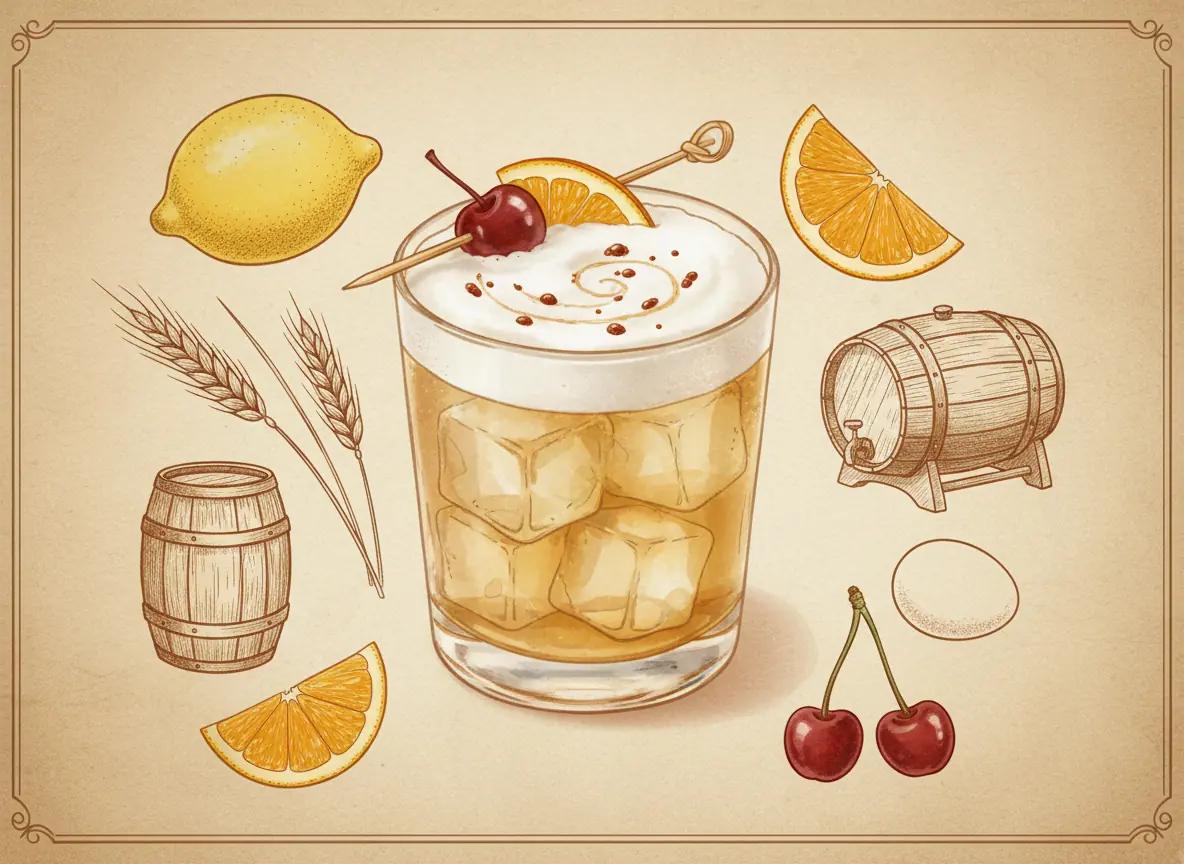
A Whiskey Sour is 45ml of bourbon, 25ml of fresh lemon juice and 20ml of sugar syrup, shaken hard with ice, then poured through a strainer onto fresh cubes in a rocks glass, with half an orange slice and a cherry. Add 15ml of egg white, dry shaken first, and dot the foam with Angostura. About 1.8 UK units. The measures are the IBA’s. The IBA’s egg white is optional and only a few drops; we use 15ml, about half a white, because that is what a full foam takes. The bitters are not in the IBA recipe, and they only go on when there is foam to hold them. The name is in print by 1870, in a Wisconsin newspaper, and the sour is older still: Jerry Thomas printed brandy, gin and rum sours in 1862. Difford’s Guide lists a Boston Sour as bourbon soured with lemon juice and smoothed by egg white.
Honey Sour
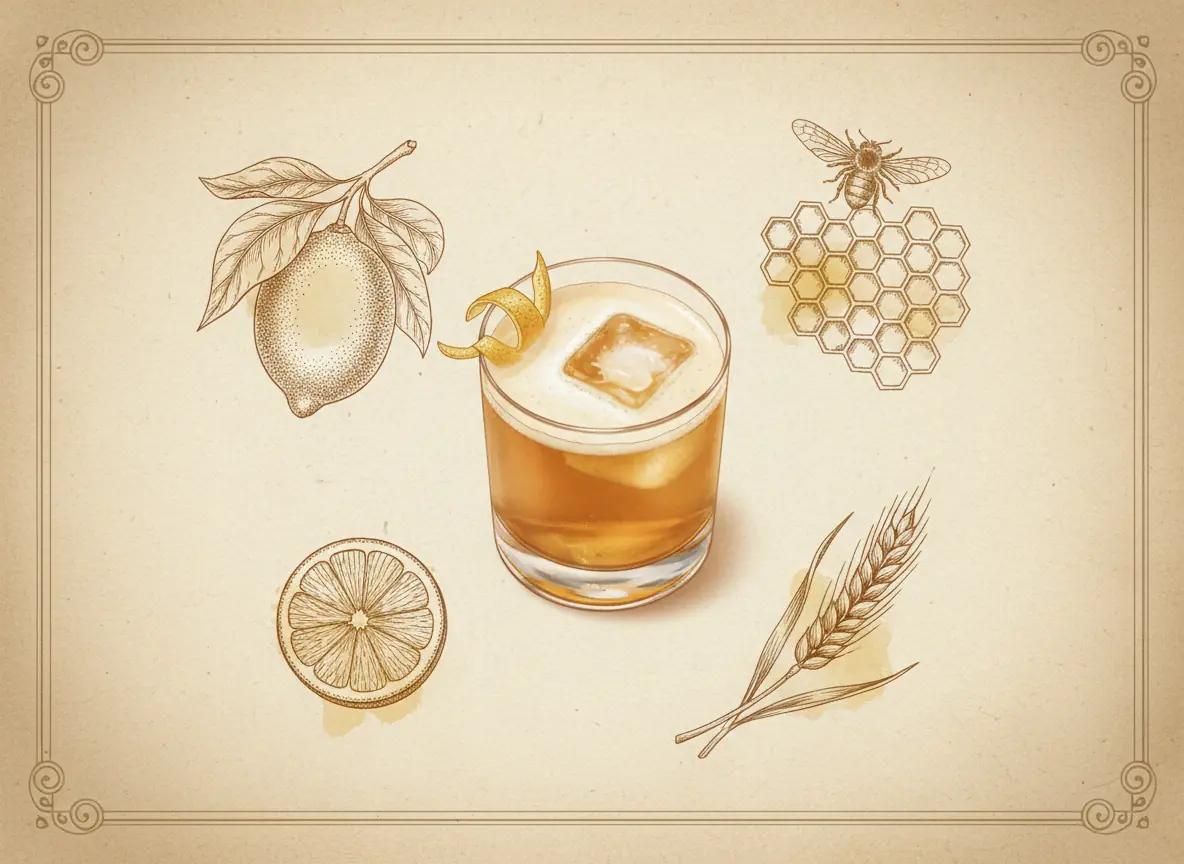
A Honey Sour is a Whiskey Sour sweetened with honey: 60ml bourbon, 25ml fresh lemon juice and 15ml honey syrup mixed at two parts honey to one of warm water, shaken hard and double strained over a large cube in a rocks glass. A 15ml egg white is optional and gives it a soft foam, with three drops of Angostura on top. Honey changes more than the sweetness. It adds a floral, waxy note on top of the bourbon’s vanilla and caramel, and more body than sugar syrup. The drink sits between the Whiskey Sour and the Gold Rush, the bourbon, lemon and honey drink that Punch credits to T. J. Siegal at Milk & Honey in New York, in 2000 by its account and 2001 by VinePair’s. The Honey Sour adds back the egg white and the bitters, with a little less syrup. No one is recorded as its inventor. It is a sweetener swap on a sour. Difford’s Guide dates the first written sour recipes to Jerry Thomas’s 1862 guide and the oldest known whiskey sour mention to a Wisconsin newspaper of 1870. A glass holds about 2.4 UK units.
Where this one sits
Recipe by Jerry Can Spirits · Updated 19 October 2026