Raspberry Lynchburg
A Raspberry Lynchburg is 40ml of Jack Daniel’s Tennessee whiskey, 15ml of Chambord, 10ml of triple sec and 20ml of fresh lemon juice, built over ice in a collins glass and topped with 90ml of sparkling lemonade, with a lemon wheel and fresh raspberries. About 2.2 UK units. It is our Lynchburg Lemonade with half the triple sec swapped for Chambord. Both liqueurs are sweet, so the raspberry replaces orange rather than joining it, and the glass stays a long, sharp highball rather than a cordial. Difford’s Guide adapts its Raspberry Lynchburg from a recipe created in 1992 by Wayne Collins at Roadhouse in London: Tennessee whiskey shaken with lime and sugar syrup, topped with lemon-lime soda, with a black raspberry liqueur such as Chambord drizzled over the surface. Ours keeps the parent drink’s lemon and lemonade.
Glassware: Collins Glass
Garnish: Lemon wheel and Raspberries
Ingredients
40ml
The same whiskey as our Lynchburg Lemonade, at 40% ABV. The charcoal filtering it gets before the barrel rounds it off under the fruit.
15ml
Black raspberry liqueur at 16.5% ABV on Chambord’s own page, with vanilla and honey behind the fruit (Chambord’s own page lists Madagascan vanilla and honey). Fifteen millilitres colours the whole glass and survives being lengthened, where a raspberry syrup tastes of sugar.
10ml
A dry triple sec such as Cointreau, whose own page gives 40% Alc./Vol., cut from the parent’s 20ml to 10ml because the Chambord brings sugar of its own.
20ml
Juiced the same day, and the only real acid here. Sweetened lemonade cannot stand in for it.
90ml
Sharp and cloudy. Ninety millilitres gives the length and the fizz; a very sweet lemonade on top of two liqueurs makes the drink cloying.
Instructions
Squeeze the lemon juice the same day, ideally just before you build.
Fill a collins glass with cubed ice.
Add the whiskey, Chambord, triple sec and lemon juice, and stir briefly.
Top with the sparkling lemonade and stir once more, gently.
Garnish with a lemon wheel and a few fresh raspberries.
Our version
Difford’s Guide adapts the Raspberry Lynchburg from Wayne Collins’s 1992 recipe at Roadhouse, London, with lime, sugar syrup, lemon-lime soda and a black raspberry liqueur drizzle. Ours builds on our Lynchburg Lemonade, with fresh lemon and sparkling lemonade, and halves the triple sec to make room for 15ml of Chambord.
Source: our own specification. Last checked 10 October 2026.
Expert Tip
Swap, do not add. Take the triple sec down to 10ml when the Chambord goes in. A full measure of each makes a glass too sweet to want a second of, and a second is the point of a long drink. Squeeze the lemon. Two liqueurs and a sweetened mixer bring plenty of sugar, and 20ml of fresh juice is the only acid that answers it. For the look of the drink Difford’s Guide adapts from the 1992 recipe, hold back the Chambord and pour it last, in a slow circle over the top. It is heavier than the lemonade and falls through the ice in red threads; stir before drinking, or not.
Behind the Raspberry Lynchburg
Flavour Profile
Where It Comes From
The Lynchburg Lemonade came first. Garden & Gun says Tony Mason, a lounge owner in Huntsville, Alabama, threw it together in 1980, and that Jack Daniel’s then started promoting it without compensating him; VinePair says the brand admitted it learned the recipe from Mason in a company newsletter in 1982. Garden & Gun says he sued in 1983, seeking $13 million, and was awarded one dollar, while VinePair says the judgment was overturned on appeal after years of wrangling. Tasting Table says the drink is named after the distillery’s birthplace, Lynchburg, Tennessee.
Difford’s Guide adapts its Raspberry Lynchburg from a recipe created in 1992 by Wayne Collins at Roadhouse in London. Difford’s Guide prints it as Tennessee whiskey shaken with lime and sugar syrup, topped with lemon-lime soda, with a black raspberry liqueur such as Chambord drizzled over the surface so it falls through the ice.
Ours is built on our own Lynchburg Lemonade instead, with fresh lemon and sparkling lemonade, and stirs the Chambord in.
Why Chambord Rather Than Syrup
Raspberry syrup and Chambord are not interchangeable, and the difference shows most at highball length.
Syrup gives bright, one-note fruit and a lot of sugar, and stretched with 90ml of lemonade it reads thin. Chambord is a black raspberry liqueur which, by its own account, is made with Madagascan vanilla, honey, Moroccan citrus peel and French spirits, and that depth survives the dilution. At 15ml it colours the glass and gives a rounded, faintly jammy body.
It is the same reason our French Martini uses Chambord rather than syrup.
The Halving
The Lynchburg Lemonade uses 20ml of triple sec. This uses 10ml, plus 15ml of Chambord.
That small piece of arithmetic does a lot of work. Both liqueurs are sweet, and a version that keeps the full orange measure and adds raspberry on top is noticeably sweeter than either the parent or this. On a single glass you might not object. On the second, on a warm afternoon, you will.
The raspberry should deepen the drink rather than candy it, and the measure decides which happens.
Why Tennessee Whiskey
The Oxford Companion says Tennessee whisky is typically passed through large amounts of maple charcoal before barrel ageing, a step known as the Lincoln County process, and that distillers claim it removes impurities and imparts a soft, sweet note. In our view it comes out rounder.
Here that roundness helps. High-rye bourbon brings pepper that fights the raspberry, and a very soft wheated bourbon vanishes. Tennessee whiskey sits between them.
The Lynchburg Family
The Raspberry Lynchburg beside the Lynchburg Lemonade and the 1992 recipe as Difford’s Guide prints it; the units are our calculation at 40% for the whiskey and triple sec and Chambord at 16.5% on its own page
Raspberry Lynchburg (ours)
- Whiskey
- 40ml Jack Daniel’s
- Liqueurs
- 15ml Chambord, 10ml triple sec
- Citrus and sugar
- 20ml lemon
- Topped with
- 90ml sparkling lemonade
- UK units
- About 2.2
Lynchburg Lemonade
- Whiskey
- 40ml Jack Daniel’s
- Liqueurs
- 20ml triple sec
- Citrus and sugar
- 20ml lemon
- Topped with
- 90ml sparkling lemonade
- UK units
- About 2.4
Difford’s Guide, adapted from Roadhouse, 1992
- Whiskey
- 50ml Tennessee whiskey
- Liqueurs
- 15ml Chambord, drizzled
- Citrus and sugar
- 22.5ml lime, 7.5ml sugar syrup
- Topped with
- 50ml lemon-lime soda
- UK units
- About 2.2
| Drink | Whiskey | Liqueurs | Citrus and sugar | Topped with | UK units |
|---|---|---|---|---|---|
| Raspberry Lynchburg (ours) | 40ml Jack Daniel’s | 15ml Chambord, 10ml triple sec | 20ml lemon | 90ml sparkling lemonade | About 2.2 |
| Lynchburg Lemonade | 40ml Jack Daniel’s | 20ml triple sec | 20ml lemon | 90ml sparkling lemonade | About 2.4 |
| Difford’s Guide, adapted from Roadhouse, 1992 | 50ml Tennessee whiskey | 15ml Chambord, drizzled | 22.5ml lime, 7.5ml sugar syrup | 50ml lemon-lime soda | About 2.2 |
How to Serve It
Build it in a collins glass packed with ice: the whiskey, Chambord, triple sec and lemon first with a short stir, then the lemonade and one last gentle stir.
A lemon wheel and a few fresh raspberries. The wheel adds fresh acid as the drink sits, and the berries tell you what is in it.
For the parent drink, make a Lynchburg Lemonade; for Chambord with vodka and pineapple, a French Martini.
Make it at home
The Spirit
Jack Daniel's Tennessee WhiskeyOld No. 7 from Jack Daniel’s is a Tennessee whiskey from Lynchburg, Tennessee, made, by Jack Daniel’s own account, from 80% corn, 12% barley and 8% rye, and listed at 40% ABV by the retailer Booths. It meets the bourbon rules but trickles through a ten-foot bed of sugar maple charcoal on its way to the barrel, the Lincoln County Process, which a Tennessee law of 2013 requires of Tennessee whiskey, by the Oxford Companion’s account. Three of our recipes use it, led by the Lynchburg Lemonade.
More to explore
Frequently Asked Questions
What is a Raspberry Lynchburg?
Who created the Raspberry Lynchburg?
Why halve the triple sec instead of just adding Chambord?
Can I use raspberry syrup instead of Chambord?
Why Tennessee whiskey rather than bourbon?
Can I make Raspberry Lynchburgs by the jug?
How strong is a Raspberry Lynchburg?
Sources.
Correct as of 19 October 2026.
- Difford’s Guide, “Raspberry Lynchburg” (secondary source: adapted from a recipe created in 1992 by Wayne Collins at Roadhouse, London; 50ml Tennessee whiskey, 22.5ml lime juice, 7.5ml sugar syrup, 50ml lemon-lime soda, 15ml black raspberry liqueur (e.g. Chambord) drizzled; 2.2 units).
- Garden & Gun (Kathleen Purvis), “Lynchburg Lemonade: A Cocktail for Tennessee” (named-author magazine: Tony Mason, a lounge owner in Huntsville, Alabama, 1980; Jack Daniel’s promoted it without compensating him; he sued in 1983 seeking $13 million and was awarded one dollar).
- Chambord, “Chambord Black Raspberry Liqueur” (maker’s own page: “Chambord Black Raspberry Liqueur, 16.5% Alc. by Vol.”).
- Chambord, “Our Ingredients” (maker’s own page: black raspberries blended with French spirits; Madagascan vanilla, honey, Moroccan citrus peel, herbs and spices).
- Jack Daniel’s, “Old No. 7 Tennessee Whiskey” (maker’s own page: “mellowed drop by drop through 10-feet of sugar maple charcoal, then matured in handcrafted barrels”).
- Booths, “Jack Daniel’s Old No. 7 Tennessee Whiskey 70cl” (retailer listing: Alcohol by ABV 40%).
- The Oxford Companion to Spirits and Cocktails (Clay Risen), “whisky, Tennessee” (secondary source: Tennessee whisky typically passed through maple charcoal before barrel ageing, the Lincoln County process; distillers claim it removes impurities and imparts a soft, sweet note).
- Cointreau, “Cointreau” (maker’s own page: “Cointreau Liqueur, 40% Alc./Vol.”).
- VinePair (Travis Gillmore), “The Lynchburg Lemonade Recipe” (named-author trade press: created in 1980 by Alabama restaurateur Tony Mason; the brand admitted it learned the recipe from Mason in a 1982 company newsletter; the judgment overturned on appeal).
- Tasting Table, “Classic Lynchburg Lemonade Recipe” (trade press: named after the distillery’s birthplace; invented by Tony Mason, an Alabama nightclub owner).
You Might Also Like
Lynchburg Lemonade
A Lynchburg Lemonade is 40ml Jack Daniel’s Tennessee whiskey, 20ml triple sec and 20ml fresh lemon juice, stirred over ice in a tall collins and lengthened with 90ml sparkling lemonade, then finished with lemon and a cherry. It carries about 2.4 UK units, and the lemonade hides most of it. VinePair says Tony Mason, an Alabama restaurateur, created it in 1980, and Garden & Gun gives a typical recipe of Jack Daniel’s, sweet and sour mix, triple sec and lemon-lime soda. The name points to Lynchburg, Tennessee, where Jack Daniel’s says its distillery sits. This version swaps the sour mix for fresh lemon and the soda for a sharp lemonade. The structure is the same: whiskey, orange liqueur, acid and length.
Whiskey Collins
A Whiskey Collins is 50ml of bourbon, 25ml of fresh lemon juice and 20ml of sugar syrup, shaken hard with ice for 10 to 12 seconds, strained into a collins glass full of fresh ice and topped with 90ml of chilled soda, with a lemon wheel and a cherry. About 2.0 UK units. It is a Whiskey Sour lengthened with soda. The Internet Archive’s scan of Jerry Thomas’s Bar-Tender’s Guide, dated 1876, prints a Tom Collins Whiskey beside gin and brandy versions, with the base shaken and strained before the soda went in, and we keep that order. Bourbon’s vanilla and caramel stand up to the soda better than gin’s lighter botanicals, so the drink reads rounder and warmer than a Tom Collins. Rye makes a drier, sharper version. In our experience some American bars call the whiskey version a John Collins; the IBA keeps that name for a gin drink.
Whiskey Sour
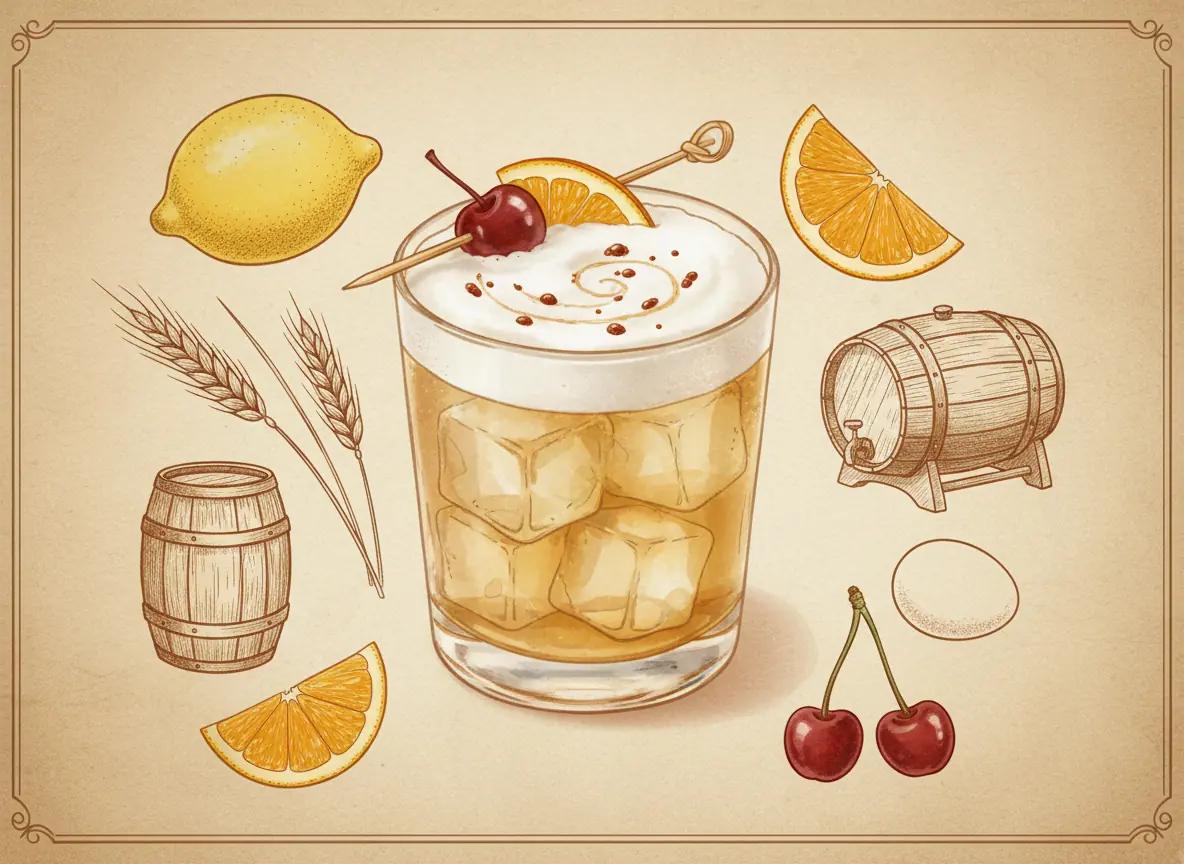
A Whiskey Sour is 45ml of bourbon, 25ml of fresh lemon juice and 20ml of sugar syrup, shaken hard with ice, then poured through a strainer onto fresh cubes in a rocks glass, with half an orange slice and a cherry. Add 15ml of egg white, dry shaken first, and dot the foam with Angostura. About 1.8 UK units. The measures are the IBA’s. The IBA’s egg white is optional and only a few drops; we use 15ml, about half a white, because that is what a full foam takes. The bitters are not in the IBA recipe, and they only go on when there is foam to hold them. The name is in print by 1870, in a Wisconsin newspaper, and the sour is older still: Jerry Thomas printed brandy, gin and rum sours in 1862. Difford’s Guide lists a Boston Sour as bourbon soured with lemon juice and smoothed by egg white.
Where this one sits
Recipe by Jerry Can Spirits · Updated 19 October 2026