Whiskey Collins
A Whiskey Collins is 50ml of bourbon, 25ml of fresh lemon juice and 20ml of sugar syrup, shaken hard with ice for 10 to 12 seconds, strained into a collins glass full of fresh ice and topped with 90ml of chilled soda, with a lemon wheel and a cherry. About 2.0 UK units. It is a Whiskey Sour lengthened with soda. The Internet Archive’s scan of Jerry Thomas’s Bar-Tender’s Guide, dated 1876, prints a Tom Collins Whiskey beside gin and brandy versions, with the base shaken and strained before the soda went in, and we keep that order. Bourbon’s vanilla and caramel stand up to the soda better than gin’s lighter botanicals, so the drink reads rounder and warmer than a Tom Collins. Rye makes a drier, sharper version. In our experience some American bars call the whiskey version a John Collins; the IBA keeps that name for a gin drink.
Glassware: Collins Glass
Garnish: Lemon wheel and Maraschino cherry
Ingredients
50ml
Bourbon at our working 40 to 45% ABV. Its vanilla and caramel carry through the soda. Rye at the same 50ml gives a drier, peppery drink.
25ml
Squeezed the same day. The only acid in a long drink, and soda shows up tired juice quickly.
20ml
Sugar and water, 1:1 by weight. At 20ml against 25ml of lemon, this Collins sits sweeter and softer than a Tom Collins.
90ml
Chilled, from a freshly opened bottle, and poured last. It is what turns a Whiskey Sour into a long drink.
Instructions
Squeeze the lemon juice the same day.
Fill a collins glass to the top with cubed ice.
Add the bourbon, lemon juice and sugar syrup to a shaker.
Fill with cubed ice and shake hard for 10 to 12 seconds.
Strain into the ice-filled collins glass.
Top with 90ml of chilled soda water and lift once with a bar spoon.
Garnish with a lemon wheel and a cherry.
Our version
Jerry Thomas gave a whiskey version in his Bar-Tender’s Guide of 1876, as the Internet Archive’s scan shows, measured in bar glasses rather than millilitres. Ours is 50ml bourbon, 25ml lemon and 20ml sugar syrup, shaken and strained over ice and topped with 90ml of soda.
Source: our own specification. Last checked 9 October 2026.
Expert Tip
Shake the bourbon, lemon and syrup before the soda goes in. The shake chills the base hard before it meets the soda, so the drink starts cold and the soda keeps more of its fizz. Pack the glass with ice right to the rim. Plenty of ice stays cold longer than a little, and a half-empty glass leaves the second half of the drink warm and watery. Add the soda slowly against the side of the glass and give it a single lift with a bar spoon. Any more stirring flattens it, and a flat Collins is just a weak sour.
Behind the Whiskey Collins
Flavour Profile
Where It Comes From
The Oxford Companion says newspapers of 1874 were filled with jocular mentions of the elusive Mr. Collins, the barroom prank behind the Tom Collins. Jerry Thomas’s Bar-Tender’s Guide, dated 1876 in the Internet Archive, prints three Tom Collins recipes: whiskey, brandy and gin (nos. 348 to 350), each shaken with lemon and gum syrup, strained, and filled up with soda.
So the whiskey Collins is as old in print as the gin one. The naming is less tidy. In our experience some American bars call the whiskey version a John Collins, while the IBA keeps John Collins for a gin drink and the Oxford Companion says the name comes from John Collin, head waiter and bar manager at Limmer’s Hotel in London from 1807, if not before.
For the gin side of the family, see the Tom Collins and the John Collins.
A Whiskey Sour, Lengthened
Our Whiskey Sour is 45ml of bourbon, 25ml of lemon and 20ml of syrup. The Whiskey Collins takes the same sour with a little more bourbon and adds 90ml of soda.
The soda changes how you drink it more than how it tastes. A sour is short, cold and gone in minutes. A Collins is twice the volume over a full glass of ice, and the whiskey moves from the front of the drink to its backbone.
Bourbon Through Bubbles
Carbonation carries light aromas out of the glass quickly. Bourbon’s vanilla and caramel come from the barrel and are heavier, so they last through the soda, and the drink still tastes of whiskey at the bottom.
Rye swaps the vanilla for pepper and dry grain. The drink is sharper and leaner, and some people want a few more millilitres of syrup with it.
The Sweeter Collins
Against the Tom Collins, this one is softer: 25ml of lemon to 20ml of syrup, where our Tom Collins runs 30ml of lemon to 15ml. Bourbon’s own roundness suits the sweeter balance.
The Whiskey Collins among the collins family and the sour it lengthens; the two IBA rows follow the IBA, the others are our recipes, and the units are our calculation
Whiskey Collins
- Spirit
- 50ml bourbon
- Citrus
- 25ml lemon
- Sugar
- 20ml syrup
- Soda
- 90ml
- Build
- Shaken, strained over ice, collins glass
Tom Collins
- Spirit
- 60ml London Dry gin
- Citrus
- 30ml lemon
- Sugar
- 15ml syrup
- Soda
- 90ml
- Build
- Built over ice, collins glass
John Collins (IBA)
- Spirit
- 45ml gin
- Citrus
- 30ml lemon
- Sugar
- 15ml syrup
- Soda
- 60ml
- Build
- Built over ice, highball
Vodka Collins
- Spirit
- 50ml vodka
- Citrus
- 25ml lemon
- Sugar
- 20ml syrup
- Soda
- 90ml
- Build
- Over ice, collins glass
Whiskey Sour (IBA)
- Spirit
- 45ml bourbon
- Citrus
- 25ml lemon
- Sugar
- 20ml syrup
- Soda
- None
- Build
- Shaken, over fresh ice in a rocks glass
| Drink | Spirit | Citrus | Sugar | Soda | Build |
|---|---|---|---|---|---|
| Whiskey Collins | 50ml bourbon | 25ml lemon | 20ml syrup | 90ml | Shaken, strained over ice, collins glass |
| Tom Collins | 60ml London Dry gin | 30ml lemon | 15ml syrup | 90ml | Built over ice, collins glass |
| John Collins (IBA) | 45ml gin | 30ml lemon | 15ml syrup | 60ml | Built over ice, highball |
| Vodka Collins | 50ml vodka | 25ml lemon | 20ml syrup | 90ml | Over ice, collins glass |
| Whiskey Sour (IBA) | 45ml bourbon | 25ml lemon | 20ml syrup | None | Shaken, over fresh ice in a rocks glass |
How to Serve It
Shaken, strained into a collins glass packed with ice, topped with soda and lifted once, with a lemon wheel and a cherry.
It is the whiskey drink for a long afternoon: lighter in the glass than a sour, and slower to finish.
Make it at home
The Spirit
Whiskey (Bourbon)Under the US standard 27 CFR 5.143, bourbon is an American whiskey whose mash is at least 51% corn, matured in fresh charred oak barrels and bottled at 40% ABV or higher, the figure our recipes use. The fresh charred wood gives it its vanilla, caramel and colour, and the corn gives a rounder, sweeter spirit than rye. It is the base of 26 of our recipes, more than any other whiskey.
Master the Techniques
More to explore
Frequently Asked Questions
What is a Whiskey Collins?
Is a Whiskey Collins the same as a John Collins?
Whiskey Collins or Whiskey Sour?
Bourbon or rye?
How strong is a Whiskey Collins?
Should the base be shaken or built in the glass?
Sources.
Correct as of 19 October 2026.
- Jerry Thomas (dated 1876), Internet Archive, “The Bar-Tenders’ Guide, or How to Mix all kinds of Plain and Fancy Drinks” (primary source: 348 Tom Collins Whiskey (gum syrup, juice of a small lemon, a large wineglass of whiskey, shaved ice, shake and strain, fill up with plain soda), 349 Brandy and 350 Gin versions).
- The Oxford Companion to Spirits and Cocktails (Robert Simonson), “Tom Collins” (secondary source: the John Collins named for John Collin of Limmer’s; the 1874 newspaper mentions of the elusive Mr. Collins; whisky and gin versions).
- The Oxford Companion to Spirits and Cocktails (David Wondrich), “The Collins” (secondary source: John Collin, head waiter and bar manager at Limmer’s Hotel from 1807 if not before; the whisky Collins taking the John Collins name by the end of the 1940s).
- IBA, “John Collins” (official specification: a gin drink).
You Might Also Like
John Collins
A John Collins is 45ml of London Dry gin, 30ml of fresh lemon juice and 15ml of sugar syrup built over ice in a collins glass, topped with 60ml of cold soda water and lifted once with a spoon, with a lemon wheel and a cherry. About 1.8 UK units. These are the IBA’s measures; the IBA serves it in a highball. It carries the family’s older name. Tradition in London points to John Collins, a head waiter at Limmer’s in London, as the man behind a gin drink of this shape, and a rhyme naming him kept him remembered. The rhyme shows he existed; it gives no recipe. The Oxford Companion says the genever version, heavier and maltier than London Dry, is the one that took the John Collins name. The IBA builds it on gin and notes that Old Tom makes it a Tom Collins. Our genever version, with its own measures, is the variation.
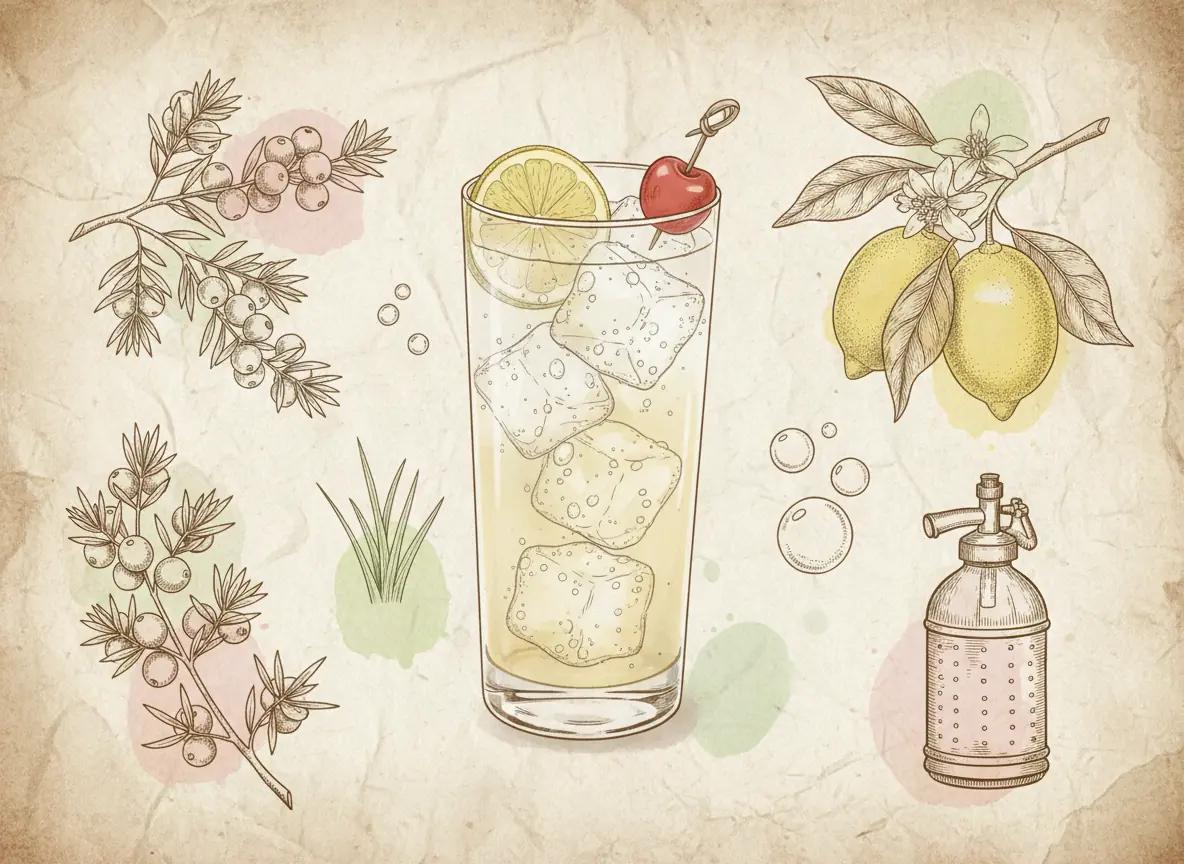
Tom Collins
A Tom Collins is 60ml London Dry gin, 30ml fresh lemon juice and 15ml sugar syrup built over ice in a collins glass, topped with 90ml of cold soda and stirred once, with a lemon slice and a cherry. It is a collins in the plainest sense: spirit, citrus and sugar, topped with soda. Difford’s Guide, a secondary source, reports one account that traces the name to the Great Tom Collins Hoax of 1874, in which people in New York were told that a man called Tom Collins had been insulting them and could be found in a bar some distance away. It also gives accounts of a real Mr Collins. The drink the name attached to may be older: Difford’s credits John Collins, head waiter at Limmer’s Hotel on Conduit Street in London, with the Collins. Early recipes used Dutch genever, and Old Tom gin came into them later; the IBA still specifies Old Tom for a Tom Collins. This version uses London Dry for a drier, sharper drink, and the Old Tom version follows as a variation.
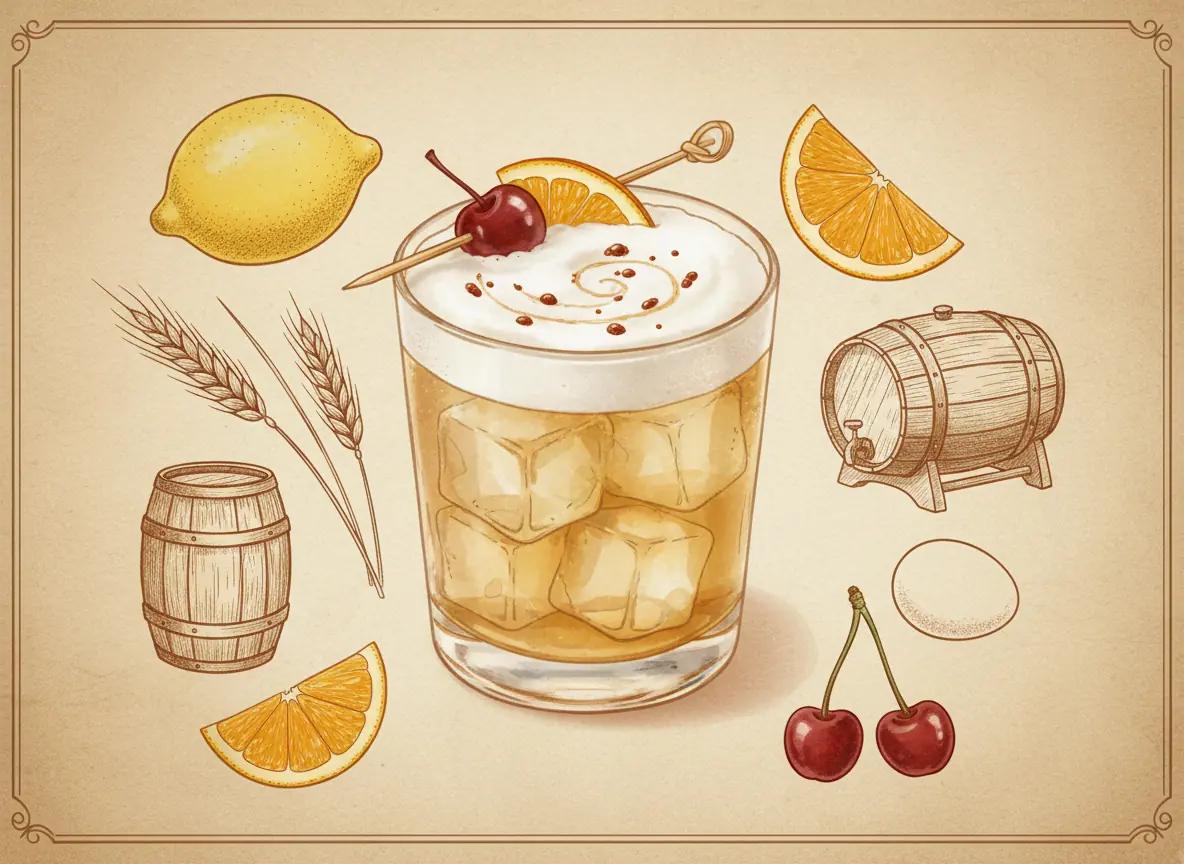
Whiskey Sour
A Whiskey Sour is 45ml of bourbon, 25ml of fresh lemon juice and 20ml of sugar syrup, shaken hard with ice, then poured through a strainer onto fresh cubes in a rocks glass, with half an orange slice and a cherry. Add 15ml of egg white, dry shaken first, and dot the foam with Angostura. About 1.8 UK units. The measures are the IBA’s. The IBA’s egg white is optional and only a few drops; we use 15ml, about half a white, because that is what a full foam takes. The bitters are not in the IBA recipe, and they only go on when there is foam to hold them. The name is in print by 1870, in a Wisconsin newspaper, and the sour is older still: Jerry Thomas printed brandy, gin and rum sours in 1862. Difford’s Guide lists a Boston Sour as bourbon soured with lemon juice and smoothed by egg white.
Where this one sits
Recipe by Jerry Can Spirits · Updated 19 October 2026