John Collins
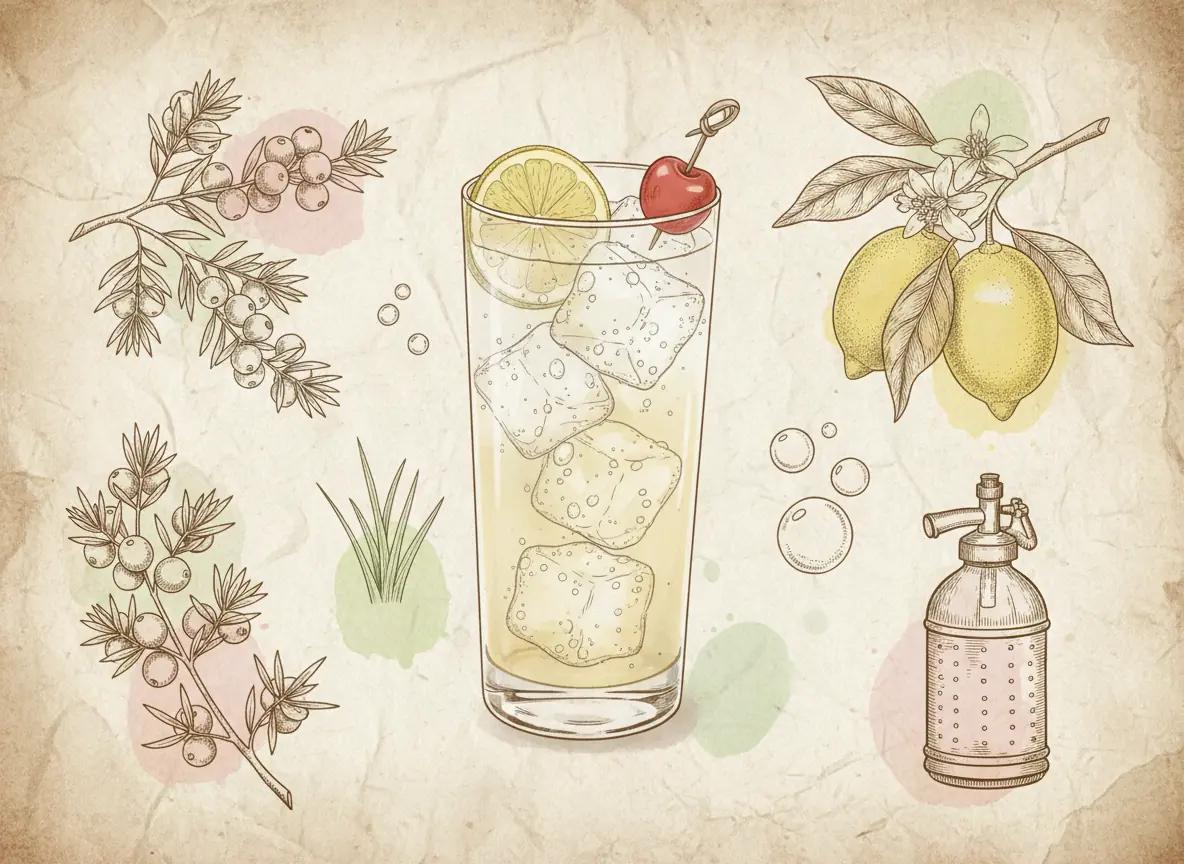
A John Collins is 45ml of London Dry gin, 30ml of fresh lemon juice and 15ml of sugar syrup built over ice in a collins glass, topped with 60ml of cold soda water and lifted once with a spoon, with a lemon wheel and a cherry. About 1.8 UK units. These are the IBA’s measures; the IBA serves it in a highball. It carries the family’s older name. Tradition in London points to John Collins, a head waiter at Limmer’s in London, as the man behind a gin drink of this shape, and a rhyme naming him kept him remembered. The rhyme shows he existed; it gives no recipe. The Oxford Companion says the genever version, heavier and maltier than London Dry, is the one that took the John Collins name. The IBA builds it on gin and notes that Old Tom makes it a Tom Collins. Our genever version, with its own measures, is the variation.
Variations
Glassware: Collins Glass
Garnish: Lemon wheel and Maraschino cherry
Ingredients
45ml
At 40% ABV. The IBA asks for gin, and a London Dry gives the crisp, juniper-led drink. Old Tom, which is sweeter, makes it a Tom Collins.
30ml
Squeezed the same day. In a drink lengthened with soda, a dull juice has nowhere to hide.
15ml
One to one, by weight. A restrained 15ml against 30ml of lemon keeps the gin version dry.
60ml
Well chilled and poured gently down the side. The soda is what makes it a Collins rather than a sour.
Instructions
Squeeze the lemon juice the same day, ideally just before you build.
Fill a collins glass to the top with cubed ice.
Add the gin, lemon juice and sugar syrup over the ice and stir briefly to combine.
Top with 60ml of chilled soda water, poured gently down the inside of the glass.
Stir once with a single upward lift of the bar spoon.
Garnish with a lemon wheel and a cherry.
Source: the IBA (Official IBA specification, served in a collins glass where the IBA uses a highball; method ours). Last checked 10 October 2026.
Expert Tip
Soda last, and one lift of the spoon. Stir the gin, lemon and syrup over the ice first, then pour the soda gently down the inside of the glass and lift once from the bottom. More stirring than that knocks out the bubbles the drink is built on. Fill the glass with ice to the top. A full glass melts more slowly than a half-full one, so the drink stays cold and holds its strength to the last mouthful. For genever, change the sugar too. Its malt base has a grainy edge that wants a little more syrup and a little less lemon; the variation gives the measures. At the gin measures it tastes thin and sour.
Behind the John Collins
Flavour Profile
Limmer’s and Its Head Waiter
London tradition credits John Collins, head waiter at Limmer’s Hotel in London, with a long gin drink. A verse beginning “My name is John Collins, head waiter at Limmer’s” kept his name in print.
The rhyme shows the man existed. It does not record what he poured. The Oxford Companion says his specialty was a Gin Punch, attested as early as 1834, and that the genever version, not the Old Tom one, took the name John Collins in New York after 1872.
John and Tom
In American bars the drink became the Tom Collins. Barflies of the 1870s pranked each other with news that a scalawag named Tom Collins had been bad-mouthing them, newspapers of 1874 were filled with mentions of the elusive Mr. Collins, and Old Tom gin most likely helped, by the Oxford Companion’s account. The record supports both explanations without settling either.
The IBA now lists the John Collins on gin and notes that Old Tom makes it a Tom. Some American bars later used the John name for a whiskey version, a real usage and not the original one.
The Genever Version
Genever’s base is malt wine, a grain spirit closer to unaged whisky than to neutral alcohol, with juniper worked into it. It is heavier, breadier and faintly sweet, and in a Collins it turns the drink rounder and less crisp, closer to a sparkling whisky sour.
It also needs different measures. Malt has a grainy edge that juniper does not, so our genever version takes 20ml of syrup against 25ml of lemon, where the gin version takes 15ml against 30ml. Each is balanced for its own spirit.
The Collins Family
The John Collins beside its relations
John Collins (IBA)
- Spirit
- 45ml London Dry gin
- Lemon
- 30ml
- Syrup
- 15ml
- Soda
- 60ml
- UK units
- About 1.8
John Collins, genever
- Spirit
- 50ml genever
- Lemon
- 25ml
- Syrup
- 20ml
- Soda
- 90ml
- UK units
- About 1.8 to 2.1
Tom Collins
- Spirit
- 60ml London Dry gin
- Lemon
- 30ml
- Syrup
- 15ml
- Soda
- 90ml
- UK units
- About 2.4
Vodka Collins
- Spirit
- 50ml vodka
- Lemon
- 25ml
- Syrup
- 20ml
- Soda
- 90ml
- UK units
- About 2.0
| Drink | Spirit | Lemon | Syrup | Soda | UK units |
|---|---|---|---|---|---|
| John Collins (IBA) | 45ml London Dry gin | 30ml | 15ml | 60ml | About 1.8 |
| John Collins, genever | 50ml genever | 25ml | 20ml | 90ml | About 1.8 to 2.1 |
| Tom Collins | 60ml London Dry gin | 30ml | 15ml | 90ml | About 2.4 |
| Vodka Collins | 50ml vodka | 25ml | 20ml | 90ml | About 2.0 |
How to Serve It
Built in the glass, as the IBA builds it: gin, lemon and syrup over a collins glass full of ice, a brief stir, the soda poured gently on top, one lift of the spoon, then a lemon wheel and a cherry.
Make it beside a Tom Collins once. The Tom’s extra 15ml of gin and extra 30ml of soda are the whole difference, and you can taste them.
For the longer, stronger relation, make a Tom Collins; for gin and lemon shaken and served short, a Gin Fizz; for vodka, a Vodka Collins.
Make it at home
The Spirit
GinGin is a spirit flavoured with juniper berries. Under the retained Regulation (EC) 110/2008, juniper must lead the taste, the floor is 37.5% ABV, and the route the flavour takes sets the grade: plain gin, distilled gin or London gin. Our recipes count it at 40%, and it carries the Martini, the Negroni and the Gin and Tonic.
More to explore
Frequently Asked Questions
What is in a John Collins?
What is the difference between a John and a Tom Collins?
Was John Collins a real person?
Can I make a John Collins with genever?
Is a John Collins ever made with whiskey?
What glass does a John Collins go in?
How strong is a John Collins?
Sources.
Correct as of 19 October 2026.
- The Oxford Companion to Spirits and Cocktails (David Wondrich), “The Collins” (secondary source: John Collin, head waiter and bar manager at Limmer’s Hotel, Conduit and George streets, London, from 1807 if not before; Gin Punch attested as early as 1834; the genever version took the John Collins name after 1872).
- The Oxford Companion to Spirits and Cocktails (Robert Simonson), “Tom Collins” (secondary source: the 1870s prank on Tom Collins; newspapers of 1874 filled with mentions of the elusive Mr. Collins; Old Tom gin most likely helped).
You Might Also Like
Tom Collins
A Tom Collins is 60ml London Dry gin, 30ml fresh lemon juice and 15ml sugar syrup built over ice in a collins glass, topped with 90ml of cold soda and stirred once, with a lemon slice and a cherry. It is a collins in the plainest sense: spirit, citrus and sugar, topped with soda. Difford’s Guide, a secondary source, reports one account that traces the name to the Great Tom Collins Hoax of 1874, in which people in New York were told that a man called Tom Collins had been insulting them and could be found in a bar some distance away. It also gives accounts of a real Mr Collins. The drink the name attached to may be older: Difford’s credits John Collins, head waiter at Limmer’s Hotel on Conduit Street in London, with the Collins. Early recipes used Dutch genever, and Old Tom gin came into them later; the IBA still specifies Old Tom for a Tom Collins. This version uses London Dry for a drier, sharper drink, and the Old Tom version follows as a variation.
Gin Fizz
A Gin Fizz is 45ml of London Dry gin, 30ml of fresh lemon juice and 10ml of sugar syrup, shaken hard with ice for 10 to 12 seconds, strained into a chilled small highball with no ice and topped with 60ml of cold soda water. A lemon wheel is optional. About 1.8 UK units. The gin, lemon and syrup are the IBA’s measures; the IBA tops with a splash of soda. No ice in the glass is the point. All of the chilling and dilution happens in the shaker, and the soda goes in short and lively, so the drink is at its best for the first few minutes. Built over ice and topped longer, the same ingredients make a Tom Collins. Difford’s Guide places the Gin Fizz in Jerry Thomas’s 1876 Bar-tenders Guide. The Oxford Companion says the fizz seems to have come from New York, and the egg variations followed: the Silver, Golden and Royal Fizz, and the Ramos Gin Fizz.
Southside
A Southside is 60ml of London Dry gin, 30ml of fresh lemon juice, 15ml of simple syrup and five or six mint leaves, shaken hard for 10 to 12 seconds and double strained into a chilled coupe, with a small mint sprig. About 2.4 UK units. Those are the IBA’s measures; 15ml of egg white is optional. The Oxford Companion, in an entry by Eric Felten, says the story that it was born in the speakeasies of Chicago’s South Side is incorrect: the drink evolved from the Mint Juleps made at Snedecor’s Tavern on Long Island, which became the Southside Sportsman’s Club, and it has long been the house drink at New York’s 21 Club. The drink does not depend on any of that. In the glass it is a gin sour scented with mint. Shaken and served up, with no soda or crushed ice, it is more concentrated than a Mojito, and the mint reads as aroma rather than as leaves in the drink.
Where this one sits
Recipe by Jerry Can Spirits · Updated 19 October 2026