Lynchburg Lemonade
A Lynchburg Lemonade is 40ml Jack Daniel’s Tennessee whiskey, 20ml triple sec and 20ml fresh lemon juice, stirred over ice in a tall collins and lengthened with 90ml sparkling lemonade, then finished with lemon and a cherry. It carries about 2.4 UK units, and the lemonade hides most of it. VinePair says Tony Mason, an Alabama restaurateur, created it in 1980, and Garden & Gun gives a typical recipe of Jack Daniel’s, sweet and sour mix, triple sec and lemon-lime soda. The name points to Lynchburg, Tennessee, where Jack Daniel’s says its distillery sits. This version swaps the sour mix for fresh lemon and the soda for a sharp lemonade. The structure is the same: whiskey, orange liqueur, acid and length.
Glassware: Collins Glass
Garnish: Lemon wheel and Maraschino cherry
Ingredients
40ml
Jack Daniel’s Old No. 7, at 40% ABV on Booths’ listing, the whiskey the drink’s town is known for. Jack Daniel’s own page says it is mellowed through ten feet of sugar maple charcoal before it is matured, which in our view leaves it soft enough to sit under lemon and orange.
20ml
Cointreau or another dry triple sec; Cointreau’s own page gives 40% Alc./Vol. It brings orange and some of the sweetness; 20ml of it against 20ml of lemon gives the drink its structure.
20ml
Juiced the same day. The lemonade is sweetened and cannot do this job; the fresh juice is the drink’s acid, standing in for the sour mix of the original.
90ml
Sharp, cloudy sparkling lemonade, standing in for the lemon-lime soda of the original. A sweet one tips the drink into squash, because the triple sec has covered the sugar.
Instructions
Squeeze the lemon juice the same day, ideally just before you build.
Fill a collins glass with cubed ice.
Add the whiskey, triple sec and lemon juice, and stir briefly.
Top with the sparkling lemonade and stir once more, gently.
Garnish with a lemon wheel and a cherry.
Expert Tip
Squeeze the lemon even though there is lemonade in the glass. The lemonade supplies sugar and fizz; the fresh juice supplies the acid. Without it the drink is sweet all the way through. Build it in the glass. Stir the whiskey, triple sec and lemon over ice first, then top with lemonade and stir once, gently, to keep the fizz. Pick a sharp, cloudy lemonade. The triple sec already sweetens the drink, and a sugary lemonade tips it into squash.
Behind the Lynchburg Lemonade
Flavour Profile
Where It Comes From
Garden & Gun says Tony Mason, a lounge owner in Huntsville, Alabama, threw the drink together one night in 1980, and Jack Daniel’s places its distillery in Lynchburg, Tennessee, the Lynchburg of the name.
VinePair says Mason shared the recipe with a bar patron who was a sales representative from the Jack Daniel’s distillery, and that the brand then released a version under its own name without compensating him.
The Court Case
Mason sued, seeking $13 million. VinePair says he won but was awarded only $1, out of the judge’s pocket, although the brand admitted it had learned the recipe from Mason in a company newsletter in 1982.
VinePair says the judgment was overturned on appeal after years of wrangling, and Garden & Gun says the case was retried and Brown-Forman, Jack Daniel’s parent company, won again. The one-dollar figure the story usually ends on was not the end of the case.
Why It Works
Lynchburg Lemonade: what each ingredient does
Jack Daniel’s Tennessee whiskey
- Measure
- 40ml
- Its job
- The base, mellowed through charcoal by Jack Daniel’s own account
Triple sec
- Measure
- 20ml
- Its job
- Orange and part of the sweetness
Fresh lemon juice
- Measure
- 20ml
- Its job
- The acid, in place of sour mix
Sparkling lemonade
- Measure
- 90ml
- Its job
- Length and fizz
| Ingredient | Measure | Its job |
|---|---|---|
| Jack Daniel’s Tennessee whiskey | 40ml | The base, mellowed through charcoal by Jack Daniel’s own account |
| Triple sec | 20ml | Orange and part of the sweetness |
| Fresh lemon juice | 20ml | The acid, in place of sour mix |
| Sparkling lemonade | 90ml | Length and fizz |
Remove any one and the drink suffers. Without the triple sec it is whiskey and lemonade; without the lemon it is sweet all the way down.
Why It Drinks So Easily
It carries about 2.4 UK units, and nothing in the flavour says so. The lemonade leads the nose, the lemon leads the palate, and the whiskey arrives as warmth.
That gap between how strong it is and how strong it tastes is part of why it sold. It is also why the second glass deserves a moment’s thought.
Tennessee Whiskey Specifically
The Oxford Companion says Tennessee whisky typically follows the bourbon requirements and is passed through maple charcoal, the Lincoln County process, before barrel ageing, and that in 2013 Tennessee passed a law requiring whisky labelled “Tennessee whisky” to be made in the state using that process. In our view that leaves it softer, which suits a glass with this much fruit.
A high-rye bourbon has a peppery edge that competes with the citrus, and a soft wheated bourbon tends to disappear underneath it.
With raspberry liqueur added, the Raspberry Lynchburg keeps the same base.
How to Serve It
In a collins glass over plenty of ice: whiskey, triple sec and lemon stirred briefly, lemonade on top and one gentle stir. A lemon wheel and a cherry to finish.
Make it at home
The Spirit
Jack Daniel's Tennessee WhiskeyOld No. 7 from Jack Daniel’s is a Tennessee whiskey from Lynchburg, Tennessee, made, by Jack Daniel’s own account, from 80% corn, 12% barley and 8% rye, and listed at 40% ABV by the retailer Booths. It meets the bourbon rules but trickles through a ten-foot bed of sugar maple charcoal on its way to the barrel, the Lincoln County Process, which a Tennessee law of 2013 requires of Tennessee whiskey, by the Oxford Companion’s account. Three of our recipes use it, led by the Lynchburg Lemonade.
More to explore
Frequently Asked Questions
What is in a Lynchburg Lemonade?
Who invented the Lynchburg Lemonade?
What happened in the Lynchburg Lemonade lawsuit?
Why fresh lemon if there is lemonade in it?
Why Tennessee whiskey rather than bourbon?
How strong is a Lynchburg Lemonade?
Can I make it by the jug?
Sources.
Correct as of 19 October 2026.
- Garden & Gun (Kathleen Purvis), “Lynchburg Lemonade: A Cocktail for Tennessee” (named-author magazine piece: Tony Mason, a lounge owner in Huntsville, Alabama, 1980; Jack Daniel’s promoted it without compensating him; he sued seeking $13 million, was awarded one dollar, and the case was retried and Brown-Forman won again).
- VinePair, “The Lynchburg Lemonade Recipe” (secondary source: created in 1980 by Tony Mason; $13 million suit; “awarded only $1”; judgment overturned on appeal).
- Jack Daniel’s, “Old No. 7 Tennessee Whiskey” (maker’s own page: “mellowed drop by drop through 10-feet of sugar maple charcoal, then matured in handcrafted barrels”).
- Booths, “Jack Daniel’s Old No. 7 Tennessee Whiskey 70cl” (retailer listing: Alcohol by ABV 40%).
- The Oxford Companion to Spirits and Cocktails (Clay Risen), “whisky, Tennessee” (secondary source: bourbon requirements plus the Lincoln County process (maple charcoal); the 2013 Tennessee law; Jack Daniel’s passes the distillate through ten vertical feet of charcoal).
- Cointreau, “Cointreau” (maker’s own page: “Cointreau Liqueur, 40% Alc./Vol.”).
- Jack Daniel’s, “Visit Us” (maker’s own page: “Nestled in Lynchburg, Tennessee, our distillery”).
You Might Also Like
Raspberry Lynchburg
A Raspberry Lynchburg is 40ml of Jack Daniel’s Tennessee whiskey, 15ml of Chambord, 10ml of triple sec and 20ml of fresh lemon juice, built over ice in a collins glass and topped with 90ml of sparkling lemonade, with a lemon wheel and fresh raspberries. About 2.2 UK units. It is our Lynchburg Lemonade with half the triple sec swapped for Chambord. Both liqueurs are sweet, so the raspberry replaces orange rather than joining it, and the glass stays a long, sharp highball rather than a cordial. Difford’s Guide adapts its Raspberry Lynchburg from a recipe created in 1992 by Wayne Collins at Roadhouse in London: Tennessee whiskey shaken with lime and sugar syrup, topped with lemon-lime soda, with a black raspberry liqueur such as Chambord drizzled over the surface. Ours keeps the parent drink’s lemon and lemonade.
Whiskey Collins
A Whiskey Collins is 50ml of bourbon, 25ml of fresh lemon juice and 20ml of sugar syrup, shaken hard with ice for 10 to 12 seconds, strained into a collins glass full of fresh ice and topped with 90ml of chilled soda, with a lemon wheel and a cherry. About 2.0 UK units. It is a Whiskey Sour lengthened with soda. The Internet Archive’s scan of Jerry Thomas’s Bar-Tender’s Guide, dated 1876, prints a Tom Collins Whiskey beside gin and brandy versions, with the base shaken and strained before the soda went in, and we keep that order. Bourbon’s vanilla and caramel stand up to the soda better than gin’s lighter botanicals, so the drink reads rounder and warmer than a Tom Collins. Rye makes a drier, sharper version. In our experience some American bars call the whiskey version a John Collins; the IBA keeps that name for a gin drink.
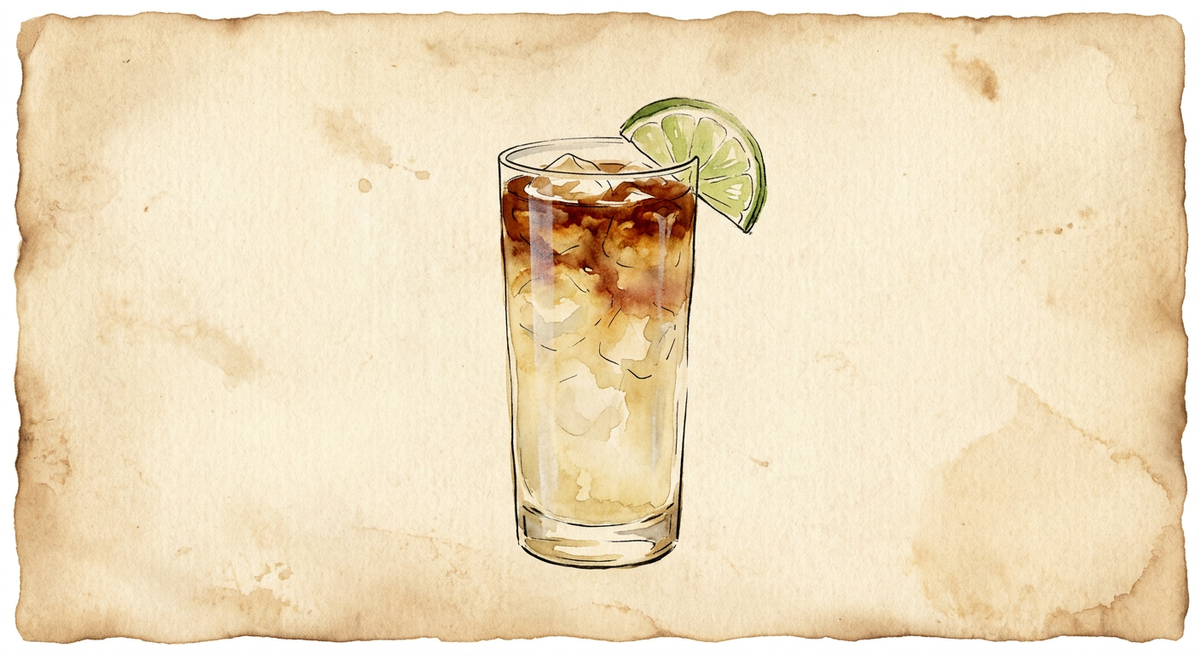
Dark ’n’ Stormy
A Dark ’n’ Stormy is 60ml of Gosling’s Black Seal rum floated over 100ml of ginger beer in a highball full of ice, with a lime wedge. About 2.4 UK units. Those are the IBA’s measures, and the name is a Gosling Brothers trade mark tied to Black Seal. The Oxford Companion says the drink purportedly originated among British sailors on shore leave in Bermuda after the First World War, though another origin story places it earlier, in the nineteenth century. Gosling’s own page puts ginger beer from a Royal Navy officers’ club with the local Black Seal rum, and a sailor is said to have called the colour that of a cloud only a fool or a dead man would sail under. The Oxford Companion says the Gosling family claimed a trademark for the cocktail’s recipe in 1991 and has repeatedly turned to the US Patent and Trademark Office to protect it, and Gosling’s own page writes the name with the registered symbol. The same build with another dark rum is a rum and ginger beer, and a sound one. The same build with another dark rum is a rum and ginger beer, and a sound one.
Where this one sits
Recipe by Jerry Can Spirits · Updated 19 October 2026