Boulevardier
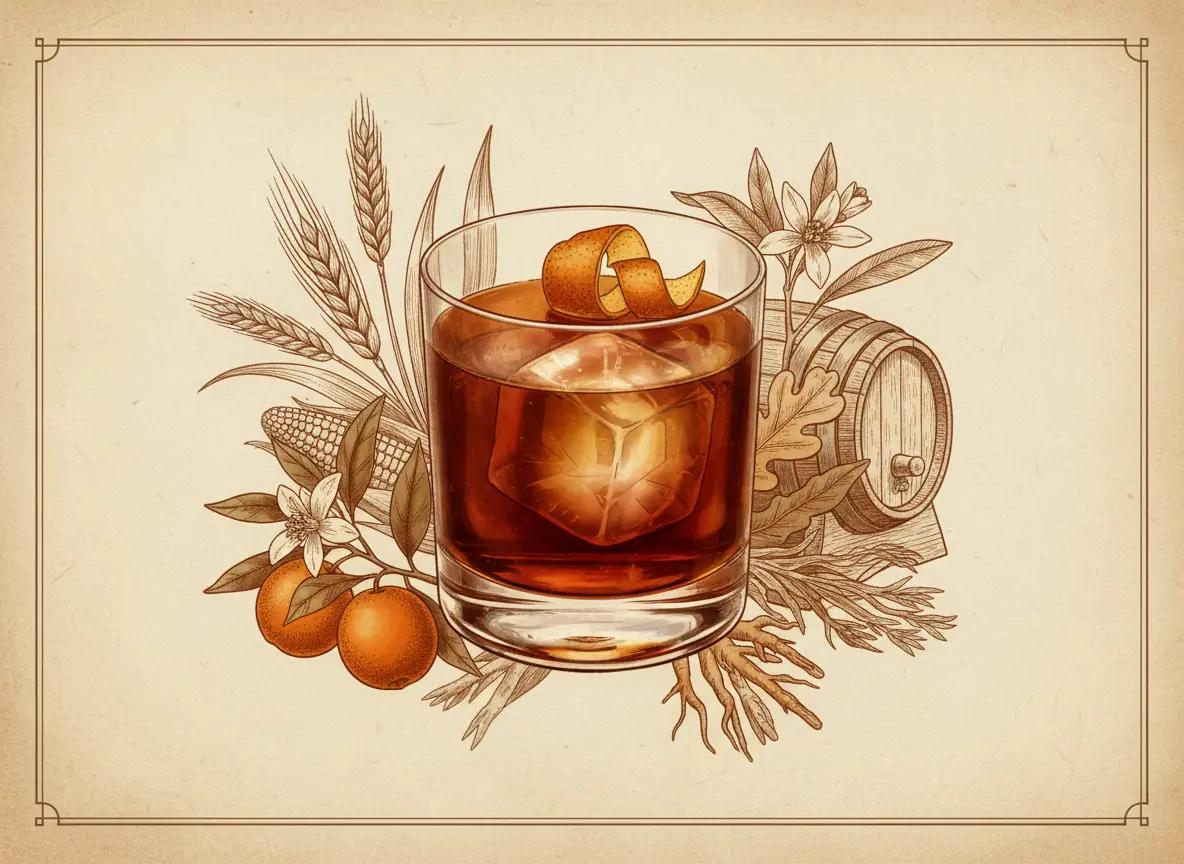
The Boulevardier was created by Erskine Gwynne, an American expatriate writer in 1920s Paris who published a monthly magazine of the same name for the city’s American community. Harry McElhone documented the drink in his 1927 book Barflies and Cocktails, attributing it to Gwynne. It is a Negroni with bourbon in place of gin, and that single substitution changes the drink more thoroughly than the swap suggests. Where the Negroni is botanical, precise and juniper-forward, the Boulevardier is warmer, rounder and more fruit-driven. Bourbon brings vanilla, caramel and a grain sweetness that gin does not carry, producing a richer balance that sits more naturally after a meal than before one. The ratio here runs slightly bourbon-forward at three to two to two rather than equal parts, because bourbon is heavier and sweeter than gin and equal measures can tip the drink toward cloying against a rich vermouth. It handles equal parts perfectly well too; adjust to the bottles in front of you.
Glassware: Rocks Glass
Garnish: Orange Peel
Ingredients
45ml
A bourbon with genuine vanilla and caramel character performs best. Avoid anything too light or too heavily oaked, because both directions push the balance out of reach.
30ml
The defining bitter element, in the same role it plays in a Negroni. The bourbon’s extra sweetness asks more of the bitterness here to hold the balance.
30ml
Refrigerate after opening and replace within four weeks. Carpano Antica Formula performs particularly well, its vanilla and dried fruit lining up directly with the bourbon.
Instructions
Fill a rocks glass with large cubed ice and set aside to chill.
Add the bourbon, Campari and sweet vermouth to a mixing glass with large cubed ice.
Stir for 20 to 25 seconds until well chilled and properly diluted.
Strain over the fresh ice in the rocks glass.
Express a wide strip of orange peel over the surface, rest it in the glass and serve.
Source: the IBA (Official IBA specification; method ours). Last checked 12 August 2026.
Expert Tip
Carpano Antica Formula is worth specifying here rather than reaching for a standard sweet vermouth. Its vanilla and dried fruit share a register with the bourbon in a way most other vermouths do not, and the result is a noticeably more coherent drink than the same build with a lighter bottle. Cocchi Storico Vermouth di Torino is the sound alternative; failing both, use the richest sweet vermouth you have access to. Then adjust the ratio to what you actually poured. A rich vermouth wants the bourbon-forward three to two to two, because equal parts against a full-flavoured whiskey tips the whole thing heavy. A lighter vermouth takes equal parts happily. The drink accommodates both, but not blindly.
Behind the Boulevardier
Flavour Profile
The Origin
Erskine Gwynne was born in 1898 into a wealthy American family and spent much of his adult life in Paris, at the point when the city was the cultural capital of the English-speaking expatriate world. He founded The Boulevardier in 1927, a monthly magazine for Americans living in or passing through, its title borrowed from the urbane figure who strolled the city’s grand avenues.
Harry McElhone documented the drink in Barflies and Cocktails the same year, attributing it to Gwynne without further explanation. Harry’s New York Bar on the Rue Daunou was the gathering point for that community, and the drink and the setting were entirely consistent with one another.
The Negroni Relationship
The Boulevardier follows the documented Negroni by eight years, if the Florence 1919 account is accepted. Whether Gwynne knew of the Negroni or arrived at the same structural solution independently is not recorded anywhere.
What is clear is that the two share an identical format and differ in a single ingredient, which makes them the most instructive comparison available for what a base spirit contributes to a bitter stirred drink. The Negroni leads with juniper against clean, precise gin. The Boulevardier leads with warmth: vanilla and caramel shifting the balance from taut to rich. Neither is better; they are built for different moments.
Ratio and Balance
Equal parts or bourbon slightly forward divides bartenders who work with the drink regularly, and both camps are right about something.
Equal parts produces a Negroni-like balance, with no single ingredient dominating and the Campari’s bitterness clearly audible. Three to two to two keeps the spirit in front and lets the Campari function as seasoning rather than as an equal structural element. The bourbon-forward ratio is also considerably more forgiving of a rich vermouth: against Carpano Antica and a full-flavoured bourbon, equal parts can tip the drink heavy. A lighter vermouth may favour the even split.
Vermouth Selection
This is one of very few drinks where a specific vermouth recommendation is worth making beyond the general freshness rule.
Carpano Antica Formula is produced in Turin to a recipe dating from 1786, with vanilla, dried fruit and a richness of body that standard sweet vermouths do not replicate. In a drink whose base spirit is also vanilla and caramel-forward, that alignment produces a coherence a lighter bottle cannot reach. Cocchi Storico Vermouth di Torino is a sound alternative with enough body to perform well. A standard commercial vermouth makes an acceptable Boulevardier; it does not make the same drink.
How to Serve It
Stirred, strained over a full glass of large cubed ice in a rocks glass, with expressed orange peel resting in the glass. The coupe is an acceptable alternative for anyone who wants a shorter, colder serve without progressive dilution, though the rocks glass suits the character better.
This is an after-dinner pour rather than an aperitivo one, heavier and warmer than a Negroni and better placed at the end of a meal than the beginning. Serve it cold and give it the time it asks for, because it opens considerably across the first ten minutes.
Make it at home
The Spirit
Whiskey (Bourbon)The only major whiskey required to use a barrel once. New charred oak is the rule that defines bourbon, gives it its sweetness and colour, and incidentally supplies most of the world's Scotch and rum with somewhere to age.
Master the Techniques
More to explore
Frequently Asked Questions
What is a Boulevardier?
How does it differ from a Negroni?
Which sweet vermouth should I use?
Equal parts or bourbon-forward?
You Might Also Like
Negroni
The Negroni is the most ordered classic cocktail in the world and the drink that defined the contemporary revival. It is also one of the simplest: equal parts gin, Campari and sweet vermouth, stirred and served over ice with an orange peel. That simplicity is a function of how precisely the three are calibrated against one another. The story most commonly told places Count Camillo Negroni at the Caffè Casoni in Florence in 1919, asking Fosco Scarselli to strengthen his Americano by replacing the soda with gin. The account is debated; the structure is not. Both drinks share the same base of Campari and sweet vermouth, and that one substitution turns a sessionable aperitif into one of the most spirit-forward short drinks there is. The sweet vermouth is the most commonly neglected variable. At equal volume it is a third of the drink rather than a background ingredient, and a bottle left open at room temperature for months will define a Negroni more completely than the gin does, with no amount of good Campari correcting it.
La Louisiane
La Louisiane was the house cocktail of Restaurant La Louisiane, one of New Orleans' most storied dining establishments, and appeared in Stanley Clisby Arthur's 1937 guide "Famous New Orleans Drinks and How to Mix 'Em." It is a Manhattan variation in structure, rye whiskey and sweet vermouth as the foundation, with Bénédictine replacing the conventional sweetener and absinthe adding an aromatic undercurrent that marks it unmistakably as a product of New Orleans drinking culture. It is a drink of considerable depth for something built in a mixing glass with no citrus and no theatre. The Bénédictine brings honey, herbal complexity, and a warmth that simple syrup or even a standard liqueur cannot replicate. The absinthe is a seasoning, not a feature. Too much and it dominates. The correct amount is the one you can sense but cannot isolate. Like many New Orleans classics, La Louisiane rewards slow consumption and a quality vermouth. This is not a drink to build with a vermouth that has been open for three months. Treat it as a perishable ingredient and the drink will tell you why immediately.
Paper Plane
The Paper Plane was created by Sam Ross at Milk & Honey in New York around 2007 and named after the M.I.A. song that was playing while he developed it. It is an equal-parts build of bourbon, Aperol, Amaro Nonino and fresh lemon juice, shaken and served cold, and it stands as one of the most precisely constructed modern classics in the canon. Equal parts is an unforgiving format. Every ingredient is fully exposed at the same volume, and a weak choice in any one of them changes the character of the finished drink in a way no adjustment elsewhere can correct. The bourbon provides warmth and vanilla. The Aperol provides bitter orange and a lightness that stops the drink turning heavy. The Nonino provides herbal complexity and a mid-palate depth neither of the others could contribute. The lemon holds all three together. Substituting a cheaper amaro for Nonino is the most common mistake made with this recipe, and the one that most visibly changes the result.
Where this one sits
Recipe by Jerry Can Spirits