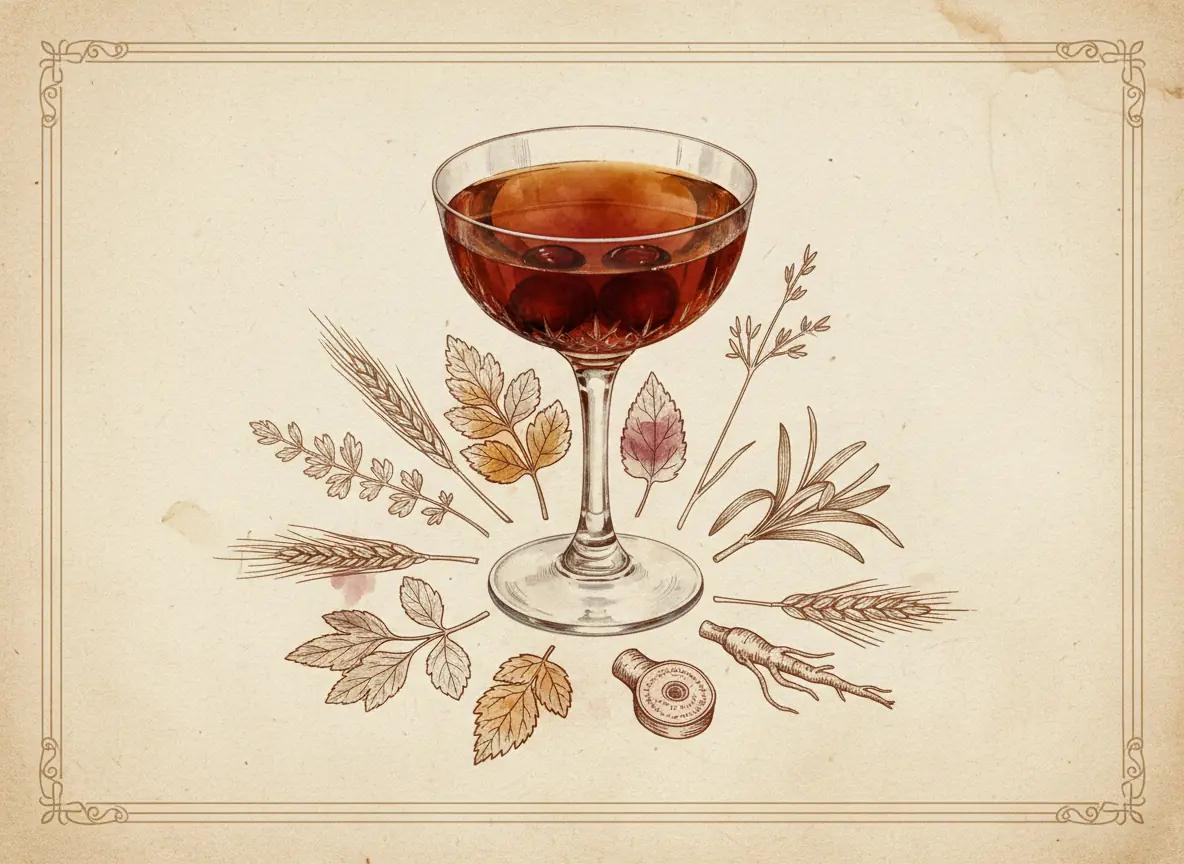
La Louisiane
La Louisiane is 30ml each of rye whiskey, sweet vermouth and Bénédictine, with two dashes of absinthe and three of Peychaud’s bitters, stirred for 20 to 30 seconds and strained into a chilled Nick & Nora, with a maraschino cherry on a pick. About 3.1 UK units. Stanley Clisby Arthur printed it in 1937, in Famous New Orleans Drinks and How to Mix ’Em, as the special cocktail served at Restaurant de la Louisiane, “one of the famous French restaurants of New Orleans”, in Difford’s Guide’s reproduction of the book. His recipe, as Difford’s Guide reproduces it, pours a third of a jigger of each of the three, with three or four dashes each of absinthe substitute and Peychaud’s; ours keeps the thirds and trims the absinthe to two dashes. It sits on the Manhattan’s frame of rye and sweet vermouth, with Bénédictine poured at the same measure as both. In our view that makes it richer and more herbal than its parent, and the anise of the absinthe and the Peychaud’s places it in New Orleans.
Glassware: Nick & Nora Glass
Garnish: Luxardo maraschino cherry on a pick
Ingredients
30ml
At 40% ABV or a little more, with rye’s spice and grip. It is the dry third of the drink and has to hold its own against a full measure of Bénédictine.
30ml
Sweet vermouth, about 16% ABV, from a bottle opened in the last few weeks and stored cold. It makes up a third of the glass, and with no citrus to hide behind, a stale bottle shows.
30ml
The French herbal liqueur, at 40% ABV, sweetened with honey. At 30ml it is a full third of the glass and does all the sweetening; there is no direct substitute.
2 dashes
Two dashes, stirred in. At our working figure of 68% ABV it is loud, and the aim is a thread of anise under the Bénédictine rather than a lead.
3 dashes
The New Orleans bitters, with anise and a floral, cherry note. Three dashes; Angostura’s clove would pull the drink somewhere else.
Instructions
Chill a Nick & Nora glass in the freezer.
Add the rye, sweet vermouth, Bénédictine, absinthe and Peychaud’s bitters to a mixing glass.
Fill with cubed ice and stir for 20 to 30 seconds.
Strain into the chilled glass.
Garnish with a maraschino cherry on a pick.
Our version
Stanley Clisby Arthur’s 1937 recipe, as Difford’s Guide reproduces it, gives a third of a jigger each of rye, vermouth and Bénédictine with three or four dashes each of absinthe substitute and Peychaud’s. Ours keeps the thirds at 30ml and uses two dashes of absinthe and three of Peychaud’s, so the anise stays in the background.
Source: our own specification. Last checked 9 October 2026.
Expert Tip
Count the absinthe. Two dashes give an anise note you notice without being able to point at it; a third starts to compete with the Bénédictine. Arthur allowed three or four, in Difford’s Guide’s reproduction, which makes a louder drink. Stir for 20 to 30 seconds. Equal parts of rye, Bénédictine and vermouth start thick and sweet, and the water from a full stir is what lets the three separate on the palate. Use a rye with some strength and spice. The Bénédictine is a full third of the drink, sweet and, by Bénédictine’s own page, at 40% ABV, and a soft whiskey disappears into it.
Behind the La Louisiane
Flavour Profile
Where It Comes From
Stanley Clisby Arthur printed the drink in Famous New Orleans Drinks and How to Mix ’Em in 1937, as the special cocktail served at Restaurant de la Louisiane, “one of the famous French restaurants of New Orleans”. Umami Mart, a drinks shop’s blog, says the restaurant was opened in 1881 by Louis and Ann Bezaudun. Arthur tied the drink to the restaurant’s cooking: it is, he wrote, “as out-of-the-ordinary as the many distinctive dishes that grace its menu”.
Difford’s Guide reproduces his recipe: a third of a jigger each of rye, Italian vermouth and Bénédictine, with three or four dashes each of absinthe substitute and Peychaud’s bitters. Umami Mart says it is not clear which of the restaurant’s owners the drink was developed under.
Three Equal Parts
Rye and sweet vermouth are the frame of a Manhattan, and La Louisiane adds a third voice at the same volume as both. In our view the rye brings spice and grip, the vermouth body and wine, the Bénédictine honey, herbs and sugar.
The Bénédictine is why there is no syrup. It sweetens and seasons at once, so the drink is richer than a Manhattan without tasting of plain sugar. The absinthe and the Peychaud’s then lay anise over the top, which is the New Orleans signature.
The Bénédictine
Bénédictine is a French herbal liqueur at 40% ABV, in which, the producer says, honey and saffron lend a rich and balanced texture. At 30ml it is a full third of the glass, against the single bar spoon a Vieux Carré takes.
There is no direct substitute. Another herbal liqueur changes the character of the drink, and syrup in its place makes a flat, sweet Manhattan.
Fresh Vermouth
Sweet vermouth fills a third of the glass, and it is wine. In our experience, once opened it oxidises: a few weeks in the fridge is fine, months on a warm shelf turns it flat. With no citrus in the glass, that shows at once.
Arthur’s Recipe and Ours
La Louisiane as Arthur printed it in 1937, in Difford’s Guide’s reproduction of the book, and as we pour it
Rye whiskey
- Arthur, 1937
- A third of a jigger
- Ours
- 30ml
Italian (sweet) vermouth
- Arthur, 1937
- A third of a jigger
- Ours
- 30ml
Bénédictine
- Arthur, 1937
- A third of a jigger
- Ours
- 30ml
Absinthe
- Arthur, 1937
- Three or four dashes of absinthe substitute
- Ours
- Two dashes
Peychaud’s bitters
- Arthur, 1937
- Three or four dashes
- Ours
- Three dashes
Method and glass
- Arthur, 1937
- Mixed in a barglass with lumps of ice and strained into a cocktail glass holding a maraschino cherry
- Ours
- Stirred 20 to 30 seconds, chilled Nick & Nora
| Element | Arthur, 1937 | Ours |
|---|---|---|
| Rye whiskey | A third of a jigger | 30ml |
| Italian (sweet) vermouth | A third of a jigger | 30ml |
| Bénédictine | A third of a jigger | 30ml |
| Absinthe | Three or four dashes of absinthe substitute | Two dashes |
| Peychaud’s bitters | Three or four dashes | Three dashes |
| Method and glass | Mixed in a barglass with lumps of ice and strained into a cocktail glass holding a maraschino cherry | Stirred 20 to 30 seconds, chilled Nick & Nora |
How to Serve It
Stirred, strained and served up in a chilled Nick & Nora or coupe, with a maraschino cherry on a pick. It suits the end of a meal, drunk at the pace of a Manhattan.
For rye and Bénédictine with cognac, make a Vieux Carré; for rye, Peychaud’s and absinthe from the same city, a Sazerac.
Make it at home
The Spirit
Whiskey (Rye)Rye whiskey, under the US standard 27 CFR 5.143, takes at least 51% of its grain from rye and its colour from new charred oak, and goes into bottle at a 40% ABV minimum; our recipes take 40% as the figure. Rye makes a drier, spicier, more peppery spirit than corn, which is why stirred classics such as the Manhattan, Vieux Carré and Brooklyn are written for it. It appears in 23 of our recipes.
Master the Techniques
More to explore
Frequently Asked Questions
What is La Louisiane?
Where does La Louisiane come from?
How is it different from a Vieux Carré?
How much absinthe goes in?
Can I use Angostura instead of Peychaud’s?
How strong is La Louisiane?
Sources.
Correct as of 19 October 2026.
- Difford’s Guide, “La Louisiane” (secondary source, reproducing Stanley Clisby Arthur, Famous New Orleans Drinks and How to Mix ’Em (1937): “the special cocktail served at Restaurant de la Louisiane, one of the famous French restaurants of New Orleans”; 1/3 jigger each of rye, Italian vermouth and Benedictine, 3-4 dashes absinthe substitute, 3-4 dashes Peychaud bitters; mix in barglass with lumps of ice, strain into a cocktail glass holding a maraschino cherry).
- Umami Mart, “Happy Hour: La Louisiane” (secondary source, a drinks shop’s blog (2013): the restaurant opened in 1881 by Louis and Ann Bezaudun; not clear whether the cocktail was developed under Bezaudan or Alciatore).
- The Oxford Companion to Spirits and Cocktails (Gwydion Stone), “absinthe” (secondary source: absinthe banned in Belgium in 1906, the Netherlands in 1909, Switzerland in 1910, the United States in 1912 and France in 1915).
- Bénédictine, “Bénédictine D.O.M” (producer’s product page: 40% alc/vol; a secret recipe of 27 herbs and spices).
- Bénédictine, “Alchemy” (producer’s page: the combination of honey and saffron lends Bénédictine its rich and balanced texture).
You Might Also Like
Bijou
A Bijou is 40ml of London Dry gin, 20ml of green Chartreuse, 20ml of sweet vermouth and two dashes of orange bitters, stirred over cubed ice for 30 seconds and strained into a chilled Nick and Nora glass, with a lemon twist expressed over it and a cherry. About 3.0 UK units. The Oxford Companion says the drink appears to be Harry Johnson’s adaptation of a cocktail first recorded in St. Louis and Cincinnati in the spring of 1895, and that his version appeared in the 1900 edition of his Bartenders’ Manual. Bijou is French for jewel, and Difford’s Guide gives the explanation that each bottle stands for a stone by its colour: gin for diamond, vermouth for ruby, Chartreuse for emerald. At 55% ABV on Chartreuse’s own page, green Chartreuse is the force to manage. Many recipes pour the three in equal measures; ours doubles the gin so its juniper holds against the Chartreuse, with the vermouth giving body and the bitters tying the herbs together.
Alaska
An Alaska is 50ml of London Dry gin and 25ml of yellow Chartreuse with two dashes of orange bitters, stirred over ice for 30 seconds and strained into a chilled Nick & Nora, with a lemon twist. About 3.1 UK units, all of it spirit. It was in print by 1914, Punch says, when Jacques Straub’s Drinks listed it as Old Tom gin with a smaller measure of yellow Chartreuse and a dash of orange bitters, shaken. The gin-led ratio has held; the Old Tom and the shaking have not. The name is unexplained; Difford’s Guide offers only a conjecture about the Alaska gold rush and the drink’s golden colour. Yellow Chartreuse is the drink. Sweet and spicy at 43% ABV on Chartreuse’s own page, softer than green, it sweetens the gin and seasons it at once. A full 30-second stir is what turns two strong bottles into one smooth drink.
Champs-Élysées
A Champs-Élysées is 45ml of cognac, 15ml of green Chartreuse, 20ml of fresh lemon juice, 10ml of sugar syrup and a dash of Angostura, shaken hard with ice for 10 to 12 seconds and double strained into a chilled coupe, finished with an expressed lemon twist. About 2.6 UK units. Difford’s Guide gives the earliest known recipe as the one in Drinks, Long and Short by Nina Toye and A. H. Adair, published in 1925: three parts brandy, one of Chartreuse and one and a half of sweetened lemon juice, with a dash of Angostura. Our measures keep the three to one of brandy to Chartreuse and split the sweetened lemon into fresh juice and syrup. It reads as a Sidecar with green Chartreuse in place of the orange liqueur. Chartreuse is 55% ABV on its own page and, in our view, intensely herbal, so even a small measure changes the whole drink: the cognac and lemon are still there, under a layer of mountain herbs.
Where this one sits
Recipe by Jerry Can Spirits · Updated 19 October 2026