Julep Cup
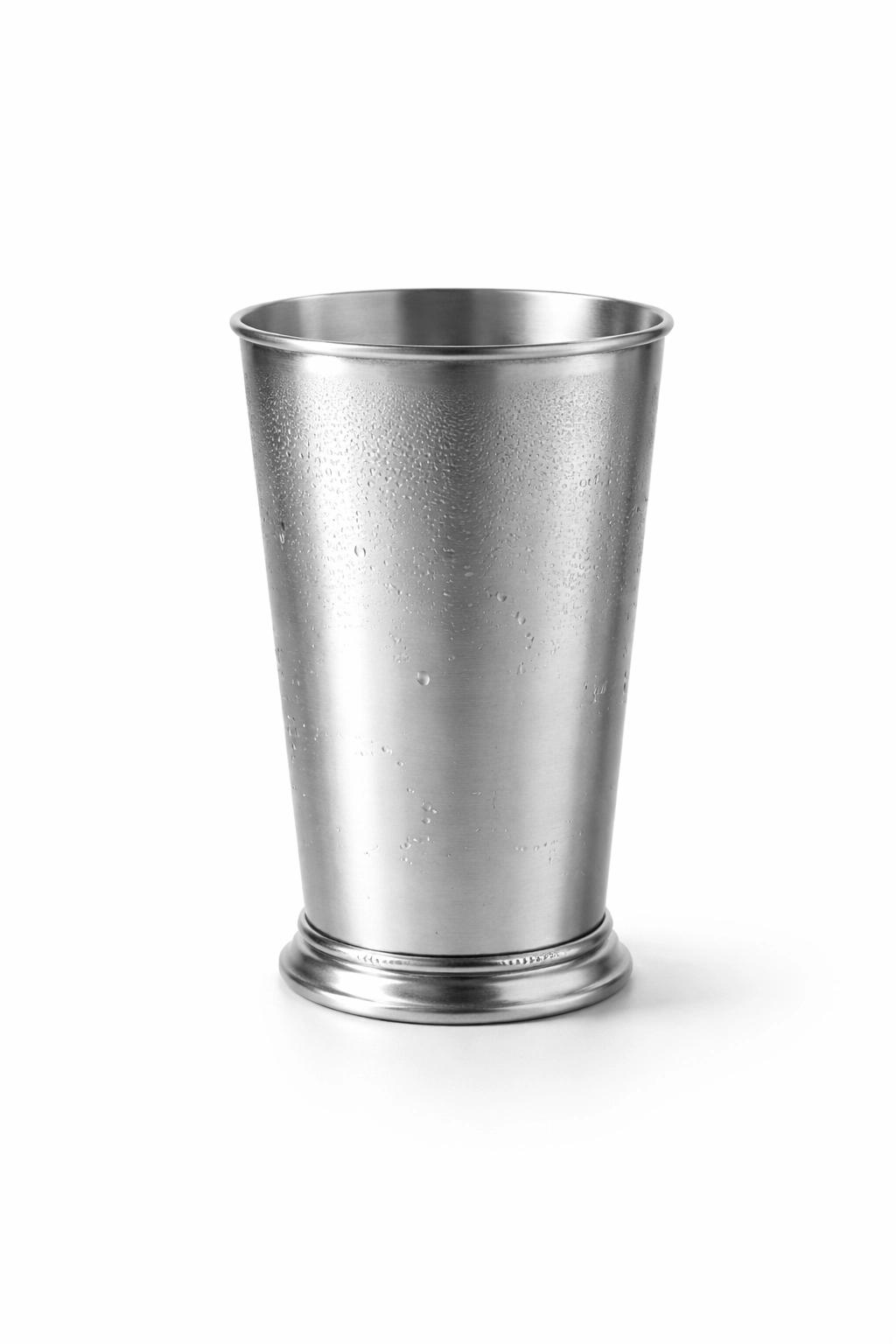
A julep cup is a straight-sided metal beaker of stainless steel, silver, silver plate or pewter, 41cl in Urban Bar’s own listing and 40cl for its steel cups. With crushed ice churned in it, the metal chills fast enough for frost to form on the outside, the sign that a julep is cold. It is the cup for the Mint Julep and our Jerry Can Julep, and it suits a Sherry Cobbler or a swizzle.
About the Julep Cup
Metal Carries the Cold to the Outside
Glass is a poor conductor of heat, so a tumbler full of crushed ice stays merely cool on the outside and mists over. Stainless steel carries heat many times faster, and silver faster still.
Once crushed ice and drink are churned in it, a metal cup's outer surface falls under 0°C. Moisture in the air freezes onto it, and the cup turns white with frost.
Fingers Off the Frost
Fingers on the body of the cup warm it and leave a print in the frost. Hold a julep cup by the rim and the foot so the frost can form and stay.
Packed, Churned and Topped Up
Our Mint Julep is built in the cup: mint pressed gently in sugar and water, crushed ice packed in, bourbon poured over and churned with a bar spoon for 20 to 30 seconds. The ice settles, so pack more on top in a dome.
The Jerry Can Julep stirs spiced rum briefly through pressed mint and syrup, then crushed ice goes in, and a dash of Angostura goes over the top.
A julep cup against other vessels for crushed-ice drinks (cup sizes from Urban Bar’s listings; rocks glass from our shop)
Stainless steel julep cup
- Usual size
- 40cl (Urban Bar)
- On the outside
- Frosts quickly
- Care
- Dishwasher-safe; hand washing keeps the finish
Silver or silver-plated cup
- Usual size
- 41cl (Urban Bar’s Julep Cup)
- On the outside
- Frosts fastest
- Care
- Hand wash and polish
Pewter cup
- Usual size
- Sizes vary; our guidance 30cl or more
- On the outside
- Frosts
- Care
- Hand wash; lead-free only
Rocks glass
- Usual size
- 26cl (our shop)
- On the outside
- Mists over
- Care
- Dishwasher-safe
| Vessel | Usual size | On the outside | Care |
|---|---|---|---|
| Stainless steel julep cup | 40cl (Urban Bar) | Frosts quickly | Dishwasher-safe; hand washing keeps the finish |
| Silver or silver-plated cup | 41cl (Urban Bar’s Julep Cup) | Frosts fastest | Hand wash and polish |
| Pewter cup | Sizes vary; our guidance 30cl or more | Frosts | Hand wash; lead-free only |
| Rocks glass | 26cl (our shop) | Mists over | Dishwasher-safe |
Steel Is Practical, Silver Is Traditional
Stainless steel is the practical choice: cheap, tough and quick to frost, and it is the cup the IBA names. Silver frosts faster and is the traditional metal, at the cost of polishing.
Pewter is another option. Buy modern pewter sold as lead-free, and keep antique pieces for the shelf.
Using the Julep Cup
Usage
Crushed-ice drinks: the Mint Julep and the Jerry Can Julep, the Sherry Cobbler and swizzles. For a Mint Julep, pack crushed ice into the cup, churn the bourbon through it with a bar spoon for 20 to 30 seconds until the outside turns white, then mound more ice over the rim.
Pro Tip
Put the empty cup in the freezer for a while before building. A cold cup frosts quickly once you start churning, and the frost holds better in a warm room.
Professional Tips
- Crushed ice goes in right to the top before you churn.
- Grip the rim or the foot, keeping your palm off the frost.
- Stand the mint bouquet beside a short straw, so the nose meets the mint.
- Top up and re-pack the ice once the first lot settles.
Alternatives
Budget Alternative
A rocks glass. Our Mint Julep and Jerry Can Julep recipes both allow one; you get the same drink, though the glass mists over rather than frosting. Fill it as tightly with crushed ice.
Premium Option
A sterling silver or heavy silver-plated cup. Silver carries cold faster than steel, so it frosts quickly, and it is the traditional metal for a julep; it needs hand washing and polishing.
Specifications
Material
Stainless steel, silver, silver plate or pewter
Capacity
40 to 41cl in Urban Bar’s listings
Details
Straight or slightly tapered sides, a rolled rim and often a beaded foot
More to explore
Common Questions
What is a julep cup made of?
Why do julep cups frost?
Can you use a julep cup for other drinks?
How do you care for a julep cup?
What size is a julep cup?
Do I need a julep cup to make a Mint Julep?
How do you hold a julep cup?
Is pewter safe to drink from?
Sources.
Checked between 18 October and 20 October 2026.
- Urban Bar, “Julep Cup 41cl”.
- Urban Bar, “Tiki Stainless Steel Julep Cup 40cl”.
- The Oxford Companion to Spirits and Cocktails (David Wondrich), “The julep” (secondary source: Virginia 1770 poem; the 1787 definition; ice first attested in 1807; Mint Julep a southern ritual with silver cups; Churchill Downs’ official drink in 1938).
- Jerry Can Spirits shop, “Club ICE Tumbler, 26cl”.
- Kentucky Derby (Churchill Downs), “The Mint Julep: official cocktail of the Kentucky Derby” (the Derby’s own page: the official drink for almost a century; an official julep glass).
Made with the Julep Cup
Used In These Cocktails
Related Equipment
Updated 20 October 2026