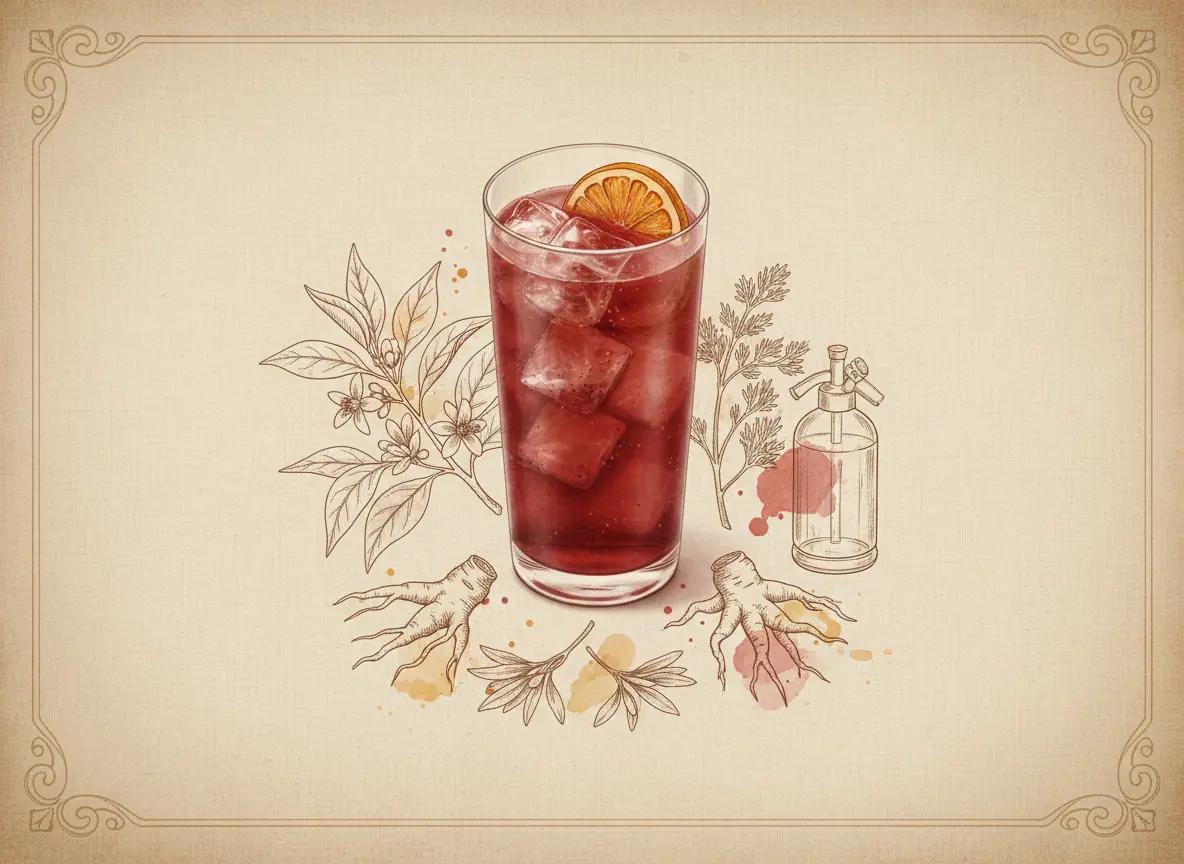
Americano
The Americano was born at Gaspare Campari's bar in Milan in the 1860s, served then as the Milano-Torino after its two principal ingredients: Campari from Milan and sweet vermouth from Turin. The name Americano came later, attributed to the American tourists and expatriates who ordered it in such volume that the drink became associated with them. It is the direct ancestor of the Negroni, predating it by roughly half a century. It is one of the simplest drinks in the canon and one of the most instructive. Three ingredients built directly in the glass, no shaking, no stirring beyond a single gentle turn to integrate the soda. The restraint is the point: this is a drink designed for length and sessionability, and for the specific pleasure of something bitter, sweet and effervescent taken slowly in warm weather before a meal. The sweet vermouth is the variable that decides the whole thing. At equal volume to the Campari it has nowhere at all to hide.
Glassware: Highball Glass
Garnish: Orange Slice and Orange Peel
Ingredients
30ml
The defining ingredient, and there is no meaningful substitute for it in this drink. Other red bitters make a pleasant aperitif; none of them makes an Americano.
30ml
Refrigerate after opening and replace within four weeks. At equal volume to the Campari, a stale vermouth will define the drink for the wrong reasons.
To top (approximately 75ml)
Well chilled before pouring. Add last and stir once gently to integrate without losing the carbonation.
Instructions
Fill a highball or rocks glass fully with large cubed ice.
Pour the Campari over the ice.
Add the sweet vermouth.
Top with chilled soda water.
Stir once gently to integrate the ingredients without losing carbonation.
Place the orange slice on the rim and serve immediately.
Source: the IBA (Official IBA specification; method ours). Last checked 12 August 2026.
Expert Tip
Stir once and stop. The Americano is a carbonated drink and aggressive stirring will flatten it before the first sip. A single slow turn with a bar spoon is enough to bring the ingredients together, and the soda does the rest as it settles. Fill the glass properly with large cubes. A half-filled glass warms fast, and a warm Americano turns syrupy as the soda goes flat; the ice is doing temperature control rather than dilution here, which is why large cubes beat crushed. Treat the vermouth as perishable, because it is. It is a wine, it oxidises from the day it is opened, and at 30ml per drink a bottle that has stood at room temperature for three months will define the drink for entirely the wrong reasons. Refrigerate it and replace it within four weeks.
Behind the Americano
Flavour Profile
The Origin
Gaspare Campari opened his bar in Milan in the 1860s and began serving a combination of his own bitter liqueur with sweet vermouth from Turin. The drink became known as the Milano-Torino, a straightforward geographical reference to where each ingredient came from. It was served on ice, which was itself a relative novelty in the Italian bar context of the time, and it attracted a clientele that included a significant number of American visitors who had developed a taste for long, cold drinks that the European bar culture of the era did not routinely provide.
The name Americano emerged from that association. Whether it was a direct tribute to the American customers who popularised it or a reference to the bittersweet amaro tradition that Americans found particularly appealing is not definitively established. What is established is that the Milano-Torino became the Americano, and the Americano went on to become the foundation upon which one of the most ordered cocktails of the modern era was built.
The Negroni Connection
The story most commonly told about the Negroni's creation is that Count Camillo Negroni walked into a Florence bar in 1919 and asked for his Americano to be strengthened by replacing the soda water with gin. Whether that account is entirely accurate or partially mythologised is debated. What is not debated is the structural relationship between the two drinks. The Americano and the Negroni share the same two base ingredients in the same ratio. The only variable is what extends them. Soda produces a long, sessionable, low-alcohol aperitif. Gin produces a short, spirit-forward, high-alcohol one. Tasting both in sequence is one of the most instructive exercises available to anyone learning to think seriously about how cocktails are constructed.
The Vermouth Question
The Americano is not a drink that rewards complacency about ingredient quality. Campari is consistent and reliable. Soda water is soda water. Sweet vermouth is the only variable, and it is a significant one. Vermouth is a wine-based product that oxidises after opening. Left at room temperature for several months, it degrades into something flat, slightly bitter, and vaguely medicinal. At 30ml per drink, representing half the spirit volume, a poor or stale vermouth will determine the character of the Americano more than any other single factor. Buy a fresh bottle, refrigerate it immediately, and replace it within four weeks.
How to Serve It
Built over ice in a highball or rocks glass, with a single stir and an orange slice on the rim. This is the canonical Italian aperitif, a category of drink designed to be consumed before a meal to stimulate appetite rather than to be lingered over as an evening drink. The low alcohol content and the bitterness of the Campari make it genuinely suited to that purpose in a way that heavier, spirit-forward drinks are not. Serve it cold, serve it simply, and serve it before food.
Make it at home
The Spirit
CampariAn Italian bitter aperitif, red, sweet and sharply bitter, made by infusing herbs, aromatic plants and fruit in alcohol and water. The recipe has been held privately since Gaspare Campari mixed the first batch in 1860, and the bitterness is structural rather than decorative.
Master the Techniques
More to explore
Frequently Asked Questions
What is an Americano?
How does it relate to the Negroni?
Why does the vermouth matter?
You Might Also Like
Negroni
The Negroni is the most ordered classic cocktail in the world and the drink that defined the contemporary revival. It is also one of the simplest: equal parts gin, Campari and sweet vermouth, stirred and served over ice with an orange peel. That simplicity is a function of how precisely the three are calibrated against one another. The story most commonly told places Count Camillo Negroni at the Caffè Casoni in Florence in 1919, asking Fosco Scarselli to strengthen his Americano by replacing the soda with gin. The account is debated; the structure is not. Both drinks share the same base of Campari and sweet vermouth, and that one substitution turns a sessionable aperitif into one of the most spirit-forward short drinks there is. The sweet vermouth is the most commonly neglected variable. At equal volume it is a third of the drink rather than a background ingredient, and a bottle left open at room temperature for months will define a Negroni more completely than the gin does, with no amount of good Campari correcting it.
Bijou
The Bijou was created by Harry Johnson and published in his 1900 Bartenders' Manual, the name taken from the French word for jewel. The three base ingredients each represent a precious stone: gin for diamond, sweet vermouth for ruby, green Chartreuse for emerald. It is one of the most demanding drinks in the classic canon to balance correctly. Green Chartreuse is a 130-botanical French liqueur made by Carthusian monks since 1737, and it does not share space quietly. It brings herbal complexity, sweetness and considerable alcoholic weight to the glass. The gin must be assertive enough to hold its own, the sweet vermouth must be fresh, and the orange bitters tie the three together. The proportions are not equal parts, whatever the jewel conceit suggests: forty millilitres of gin against twenty each of Chartreuse and vermouth is what keeps the drink standing upright rather than collapsing into herbal sweetness. The result is rich, complex and entirely spirit-forward. This is not a drink for the uninitiated and it does not pretend to be.
La Louisiane
La Louisiane was the house cocktail of Restaurant La Louisiane, one of New Orleans' most storied dining establishments, and appeared in Stanley Clisby Arthur's 1937 guide "Famous New Orleans Drinks and How to Mix 'Em." It is a Manhattan variation in structure, rye whiskey and sweet vermouth as the foundation, with Bénédictine replacing the conventional sweetener and absinthe adding an aromatic undercurrent that marks it unmistakably as a product of New Orleans drinking culture. It is a drink of considerable depth for something built in a mixing glass with no citrus and no theatre. The Bénédictine brings honey, herbal complexity, and a warmth that simple syrup or even a standard liqueur cannot replicate. The absinthe is a seasoning, not a feature. Too much and it dominates. The correct amount is the one you can sense but cannot isolate. Like many New Orleans classics, La Louisiane rewards slow consumption and a quality vermouth. This is not a drink to build with a vermouth that has been open for three months. Treat it as a perishable ingredient and the drink will tell you why immediately.
Where this one sits
Recipe by Jerry Can Spirits