Rome With a View
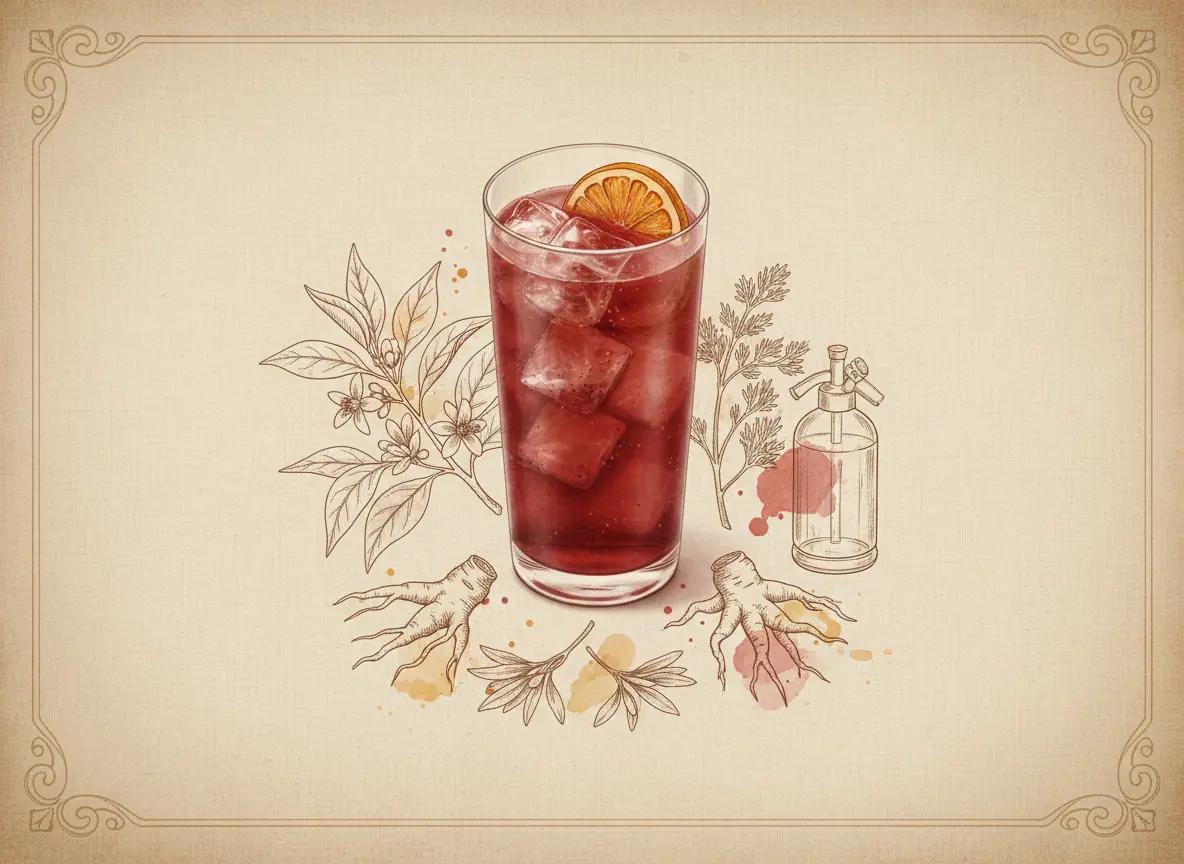
A Rome With a View is 30ml of Campari, 30ml of dry vermouth, 30ml of fresh lime juice and 15ml of simple syrup, shaken hard for 10 to 12 seconds, strained over fresh ice in a highball and lengthened with 60ml of soda water, with an orange slice in the glass. About 1.3 UK units. There is no spirit in it. Difford’s Guide adapts its recipe from one created in 2008 by Michael McIlroy at Milk & Honey in Manhattan. It is a Campari sour: two aperitifs stand where a base spirit would be, and the lime goes in at a full sour measure. That measure is the point. The bitterness stays, the lime makes it bright, and the soda turns it into a long drink for the afternoon. Punch’s recipe, credited to McIlroy, pours 22.5ml of syrup; ours trims it to 15ml, because Campari is sweet already.
Glassware: Highball Glass
Garnish: Orange slice
Ingredients
30ml
At 25% ABV, the strength LWC lists in the UK, it is half the base rather than a modifier, and it brings its own sugar. That is why the syrup stays at 15ml against a full 30ml of lime.
30ml
The other half of the base, at our working figure of 18% ABV. Its dry, herbal edge stops the Campari reading as sweet. We use a bottle opened within the month and kept cold.
30ml
Squeezed the same day, and the full 30ml. Trim it and the drink stops being a sour.
15ml
Sugar and water, one to one by weight. Half the lime rather than equal to it, because the Campari is already sweet; Punch’s recipe for McIlroy pours 22.5ml.
60ml
Cold and freshly opened, 60ml poured down the side after the shake. It lengthens the drink without watering the sour underneath.
Instructions
Squeeze the lime juice the same day.
Add the Campari, dry vermouth, lime juice and simple syrup to a shaker.
Fill with cubed ice and shake hard for 10 to 12 seconds.
Strain into a highball filled with fresh ice.
Pour the soda water down the side and stir once.
Garnish with an orange slice in the glass.
Our version
Punch’s recipe, credited to Michael McIlroy, pours 22.5ml of syrup and tops with soda. Ours pours 15ml of syrup, because Campari brings sugar of its own, and measures the soda at 60ml.
Source: our own specification. Last checked 9 October 2026.
Expert Tip
Keep the lime at 30ml. It looks heavy beside two aperitifs, and the urge is to cut it to 20. Cut it and the drink slides back towards a fizzy Americano: pleasant, flatter, and no longer a sour. Shake the base and add the soda afterwards. Soda in a shaker goes flat and can force the tin open. Strain over fresh ice, pour the soda down the side and stir once to lift it through. Open a fresh bottle of dry vermouth and keep it in the fridge. At 30ml it is half the base, and a bottle open for months tastes stale through the lime.
Behind the Rome With a View
Flavour Profile
Where It Comes From
Difford’s Guide adapts its recipe from one created in 2008 by Michael McIlroy at Milk & Honey in Manhattan, and says he was apparently inspired by the Triumph of Pompeii cocktail. Punch places it between an afternoon-appropriate Collins and an Americano, low in alcohol and bracingly bittersweet.
The name echoes A Room with a View, E. M. Forster’s novel.
A Sour With No Spirit
Take a daiquiri and remove the rum, and the lime and sugar have nothing to stand on.
Here Campari and dry vermouth take the spirit’s place. In our view Campari brings bitterness, sugar and weight; the vermouth brings herbs and dryness; between them there is enough flavour to meet a full measure of lime. What they do not bring is much alcohol, which is why the glass holds about 1.3 units.
The Sugar Arithmetic
In most sours the syrup and the citrus are close to equal. Here the syrup is half the lime.
Campari is the reason. It is sweet as well as bitter, so the drink is balancing two sources of sugar. Punch’s recipe for McIlroy pours 22.5ml of syrup; we pour 15ml and let the Campari make up the rest, which keeps the finish drier.
McIlroy’s Recipe and Ours
Rome With a View as Punch prints McIlroy’s recipe and as we pour it
Campari
- McIlroy
- 30ml
- Ours
- 30ml
Dry vermouth
- McIlroy
- 30ml
- Ours
- 30ml
Fresh lime juice
- McIlroy
- 30ml
- Ours
- 30ml, squeezed the same day
Simple syrup
- McIlroy
- 22.5ml
- Ours
- 15ml
Soda water
- McIlroy
- To top
- Ours
- 60ml
Glass
- McIlroy
- Collins
- Ours
- Highball
Garnish
- McIlroy
- Orange wheel
- Ours
- Orange slice
| Element | McIlroy | Ours |
|---|---|---|
| Campari | 30ml | 30ml |
| Dry vermouth | 30ml | 30ml |
| Fresh lime juice | 30ml | 30ml, squeezed the same day |
| Simple syrup | 22.5ml | 15ml |
| Soda water | To top | 60ml |
| Glass | Collins | Highball |
| Garnish | Orange wheel | Orange slice |
How to Serve It
Shaken, strained over fresh ice in a highball and topped with soda, with an orange slice in the glass. The orange picks up the Campari rather than repeating the lime.
It suits the afternoon: long, bitter and low in alcohol.
For Campari and sweet vermouth with soda and no lime, make an Americano; for Campari with orange juice, a Garibaldi.
Make it at home
The Spirit
CampariCampari is a red Italian bitter liqueur, 25% ABV in the UK on a wholesaler’s listing, made in the style Difford’s Guide describes: an infusion of herbs and fruit in alcohol and water. Campari dates it to 1860 and Gaspare Campari; the Oxford Companion has Gaspare setting up in Novara in 1856 and moving to Milan in 1862. Its bitterness anchors the Negroni and the Americano, and lengthened with soda over ice it needs nothing else.
Master the Techniques
More to explore
Frequently Asked Questions
What is a Rome With a View?
Why is the lime measure so large?
Can I use sweet vermouth instead?
What is dry vermouth?
Who created the Rome With a View?
How strong is a Rome With a View?
Sources.
Correct as of 19 October 2026.
- Difford’s Guide, “Rome With a View” (secondary source: adapted from a recipe created in 2008 by Michael McIlroy at Milk & Honey in Manhattan; apparently inspired by the Triumph of Pompeii cocktail, inspired by Rome Is Burning; 1.3 units).
- Punch, “Rome With a View” (secondary source: McIlroy’s recipe, 1 oz Campari, 1 oz dry vermouth, 1 oz lime juice, 3/4 oz simple syrup, soda to top, Collins glass, orange wheel; between a Collins and an Americano).
- LWC, “Campari 70cl” (UK wholesaler listing: Alcohol By Volume 25%).
- legislation.gov.uk, “Regulation (EU) 251/2014, Annex II (retained)” (vermouth: aromatised wine to which alcohol has been added, with a characteristic taste from Artemisia species).
You Might Also Like
Garibaldi
A Garibaldi is 45ml of Campari and 120ml of freshly squeezed orange juice over ice in a highball, with an orange wedge. Those are the IBA’s measures. What makes the drink is the juice: squeezed at the moment of serving and aerated until it is light and foamy. About 1.1 UK units. Punch credits the fluffy orange juice to Dante, the Italian-inspired bar in New York’s West Village, where creative director Naren Young and his team make each batch to order in a Breville juicer kept behind the bar. In our view the froth softens the Campari’s bitterness. Punch quotes Young: “We didn’t invent the Garibaldi, but we perfected it.” VinePair says the drink is named after Giuseppe Garibaldi, with its red-orange colour said to honour the red shirts his followers wore. We have found no early source for the story, so take it as a good explanation rather than a fact.
Americano
An Americano is 30ml Campari and 30ml sweet vermouth built over ice in a highball, topped with 75ml of cold soda and stirred once, with an orange slice. Bitter and sweet in equal measure, lengthened with soda: a Negroni with soda in place of the gin, at about half the alcohol. It grew out of the Milano-Torino, Campari from Milan with vermouth from Turin, which Difford’s Guide says Gaspare Campari created in the 1860s at his Caffè Campari in Milan. Difford’s adds that soda was said to have been added later, to make the Americano. The vermouth decides the result. At equal volume with the Campari it has nowhere to hide, and in our experience an opened bottle that has stood at room temperature for months will flatten the drink. Keep it in the fridge.
Milano-Torino
A Milano-Torino is 45ml of Campari and 45ml of sweet vermouth, built over large ice cubes in a rocks glass, stirred for 20 to 30 seconds and finished with an orange slice in the glass. About 1.8 UK units. There is no spirit in it: one bitter liqueur and one aromatised wine. The name gives the parts away. Campari came from Milan, vermouth from Turin. Difford’s Guide dates the pairing to the 1860s at Gaspare Campari’s Caffè Campari in Milan, and Punch says it is shortened to Mi-To; the decade is tradition rather than a dated record. Lengthen it with soda and it becomes an Americano. Add gin and it becomes a Negroni. Drink the Milano-Torino first and you taste the base both are built on: orange, herbs and wood from the Campari, as its product page has it, and vanilla, dried fruit and spice from a rich vermouth such as Carpano’s Antica Formula, as its own page has it, with nothing to stretch or strengthen either.
Where this one sits
Recipe by Jerry Can Spirits · Updated 19 October 2026