Julep Strainer
A julep strainer is a shallow perforated metal bowl, about 7 to 8cm across on the ones we use, on a short handle, used to strain stirred drinks out of a mixing glass. It sits inside the glass, face down on the ice, and holds the cubes back while the drink pours past. It serves stirred drinks such as the Bamboo, the Martinez and the Boulevardier.
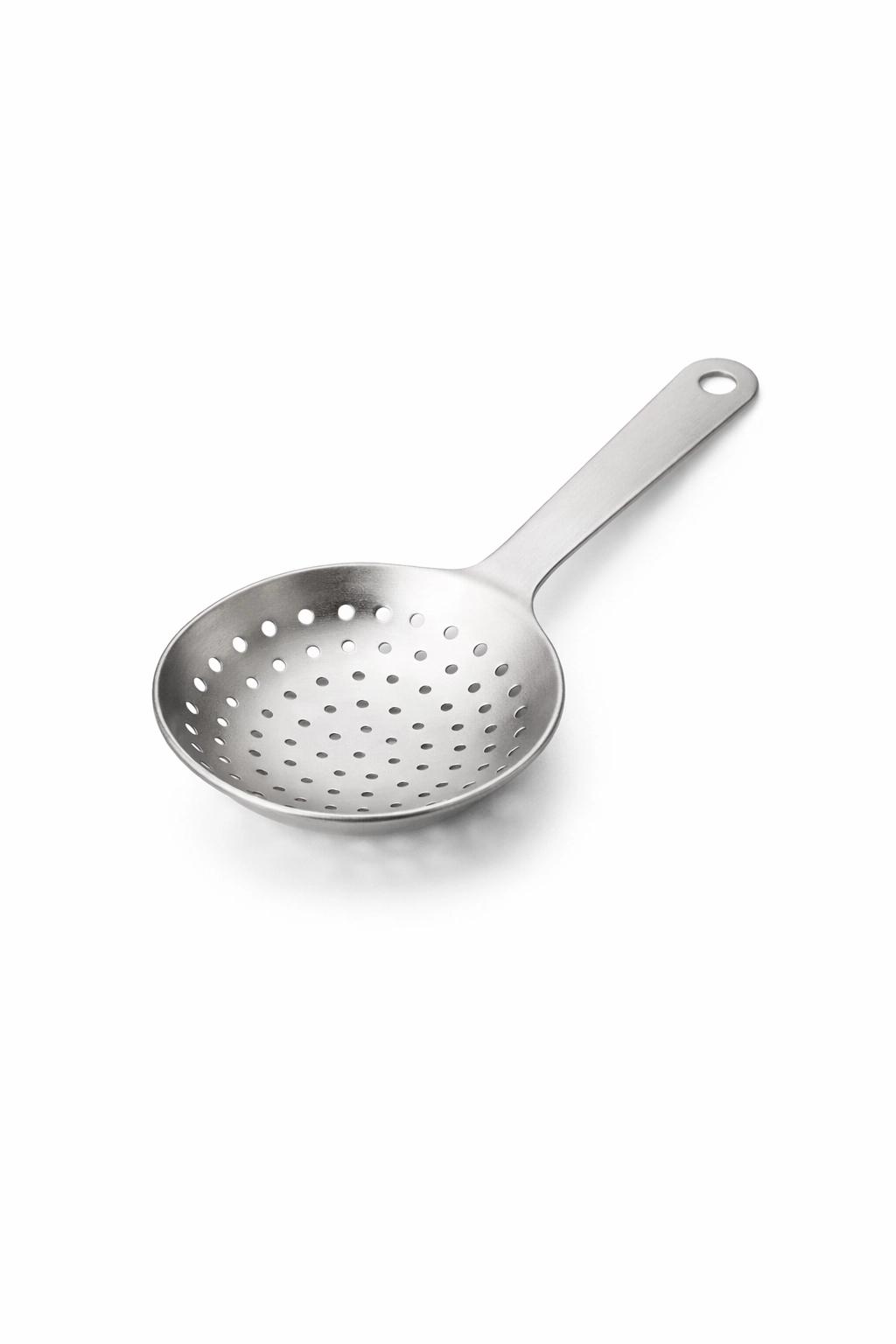
About the Julep Strainer
A Bowl With Holes
There is little to it: a shallow perforated dome with a short handle, sized to sit inside a standard mixing glass at an angle.
That simplicity is the appeal. A Hawthorne has a spring that wears, a gate that slides and a rim that has to press evenly. A julep strainer has a bowl. It cannot lose tension, and it rinses clean in a second under a tap.
It is also the more comfortable tool to pour with once learned, because the hand holding the glass and the hand controlling the strainer are the same hand.
The Name Comes From the Julep
By the usual account, it was not designed to strain anything. It was there to keep crushed ice out of a drinker's teeth.
A nineteenth-century julep arrived packed with crushed ice, and the perforated bowl sat in the cup as a guard. As straws took over, the guard was no longer needed, and bartenders found the shape well suited to holding cubes back while pouring off a stirred drink.
Julep for Stirred, Hawthorne for Shaken
The division follows the method rather than taste.
The reason is the ice. Stirring keeps cubes whole, and a julep bowl holds whole cubes well. Shaking shatters them, and small fragments slip straight past the perforations, which is what a Hawthorne's spring is there to catch.
Julep, Hawthorne and fine strainer compared
Julep
- Fits
- Inside a mixing glass
- Holds back
- Whole cubes
- Use it for
- Stirred drinks
Hawthorne
- Fits
- Over a tin or a mixing glass
- Holds back
- Cubes and most shards, with its spring
- Use it for
- Shaken drinks, and stirred ones at a pinch
Fine strainer
- Fits
- Held under a Hawthorne
- Holds back
- Shards, pulp and herb fragments
- Use it for
- Double straining shaken drinks
| Strainer | Fits | Holds back | Use it for |
|---|---|---|---|
| Julep | Inside a mixing glass | Whole cubes | Stirred drinks |
| Hawthorne | Over a tin or a mixing glass | Cubes and most shards, with its spring | Shaken drinks, and stirred ones at a pinch |
| Fine strainer | Held under a Hawthorne | Shards, pulp and herb fragments | Double straining shaken drinks |
A Hawthorne will strain a stirred drink well, so a home bar that owns one needs no julep at all. Bars keep both because the julep is quicker and tidier on the drinks it suits.
Holding It Properly
Domed side up, face down onto the ice, angled so the low edge points at the spout. Index finger flat on the handle, thumb braced against the rim of the glass.
That grip means the strainer and the glass move together as one object, so you can tilt to a near-vertical pour without the bowl shifting. People who find julep strainers awkward are usually holding the handle like a spoon and letting the bowl float.
Stir for 20 to 30 seconds first, as our stirred recipes do, then pour steadily rather than fast. The drink comes around the edges of the bowl, and rushing it pushes ice against the perforations.
Using the Julep Strainer
Usage
Straining stirred drinks from a mixing glass. The bowl cups the cubes and holds them back while the drink pours around its edge, and because it sits inside the glass rather than clamping over it, the pour is controlled by how far you tilt.
Pro Tip
Index finger flat on the handle, thumb on the rim of the mixing glass. Glass and strainer then tilt as one, and the bowl stays seated through the whole pour.
Professional Tips
- Face down, domed side up, low edge towards the spout.
- Index finger on the handle, thumb braced on the glass rim.
- Tilt the glass and strainer together; do not slide the strainer.
- It is not made for a shaker tin. Use a Hawthorne there.
Alternatives
Budget Alternative
A Hawthorne strainer held over the mixing glass does the job, so a home bar with one Hawthorne does not need a julep strainer.
Premium Option
Thicker steel with a rolled rim. It holds its shape for years and sits more securely in the glass.
Specifications
Material
Stainless steel
Capacity
Not applicable
Details
Shallow perforated bowl, about 7 to 8cm across on the ones we use, on a short handle; Urban Bar’s own julep-style strainer is 22cm long overall
More to explore
Common Questions
What is a julep strainer for?
Why is it called a julep strainer?
Julep or Hawthorne strainer?
How do you hold a julep strainer?
Can you use a julep strainer on a shaker?
Does a julep strainer fit every mixing glass?
How long do you stir before straining?
Sources.
Correct as of 18 October 2026.
Master the Technique
Made with the Julep Strainer
Used In These Cocktails
Related Equipment
Updated 18 October 2026