Bellini
A Bellini is 100ml prosecco over 50ml white peach purée: the purée goes into a chilled flute, the cold prosecco is poured over in stages and folded in, and it is served straight away. About 1.1 UK units. It sits on the IBA’s Contemporary Classics list at these measures. The Oxford Companion says Giuseppe Cipriani, the founder of Harry’s Bar in Venice, created it around 1945, and named it for the fifteenth-century Venetian painter Giovanni Bellini because its peach hue resembled one characteristic of his work. Cipriani’s own Bellini page gives 1948 and says he was inspired by that painter. White peaches decide it. They are paler, more floral and usually milder than yellow ones, and they give the soft blush; yellow fruit makes a sharper drink of the wrong colour.
Glassware: Champagne Flute
Garnish: None: the colour is the garnish
Ingredients
50ml
Ripe white peaches, skinned, stoned, blended and sieved, or a good frozen white peach purée. A squeeze of lemon stops it browning if it has to stand.
100ml
Brut, at our working figure of 11% ABV, and very cold. Its soft fruit and gentle fizz suit the peach; Champagne is heavier and takes over.
Instructions
Chill a flute, the peach purée and the prosecco.
Pour the cold white peach purée into the flute.
Add the prosecco slowly, in two or three stages, folding gently with a bar spoon between each.
Serve at once.
Source: the IBA (Official IBA specification, folded in the flute where the IBA stirs over ice in a mixing glass; method ours). Last checked 9 October 2026.
Expert Tip
Chill everything first: flute, purée and prosecco. Warm purée knocks the fizz out of the wine on contact, and the drink arrives flat. Pour the prosecco in stages, folding gently with a bar spoon between each pour. Purée and wine separate if hurried, and the drink should be one even colour. Sieve the purée. Blended peach alone keeps fibres that catch the bubbles and turn the top of the glass foamy.
Behind the Bellini
Flavour Profile
The Origin
The Bellini comes from Harry’s Bar in Venice. The Oxford Companion says Giuseppe Cipriani created it there around 1945. Cipriani’s own Bellini page gives 1948.
The name is Giovanni Bellini’s, the fifteenth-century Venetian painter. The Oxford Companion says the drink’s peach hue resembled one characteristic of his work, and Cipriani’s own page says he was inspired by the painter.
The White Peach
The fruit is the whole drink. White peaches are paler, more floral and usually milder than yellow, and the colour and character of the Bellini both depend on them.
Making the Purée
Skin, stone and blend ripe white peaches, then push the purée through a sieve. Blending alone leaves fibres that catch the bubbles and foam on top.
The fruit should give under a thumb and smell of peach. Out of season, a good frozen white peach purée beats a hard fresh one, and a little lemon juice keeps it from browning.
Prosecco, Not Champagne
The IBA specifies prosecco, and its soft fruit and gentle fizz suit the peach. Champagne’s toasty, yeasty depth competes with the fruit, at a higher price.
The Family
Bellini, Rossini and Mimosa compared; the Bellini and Mimosa measures are the IBA’s, the Rossini follows the IBA’s variation with our measures
Bellini (IBA)
- Spec
- 50ml white peach purée, 100ml prosecco
- Strength
- About 1.1 UK units
- Fruit
- White peach
Rossini
- Spec
- 50ml strawberry purée, 100ml prosecco
- Strength
- About 1.1 UK units
- Fruit
- Strawberry
Mimosa
- Spec
- 75ml fresh orange juice, 75ml prosecco
- Strength
- About 0.8 UK units
- Fruit
- Orange
| Drink | Spec | Strength | Fruit |
|---|---|---|---|
| Bellini (IBA) | 50ml white peach purée, 100ml prosecco | About 1.1 UK units | White peach |
| Rossini | 50ml strawberry purée, 100ml prosecco | About 1.1 UK units | Strawberry |
| Mimosa | 75ml fresh orange juice, 75ml prosecco | About 0.8 UK units | Orange |
A third of the glass in fruit is a lot for a sparkling drink, and it works only because white peach purée is thin and mild.
For strawberry in place of peach, the Rossini uses the same measures.
How to Serve It
Cold, folded gently and drunk soon after pouring, in a chilled flute with no garnish. For a party, keep the purée chilled and top each glass to order.
More to explore
Frequently Asked Questions
Why white peaches?
Prosecco or Champagne?
Can I use peach nectar or peach schnapps?
How strong is a Bellini?
Bellini or Rossini: what changes?
Who invented the Bellini?
Can I make Bellinis ahead for a party?
How much peach purée goes in a Bellini made with cava?
Sources.
Correct as of 19 October 2026.
- The Oxford Companion to Spirits and Cocktails (Tony Conigliaro), “The Bellini” (secondary source: created around 1945 by Giuseppe Cipriani, founder of Harry’s Bar in Venice; white peach purée and prosecco; named for the painter Giovanni Bellini as the peach hue resembled one characteristic of his work).
- IBA, “Bellini” (official specification: 100ml prosecco, 50ml white peach purée; variations Puccini (mandarin), Rossini (strawberry), Tintoretto (pomegranate)).
- Cipriani, “Bellini” (the maker’s own page: “in creating what was to become known as the Bellini cocktail in 1948, Giuseppe Cipriani was once again inspired by a painter, the fifteenth century Venetian painter Giovanni Bellini”; white peaches and Prosecco; named it Bellini).
You Might Also Like
Rossini
A Rossini is 50ml fresh strawberry purée topped with 100ml cold prosecco in a chilled flute, folded gently and served at once. It is the Bellini’s strawberry relative: the same build and the same wine, with strawberries in place of white peach. About 1.1 UK units. The Consorzio Tutela Prosecco DOC says it pays tribute to the composer Gioacchino Rossini, and the IBA lists it as the Bellini made with fresh strawberry purée. Cipriani’s own page says Giuseppe Cipriani created the Bellini at Harry’s Bar in Venice in 1948, inspired by the painter Giovanni Bellini; the Oxford Companion to Spirits and Cocktails says about 1945. We found no creator and no date for the Rossini. Strawberries bring more acidity and colour than white peach, so the purée needs little help: blend ripe berries, sieve out the seeds and add a few drops of lemon to keep the colour bright.
Mimosa
A Mimosa is 75ml of fresh orange juice poured into a cold flute, then 75ml of cold prosecco added slowly and stirred once. About 0.8 UK units. Those are the IBA’s measures, and the IBA lists an orange twist as an optional garnish. Difford’s Guide, a secondary source, says many books credit Frank Meier at the Ritz in Paris in 1925, though it puts the creation between 1921 and 1923, and the name is commonly said to come from the bright yellow flowers of the mimosa tree; we have found no primary record. The IBA also lists it as Buck’s Fizz. Difford’s defines the Buck’s Fizz as two parts champagne to one of juice and thinks it was created in 1921 by Malachi “Pat” MacGarry, the bartender at Buck’s Club in London. Half the glass is juice, so squeeze it the same day. Carton juice makes a dull Mimosa.
Aperol Spritz
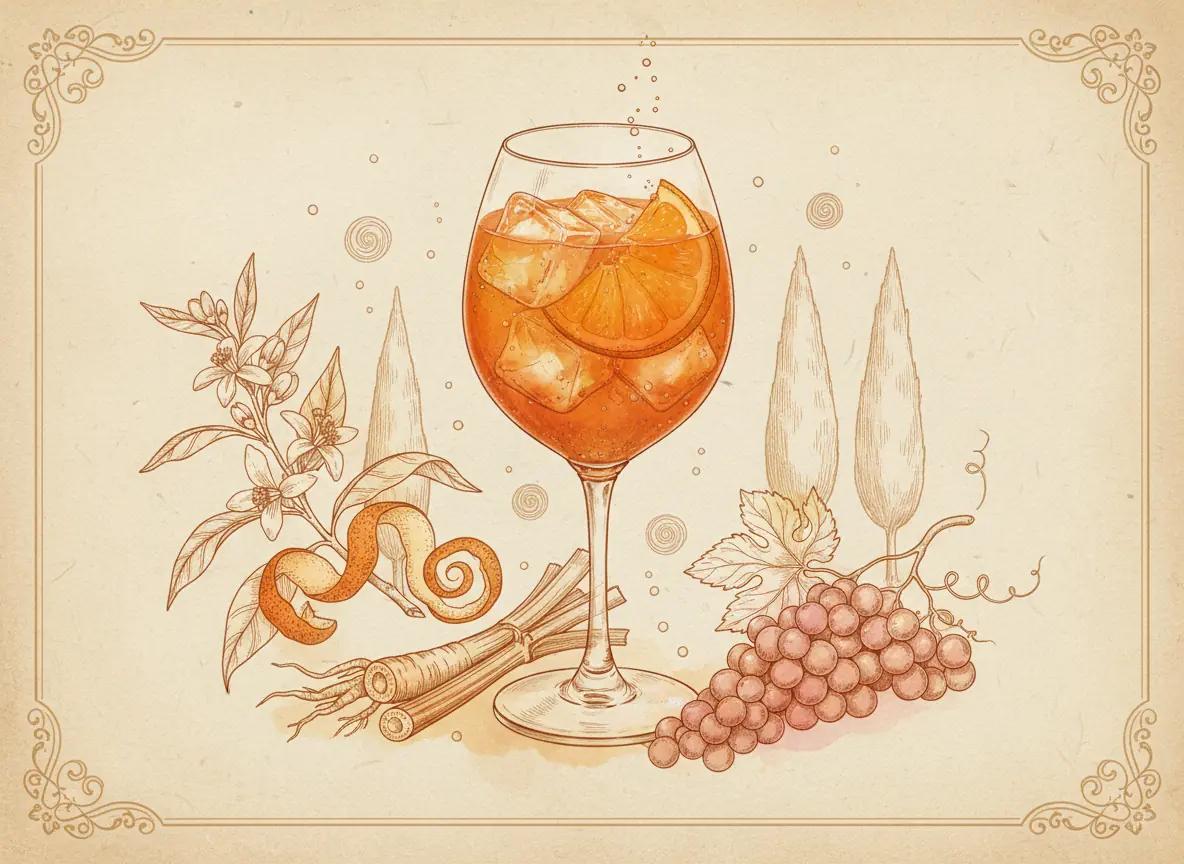
An Aperol Spritz is three parts prosecco, two parts Aperol and one part soda: 90ml prosecco, 60ml Aperol and 30ml soda water, poured in that order into a large wine glass packed with ice, with an orange slice to finish. That is the International Bartenders Association’s Spritz, with its splash of soda measured. Aperol is an Italian aperitivo at 11% ABV by its maker’s FAQ, with zesty orange and herbal notes on its product page; Difford’s Guide, a secondary source, names bitter orange, gentian, cinchona bark and Chinese rhubarb among its ingredients. Aperol says Luigi and Silvio Barbieri created it in 1919, and Difford’s Guide places the company in Padua. The spritz habit in the Veneto is older; VinePair traces it to the Veneto under Austrian rule, when the Austrians added a splash of water, a spritz, to the local wine. Pour the prosecco first and the Aperol mixes as it goes in. A glass holds about 1.7 UK units.
Where this one sits
Recipe by Jerry Can Spirits · Updated 19 October 2026