Little Italy
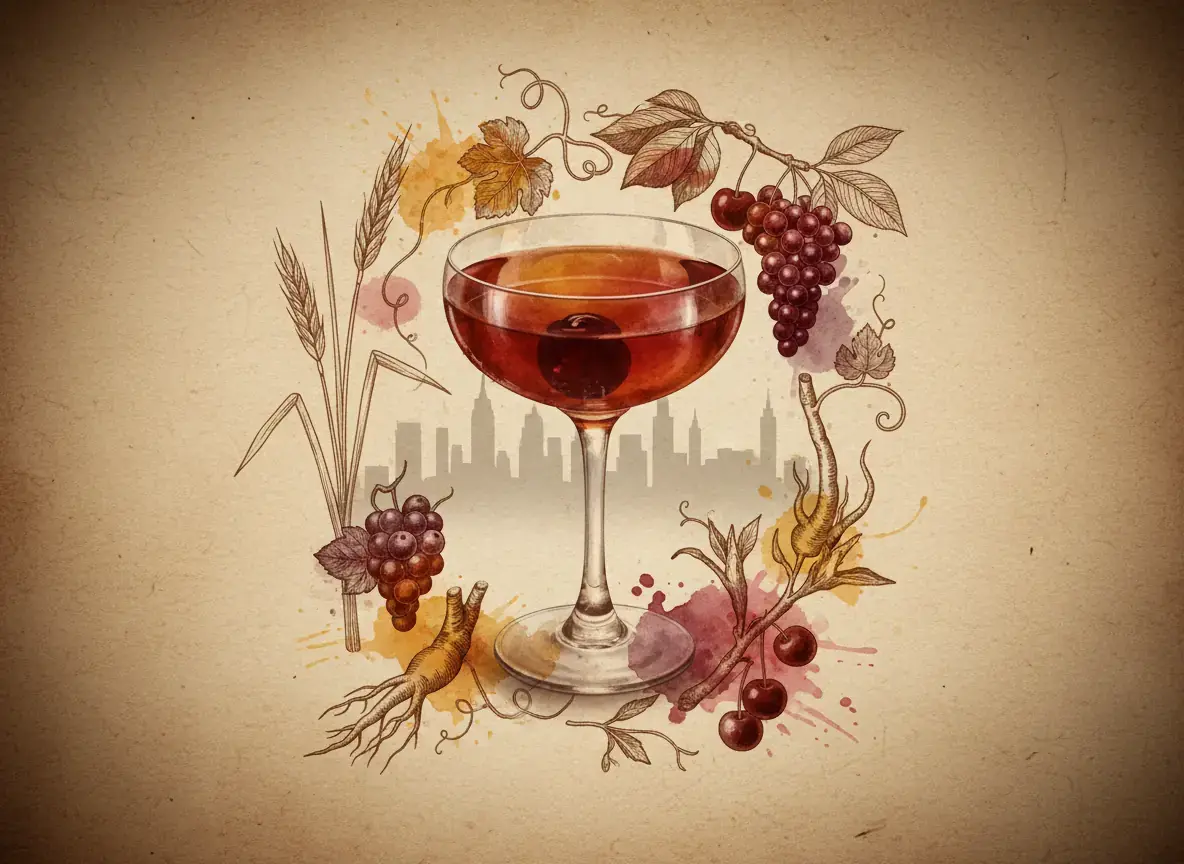
A Little Italy is 60ml of rye whiskey, 22.5ml of sweet vermouth and 15ml of Cynar, stirred over ice, poured through a strainer into a chilled coupe, and finished with two skewered cherries. About 3.0 UK units, counting 60ml of rye at 40% ABV, the vermouth at 16% and the Cynar at 16.5%. The measures are Imbibe’s, converted from ounces and rounded. Imbibe asks for a small cocktail glass, and we use a coupe. Imbibe credits Audrey Saunders of the Pegu Club in New York City, who named it for the neighbourhood. In our view the Manhattan is the parent, with the sweet vermouth cut back to make room for a bitter Italian liqueur. It is a dry, peppery rye drink with a bitter-herbal edge and a dark cherry finish.
Glassware: Coupe Glass
Garnish: Two cherries, skewered Imbibe asks for Luxardo cherries with a little syrup left on
Ingredients
Instructions
Chill a coupe.
Add the rye, sweet vermouth and Cynar to a mixing glass filled with ice.
Stir for 20 to 30 seconds.
Strain into the chilled coupe.
Skewer two cherries and lay them across the glass.
Source: its creator's published specification (Audrey Saunders, Pegu Club, New York City, published at Imbibe (imbibemagazine.com/recipe/little-italy-cocktail-recipe/, 12 April 2011); measures and method as printed there (2 oz rye whiskey, 3/4 oz sweet vermouth, 1/2 oz Cynar, stirred with ice, strained into a chilled small cocktail glass, 2 skewered Luxardo cherries); ounces converted to ml; no creation date printed). Last checked 1 November 2026.
Expert Tip
Keep the Cynar to its 15ml. It is a quiet bitter, but it builds, and a heavy hand makes the drink taste of the bottle. Stir until the mixing glass is cold enough to sting your fingers. The drink has no citrus and no water of its own, so the dilution does a lot of work. Spoon a little cherry syrup onto the skewer before you lay it across, as Imbibe suggests.
Behind the Little Italy
Flavour Profile
A Manhattan with an Italian bitter in the room
Imbibe prints the Little Italy as the work of Audrey Saunders at the Pegu Club in New York City, and says she named it for the neighbourhood. It calls the drink New York all the way: the American weight of rye whiskey, set against Italian richness. Imbibe gives no year for the creation, so we give none.
The shape comes from the Manhattan. Rye and sweet vermouth stay. The Angostura goes, and a measure of Cynar takes its place as the bitter note. The proportions are Imbibe’s four parts rye to one and a half of vermouth to one of Cynar.
Why Cynar works with rye
Rye whiskey is the drier, spicier choice, and it can carry a lot of sweetness. Sweet vermouth supplies it. Cynar is a bitter Italian liqueur at 16.5% ABV, about the strength of the vermouth, so it adds bitterness and herbs without adding much alcohol. Our vermouth guide covers what the vermouth is bringing.
Imbibe has one tip on the garnish. Take cherries with a little extra syrup on them, because it runs into the drink and gives it a port-like undertone. A maraschino cherry from a good jar does the same job.
The Little Italy beside three rye stirred drinks
Little Italy
- Rye
- 60ml
- Partner
- 22.5ml sweet vermouth
- Bitter or extra
- 15ml Cynar
Manhattan
- Rye
- 50ml
- Partner
- 20ml sweet vermouth
- Bitter or extra
- Angostura bitters
Black Manhattan
- Rye
- 50ml
- Partner
- 20ml Averna
- Bitter or extra
- Angostura and orange bitters
Red Hook
- Rye
- 60ml
- Partner
- 22.5ml Punt e Mes
- Bitter or extra
- 15ml maraschino liqueur
| Drink | Rye | Partner | Bitter or extra |
|---|---|---|---|
| Little Italy | 60ml | 22.5ml sweet vermouth | 15ml Cynar |
| Manhattan | 50ml | 20ml sweet vermouth | Angostura bitters |
| Black Manhattan | 50ml | 20ml Averna | Angostura and orange bitters |
| Red Hook | 60ml | 22.5ml Punt e Mes | 15ml maraschino liqueur |
The Black Manhattan swaps all the vermouth for amaro. The Red Hook is the nearest in proportion.
Make it at home
The Spirit
Whiskey (Rye)Rye whiskey, under the US standard 27 CFR 5.143, takes at least 51% of its grain from rye and its colour from new charred oak, and goes into bottle at a 40% ABV minimum; our recipes take 40% as the figure. Rye makes a drier, spicier, more peppery spirit than corn, which is why stirred classics such as the Manhattan, Vieux Carré and Brooklyn are written for it. It appears in 23 of our recipes.
Master the Techniques
More to explore
Frequently Asked Questions
What is a Little Italy?
Who created the Little Italy?
How does a Little Italy differ from a Manhattan?
How strong is a Little Italy?
Can I use bourbon instead of rye?
Can I use another amaro?
Which glass suits it?
Can I batch it?
Sources.
Correct as of 1 November 2026.
- Imbibe, “Little Italy Cocktail” (recipe and origin: Audrey Saunders, Pegu Club, New York City; 2 oz rye, 3/4 oz sweet vermouth, 1/2 oz Cynar, stirred, small cocktail glass, two Luxardo cherries; the cherry-syrup tip; no creation date).
- NHS, “Calculating alcohol units” (the 14-units-a-week guidance and the units calculation).
You Might Also Like
Manhattan
The IBA specifies 50ml of rye whiskey, 20ml of sweet vermouth and a dash of Angostura bitters, strained into a chilled glass with a cocktail cherry; we stir it over ice for 20 to 30 seconds and serve it in a coupe. That is five parts whiskey to two of vermouth. About 2.3 UK units. The Oxford Companion says the most commonly told story puts it at New York’s Manhattan Club on 29 December 1874, at a testimonial dinner for Samuel J. Tilden, later retold with Jennie Jerome, Lady Randolph Churchill, as host or inspiration, and calls that story simply not true: she had given birth to Winston Churchill in Oxfordshire less than a month earlier. The Companion names O. H. Byron’s Modern Bartenders’ Guide among the bar books that printed the drink in 1884, and we read Byron’s and Charlie Paul’s books of that year in the Internet Archive scans. With so little in the glass, the vermouth decides it. Twenty millilitres is over a quarter of the drink, and a bottle opened months ago tastes flat and sour against the rye. We keep it in the fridge and replace it within about four weeks.
Black Manhattan
A Black Manhattan is 50ml of rye whiskey, 20ml of Averna and a dash each of Angostura and orange bitters, stirred over ice for 20 to 30 seconds and strained into a chilled coupe, with a cocktail cherry. About 2.6 UK units. It keeps the Manhattan’s five parts whiskey to two of the sweet partner and replaces all of the vermouth with amaro. Drinks and Drinking, a drinks newsletter, credits Todd Smith with it in 2005, when he was working at Cortez, a San Francisco restaurant; it gives his first version as bourbon, a smaller measure of Averna and coffee-cherry bitters he made himself. Kindred Cocktails, a cocktail database, says a 2008 Washington Post recipe already had rye, Averna, Angostura and orange bitters. Averna is a Sicilian amaro at 29% ABV on Difford’s Guide’s listing, and in our view sweet first and bitter after, with orange peel and a note close to cola. In the vermouth’s place it makes a darker, denser drink with a longer bitter finish.
Red Hook
A Red Hook is 60ml of rye whiskey, 22.5ml of Punt e Mes and 15ml of maraschino liqueur, stirred over ice for 20 to 30 seconds and strained into a chilled Nick and Nora glass with a cocktail cherry. About 3.2 UK units. Imbibe credits Vincenzo Errico with it, at Milk & Honey in New York in 2003, and says it takes its name from Red Hook, the south Brooklyn neighbourhood that was a 19th-century industrial shipping port. It sits between the Manhattan and the Brooklyn: rye from both, maraschino from the Brooklyn, and Punt e Mes, a bitter-edged Italian vermouth, doing the work of sweet vermouth and the bitter Amer Picon at once. Imbibe’s published recipe takes half an ounce, 15ml, of Punt e Mes. We pour 22.5ml, which keeps the bitterness in step with a maraschino measure twice the size of the Brooklyn’s.
Brooklyn
A Brooklyn is 60ml of rye whiskey and 22.5ml of dry vermouth, with 7.5ml each of maraschino liqueur and Averna and two dashes of orange bitters, stirred over ice for 20 to 30 seconds and strained into a chilled Nick and Nora glass with a cherry. About 3.3 UK units. The Averna and orange bitters stand in for Amer Picon, the French bitter orange aperitif the old recipes call for. The Oxford Companion says Picon’s strength fell from about 40% ABV to 38% in the 1920s, 27% in the 1970s and 18% in 1989, and Punch says it is still largely unavailable in the United States; in our view any Brooklyn poured now is a reconstruction. Difford’s Guide says the Brooklyn as we know it first appears in print in Jacob Grohusko’s Jack’s Manual, 1908, as equal parts rye and Italian vermouth with a dash each of Picon and maraschino. In 1913 Jacques Straub’s manual, as Difford’s Guide reproduces it, made it with French, or dry, vermouth.
Where this one sits
Recipe by Jerry Can Spirits · Updated 1 November 2026