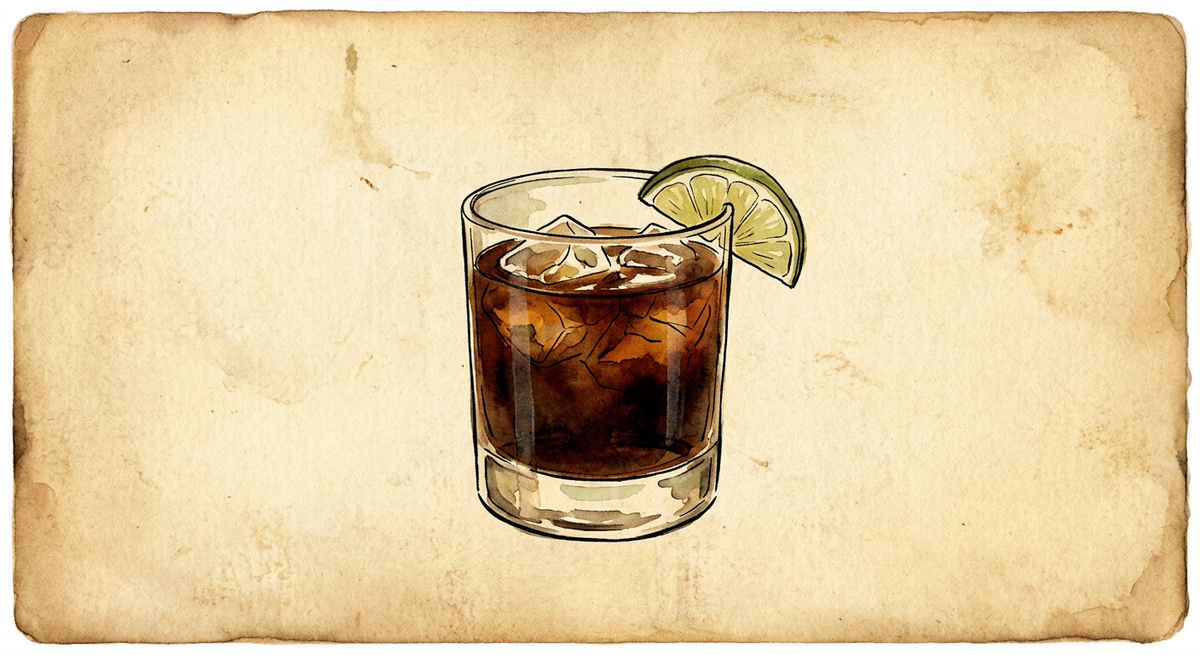
Corn n’ Oil
A Corn n’ Oil is 15ml of falernum over crushed ice in a rocks glass, with 60ml of blackstrap rum floated on top, two dashes of Angostura and a squeeze of lime, served unstirred. About 2.6 UK units. The Oxford Companion says almonds are sometimes added to falernum, so treat the drink as containing nuts. Difford’s Guide calls the Corn ’n’ Oil a traditional Barbadian planters’ drink, authentic with a Bajan rum and no oil-slick float. The blackstrap version, with near-black rum sitting on top of the falernum, is a later bar reading: bar-vademecum credits Murray Stenson of the Zig Zag Café in Seattle with the version made with Cruzan Black Strap. Ours is that blackstrap version. The rum is dark, heavy and slightly bitter; the falernum brings lime, clove and sugar; and the lime and bitters keep the two from turning sweet.
Glassware: Rocks Glass
Garnish: Lime wedge
Ingredients
60ml
A blackstrap rum at 40% ABV, near-black and bitter-sweet, heavy enough in flavour to stand over the falernum. For the Barbadian form, use an aged Barbados rum and stir the drink instead.
15ml
Velvet Falernum, 11% ABV on LWC’s UK listing, is the usual bottle: lime, cane syrup, almonds and cloves on that listing. A syrup falernum carries no alcohol and more sugar; use 10ml. Check the label for nuts.
2 dashes
Two dashes, at 44.7% ABV. Clove and bitter bark tie the rum to the falernum and stop the finish going sweet.
1 wedge, squeezed
One wedge, cut the same day, squeezed over the top and dropped in. It lifts the drink without making it a sour.
Instructions
Fill a rocks glass with crushed ice and pour in the falernum.
Float the blackstrap rum on top, pouring it slowly over the back of a bar spoon.
Add two dashes of Angostura.
Squeeze a lime wedge over the top, drop it in and serve unstirred.
Our version
The blackstrap bar version: 60ml of blackstrap rum floated over 15ml of falernum on crushed ice, with two dashes of Angostura and a squeeze of lime. Difford’s Guide says authentic Barbadian versions use a Bajan rum, and Imbibe reports that most historical recipes suggest a stirred drink.
Source: our own specification.
Expert Tip
Float the rum slowly over the back of a bar spoon held just over the falernum. Poured fast, it punches through and mixes the drink before it reaches the table. Taste your falernum first. Velvet Falernum, at 11% ABV on LWC’s UK listing, is the usual bottle; a non-alcoholic falernum syrup is sweeter, so cut it to 10ml. Serve it unstirred and let it mix as it is drunk. The first sips are mostly rum and the last mostly falernum, and crushed ice dilutes quickly, so it is a drink to finish while it is cold.
Behind the Corn n’ Oil
Flavour Profile
A Barbadian Pairing
The Oxford Companion, in an entry by Martin Cate, describes falernum as a traditional liqueur from Barbados, historically rum-, sugar- and lime-based, with Caribbean spices such as cloves, ginger and nutmeg and sometimes almonds, and lists the Corn ’n’ Oil as rum, falernum and bitters. Difford’s Guide calls rum and falernum a traditional Barbadian planters’ drink, made with a Bajan rum.
Its origin is obscure, bar-vademecum says, and Difford’s Guide reports the name as said to come from the Book of Deuteronomy, which promises corn, wine and oil; the story behind the name has not been pinned down.
The Blackstrap Version
Away from Barbados the drink took a different shape. bar-vademecum credits Murray Stenson, at the Zig Zag Café in Seattle, with a version made with Cruzan Black Strap from the Virgin Islands, which it calls the modern standard, and Difford’s Guide says the oil-slick float is not traditional in Barbados. Floated over the falernum, it is the version we make.
Blackstrap rum is made with blackstrap molasses, which bar-vademecum describes as low in sugar and rich in molasses flavour; we taste burnt sugar and a bitter edge. That bitterness is what the sugar in the falernum answers.
Why It Is Not Stirred
Falernum is sweet and dense; rum at our working figure of 40% ABV is lighter, so poured gently it sits on top. The drink then changes as it goes, from nearly neat rum at the first sip to sweet lime and clove at the bottom. The Barbadian stirred version gives the same flavours evenly, all at once.
Rum and Falernum, Rum and Bitterness
Our Corn n’ Oil beside the Barbadian form and our Jungle Bird; the Barbadian form follows Difford’s Guide and Imbibe, and the units are our calculation at our working figure of 40% for rum, Velvet Falernum at 11% on LWC’s listing and Campari at 25% on LWC’s listing
Rum
- Corn n’ Oil (ours)
- 60ml blackstrap, floated
- Barbadian style
- 60ml aged Barbados rum, stirred
- Jungle Bird
- 45ml blackstrap, shaken
Sweet
- Corn n’ Oil (ours)
- 15ml falernum
- Barbadian style
- 15ml falernum
- Jungle Bird
- 15ml demerara syrup, 45ml pineapple
Bitter and sour
- Corn n’ Oil (ours)
- Two dashes Angostura, a lime squeeze
- Barbadian style
- Two dashes Angostura, a lime slice
- Jungle Bird
- 22.5ml Campari, 15ml lime
UK units
- Corn n’ Oil (ours)
- About 2.6
- Barbadian style
- About 2.6
- Jungle Bird
- About 2.4
| Element | Corn n’ Oil (ours) | Barbadian style | Jungle Bird |
|---|---|---|---|
| Rum | 60ml blackstrap, floated | 60ml aged Barbados rum, stirred | 45ml blackstrap, shaken |
| Sweet | 15ml falernum | 15ml falernum | 15ml demerara syrup, 45ml pineapple |
| Bitter and sour | Two dashes Angostura, a lime squeeze | Two dashes Angostura, a lime slice | 22.5ml Campari, 15ml lime |
| UK units | About 2.6 | About 2.6 | About 2.4 |
How to Serve It
In a rocks glass over crushed ice, the rum floated last, with two dashes of Angostura and a lime wedge squeezed and dropped in. Hand it over unstirred.
For blackstrap rum with Campari and pineapple, a Jungle Bird; for rhum agricole with cane syrup, a Ti’ Punch.
Make it at home
The Spirit
Blackstrap RumBlackstrap rum is a near-black, heavy rum, generally 40% ABV and bitter-sweet with treacle, liquorice and burnt sugar. The name borrows from blackstrap molasses, which the Oxford Companion, a secondary source, describes as dark, rich, bitter and thick after several boilings, but Regulation (EC) 110/2008 gives the style no definition. Our Corn n’ Oil floats it over falernum, and our Jungle Bird stands it against Campari.
More to explore
Frequently Asked Questions
What is in a Corn n’ Oil?
Why is it called Corn n’ Oil?
Is blackstrap rum traditional?
What is falernum?
What if I cannot find blackstrap rum?
Should I stir a Corn n’ Oil?
How strong is a Corn n’ Oil?
Sources.
Checked between 18 October and 19 October 2026.
- Difford’s Guide, “Corn ’n’ Oil” (secondary source: a traditional Barbadian planters’ drink; name said to derive from Deuteronomy; the blackstrap float is not traditional in Barbados; authentic with a Bajan rum).
- bar-vademecum, “Corn ’n’ Oil” (secondary source: origin obscure, from Barbados; Murray Stenson’s Cruzan Black Strap version from the Zig Zag Café, Seattle, the modern standard; blackstrap molasses).
- Imbibe, “Corn ’n’ Oil” (secondary source: most historical recipes suggest a stirred drink).
- The Oxford Companion to Spirits and Cocktails (Martin Cate), “falernum” (secondary source: a traditional liqueur from Barbados; rum-, sugar- and lime-based with Caribbean spices such as cloves, ginger and nutmeg; almonds sometimes added; the traditional Corn ’n’ Oil is rum, falernum and bitters).
- LWC, “Taylors Velvet Falernum 70cl” (UK wholesaler listing: 11% ABV; lime, cane syrup, almonds and cloves).
You Might Also Like
Old Fashioned
The IBA’s Old Fashioned is 45ml of bourbon or rye whiskey, one sugar cube, a few dashes of Angostura bitters and a few dashes of water; we use bourbon and two dashes. The sugar and bitters are muddled in a rocks glass until the cube dissolves, then ice goes in, the bourbon goes over it and the drink is stirred for 15 to 20 seconds. Orange peel is expressed over the top. About 1.9 UK units. Only the sugar and bitters are muddled: no orange flesh, no cherry. The recipe predates the name. The Oxford Companion says that when a newspaper in Hudson, New York, defined the cocktail in 1806, it described “spirits of any kind, sugar, water, and bitters”. The name came later in the century: the Companion has people ordering Old-Fashioneds in Chicago in 1880, as bartenders added liqueurs to the format and drinkers who wanted it plain asked for one made the old-fashioned way.
Ti’ Punch
A Ti’ Punch is 60ml rhum agricole blanc and 10ml cane syrup over a small disc of lime, squeezed and dropped into a rocks glass, stirred briefly and served without ice. With a Martinique blanc at our working figure of 50% ABV it holds about 3.0 UK units, and the glass carries only about 70ml. The Oxford Companion says the name is Creole, from the French petit punch, and that the drink dates to at least the 1880s, when Lafcadio Hearn met it in Martinique; Imbibe calls it the national drink of Martinique. The saying that goes with it, chacun prépare sa propre mort, roughly each prepares his own death, refers to the custom of setting out the bottle, the syrup and the limes so every drinker builds their own. The lime disc is cut from the side of the fruit, mostly peel, and it perfumes the drink rather than souring it. That is the point most often missed.
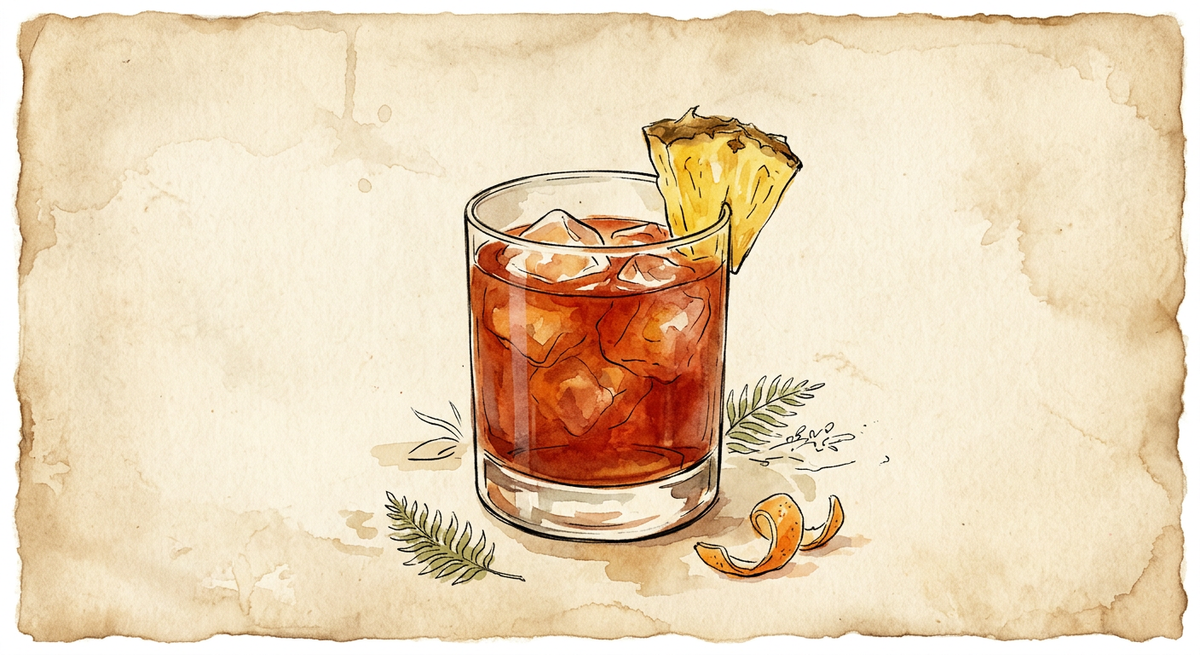
Jungle Bird
A Jungle Bird is 45ml of blackstrap rum, 22.5ml of Campari, 45ml of fresh pineapple juice, 15ml of fresh lime juice and 15ml of demerara syrup, shaken hard for 10 to 12 seconds and strained over fresh ice in a double rocks glass, with a pineapple wedge. About 2.4 UK units. These are the IBA’s measures. It is credited to Jeffrey Ong, beverage manager at the Aviary Bar of the Kuala Lumpur Hilton, where it was poured as a welcome drink for guests; Difford’s Guide dates it to the hotel’s opening on 6 July 1973. The recipe reached print in John J. Poister’s New American Bartender’s Guide in 1989. Campari is what sets it apart. Pineapple has the body and sugar to carry the bitterness, and a heavy rum underneath holds both.
Where this one sits
Recipe by Jerry Can Spirits · Updated 19 October 2026