French Connection
The spirit with amaretto in a French Connection is cognac. The drink is 35ml of each, poured over ice in a rocks glass and stirred, with no garnish. That is the International Bartenders Association specification, and the only change here is the ice: one large cube rather than a glass of small ones. Difford’s Guide, a secondary source, finds it with the Godfather, which pours Scotch where this pours cognac, and the Godmother in Brian F. Rea’s 1976 Brian’s Booze Guide, and says it is named after the 1971 film The French Connection. No inventor is recorded. Equal parts puts the almond beside the brandy rather than behind it. The cognac brings dried fruit and oak, the amaretto sweetness and a bitter edge, and one glass carries about 2.4 UK units. Choose an amaretto with some bitterness under the sugar; a confectionery one turns the drink to marzipan.
Glassware: Rocks Glass
Garnish: None: the drink is its own company
Ingredients
35ml
A VS or VSOP with plenty of fruit, usually 40% ABV. It is the backbone of the drink; a very old cognac loses its detail under the amaretto.
35ml
The Oxford Companion to Spirits and Cocktails says amaretto is generally made from apricot kernels, and brands differ, so check the label for nut or egg allergies. Disaronno is 28% ABV on Drinkfinder’s listing. Pick one with a bitter edge under the sweetness.
Instructions
Put one large cube of ice in a rocks glass.
Pour in the cognac and the amaretto.
Stir gently for 15 to 20 seconds.
Serve without a garnish.
Source: the IBA (Official IBA specification; method ours). Last checked 9 October 2026.
Expert Tip
Taste the amaretto on its own before you build. Traditional amaretto takes its flavour from apricot kernels and has a bitter finish under the sugar. Cheaper bottles taste of sweet almond essence and little else. The first kind leaves the drink dry at the end; the second makes it cloying, and the cognac cannot pull it back. Stir for 15 to 20 seconds over one large cube and stop. The big cube chills the drink while melting slowly, so it stays the same drink to the bottom of the glass. Built over small cubes, it is thin by the last third. If equal parts is too sweet for you, take the amaretto down to 25ml. That is a variation, not the specification, and it suits an older cognac with more oak to show.
Behind the French Connection
Flavour Profile
Cognac and Amaretto, Equal Parts
A French Connection is two bottles and a glass of ice. The cognac gives the drink its structure: grape, dried fruit and a little oak. The amaretto brings sweetness and an almond flavour with a bitter edge. At 35ml each, neither leads.
That balance is the reason for the equal pour. Shift it towards the cognac and you have a brandy with a sweetener in it. Shift it towards the amaretto and the drink turns to dessert.
Where It Comes From
No inventor or bar is on record. Difford’s Guide names the 1971 film as the source of the name, and finds the drink in Brian F. Rea’s 1976 Brian’s Booze Guide, alongside the Godfather and the Godmother, and in Stanley M. Jones’s 1977 Complete Barguide. Both are secondary accounts, so treat them as the usual account rather than a primary record.
What is settled is the recipe. The International Bartenders Association lists the French Connection among its official cocktails, at 35ml cognac and 35ml amaretto, poured over ice cubes in an old fashioned glass and stirred gently.
The IBA Specification and Ours
The French Connection against the IBA and the Godfather
French Connection (IBA)
- Spirit
- 35ml cognac
- Amaretto
- 35ml
- Ice and method
- Ice cubes, stirred gently
- UK units
- 2.4
French Connection (ours)
- Spirit
- 35ml cognac
- Amaretto
- 35ml
- Ice and method
- One large cube, stirred 15 to 20 seconds
- UK units
- 2.4
Godfather (ours)
- Spirit
- 45ml Scotch
- Amaretto
- 22.5ml
- Ice and method
- Over ice
- UK units
- 2.4
| Drink | Spirit | Amaretto | Ice and method | UK units |
|---|---|---|---|---|
| French Connection (IBA) | 35ml cognac | 35ml | Ice cubes, stirred gently | 2.4 |
| French Connection (ours) | 35ml cognac | 35ml | One large cube, stirred 15 to 20 seconds | 2.4 |
| Godfather (ours) | 45ml Scotch | 22.5ml | Over ice | 2.4 |
The measures are the IBA’s. The only change is the ice. Small cubes melt quickly into 70ml of liquid, and a drink this short has little room for water; one large cube chills it as well and dilutes it far more slowly.
The Amaretto Decides It
The Oxford Companion to Spirits and Cocktails says amaretto is generally made from apricot kernels macerated in brandy, though it is commonly thought of as almond-flavoured, which matters to anyone with a nut allergy and is not shown by the name.
Bottles differ more than cognacs do at this level. A good one has a dry, bitter-almond finish under the sugar, and that finish keeps the French Connection from tasting like liqueur poured over brandy. A sweet, essence-led amaretto has nothing behind its sugar, and at equal parts it takes over.
Against the Godfather
The Godfather is the same idea with Scotch. Ours pours it at two to one, 45ml to 22.5ml, because Scotch has the dryness to carry less sugar, and the two come out at the same strength. The French Connection is fruitier and softer; the Godfather is drier, and smoky if the blend has any peat in it.
How Strong It Is
With the cognac at our working figure of 40% ABV and the amaretto at 28%, as Drinkfinder lists Disaronno, a French Connection carries about 2.4 UK units in 70ml. It is short, sweet and easy to finish quickly, so it is worth pacing.
Make it at home
The Spirit
CognacCognac is a grape spirit distilled twice from white wine in copper pot stills in the Cognac area of western France and, under INAO’s specification, aged at least two years in oak and sold at no less than 40% ABV. The letters on the label are minimum ages, by the BNIC’s account: VS at least two years, VSOP four, XO ten. A VS or VSOP is what our cocktails assume.
More to explore
Frequently Asked Questions
What spirit goes with amaretto in a French Connection?
What is the IBA recipe for a French Connection?
How strong is a French Connection?
What is the difference between a French Connection and a Godfather?
Does a French Connection contain nuts?
Which cognac and amaretto should I use?
Should a French Connection have ice?
Sources.
Checked between 18 October and 19 October 2026.
- Difford’s Guide, “French Connection” (secondary source: named after the 1971 film; Brian F. Rea’s 1976 Brian’s Booze Guide; Stanley M. Jones 1977; the Godchild later largely replaced it).
- IBA, “French Connection” (IBA Contemporary Classics: 35 ml cognac, 35 ml amaretto, built in an old fashioned glass with ice cubes, stirred gently).
- Oxford Companion to Spirits and Cocktails (spiritsanddistilling.com), “almond liqueurs” (secondary source: amaretto generally made from apricot kernels macerated in brandy; Disaronno steeps herbs and fruits in crushed apricot kernel oil; Lazzaroni uses an infusion of Amaretti di Saronno biscuits).
- Drinkfinder, “Disaronno 50cl” (UK retail listing: 28% ABV).
You Might Also Like
Stinger
A Stinger is 50ml of cognac and 20ml of white crème de menthe, stirred with ice for 20 to 30 seconds and strained over crushed ice in a rocks glass, with a sprig of mint if you want one. About 2.5 UK units. The measures are the IBA’s, which strains it up into a chilled cocktail glass instead. The Oxford Companion says the Stinger first appears in 1890 as the Bartholdi Cocktail, brandy and crème de menthe shaken together, that the same mix surfaced for two decades under other names, among them the Judge, a mix of brandy, crème de menthe and gum that William Schmidt printed in 1892, and that it hit big as the Stinger in 1913. The Companion calls it the king of after-dinner cocktails and says it petered out in the 1980s. There is no citrus and no bitters, so the cognac does most of the talking. The peppermint cools the finish and takes the edge off the brandy’s heat. Use white crème de menthe: the green is the same liqueur with colouring, and it turns the glass the colour of mouthwash.
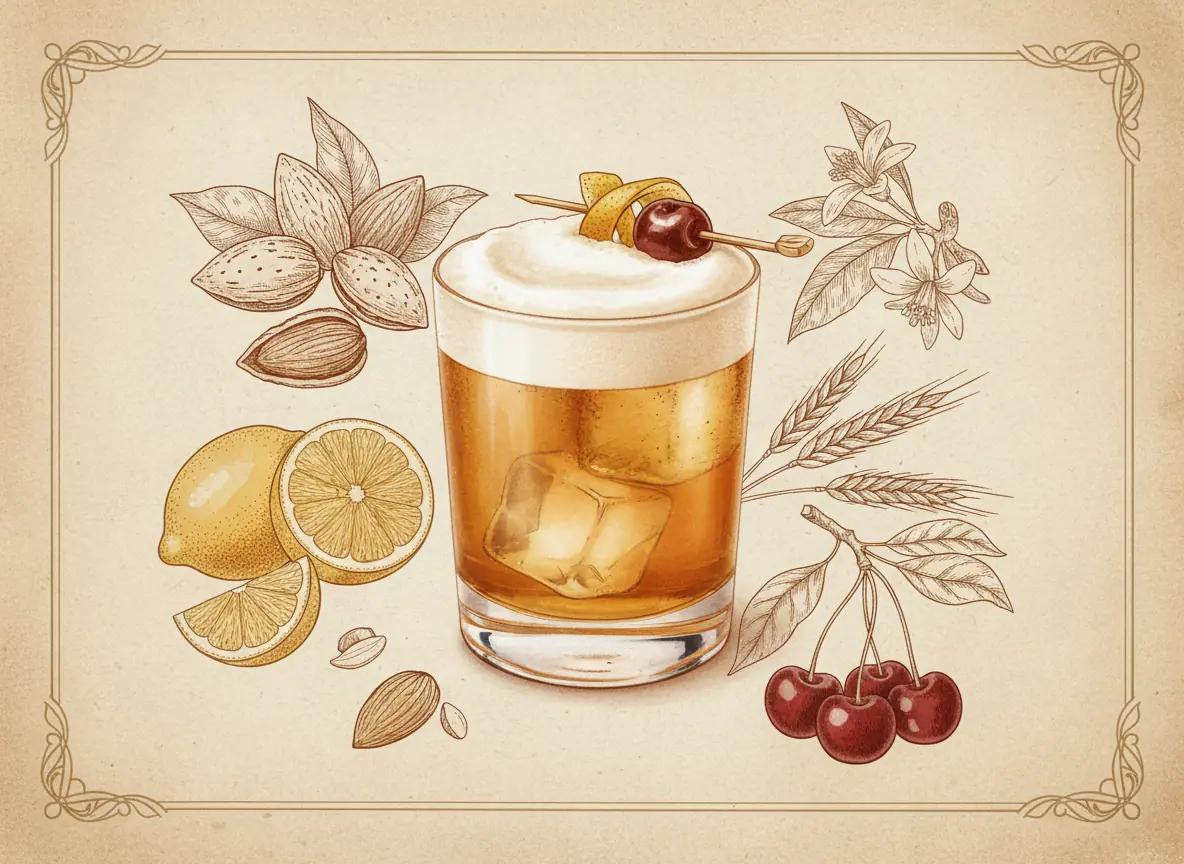
Amaretto Sour
An Amaretto Sour made the way Jeffrey Morgenthaler published it in 2012, as Difford’s Guide records his formula, is 45ml amaretto, 22.5ml cask-strength bourbon, 30ml fresh lemon juice, 5ml rich sugar syrup and an optional 15ml egg white. It is shaken without ice, then with it, and strained onto a single large ice cube in a rocks glass, then finished with a lemon peel and a cherry. The bourbon is why it works. Amaretto is sweet and, at Disaronno’s 28% ABV on Drinkfinder’s listing, too light to carry a sour alone; Morgenthaler’s point was that it needs help. A small measure of cask-strength bourbon adds strength, oak and spice while the almond stays in front. The Oxford Companion to Spirits and Cocktails says amaretto is generally made from apricot kernels, though it is commonly thought of as almond-flavoured; anyone with a nut allergy should read the label. The egg white is raw egg. A glass holds about 2.6 UK units, taking the cask-strength bourbon at our working figure of 60% ABV and the amaretto at 28%, as Drinkfinder lists Disaronno.
Rusty Nail
A Rusty Nail is 45ml Scotch whisky and 25ml Drambuie, stirred for 15 to 20 seconds over one large ice cube in a rocks glass and finished with a lemon twist, expressed and dropped in. About 2.8 UK units. The IBA gives the same measures, a little under two parts whisky to one of liqueur. Drambuie’s own site calls it a whisky liqueur, a blend of aged Scotch whisky, spices, herbs and heather honey, so the drink pairs a spirit with a sweeter version of itself. Difford’s Guide says David Wondrich has traced the pairing to 1937 and a drink called B.I.F., and the Oxford Companion to Spirits and Cocktails says the name Rusty Nail, first recorded in 1961, appears to have originated in New York City. The ratio is the whole recipe. In our view more Drambuie makes a honeyed after-dinner drink; more whisky makes it drier and leaves the honey as an accent.
Where this one sits
Recipe by Jerry Can Spirits · Updated 19 October 2026