Stinger
A Stinger is 50ml of cognac and 20ml of white crème de menthe, stirred with ice for 20 to 30 seconds and strained over crushed ice in a rocks glass, with a sprig of mint if you want one. About 2.5 UK units. The measures are the IBA’s, which strains it up into a chilled cocktail glass instead. The Oxford Companion says the Stinger first appears in 1890 as the Bartholdi Cocktail, brandy and crème de menthe shaken together, that the same mix surfaced for two decades under other names, among them the Judge, a mix of brandy, crème de menthe and gum that William Schmidt printed in 1892, and that it hit big as the Stinger in 1913. The Companion calls it the king of after-dinner cocktails and says it petered out in the 1980s. There is no citrus and no bitters, so the cognac does most of the talking. The peppermint cools the finish and takes the edge off the brandy’s heat. Use white crème de menthe: the green is the same liqueur with colouring, and it turns the glass the colour of mouthwash.
Glassware: Rocks Glass
Garnish: Mint sprig (optional)
Ingredients
50ml
A VS or VSOP at 40% ABV, with clear fruit. It is five sevenths of the drink and sets its character, so a harsh brandy shows straight through 20ml of mint.
20ml
Clear peppermint liqueur, at our working figure of 24% ABV. White rather than green, which is the same liqueur coloured. It sweetens the drink as well as cooling it, so measure it.
Instructions
Fill a rocks glass with crushed ice.
Add the cognac and white crème de menthe to a mixing glass.
Fill with cubed ice and stir for 20 to 30 seconds.
Strain over the crushed ice.
Add a mint sprig, if using.
Source: the IBA (Official IBA specification; strained over crushed ice in a rocks glass where the IBA serves it up; method ours). Last checked 9 October 2026.
Expert Tip
Buy white crème de menthe, never green. They taste alike, and the green is dyed; at 20ml against 50ml of cognac it turns the drink a pool-water colour that no amount of good brandy rescues. Hold the crème de menthe at 20ml. Older recipes ran as far as equal parts, which tastes of mint sweets. At the IBA’s two and a half to one, the mint sits behind the cognac and cools the finish. Stir for 20 to 30 seconds, then strain over fresh crushed ice, not the cubes you stirred with. Crushed ice melts fast, so serve it at once; the drink is at its best in the first ten minutes.
Behind the Stinger
Flavour Profile
Where It Comes From
The Oxford Companion says the Stinger first appears in 1890, when Herman, head bartender at New York’s Hotel Bartholdi, introduced the Bartholdi Cocktail of cognac and green crème de menthe shaken with ice and finished with lemon oil. Over the next two decades the mix surfaced under other names, among them the Judge, in William Schmidt’s The Flowing Bowl of 1892: a mixing glass three-quarters full of ice, three dashes of gum, a third of crème de menthe and two thirds of brandy, shaken and strained into a cocktail glass. The Companion calls the Stinger the king of after-dinner cocktails.
The Oxford Companion says the name Stinger arrived in 1913, most likely from a boxing term for a quick jab, and that the drink kept its cachet for the next fifty or sixty years, finally petering out in the 1980s.
A Society Drink
The Oxford Companion says the Stinger became the sort of thing drunk by clubmen and debutantes. The millionaire Reginald Vanderbilt always used to shake them up for his friends at the bar in his New York mansion, with a dash of absinthe, though it is quite unlikely that he invented the drink, as was claimed in the 1920s.
The Ratio
With two ingredients, the ratio is the recipe. Cognac brings fruit, oak and the strength; crème de menthe brings sugar and cold peppermint. The IBA’s 50ml to 20ml keeps the brandy in front and the mint as a cool finish.
Move towards equal parts and the drink turns sweet as the mint takes over. Move towards three to one and it becomes a cognac with a chill on it.
White, Never Green
The two crèmes de menthe are the same peppermint liqueur, and the green one is coloured. White is clear, so the Stinger arrives the pale gold of the cognac.
Green, at 20ml against 50ml of brandy, turns the glass a bright artificial green. It tastes the same and looks like a novelty.
The IBA and Ours
The IBA’s Stinger and ours
Cognac
- IBA
- 50ml
- Ours
- 50ml
White crème de menthe
- IBA
- 20ml
- Ours
- 20ml
Method
- IBA
- Stirred with ice
- Ours
- Stirred 20 to 30 seconds
Glass
- IBA
- Chilled cocktail glass, served up
- Ours
- Rocks glass over crushed ice
Garnish
- IBA
- Optional mint leaf
- Ours
- Optional mint sprig
UK units
- IBA
- About 2.5
- Ours
- About 2.5
| Element | IBA | Ours |
|---|---|---|
| Cognac | 50ml | 50ml |
| White crème de menthe | 20ml | 20ml |
| Method | Stirred with ice | Stirred 20 to 30 seconds |
| Glass | Chilled cocktail glass, served up | Rocks glass over crushed ice |
| Garnish | Optional mint leaf | Optional mint sprig |
| UK units | About 2.5 | About 2.5 |
How to Serve It
After dinner, over crushed ice in a rocks glass, in place of a dessert wine. Make it to order; crushed ice does not wait.
For cognac with amaretto, make a French Connection; for Scotch with Drambuie, a Rusty Nail; for cognac with orange liqueur and lemon, a Sidecar.
Make it at home
The Spirit
CognacCognac is a grape spirit distilled twice from white wine in copper pot stills in the Cognac area of western France and, under INAO’s specification, aged at least two years in oak and sold at no less than 40% ABV. The letters on the label are minimum ages, by the BNIC’s account: VS at least two years, VSOP four, XO ten. A VS or VSOP is what our cocktails assume.
Master the Techniques
More to explore
Frequently Asked Questions
What is in a Stinger?
Where does the Stinger come from?
Why must it be white crème de menthe?
Should a Stinger be shaken or stirred?
What is the right ratio?
Should it be served up or over ice?
How strong is a Stinger?
Sources.
Correct as of 19 October 2026.
- The Oxford Companion to Spirits and Cocktails (David Wondrich), “The Stinger” (secondary source: first appears 1890 as the Bartholdi Cocktail at New York’s Hotel Bartholdi; later the Judge, the Brant, the Ice Trust Cocktail; the Stinger from 1913; Vanderbilt’s claim unlikely; always shaken, often frappé; petered out in the 1980s).
- Internet Archive, “The Flowing Bowl: when and what to drink (William Schmidt, 1892)” (scanned reproduction of the 1892 book: “155. The Judge. A mixing-glass ¾ full of ice, 3 dashes of gum, ⅓ of crème de menthe, ⅔ of brandy. Shake to the freezing-point; strain, and serve in a cocktail glass.”).
You Might Also Like
French Connection
The spirit with amaretto in a French Connection is cognac. The drink is 35ml of each, poured over ice in a rocks glass and stirred, with no garnish. That is the International Bartenders Association specification, and the only change here is the ice: one large cube rather than a glass of small ones. Difford’s Guide, a secondary source, finds it with the Godfather, which pours Scotch where this pours cognac, and the Godmother in Brian F. Rea’s 1976 Brian’s Booze Guide, and says it is named after the 1971 film The French Connection. No inventor is recorded. Equal parts puts the almond beside the brandy rather than behind it. The cognac brings dried fruit and oak, the amaretto sweetness and a bitter edge, and one glass carries about 2.4 UK units. Choose an amaretto with some bitterness under the sugar; a confectionery one turns the drink to marzipan.
Rusty Nail
A Rusty Nail is 45ml Scotch whisky and 25ml Drambuie, stirred for 15 to 20 seconds over one large ice cube in a rocks glass and finished with a lemon twist, expressed and dropped in. About 2.8 UK units. The IBA gives the same measures, a little under two parts whisky to one of liqueur. Drambuie’s own site calls it a whisky liqueur, a blend of aged Scotch whisky, spices, herbs and heather honey, so the drink pairs a spirit with a sweeter version of itself. Difford’s Guide says David Wondrich has traced the pairing to 1937 and a drink called B.I.F., and the Oxford Companion to Spirits and Cocktails says the name Rusty Nail, first recorded in 1961, appears to have originated in New York City. The ratio is the whole recipe. In our view more Drambuie makes a honeyed after-dinner drink; more whisky makes it drier and leaves the honey as an accent.
Sidecar
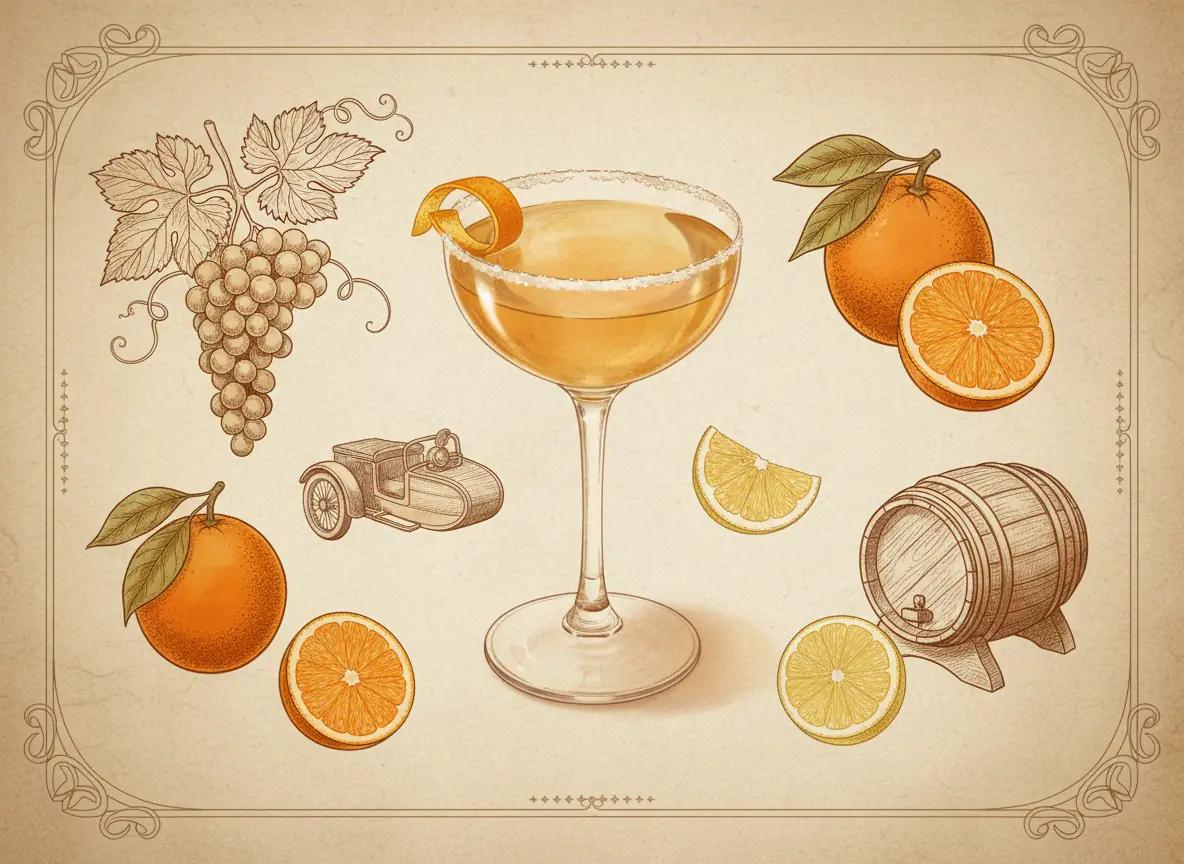
A Sidecar is a cognac sour: 50ml cognac, 20ml Cointreau or another triple sec and 20ml fresh lemon juice, shaken hard and double strained into a chilled coupe under an expressed strip of lemon peel. The IBA gives these measures, which put the cognac at two and a half parts to one each of orange and lemon. The Oxford Companion dates the first printed recipes to 1922, in Robert Vermeire’s Cocktails: How to Mix Them in May and Harry MacElhone’s Harry’s ABC of Mixing Cocktails at the end of the year, both at equal parts by Difford’s Guide. Both named Pat MacGarry of Buck’s Club in London; Difford’s says later editions of MacElhone’s book appear to take the credit for himself. The sugared rim came later: the earliest mention we have read is a 1932 American book, and the Oxford Companion says the drink has often been served with one since the 1930s. Ours has no rim. Each Sidecar carries about 2.8 UK units.
Where this one sits
Recipe by Jerry Can Spirits · Updated 19 October 2026