Gin Basil Smash
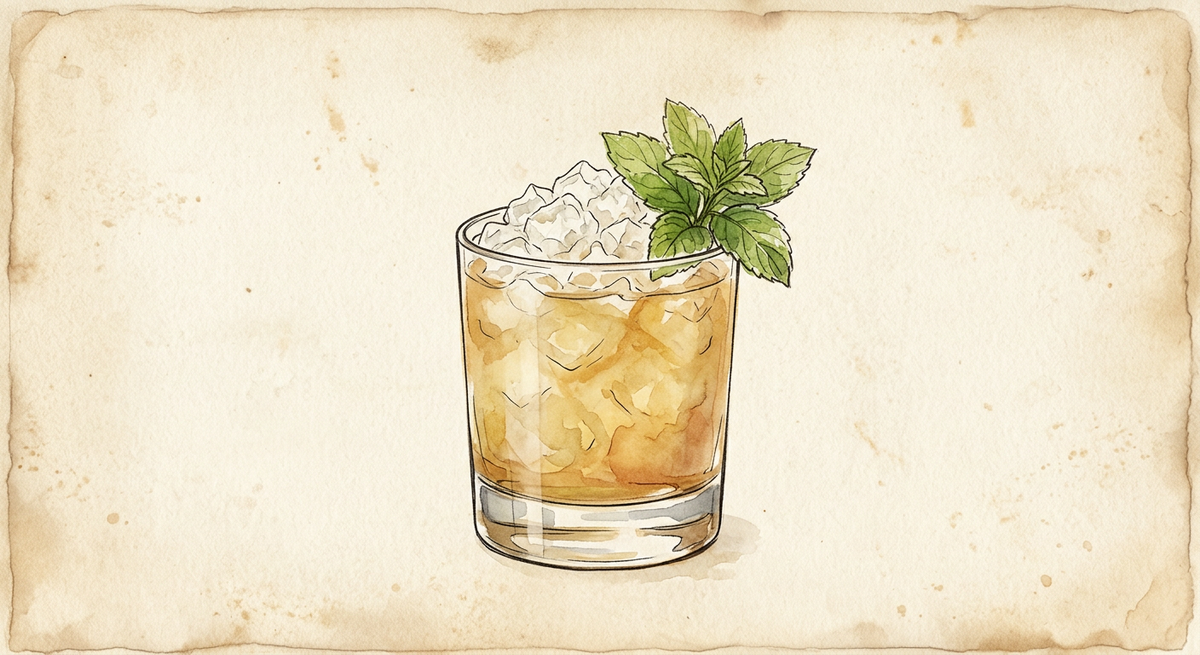
A Gin Basil Smash is 60ml London Dry gin, 22.5ml fresh lemon juice, 22.5ml simple syrup and ten basil leaves. The basil is muddled firmly into the lemon and syrup, the gin goes in, and the drink is shaken hard, double strained over fresh ice in a rocks glass and finished with a basil sprig. In short, a bright green gin sour, at about 2.4 UK units. Punch, a secondary source, says Jörg Meyer, owner of Le Lion in Hamburg, first sold it as the Gin Pesto in spring 2008, and that Meyer counts 10 July 2008 as its birthday: the date of his post on the Bitters Blog about the drink re-christened the Gin Basil Smash. The IBA lists it among its New Era cocktails, measure for measure. The muddle decides it. Basil gives up its pepper and anise only under real pressure, and a timid press leaves a pale sour with a leaf in it.
Glassware: Rocks Glass
Garnish: Basil sprig
Ingredients
60ml
A London Dry at 40% ABV or more. Its juniper sits beside the basil as one more green herb rather than competing with it.
22.5ml
Squeezed the same day. Its 22.5ml is matched to the syrup so neither leads, and its acid draws colour from the leaves during the muddle.
22.5ml
Sugar and water, 1:1 by weight. It goes in with the basil because the sugar gives the muddler something to grind the leaves against.
10 leaves
Ten fresh leaves of sweet Genovese basil, muddled firmly and strained out. Use leaves that smell of basil when rubbed; limp, pale ones give little.
Instructions
Squeeze the lemon juice the same day, ideally just before you build.
Put ten basil leaves in the base of a shaker with the lemon juice and simple syrup, and muddle firmly for about 20 seconds.
Add the gin, fill the shaker with cubed ice and shake hard for 10 to 12 seconds.
Fill a rocks glass with fresh cubed ice.
Double strain the drink over the ice.
Garnish with a basil sprig and serve at once.
Source: the IBA (Official IBA specification, muddled and strained over ice in a rocks glass as in Meyer’s original, where the IBA shakes it and serves it up; method ours). Last checked 9 October 2026.
Expert Tip
Muddle the basil into the lemon and syrup before the gin goes in. Ten leaves, pressed firmly for about 20 seconds: the sugar gives the leaves something to grind against, and the acid starts drawing out the colour. Press harder than you would for mint. Basil holds its oils deeper in the leaf and turns far less bitter when crushed, so too much pressure is rarely the problem. Double strain and serve at once. Leaf fragments look careless and turn bitter in the glass, and the green starts to dull within the hour.
Behind the Gin Basil Smash
Flavour Profile
The Origin
Punch says Jörg Meyer, owner of Le Lion in Hamburg, first sold the drink as the Gin Pesto in spring 2008, after tasting Dale DeGroff’s Whiskey Smash at Pegu Club in New York in 2007 and seeing a basil garnish in a G’Vine recipe booklet. Punch says Meyer counts 10 July 2008 as its birthday, the date of his post on the Bitters Blog about the drink re-christened the Gin Basil Smash.
Punch says it spread across Germany and Europe, and that 300 to 500 are sold at Le Lion every week. The IBA lists it in its New Era category at the same measures as ours.
Why Basil Works
Basil’s pepper and anise sit beside juniper rather than against it, so the gin reads as one more herb in the glass. Lemon and syrup at 22.5ml each give the leaf a level sour to sit in.
Gin Basil Smash: what each ingredient does
London Dry gin
- Measure
- 60ml
- Its job
- Strength, and juniper to meet the basil
Fresh lemon juice
- Measure
- 22.5ml
- Its job
- Acid, and it pulls colour from the leaves
Simple syrup
- Measure
- 22.5ml
- Its job
- Balance, and grit for the muddle
Basil
- Measure
- Ten leaves, muddled
- Its job
- Pepper, anise and the green
| Ingredient | Measure | Its job |
|---|---|---|
| London Dry gin | 60ml | Strength, and juniper to meet the basil |
| Fresh lemon juice | 22.5ml | Acid, and it pulls colour from the leaves |
| Simple syrup | 22.5ml | Balance, and grit for the muddle |
| Basil | Ten leaves, muddled | Pepper, anise and the green |
The Muddle
Mint holds its oils in glands on the surface of the leaf, which is why a slap releases them and a hard muddle tears the leaf and turns it bitter. Basil’s oils sit deeper in the tissue, so the leaf has to be crushed to reach them.
Ten leaves, firm pressure against the sugar and lemon, about 20 seconds of work. Press too lightly and you get a pale gin sour with a garnish.
The Colour
Chlorophyll fades on contact with air and acid, so the colour starts to dull from the moment the basil is crushed.
So it is made to order. Pre-muddled basil, or a jug mixed before guests arrive, comes out brown-green and flat by the time anyone gets a glass.
The Smash Lineage
A smash is, in the Oxford Companion’s account, an adaptation of the julep that Jerry Thomas called a “Julep on a small plan”: spirit, sugar and a bruised herb, served short over ice. For most of its life the herb was mint.
Meyer kept the format of Dale DeGroff’s Whiskey Smash, which Punch gives as bourbon, simple syrup, lemon juice and muddled mint, and changed the herb and the spirit. In our reading, herb smashes since have tended to follow his outline of one herb, one citrus and one spirit.
For mint, lemon and gin served up, the Southside is the older drink in the same territory.
How to Serve It
Over fresh ice in a rocks glass, still bright green, with a basil sprig. Serve it straight away.
At about 2.4 UK units it is a full-strength sour, however light the basil makes it taste.
Make it at home
The Spirit
GinGin is a spirit flavoured with juniper berries. Under the retained Regulation (EC) 110/2008, juniper must lead the taste, the floor is 37.5% ABV, and the route the flavour takes sets the grade: plain gin, distilled gin or London gin. Our recipes count it at 40%, and it carries the Martini, the Negroni and the Gin and Tonic.
More to explore
Frequently Asked Questions
Who invented the Gin Basil Smash?
What is in a Gin Basil Smash?
Why does it need a hard muddle?
Why has my smash gone dull?
How strong is a Gin Basil Smash?
Is it served up or over ice?
Can I use a different herb?
Sources.
Checked between 18 October and 19 October 2026.
- Punch, “How the Gin Basil Smash Became a Modern Classic” (secondary source (Robert Simonson, 28 June 2021): Meyer, Le Lion, Gin Pesto in spring 2008; 10 July 2008 post on the Bitters Blog; DeGroff’s Whiskey Smash at Pegu Club in 2007; 300 to 500 sold a week).
- IBA, “Gin Basil Smash” (official specification: 60ml gin, 22.5ml lemon juice, 22.5ml sugar syrup, ten Italian basil leaves; New Era).
- The Oxford Companion to Spirits and Cocktails (David Wondrich), “The smash” (secondary source: spirits, sugar, mint and ice, shaken together; the adaptation of the julep, “Julep on a small plan” (Jerry Thomas, 1862)).
You Might Also Like
Rum Smash
A Rum Smash is 60ml of spiced rum, three lemon wedges, 15ml of demerara syrup and eight mint leaves. The lemon is muddled hard with the syrup and the mint pressed gently after it; then the rum goes in and the lot is shaken hard with ice for 10 to 12 seconds and strained over crushed ice in a rocks glass, with a slapped mint sprig. About 2.4 UK units with Expedition Spiced Rum at 40% ABV. The smash is a julep cut down: Jerry Thomas’s 1862 guide, in the Internet Archive’s scan, calls it “simply a julep on a small plan”. Muddled lemon is the modern addition, and that lemon divides a smash from a julep now: the peel oils give it a bitter, aromatic edge that juice alone does not. Spiced rum suits the lemon version. Vanilla and baking spice sit under the peel oils and the mint, and the caramel of the demerara ties them together.
Southside
A Southside is 60ml of London Dry gin, 30ml of fresh lemon juice, 15ml of simple syrup and five or six mint leaves, shaken hard for 10 to 12 seconds and double strained into a chilled coupe, with a small mint sprig. About 2.4 UK units. Those are the IBA’s measures; 15ml of egg white is optional. The Oxford Companion, in an entry by Eric Felten, says the story that it was born in the speakeasies of Chicago’s South Side is incorrect: the drink evolved from the Mint Juleps made at Snedecor’s Tavern on Long Island, which became the Southside Sportsman’s Club, and it has long been the house drink at New York’s 21 Club. The drink does not depend on any of that. In the glass it is a gin sour scented with mint. Shaken and served up, with no soda or crushed ice, it is more concentrated than a Mojito, and the mint reads as aroma rather than as leaves in the drink.
Eastside
An Eastside is 60ml of gin, 25ml of fresh lime juice and 20ml of simple syrup, with three slices of cucumber and six mint leaves pressed gently in the shaker first. It is shaken hard for 10 to 12 seconds and double strained into a chilled coupe, with a cucumber ribbon to finish. About 2.4 UK units. It is a Southside with two changes: lime where the Southside takes lemon, and cucumber, which adds a green, watery coolness under the mint. Difford’s Guide says George Delgado created it in 2004 at Libation in New York, originally as a long drink, and VinePair notes a competing account that credits Chad Solomon. The care goes into the muddling. Press the cucumber enough to release its juice and the mint only enough to bruise it. Torn mint tastes bitter and grassy, and no amount of syrup covers it.
Where this one sits
Recipe by Jerry Can Spirits · Updated 19 October 2026