Virgin Colada
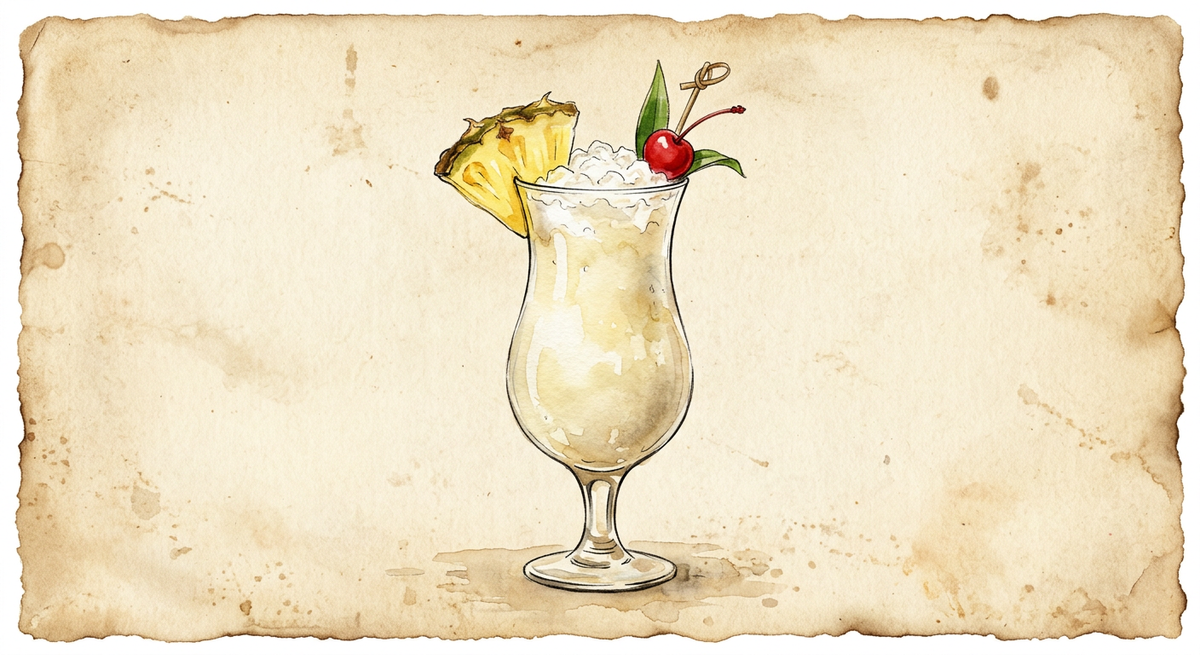
A Virgin Colada is 120ml of fresh pineapple juice, 45ml of cream of coconut and 15ml of fresh lime juice, blended with a cup of crushed ice for 10 to 15 seconds and poured into a hurricane glass, with a pineapple wedge and a cherry. It is alcohol-free. It is the Piña Colada without its 50ml of white rum. The Caribe Hilton’s own history page says its bartender Ramón “Monchito” Marrero created that drink in 1954 and that it became the official drink of Puerto Rico in 1978, though Difford’s Guide records rival claims. Taking the rum out removes dryness as well as alcohol. So the pineapple goes up to fill the glass and the lime moves from a few optional drops to 15ml, to stop the drink tasting only sweet. Cream of coconut, the sweetened kind sold in tins, still decides it.
Glassware: Hurricane Glass
Garnish: Pineapple wedge, Maraschino cherry and Cocktail umbrella permitted
Ingredients
120ml
Juice a ripe pineapple on the day, or blend in four peeled slices. This is most of the glass, so juice made from concentrate, with its cooked taste, shows.
45ml
The sweetened, thickened tinned kind made for drinks, which brings the sugar and the body together. Shake the tin hard first. Unsweetened coconut milk or cream will not thicken it.
15ml
Squeezed the same day. It does the job the rum’s dryness did, and without it the drink is only sweet.
Instructions
Shake the tin of cream of coconut, then add the pineapple juice, cream of coconut and lime juice to a blender.
Add a cup of crushed ice.
Blend for 10 to 15 seconds, until smooth but still thick.
Pour into a hurricane glass.
Garnish with a pineapple wedge and a cherry.
Our version
The IBA Piña Colada without its 50ml of white rum, rebalanced (the IBA’s measures are 50ml white rum, 30ml coconut cream and 50ml pineapple juice): pineapple juice up from 50ml to 120ml, cream of coconut up from 30ml to 45ml, and 15ml of fresh lime to replace the dryness the rum gave.
Source: our own specification. Last checked 10 October 2026.
Expert Tip
Use cream of coconut, not coconut milk. Cream of coconut is sweetened and thick, and the tin separates on the shelf, so shake it hard before opening or you pour off the thin liquid and leave the body behind. Blend for 10 to 15 seconds and stop. Past that the ice whips into foam, the drink loses its body and starts separating in the glass before it reaches the table. Taste before you pour. Cream of coconut varies in sweetness between brands; if the drink is cloying, add a little more lime rather than more ice.
Behind the Virgin Colada
Flavour Profile
From the Piña Colada
The Oxford Companion says the Piña Colada was first concocted in Puerto Rico in the mid-1950s or early 1960s. The Caribe Hilton’s own history page says its bartender Ramón “Monchito” Marrero created it in 1954. Difford’s Guide records that Marrero himself claimed 15 August 1952, that Ricardo Garcia, who also worked at the Caribe, says he invented it, and that Ramón Portas Mingot says he created it in 1963 at the Barrachina restaurant in Old San Juan.
The drink depends on sweetened cream of coconut. Difford’s Guide dates the development of Coco López, the original brand of cream of coconut, to 1948 and a Puerto Rican government development grant, while the Oxford Companion dates the introduction of Coco Lopez to 1949, under Puerto Rico’s postwar Bootstraps Program. Leave out the rum and every other part is still there, which is why the alcohol-free version holds together better than most.
What the Rum Did
Pineapple and cream of coconut carry the flavour and the body. The rum’s job was dryness: a measure of white rum cuts a very sweet, very rich glass and stops it cloying.
Take it out and that job needs filling. Lime does it here, at 15ml instead of a few drops, and extra pineapple makes up the volume. Nothing else changes.
Cream of Coconut
This is where the drink is usually lost, at the shop. Cream of coconut is a sweetened, thickened product sold in tins for drinks like this one. Coconut milk and the coconut cream sold for cooking are both unsweetened.
The tin separates as it stands, with the solids setting at the top. Shake it hard before opening and stir what comes out, or the drink gets the thin liquid and none of the body.
The Blend
Ten to 15 seconds is enough. Use crushed or small ice so the blender is not fighting large cubes, and stop as soon as the texture is even. Thick enough to hold a straw upright is about right.
The Piña Colada and the Virgin Colada
The Piña Colada and the Virgin Colada side by side
White rum
- Piña Colada
- 50ml
- Virgin Colada
- None
Fresh pineapple juice
- Piña Colada
- 50ml
- Virgin Colada
- 120ml
Cream of coconut
- Piña Colada
- 30ml
- Virgin Colada
- 45ml
Fresh lime juice
- Piña Colada
- A few drops, optional
- Virgin Colada
- 15ml
Method
- Piña Colada
- Blended 10 to 15 seconds with crushed ice
- Virgin Colada
- Blended 10 to 15 seconds with crushed ice
Alcohol
- Piña Colada
- Contains alcohol
- Virgin Colada
- None
| Element | Piña Colada | Virgin Colada |
|---|---|---|
| White rum | 50ml | None |
| Fresh pineapple juice | 50ml | 120ml |
| Cream of coconut | 30ml | 45ml |
| Fresh lime juice | A few drops, optional | 15ml |
| Method | Blended 10 to 15 seconds with crushed ice | Blended 10 to 15 seconds with crushed ice |
| Alcohol | Contains alcohol | None |
How to Serve It
In a hurricane glass with a pineapple wedge, a cherry and a straw, given the same treatment as every other drink on the tray. The person not drinking notices when theirs comes in the same glass.
For the original with white rum, make a Piña Colada; for another alcohol-free long drink, a Virgin Mojito.
Make it at home
Master the Techniques
More to explore
Frequently Asked Questions
Is a Virgin Colada alcohol-free?
What is in a Virgin Colada?
What replaces the rum?
Cream of coconut or coconut milk?
Is coconut a nut allergen?
Can I make it without a blender?
Why does my Virgin Colada separate?
Sources.
Correct as of 19 October 2026.
- Hilton (Caribe Hilton, own history page), “The Birthplace of the Piña Colada” (the hotel’s own account: bartender Ramón “Monchito” Marrero, 1954; the official drink of Puerto Rico in 1978).
- IBA, “Pina Colada” (official specification: 50ml white rum, 30ml coconut cream, 50ml fresh pineapple juice, blended with ice; note: historically a few drops of lime juice).
- legislation.gov.uk, “Regulation (EU) No 1169/2011, Annex II (retained)” (the 14 allergens: the nuts listed are almonds, hazelnuts, walnuts, cashews, pecans, Brazil nuts, pistachios and macadamias).
- Difford’s Guide, “Coco Lopez Cream of Coconut” (secondary source: “developed in 1948 in Puerto Rico … after receiving a development grant from the Puerto Rican government”).
- The Oxford Companion to Spirits and Cocktails (Wayne Curtis), “Piña Colada” (secondary source: first concocted in Puerto Rico in the mid-1950s or early 1960s; Coco Lopez introduced in 1949 under the Bootstraps Program; the Caribe Hilton and Barrachina claims; the national drink of Puerto Rico in 1978).
- Difford’s Guide, “Piña Colada history” (secondary source: three Puerto Rican bartenders contest the drink: Marrero (Caribe Hilton), Ricardo Garcia and Ramón Portas Mingot (Barrachina, 1963)).
You Might Also Like
Piña Colada
A Piña Colada is white rum, pineapple and cream of coconut blended with ice: 50ml white rum, 50ml fresh pineapple juice and 30ml cream of coconut, blended for 10 to 15 seconds with a cup of crushed ice and poured into a hurricane glass, with a pineapple wedge and a cherry. The measures are the IBA’s own. A few drops of lime are optional, to correct a sweet batch. The Caribe Hilton in San Juan credits its bartender Ramón “Monchito” Marrero with the drink in 1954, as Difford’s Guide reports; Difford’s adds that Marrero himself claimed 15 August 1952. It depends on Coco López, the sweetened cream of coconut Ramón López Irizarry developed in 1949, by Imbibe’s account. There are rivals: Ricardo García, also at the Caribe Hilton, claims to have invented it, with 1954 the year Punch gives, and the Barrachina restaurant, by its own account, names Ramón Portas Mingot in 1963. Punch says the Piña Colada was declared Puerto Rico’s national drink in 1978. Cream of coconut is the ingredient that decides it: thick, sweet and rich in fat, never coconut milk. Each one carries about 2.0 UK units.
Virgin Mojito
A Virgin Mojito is ten mint leaves pressed gently with 25ml fresh lime juice and 20ml simple syrup in a highball, packed with crushed ice and topped with 120ml of soda water, then finished with a slapped mint sprig and a lime wheel. It contains no alcohol, so there are no units to count. It is the Mojito with the rum left out and the build kept whole. The Mojito’s flavour sits in mint, lime, sugar and soda, so taking out the rum costs it warmth and a little body rather than its character. Against the Mojito, syrup replaces the two teaspoons of sugar, because it mixes into cold lime at once, and the lime rises from 20ml to 25ml to keep the longer soda pour sharp.
Shirley Temple
A Shirley Temple is an alcohol-free drink of ginger ale and grenadine: 150ml ginger ale in an ice-filled highball, with 15ml grenadine poured in last so it sinks, and a maraschino cherry on top. A squeeze of lime is optional and makes it less sweet. There is no alcohol in it. Tasting Table, a secondary source, lists the Brown Derby, Chasen’s and the Royal Hawaiian Hotel among the places that claim it. NPR quotes Temple placing its creation in the 1930s at the Brown Derby in Hollywood, and Tasting Table has her telling NPR in the mid-1980s that she thought such drinks saccharine and icky. Tasting Table dates her legal action against a bottled soda using her name to 1988. Her complaint is fair, and fixable. A ginger ale with some bite and a grenadine made from pomegranate turn it from a glass of sugar into a drink with ginger heat and tart fruit.
Where this one sits
Recipe by Jerry Can Spirits · Updated 19 October 2026