Vodka Gimlet
A Vodka Gimlet is 60ml vodka and 22.5ml lime cordial, stirred over ice for 20 to 30 seconds and strained into a chilled coupe, then finished with a lime wheel. This is the Gimlet with vodka in place of gin, at the same measures, and comes to about 2.4 UK units. With no juniper, the cordial leads. The drink tastes of preserved lime: rounder than fresh juice, sweet at the edges and faintly bitter from the peel. Both bottles have to be good, because the glass holds nothing else. The Oxford Companion puts the name in print in 1922, with gin, and says vodka eventually supplanted gin in many late-twentieth-century Gimlets. For a sharper drink, shake the vodka with fresh lime and syrup instead.
Variations
Glassware: Coupe Glass
Garnish: Lime wheel
Ingredients
60ml
At 40% ABV, with some texture: wheat for softness, rye for edge, potato for weight. A characterless bottle shows, because it is nearly all of the drink.
22.5ml
Lime juice preserved with sugar, rather than fresh juice. Home-made, with the zest left in to steep, it keeps the peel oils a long-opened commercial bottle has lost.
Instructions
Chill a coupe in the freezer or with ice water.
Add the vodka and lime cordial to a mixing glass.
Fill the mixing glass with cubed ice and stir for 20 to 30 seconds.
Discard the ice from the coupe and strain the drink into it.
Garnish with a lime wheel and serve.
Expert Tip
Use a good cordial, or make one. With two ingredients, a tired commercial cordial tastes mostly of sugar here; one made from lime juice, sugar and zest keeps the peel oils. Stir for 20 to 30 seconds on plenty of cubed ice and strain into a frozen coupe. With no juice to aerate, stirring keeps it clear, and the cold does most of the work. Choose a vodka with some texture. Wheat is soft, rye sharper, potato heavier; a vodka filtered to nothing leaves the cordial alone.
Behind the Vodka Gimlet
Flavour Profile
The Origin
The Oxford Companion puts the name in print in 1922, in Harry’s ABC of Cocktails, with equal parts Rose’s lime juice and Plymouth gin, and says vodka eventually supplanted gin in many late-twentieth-century Gimlets. Difford’s Guide gives a theory tying the name to the Royal Navy surgeon Sir Thomas Gimlette, which it says his obituary in The Times does not support, and a rival one: a gimlet was a small tool for tapping the barrels of spirits on navy ships.
Cold vodka and lime cordial make a plain, clean drink that needs no explaining.
What Losing the Juniper Does
A gin Gimlet sets juniper, coriander and citrus peel against preserved lime. Take the gin out and the cordial has the glass to itself.
What you taste then is preserved lime: rounder than fresh juice, faintly cooked, sweet at the edges and bitter underneath from the zest oils. It is smoother and plainer than the gin version, not a lesser one.
Vodka Gimlet, Gimlet and the fresh-lime version compared
Vodka Gimlet
- Spec
- 60ml vodka, 22.5ml lime cordial
- Method
- Stirred, served up
- Strength
- About 2.4 UK units
Gimlet
- Spec
- 60ml gin, 22.5ml lime cordial
- Method
- Stirred, served up
- Strength
- About 2.4 UK units
Fresh-lime Vodka Gimlet
- Spec
- 60ml vodka, 22.5ml fresh lime, 15ml syrup
- Method
- Shaken, double strained
- Strength
- About 2.4 UK units
| Drink | Spec | Method | Strength |
|---|---|---|---|
| Vodka Gimlet | 60ml vodka, 22.5ml lime cordial | Stirred, served up | About 2.4 UK units |
| Gimlet | 60ml gin, 22.5ml lime cordial | Stirred, served up | About 2.4 UK units |
| Fresh-lime Vodka Gimlet | 60ml vodka, 22.5ml fresh lime, 15ml syrup | Shaken, double strained | About 2.4 UK units |
The Vodka
Vodkas differ more in texture than in flavour, and texture is what shows here. Wheat brings a soft, faintly sweet body; rye is sharper and drier; potato carries a creamy weight that suits the cordial. A bottle filtered to disappear leaves the cordial on its own.
The Cordial
Lime cordial is lime juice preserved with sugar, and the commercial standard was made to keep rather than to impress. It works, but it sets a low ceiling, and in a two-ingredient drink the cordial makes the biggest difference.
Home-made from lime juice, sugar and zest, warmed only enough to dissolve the sugar, it keeps the peel oils that an old bottle in the fridge door has lost.
For juniper in the same frame, the gin Gimlet takes the same 60ml and 22.5ml.
How to Serve It
Stirred and strained into a frozen coupe, with a lime wheel. With two ingredients, temperature is close to a third, and a lukewarm one has no cover.
Make it at home
The Spirit
VodkaVodka is spirit made from a farmed crop, usually grain or potatoes, distilled and refined so that the taste of that crop is deliberately reduced. Under the retained Regulation (EC) 110/2008 its minimum is 37.5% ABV and it may not be given a predominant flavour, which separates it from flavoured vodka and from gin; our recipes count it at 40%. In a mixed drink it adds strength and body while the other ingredients carry the taste.
More to explore
Frequently Asked Questions
What is the difference between a Vodka Gimlet and a Gimlet?
Which came first, the gin or the vodka Gimlet?
Which vodka works best?
Can I make it with fresh lime instead?
Why stir rather than shake?
How strong is a Vodka Gimlet?
Sources.
Correct as of 19 October 2026.
- The Oxford Companion to Spirits and Cocktails (Wondrich et al.), “A Gimlet” (secondary source: gin and preserved lime juice; the Merchant Shipping Act 1867 and Lauchlan Rose’s patent; the name and Rose’s in print in 1922 in Harry’s ABC of Cocktails; vodka supplanted gin in many late-twentieth-century Gimlets).
- Difford’s Guide, “Gimlet (Difford’s Recipe)” (secondary source: Rose’s Lime Cordial and the Navy; Harry MacElhone 1923 ABC (Gimlet, half Plymouth gin, half Rose’s, a very popular beverage in the Navy); the gimlet tool; the Gimlette story not substantiated in his Times obituary).
You Might Also Like
Gimlet
A Gimlet is 60ml of gin and 22.5ml of lime cordial, stirred with ice for 20 to 30 seconds and strained into a chilled coupe, with a lime wheel. About 2.4 UK units. Gin and cordial only, with no fresh juice: the preserved lime is what makes it a Gimlet. The usual story ties it to the Royal Navy. The Oxford Companion says the Merchant Shipping Act of 1867 required British merchant ships to carry lime juice against scurvy, and that Lauchlan Rose patented an alcohol-free way of preserving lime juice the same year. Harry’s ABC of Cocktails calls a Gimlet of equal parts Plymouth gin and Rose’s lime cordial “a very popular beverage in the Navy”, and Cigar Aficionado quotes Raymond Chandler’s The Long Goodbye of 1953: a real gimlet is half gin and half Rose’s lime juice and nothing else. Ours is drier, a little under three to one. Cordial tastes rounder than fresh lime, with a cooked, marmalade edge, and the stir keeps the drink clear and silky.
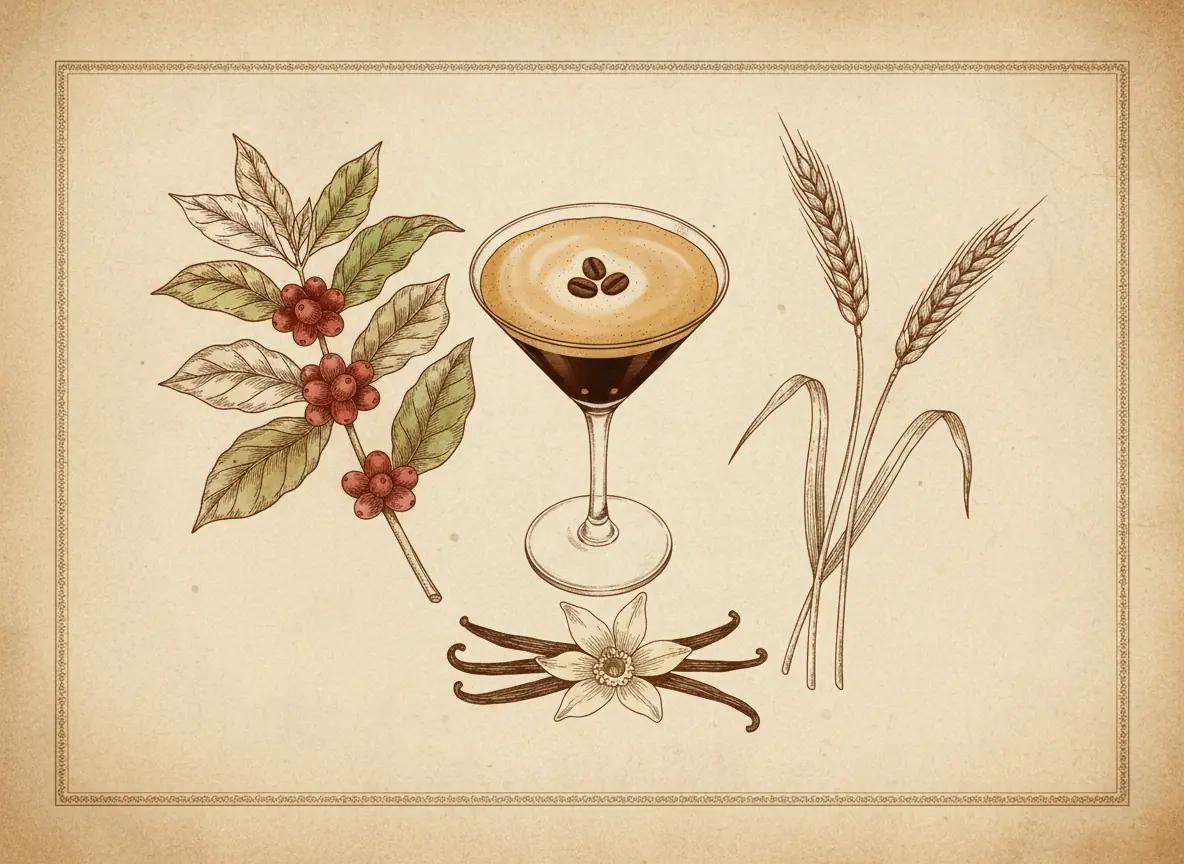
Espresso Martini
An Espresso Martini is 50ml of vodka, 30ml of Kahlúa, 10ml of sugar syrup and one freshly pulled espresso of about 30ml, shaken hard for 10 to 12 seconds and double strained into a chilled martini glass, with three coffee beans laid on the foam. About 2.5 UK units, and the caffeine of a single shot. The Oxford Companion says Dick Bradsell created it at the Soho Brasserie in London in 1983, for a famous model who asked for a drink to wake her up and then mess her up; he never said who she was. The measures are the IBA’s. Vodka gives strength and cold without flavour, so the coffee leads. The foam comes from the crema of a shot pulled moments before the shake, which is why the espresso goes in last.
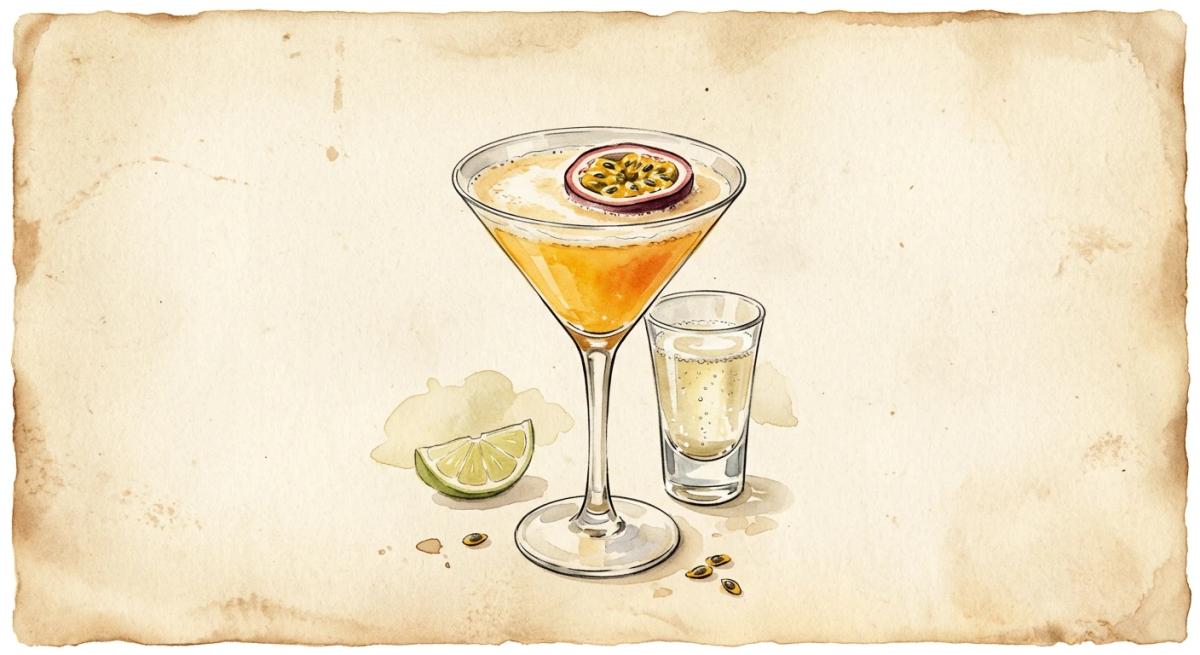
Pornstar Martini
A Pornstar Martini is 50ml vanilla vodka, 20ml passion fruit liqueur, 50ml passion fruit purée and 10ml vanilla syrup, shaken, double strained and served in a chilled martini glass with half a passion fruit floating on top. A 50ml shot of chilled Champagne is served alongside. About 2.2 UK units in the glass and 2.8 with the Champagne. Douglas Ankrah created it in 2002 at Townhouse, his bar in Knightsbridge, by Difford’s Guide’s account, which says he first called it the Maverick Martini after a Cape Town nightclub; his 2004 book, as Difford’s quotes it, headed the recipe Maverick Martini or Porn Star Martini. In November 2018 the Morning Advertiser reported CGA figures that put it first among UK cocktails by share of serves in managed outlets. Passion fruit does the work. The purée gives sharpness and body, the liqueur sweetness and perfume, and the vanilla rounds both. The Champagne is a separate drink, sipped alongside or after.
Where this one sits
Recipe by Jerry Can Spirits · Updated 19 October 2026