White Russian
A White Russian is 50ml vodka and 25ml coffee liqueur stirred over one large cube in a rocks glass for 15 to 20 seconds, then 30ml of fresh single cream poured gently onto the surface from a spoon. Nothing else garnishes it: the cream marbling down through the dark liquid is the finish. About 2.5 UK units. It is the Black Russian with cream. The IBA lists it only as a note to that drink, which is 50ml vodka and 20ml coffee liqueur: float fresh cream on top and stir it in slowly. Our extra 5ml of liqueur holds the coffee against the cream. The Oxford Companion dates its final form and name to 1965, when Southern Comfort used it to promote its short-lived Coffee Southern. The Oxford Companion says that in the Coen Brothers’ cult film The Big Lebowski the White Russian is the Dude’s main source of sustenance, and that it has become something of a cult drink.
Glassware: Rocks Glass
Garnish: None
Ingredients
50ml
A clean vodka at 40% ABV. It adds strength and leaves the flavour to the coffee and the cream.
25ml
Pernod Ricard’s page gives Kahlúa Original at 16% ABV and Difford’s Guide’s page gives Tia Maria at 20%. The 25ml here, 5ml over the IBA’s Black Russian, keeps the coffee audible under the cream. Coffee goes into it, so it carries a trace of caffeine.
30ml
Fresh single cream, floated over the back of a spoon. It is dairy; oat cream is the dairy-free swap and floats well.
Instructions
Place one large ice cube in a rocks glass.
Add the vodka and coffee liqueur and stir for 15 to 20 seconds.
Pour the cream slowly over the back of a bar spoon so it floats on top.
Serve without a garnish, with a stirrer if you like.
Expert Tip
Float the cream; do not mix it in. Stir the vodka and coffee liqueur over the ice first, then pour the cream slowly over the back of a bar spoon so it settles on top. The drink starts dark and turns pale as it is stirred or sipped, and the person drinking it decides when. Single cream floats and marbles most easily. Double cream sits thicker and blends reluctantly; whip it very lightly first if it will not settle. Oat cream works for anyone avoiding dairy. Keep the cream cold and use it fresh. Cream on the turn sours against the coffee liqueur and can curdle in the glass.
Behind the White Russian
Flavour Profile
The Origin
The Oxford Companion traces the White Russian to the vodka drinks of the 1930s, with the Russian Bear the likeliest progenitor, and says it took its final form and name in 1965, when Southern Comfort used it to promote Coffee Southern, a short-lived coffee liqueur, to contrast with the then-popular Black Russian. Difford’s Guide dates the Black Russian to 1949.
Difford’s Guide dates the Black Russian to 1949 and the Oxford Companion dates the White Russian’s name to 1965. In our view the White Russian had become a period piece by the end of the century, until The Big Lebowski brought it back.
The Ratio
Our build is 50ml vodka, 25ml coffee liqueur and 30ml cream. The IBA keeps the Black Russian at 50ml and 20ml and simply floats cream on it for a White Russian; the extra 5ml of liqueur here holds the coffee against the cream.
More liqueur pushes it towards dessert. More cream mutes the coffee. More vodka gives a drier, sharper glass.
The Float
Stir the spirits over the ice first, then pour the cream slowly over the back of a spoon so it settles as a pale layer. The drink marbles downward as it is sipped or stirred.
Single cream floats best and marbles most readily. Double cream sits higher and merges slowly. Oat cream floats well too.
The Lebowski Effect
In the Coen Brothers’ The Big Lebowski, the Oxford Companion says, the White Russian is the Dude’s main source of sustenance, and the film has made it something of a cult drink. In our view a dated, creamy drink became a cult order.
Plenty of drinks are ordered once for a film reference. This one kept being ordered, because it is easy to like: sweet, cold, tasting of coffee and with little bite.
The Coffee-Vodka Family
The White Russian beside its relatives
Black Russian
- Vodka
- 50ml
- Coffee
- 20ml coffee liqueur
- Other
- None
- Method
- Stirred over ice
White Russian
- Vodka
- 50ml
- Coffee
- 25ml coffee liqueur
- Other
- 30ml cream
- Method
- Built, cream floated on top
Espresso Martini
- Vodka
- 50ml
- Coffee
- 30ml coffee liqueur and a fresh espresso
- Other
- 10ml syrup
- Method
- Shaken hard, served up
| Drink | Vodka | Coffee | Other | Method |
|---|---|---|---|---|
| Black Russian | 50ml | 20ml coffee liqueur | None | Stirred over ice |
| White Russian | 50ml | 25ml coffee liqueur | 30ml cream | Built, cream floated on top |
| Espresso Martini | 50ml | 30ml coffee liqueur and a fresh espresso | 10ml syrup | Shaken hard, served up |
Without the cream it is the Black Russian, stirred and served dark. Add fresh espresso and a hard shake, and vodka and coffee become an Espresso Martini.
How to Serve It
After dinner, over one large cube in a rocks glass, with a stirrer or a short straw. Let the drinker decide when the dark turns pale.
The large cube matters: smaller ice melts quickly and waters a cream drink down.
Make it at home
The Spirit
VodkaVodka is spirit made from a farmed crop, usually grain or potatoes, distilled and refined so that the taste of that crop is deliberately reduced. Under the retained Regulation (EC) 110/2008 its minimum is 37.5% ABV and it may not be given a predominant flavour, which separates it from flavoured vodka and from gin; our recipes count it at 40%. In a mixed drink it adds strength and body while the other ingredients carry the taste.
More to explore
Frequently Asked Questions
What is the difference between a White and a Black Russian?
How strong is a White Russian?
What cream should I use?
Stirred or layered?
When was the White Russian invented?
Why is it linked with The Big Lebowski?
Is a White Russian dairy-free or caffeine-free?
Sources.
Correct as of 19 October 2026.
- The Oxford Companion to Spirits and Cocktails (Rosie Schaap), “The White Russian” (secondary source: origins in the 1930s vodka drinks (the Savoy’s Barbara, Meier’s Russian, Gaige’s Russian Bear); final form and name in 1965 when Southern Comfort promoted Coffee Southern; a cult drink through The Big Lebowski).
- Difford’s Guide, “Black Russian” (secondary source: created in 1949 by Gustave Tops at the Metropolitan Hotel in Brussels, for Perle Mesta).
- Pernod Ricard, “Kahlúa” (owner’s brand page: Kahlúa Original, 16% ABV).
- Difford’s Guide, “Tia Maria Cold Brew Coffee Liqueur” (secondary source: alc./vol: 20%).
You Might Also Like
Black Russian
A Black Russian takes 50ml of vodka and 20ml of coffee liqueur, stirred in a rocks glass over a single large cube for 15 to 20 seconds and served without a garnish. The measures are the IBA’s. About 2.4 UK units. Difford’s Guide says Gustave Tops, a bartender at the Metropolitan Hotel in Brussels, created it in 1949 for Perle Mesta, then United States ambassador to Luxembourg. Barry Popik finds no contemporary documentation for that story and traces the drink in print to 1956. Its name joins the vodka to the dark colour of the coffee liqueur. At five parts vodka to two of liqueur, the coffee seasons the drink rather than sweetening it. Float cream on top and it becomes a White Russian.
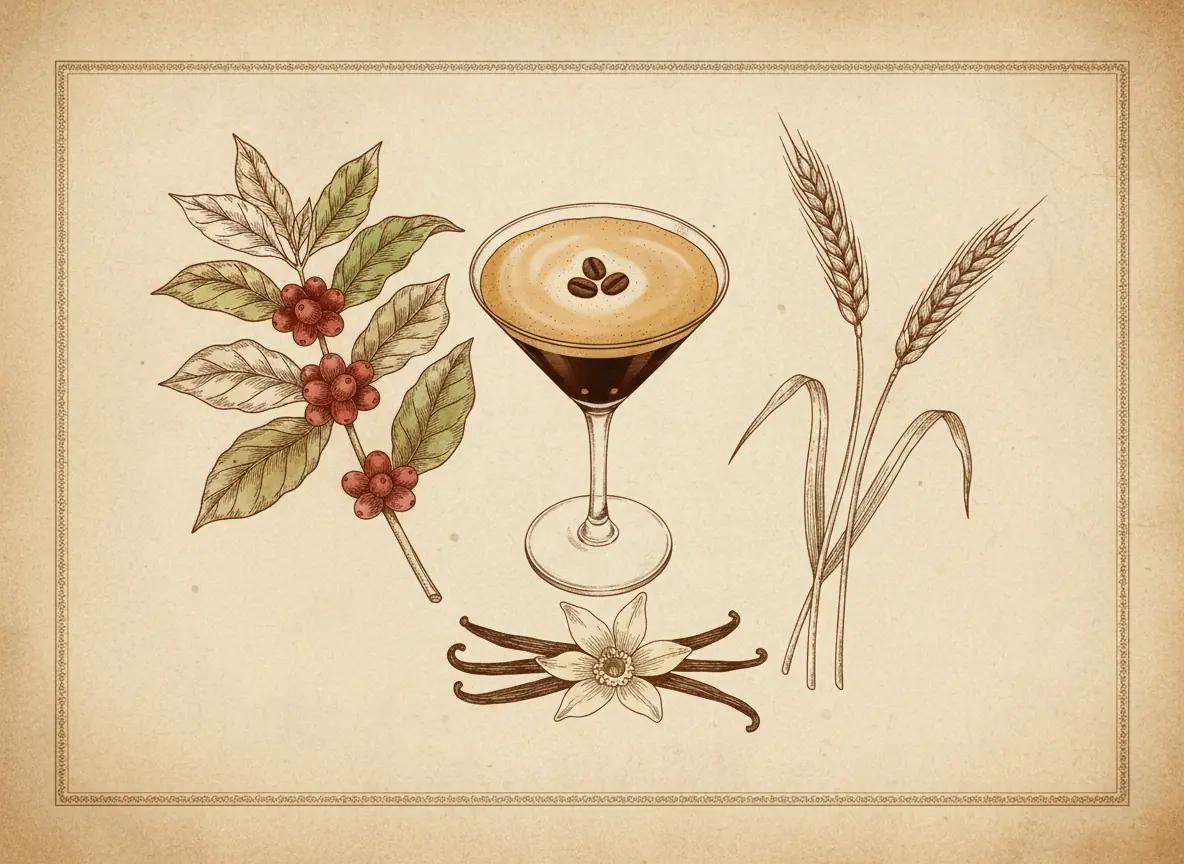
Espresso Martini
An Espresso Martini is 50ml of vodka, 30ml of Kahlúa, 10ml of sugar syrup and one freshly pulled espresso of about 30ml, shaken hard for 10 to 12 seconds and double strained into a chilled martini glass, with three coffee beans laid on the foam. About 2.5 UK units, and the caffeine of a single shot. The Oxford Companion says Dick Bradsell created it at the Soho Brasserie in London in 1983, for a famous model who asked for a drink to wake her up and then mess her up; he never said who she was. The measures are the IBA’s. Vodka gives strength and cold without flavour, so the coffee leads. The foam comes from the crema of a shot pulled moments before the shake, which is why the espresso goes in last.
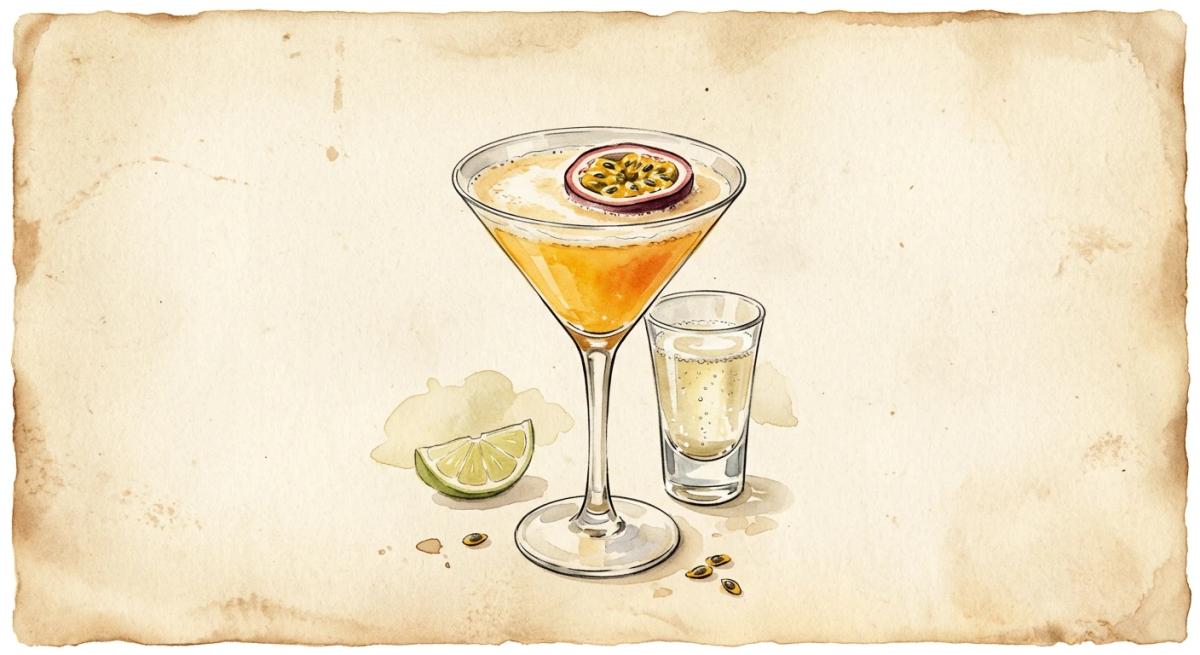
Pornstar Martini
A Pornstar Martini is 50ml vanilla vodka, 20ml passion fruit liqueur, 50ml passion fruit purée and 10ml vanilla syrup, shaken, double strained and served in a chilled martini glass with half a passion fruit floating on top. A 50ml shot of chilled Champagne is served alongside. About 2.2 UK units in the glass and 2.8 with the Champagne. Douglas Ankrah created it in 2002 at Townhouse, his bar in Knightsbridge, by Difford’s Guide’s account, which says he first called it the Maverick Martini after a Cape Town nightclub; his 2004 book, as Difford’s quotes it, headed the recipe Maverick Martini or Porn Star Martini. In November 2018 the Morning Advertiser reported CGA figures that put it first among UK cocktails by share of serves in managed outlets. Passion fruit does the work. The purée gives sharpness and body, the liqueur sweetness and perfume, and the vanilla rounds both. The Champagne is a separate drink, sipped alongside or after.
Where this one sits
Recipe by Jerry Can Spirits · Updated 19 October 2026