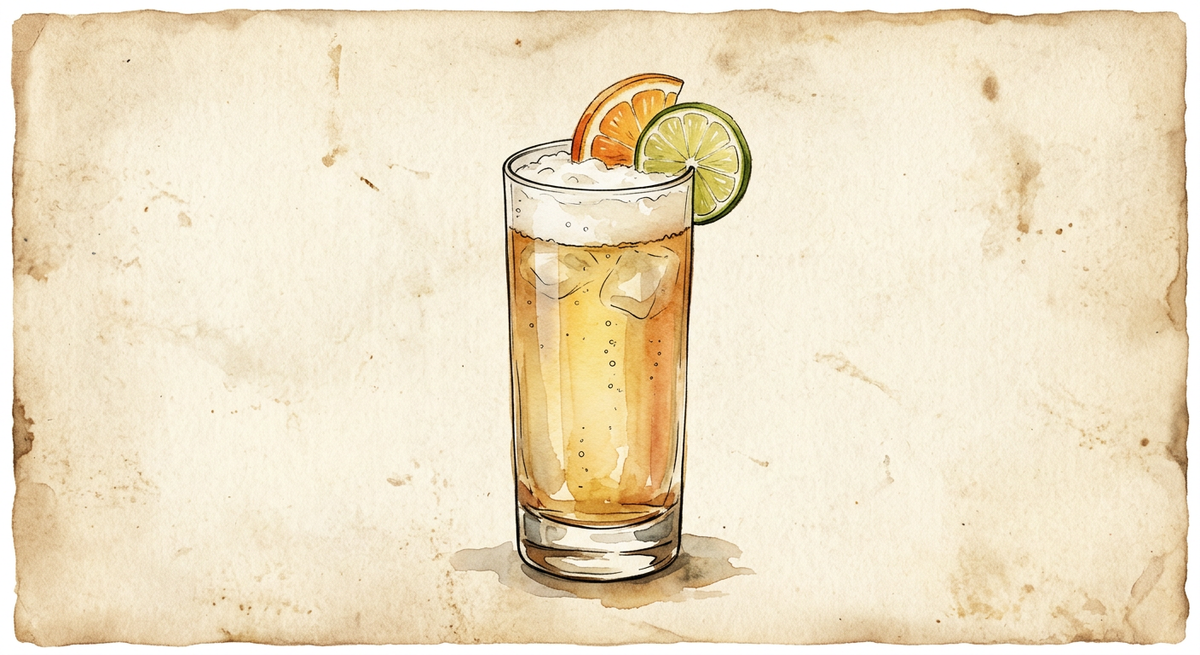
Añejo Highball
An Añejo Highball is 45ml of aged rum, 15ml of orange curaçao, 7.5ml of fresh lime juice and two dashes of Angostura bitters, built over ice in a highball glass and topped with 60ml of ginger beer, with an orange slice and a lime wheel. About 2.4 UK units. Difford’s Guide says Dale DeGroff created it in the late 1990s at the Rainbow Room in New York. Fine Art Bartending’s recipe page calls it his cocktail tribute to the Cuban bartenders of days past. It is a rum buck with more seasoning than most. Curaçao runs bitter orange through the ginger, the bitters give a long drink a dry, spiced finish, and the lime is kept to a quarter of an ounce. Using only 60ml of ginger beer keeps the rum in front, so the drink tastes of aged rum and orange first and ginger second.
Glassware: Highball Glass
Garnish: Orange slice and Lime wheel
Ingredients
45ml
A Spanish-style aged rum at about 40% ABV, the light Cuban style. A heavy Jamaican rum overpowers the curaçao.
15ml
A dry orange curaçao at about 40% ABV. It carries bitter peel through the ginger; a sweet triple sec adds sugar and little else, so use less of it.
7.5ml
A quarter of an ounce, squeezed the same day. Enough to sharpen the drink without turning it into a sour; the ginger beer brings acidity of its own.
60ml
A fiery brewed ginger beer, well chilled. Only 60ml goes in, so it has to be sharp enough to be noticed. Most ginger beers are under 0.5% ABV.
2 dashes
Two dashes, in before the ginger beer so they mix through. They give the long drink a dry, spiced finish like a stirred one.
Instructions
Fill a highball glass with cubed ice.
Add the rum, curaçao, lime juice and bitters.
Top with 60ml of chilled ginger beer.
Stir once, gently, to bring the bitters through the drink.
Garnish with an orange slice and a lime wheel.
Our version
Dale DeGroff’s measures as Punch prints them: one and a half ounces (45ml) of aged rum, half an ounce (15ml) of Curaçao, a quarter-ounce (7.5ml) of lime juice, two dashes of Angostura and two ounces (60ml) of ginger beer. We use two dashes of bitters, as Punch does; Difford’s gives one and shakes the first four ingredients.
Source: our own specification. Last checked 10 October 2026.
Expert Tip
Measure the ginger beer. At 60ml it is a short top, and the drink is built around that: the rum and curaçao should lead. Fill the glass to the brim with ginger beer and it becomes an ordinary rum and ginger. Choose a ginger beer with real heat. Because there is so little of it, a mild, sweet one disappears behind the curaçao and the drink loses its edge. Use a dry orange curaçao rather than a sweet triple sec. It brings bitter peel, which is what links the rum to the ginger. With a sweeter orange liqueur, drop to 10ml.
Behind the Añejo Highball
Flavour Profile
DeGroff’s Tribute to Havana
The Oxford Companion, in an entry by William Grimes, has the Rainbow Room’s Promenade Bar opening in 1987 with Dale DeGroff as head bartender, reviving classic techniques and recipes with fresh juices and top-quality spirits. Difford’s Guide says he created the Añejo Highball there in the late 1990s.
Fine Art Bartending calls it his cocktail tribute to the Cuban bartenders of days past, and a riff on the Moscow Mule. In our reading the Cuban link is in the glass: aged rum, orange curaçao and lime.
A Buck With Seasoning
A buck is spirit, citrus and ginger beer. Most stop there, and the ginger beer does the heavy lifting. DeGroff’s version adds curaçao for bitter orange and Angostura for spice, and cuts both the lime and the ginger beer back.
The result is closer to a lengthened cocktail than a mixer drink. The rum and curaçao lead, the bitters dry the finish, and the ginger beer adds heat and bubbles rather than volume.
Choosing the Rum
The Cuban style is light-bodied and dry, aged long enough to pick up vanilla and a little oak. It suits the drink, and Difford’s Guide uses Havana Club Añejo 7 Años. Other Spanish-style aged rums do the same job.
A heavy Jamaican rum adds funk that fights the curaçao. A black rum turns it into a different drink. White rum is too thin to hold up against the orange and ginger.
Three Rum and Ginger Drinks
Our Añejo Highball beside our Dark ’n’ Stormy and Moscow Mule
Spirit
- Añejo Highball
- 45ml aged rum
- Dark ’n’ Stormy
- 60ml Gosling’s Black Seal
- Moscow Mule
- 45ml vodka
Liqueur
- Añejo Highball
- 15ml orange curaçao
- Dark ’n’ Stormy
- None
- Moscow Mule
- None
Lime
- Añejo Highball
- 7.5ml juice
- Dark ’n’ Stormy
- Wedge, to squeeze
- Moscow Mule
- 10ml juice
Bitters
- Añejo Highball
- Two dashes Angostura
- Dark ’n’ Stormy
- None
- Moscow Mule
- None
Ginger beer
- Añejo Highball
- 60ml
- Dark ’n’ Stormy
- 100ml
- Moscow Mule
- 120ml
Build
- Añejo Highball
- Stirred once
- Dark ’n’ Stormy
- Rum floated, unstirred
- Moscow Mule
- Stirred once
UK units
- Añejo Highball
- About 2.4
- Dark ’n’ Stormy
- About 2.4
- Moscow Mule
- About 1.8
| Element | Añejo Highball | Dark ’n’ Stormy | Moscow Mule |
|---|---|---|---|
| Spirit | 45ml aged rum | 60ml Gosling’s Black Seal | 45ml vodka |
| Liqueur | 15ml orange curaçao | None | None |
| Lime | 7.5ml juice | Wedge, to squeeze | 10ml juice |
| Bitters | Two dashes Angostura | None | None |
| Ginger beer | 60ml | 100ml | 120ml |
| Build | Stirred once | Rum floated, unstirred | Stirred once |
| UK units | About 2.4 | About 2.4 | About 1.8 |
Of the three, the Añejo Highball has the least ginger beer and the most going on besides it. The Dark ’n’ Stormy is the rum and the ginger; the Mule is the ginger and the lime.
How to Serve It
Build it in a highball filled with ice, which keeps a short pour cold without watering it down. Stir once to lift the bitters, no more, so the ginger beer keeps its fizz.
An orange slice and a lime wheel go in last. They are the two citrus notes of the drink, and they put orange and lime on the nose before the first sip.
For black rum over ginger beer, make a Dark ’n’ Stormy; for vodka and lime, a Moscow Mule.
Make it at home
The Spirit
Aged RumAged rum is rum that has spent years in oak casks, usually ex-bourbon barrels, and taken on vanilla, caramel and dried fruit; our recipes count it at 40% ABV. In our recipes it is the rum for drinks where you should taste the spirit: the Old Cuban, the Mai Tai, the Rum Sour and the punch bowl.
More to explore
Frequently Asked Questions
Who created the Añejo Highball?
What is in an Añejo Highball?
How is it different from a rum and ginger beer?
Why so little ginger beer?
Which rum should I use?
Is orange curaçao the same as triple sec?
How strong is an Añejo Highball?
Sources.
Correct as of 19 October 2026.
- Difford’s Guide, “Anejo Highball” (secondary source: “created in the late 1990s by Dale DeGroff at The Rainbow Room, New York City”; its own spec 45ml Havana Club Añejo 7 Años, 15ml Ferrand Dry Curaçao, 7.5ml lime, 1 dash Angostura, 60ml ginger beer, first four shaken).
- Punch, “Añejo Highball” (secondary source: Dale DeGroff, New York City; 1½ oz aged rum, ½ oz Curaçao, ¼ oz lime juice, 2 dashes Angostura, 2 oz ginger beer; built over ice).
- The Oxford Companion to Spirits and Cocktails (William Grimes), “The Rainbow Room bar” (secondary source: the Promenade Bar opened in 1987 under head bartender Dale DeGroff, who revived classic techniques and pre-Prohibition cocktails with fresh juices and top-quality spirits).
- Fine Art Bartending, “Anejo Highball Cocktail Recipe” (recipe page: “his cocktail tribute to the Cuban bartenders of days past”; a riff on the Moscow Mule (it dates the drink to the early 1990s, which Difford’s does not)).
You Might Also Like
Moscow Mule
A Moscow Mule is 45ml of vodka and 10ml of fresh lime juice over ice in a copper mug, topped with 120ml of cold ginger beer and stirred once, with a lime wedge. Those are the IBA’s measures. About 1.8 UK units, all from the vodka. It is usually dated to 1941 and credited to John G. Martin of Heublein, which had bought Smirnoff and was left with a surplus of vodka, and Jack Morgan of the Cock ’n’ Bull in Los Angeles, who was pushing his own ginger beer, VinePair reports. The Oxford Companion gives other accounts: that Morgan and Martin devised it in New York, or that the Cock ’n’ Bull’s head bartender, Wes Price, did. The ginger beer decides the drink. At 120ml it is two thirds of the glass, so a soft, sugary one gives a soft, sugary Mule. Use the fieriest you can find, and keep the lime short: good ginger beer brings its own bite.
Dark ’n’ Stormy
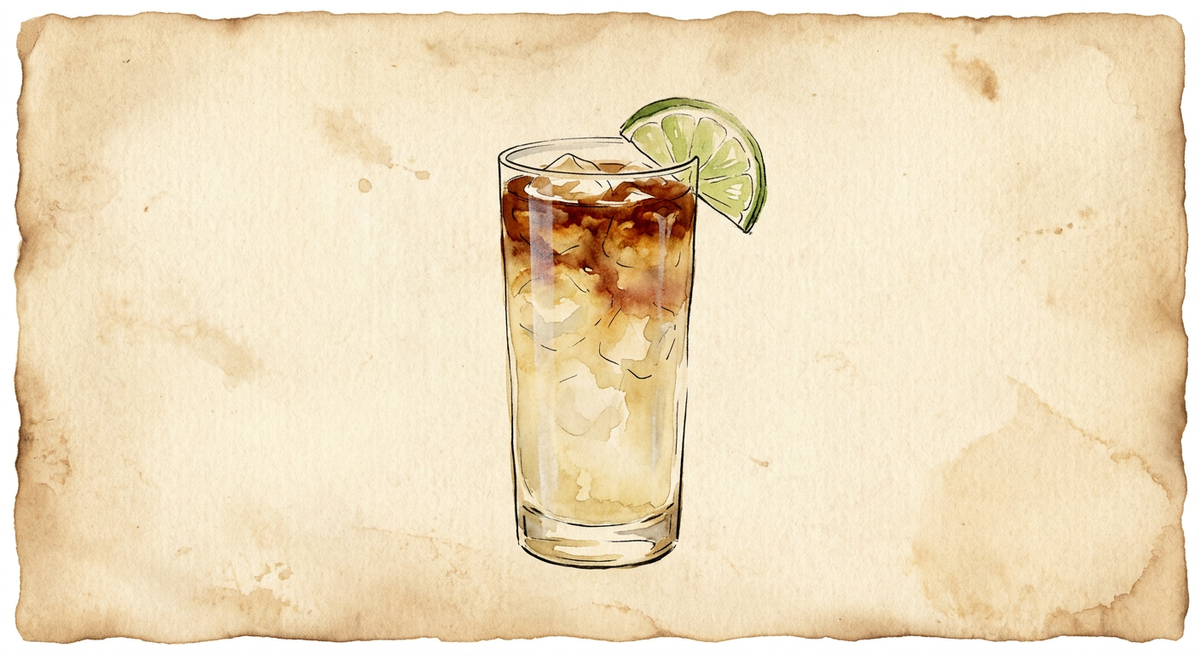
A Dark ’n’ Stormy is 60ml of Gosling’s Black Seal rum floated over 100ml of ginger beer in a highball full of ice, with a lime wedge. About 2.4 UK units. Those are the IBA’s measures, and the name is a Gosling Brothers trade mark tied to Black Seal. The Oxford Companion says the drink purportedly originated among British sailors on shore leave in Bermuda after the First World War, though another origin story places it earlier, in the nineteenth century. Gosling’s own page puts ginger beer from a Royal Navy officers’ club with the local Black Seal rum, and a sailor is said to have called the colour that of a cloud only a fool or a dead man would sail under. The Oxford Companion says the Gosling family claimed a trademark for the cocktail’s recipe in 1991 and has repeatedly turned to the US Patent and Trademark Office to protect it, and Gosling’s own page writes the name with the registered symbol. The same build with another dark rum is a rum and ginger beer, and a sound one. The same build with another dark rum is a rum and ginger beer, and a sound one.
El Diablo
El Diablo is 45ml of blanco tequila, 15ml of crème de cassis and 15ml of fresh lime juice, stirred over ice in a highball and topped with 90ml of chilled ginger beer, with the spent lime shell dropped in. About 2.0 UK units. Its earliest known printing is in Trader Vic’s Book of Food and Drink of 1946, as the Mexican El Diablo, which the book marks as a Trader Vic original. That version was topped with ginger ale. Ginger beer is the usual choice now, and ours: its heat stands up to the cassis, where ginger ale lets the drink turn sweet. Cassis is French blackcurrant liqueur. It turns the glass deep red, sweetens it and adds dark fruit, so the tequila’s pepper, the ginger and the lime all have something to push against.
Where this one sits
Recipe by Jerry Can Spirits · Updated 19 October 2026