Comte de Sureau
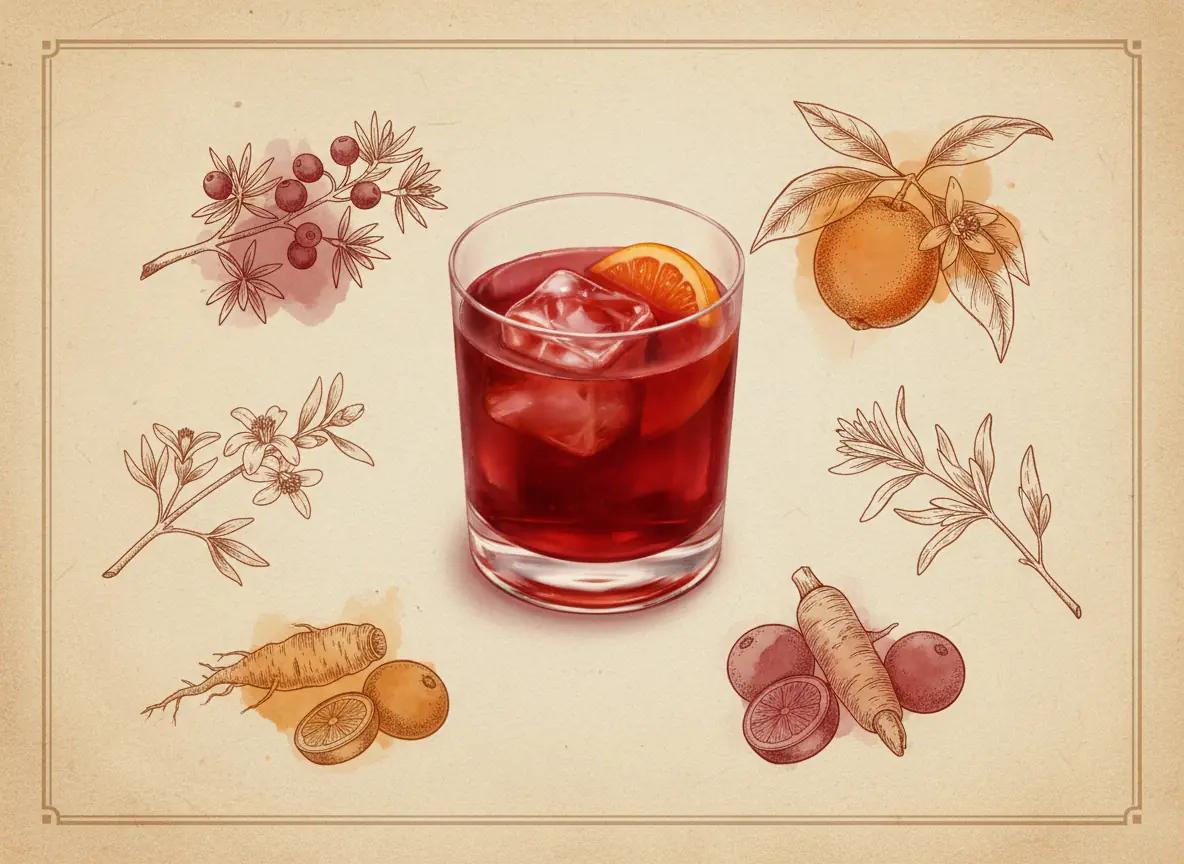
A Comte de Sureau is 45ml of London Dry gin, 25ml of elderflower liqueur and 7.5ml of Campari, stirred over ice for 20 to 30 seconds and strained over one large cube in a rocks glass, with orange and lemon peel twisted over it. About 2.5 UK units. It is a Negroni rebalanced: elderflower liqueur takes the sweet vermouth’s place and the Campari drops to a quarter of a Negroni’s 30ml. At equal parts, the Campari would bury the flower. Difford’s Guide adapts its recipe from one created in 2007/8 by Gonçalo de Sousa Monteiro at Le Lion in Hamburg, and says many know it as the Elderflower Negroni. Comte de Sureau means Count of Elderflower.
Glassware: Rocks Glass
Garnish: Orange twist and Lemon twist both expressed
Ingredients
45ml
A London Dry gin at 40% ABV. Neither the elderflower nor the small measure of Campari brings any structure, so the juniper has to.
25ml
St-Germain or another elderflower liqueur at 20% ABV, the strength LWC lists for St-Germain. It replaces the vermouth and supplies all of the sweetness; at 25ml it becomes the subject, and the Campari keeps the finish dry.
7.5ml
Campari at 25% ABV, the strength LWC lists in the UK, a quarter of a Negroni’s measure. It gives a bitter-orange frame and a dry finish while leaving the flower audible.
Instructions
Add the gin, elderflower liqueur and Campari to a mixing glass.
Fill the mixing glass with cubed ice and stir for 20 to 30 seconds.
Place one large ice cube in a rocks glass.
Strain the drink over the cube.
Express an orange twist over the surface, then a lemon twist, and drop both in.
Source: Difford's Guide (Difford’s Guide specification, with Campari as the red bitter liqueur; stir time ours). Last checked 10 October 2026.
Expert Tip
Measure the Campari. 7.5ml is a bar spoon and a half, and a free pour almost always lands nearer double, which is enough to flatten the elderflower. Use a small jigger. Stir for 20 to 30 seconds. There is no juice, so all the water in the drink comes from the ice, and an under-stirred glass tastes hot and sweet. Then strain over one large cube, which keeps it cold without much further dilution. Express the orange peel first, then the lemon. Orange oil sits with the Campari; lemon is sharper and lifts the elderflower. With one twist only, the drink leans whichever way you chose.
Behind the Comte de Sureau
Flavour Profile
Where It Comes From
Difford’s Guide adapts its recipe from one created in 2007/8 by Gonçalo de Sousa Monteiro at Le Lion in Hamburg, so the year is given both ways.
From Hamburg it travelled widely, and Difford’s Guide says many now know it as the Elderflower Negroni. Comte de Sureau means Count of Elderflower, a grand title for a hedgerow flower.
Why the Ratio Is Not Equal
Campari is bitter and strongly aromatic. Elderflower liqueur is sweet, floral and quiet. Put 30ml of each in a glass, as a Negroni would, and the elderflower is gone.
At 7.5ml the Campari becomes a frame: bitter orange and a dry finish around the flower. The gin rises to 45ml because neither of the other two gives the drink any structure.
Comte de Sureau against its relations
Comte de Sureau
- Gin
- 45ml
- Sweet part
- 25ml elderflower liqueur
- Bitter or dry part
- 7.5ml Campari
- Served
- Over one large cube
Negroni
- Gin
- 30ml
- Sweet part
- 30ml sweet vermouth
- Bitter or dry part
- 30ml Campari
- Served
- Over large ice
Left Bank Martini
- Gin
- 60ml
- Sweet part
- 15ml elderflower liqueur
- Bitter or dry part
- 15ml white wine, 7.5ml dry vermouth
- Served
- Up, in a coupe
| Drink | Gin | Sweet part | Bitter or dry part | Served |
|---|---|---|---|---|
| Comte de Sureau | 45ml | 25ml elderflower liqueur | 7.5ml Campari | Over one large cube |
| Negroni | 30ml | 30ml sweet vermouth | 30ml Campari | Over large ice |
| Left Bank Martini | 60ml | 15ml elderflower liqueur | 15ml white wine, 7.5ml dry vermouth | Up, in a coupe |
Elderflower in Vermouth’s Place
Sweet vermouth has two roles in a Negroni. It sweetens, and it brings a herbal, faintly bitter depth that meets the Campari halfway.
Elderflower liqueur fills the first role and not the second. What you gain is a drink that smells of a hedgerow in June and finishes dry. What you lose is the depth a Negroni has at the back.
The Two Twists
Orange first, then lemon, both expressed over the surface. Orange oil sits with the Campari and reinforces the bitter citrus. Lemon oil is sharper and greener and lifts the elderflower. Using only orange makes something close to a light Negroni; only lemon, a floral drink with an odd bitter edge.
How to Serve It
Over one large cube in a rocks glass, cold, before dinner. It has enough bitterness to sharpen an appetite and enough sweetness to drink without food.
For the full-weight original, with sweet vermouth and Campari at equal measures, try the Negroni.
Make it at home
The Spirit
GinGin is a spirit flavoured with juniper berries. Under the retained Regulation (EC) 110/2008, juniper must lead the taste, the floor is 37.5% ABV, and the route the flavour takes sets the grade: plain gin, distilled gin or London gin. Our recipes count it at 40%, and it carries the Martini, the Negroni and the Gin and Tonic.
Master the Techniques
More to explore
Frequently Asked Questions
What is a Comte de Sureau?
Why is it not equal parts?
Do I need both twists?
How does it compare with the Left Bank Martini?
Who created the Comte de Sureau?
How strong is a Comte de Sureau?
Can I use Aperol instead of Campari?
Sources.
Correct as of 19 October 2026.
- Difford’s Guide, “Comte de Sureau” (secondary source: adapted from a recipe created in 2007/8 by Gonçalo de Sousa Monteiro at Le Lion in Hamburg; 45ml gin, 25ml elderflower liqueur, 7.5ml red bitter; “known by many as an Elderflower Negroni”).
- LWC, “St-Germain 70cl” (UK wholesaler listing: Alcohol By Volume 20%).
- LWC, “Campari 70cl” (UK wholesaler listing: Alcohol By Volume 25%).
You Might Also Like
White Negroni
A White Negroni is 45ml of London Dry gin, 30ml of Lillet Blanc and 20ml of Suze, stirred over one large cube in a rocks glass for 20 to 30 seconds, with a lemon twist expressed over the top and dropped in. About 2.7 UK units. Punch reports that Wayne Collins, a London bartender, made the first ones on a hot summer night in 2001 near Bordeaux, where he and Nick Blacknell, then director of Plymouth Gin, were in town for Vinexpo. Rummaging in a local liquor store for the ingredients, they bought French bottles instead, Punch says: Suze for the bitter, Lillet Blanc for the wine. Collins chose the name, he told Punch, because it would be easy to communicate to the trade. The shape survives and every flavour moves. Suze is bitter from gentian root, earthy where Campari is orange peel, and Lillet is lighter and more honeyed than sweet vermouth. Suze is also the louder of the two bitters, which is why ours trims it to 20ml rather than pouring three equal measures.
Negroni
A Negroni is 30ml each of gin, Campari and sweet vermouth, stirred with ice for 20 to 30 seconds and strained over fresh ice in a rocks glass, with an orange peel expressed over the top. About 2.4 UK units. The measures are the IBA’s; the IBA builds the drink in the glass and garnishes it with half an orange slice. Difford’s Guide gives the most widely reported account: Florence in 1919, at the Casoni Bar, where the bartender Fosco Scarselli is said to have replaced the soda in Count Camillo Negroni’s Americano with gin. The Oxford Companion has the drink named in a surviving letter of October 1920 and then absent under that name until 1947. A French book of 1929 by Alimbau and Milhorat, in the Internet Archive’s scan, gives equal parts of the three as the Campari Mixte. Each third has a job. Gin gives strength and juniper, the red bitter gives bitterness and orange, and the vermouth gives body and sugar. With no juice or soda in the glass, a tired vermouth shows at once.
Left Bank Martini
A Left Bank Martini is 60ml London Dry gin, 15ml elderflower liqueur, 15ml unoaked dry white wine and 7.5ml dry vermouth, stirred over ice for 20 to 30 seconds and strained into a chilled coupe, with a lime twist. It is a gin Martini with elderflower and white wine in it: dry, floral and cold, at about 3.0 UK units. Difford’s Guide records that Simon Difford created it in 2006 at the Cabinet Room in London, for the launch of St-Germain elderflower liqueur. It says the name points at Saint-Germain-des-Prés, the Paris district on the left bank of the Seine. Difford’s says his first version used Sauvignon Blanc, with more elderflower and more vermouth; he cut both in 2013, and the current recipe takes a Chardonnay, Chablis in his specification. The wine is what sets it apart. It brings acidity and a little fruit without the herbs of a full vermouth measure, so the elderflower reads as blossom rather than sugar.
Where this one sits
Recipe by Jerry Can Spirits · Updated 19 October 2026