White Negroni
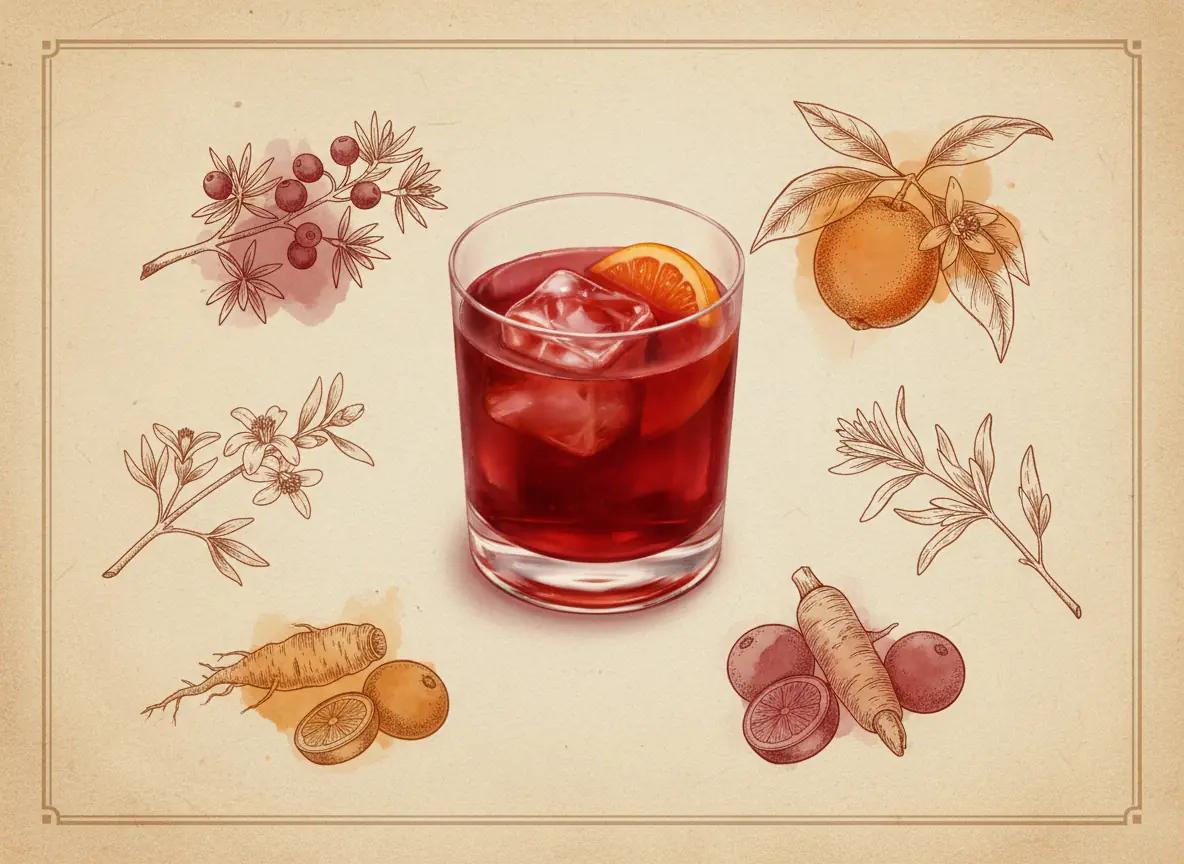
A White Negroni is 45ml of London Dry gin, 30ml of Lillet Blanc and 20ml of Suze, stirred over one large cube in a rocks glass for 20 to 30 seconds, with a lemon twist expressed over the top and dropped in. About 2.7 UK units. Punch reports that Wayne Collins, a London bartender, made the first ones on a hot summer night in 2001 near Bordeaux, where he and Nick Blacknell, then director of Plymouth Gin, were in town for Vinexpo. Rummaging in a local liquor store for the ingredients, they bought French bottles instead, Punch says: Suze for the bitter, Lillet Blanc for the wine. Collins chose the name, he told Punch, because it would be easy to communicate to the trade. The shape survives and every flavour moves. Suze is bitter from gentian root, earthy where Campari is orange peel, and Lillet is lighter and more honeyed than sweet vermouth. Suze is also the louder of the two bitters, which is why ours trims it to 20ml rather than pouring three equal measures.
Glassware: Rocks Glass
Garnish: Lemon twist expressed and dropped in
Ingredients
45ml
Around 40% ABV at our working figure, with plenty of juniper; Difford’s Guide says Collins made the first ones with Plymouth. Gentian is earthy and needs juniper to push against, and a soft floral gin disappears between the other two bottles.
30ml
An aromatised wine from Bordeaux, made at Podensac by Difford’s Guide’s producer listing, and given at 17% ABV on Pernod Ricard’s product page: honeyed citrus with a light quinine edge, standing where sweet vermouth stood. We keep it cold once open.
20ml
A French gentian aperitif, 20% ABV in the UK on Fareham Wine Cellar’s listing and 15% on Pernod Ricard’s page. Earthy and vegetal rather than orange-bitter, and louder than Campari, which is why it gets 20ml rather than an equal third.
Instructions
Put one large ice cube in a rocks glass.
Add the gin, Lillet Blanc and Suze.
Stir for 20 to 30 seconds.
Express a lemon twist over the drink and drop it in.
Our version
Wayne Collins made the first White Negronis near Bordeaux in 2001 from gin, Suze and Lillet Blanc, by Punch’s account; Difford’s Guide, a secondary source, says he used Plymouth. We pour 45ml of gin, 30ml of Lillet and 20ml of Suze, trimming the Suze because gentian is louder than Campari.
Source: our own specification. Last checked 9 October 2026.
Expert Tip
Trim the Suze. Gentian takes up more of the palate than Campari does, and at an equal third it buries the gin and the Lillet. Learn the drink at 45, 30 and 20, then try equal parts once you know what gentian tastes like. Keep the Lillet in the fridge and buy a size you will finish. It is an aromatised wine, and once it oxidises it loses the honeyed roundness the Suze pushes against. Stir it in the glass for the full 20 to 30 seconds. One large cube melts slowly, so the drink needs that time to come down to temperature, and an under-stirred White Negroni tastes hot and harsh.
Behind the White Negroni
Flavour Profile
Where It Comes From
In the summer of 2001, Punch reports, Wayne Collins, a London bartender, was near Bordeaux for Vinexpo with Nick Blacknell, then director of Plymouth Gin. Blacknell wanted a cold Negroni and, Punch says, the ingredients were in a local liquor store; Collins suggested French ones, and they bought Suze for the bitter and Lillet Blanc for the wine, with Plymouth from the house for the gin.
Collins called it a White Negroni because, he told Punch, it would be easy to communicate to the trade. His first ones carried a wedge of pink grapefruit, Punch adds; ours take a lemon twist, which sharpens the citrus already in the Lillet and the Suze.
The Translation
Every swap does the job of the bottle it replaces and tastes nothing like it. Campari is bitter orange; Suze is gentian, earthy and vegetal, with a note like dried citrus peel. Sweet vermouth is spiced and heavy; Lillet Blanc is honeyed, lightly quinined and much drier.
Keep the gin, the stir and the large cube, and the drink still behaves like a Negroni: bitter, aromatic and made to sip slowly. It simply tastes as though it grew somewhere else.
Why the Suze Is Trimmed
A classic Negroni is equal parts, and the obvious move is to keep that. Suze is more assertive than Campari, though, and at an equal third the drink becomes mostly gentian.
At 45ml of gin, 30ml of Lillet and 20ml of Suze, all three can be tasted. Equal parts is a drier and far more bitter drink, worth making once the bottle is familiar.
The White Negroni Beside the Negroni
The White Negroni against the drink it translates; the units are our calculation at our working figures of 40% for gin and 16% for sweet vermouth and 11% for prosecco, with Lillet at 17% on Pernod Ricard’s product page, Suze at 20% on a UK retailer’s listing and Campari at 25% on LWC’s listing
White Negroni (ours)
- Gin
- 45ml London Dry
- Bitter
- 20ml Suze
- Aromatised wine
- 30ml Lillet Blanc
- UK units
- About 2.7
Negroni
- Gin
- 30ml
- Bitter
- 30ml Campari
- Aromatised wine
- 30ml sweet vermouth
- UK units
- About 2.4
Negroni Sbagliato
- Gin
- None: 30ml prosecco instead
- Bitter
- 30ml Campari
- Aromatised wine
- 30ml sweet vermouth
- UK units
- About 1.6
| Drink | Gin | Bitter | Aromatised wine | UK units |
|---|---|---|---|---|
| White Negroni (ours) | 45ml London Dry | 20ml Suze | 30ml Lillet Blanc | About 2.7 |
| Negroni | 30ml | 30ml Campari | 30ml sweet vermouth | About 2.4 |
| Negroni Sbagliato | None: 30ml prosecco instead | 30ml Campari | 30ml sweet vermouth | About 1.6 |
Make a Negroni beside it once; for the version with no gin at all, try the Negroni Sbagliato.
What It Did for Suze
Suze is a French aperitif, drunk at home over ice or with tonic. Punch reports that the White Negroni drove demand for it among American bartenders, until Pernod Ricard began to import Suze in 2012.
It is also the easiest way into gentian, an unfamiliar bitterness, because the drink around it has a shape most people already know.
How to Serve It
Stirred over one large cube in a rocks glass, like its parent, with a lemon twist expressed over the surface and dropped in.
Serve it before dinner. Its dryness and bitterness sharpen the appetite rather than close a meal.
Make it at home
The Spirit
GinGin is a spirit flavoured with juniper berries. Under the retained Regulation (EC) 110/2008, juniper must lead the taste, the floor is 37.5% ABV, and the route the flavour takes sets the grade: plain gin, distilled gin or London gin. Our recipes count it at 40%, and it carries the Martini, the Negroni and the Gin and Tonic.
More to explore
Frequently Asked Questions
Who invented the White Negroni?
What is Suze?
What does Suze change?
Why not equal parts, like a Negroni?
Can I use dry vermouth instead of Lillet?
Is a White Negroni stirred or shaken?
How strong is a White Negroni?
Sources.
Checked between 18 October and 20 October 2026.
- Punch, “How the White Negroni Became a Modern Classic” (secondary source: summer 2001, Médoc; Collins and Blacknell (then director of Plymouth Gin); local liquor store; Suze and Lillet Blanc; pink grapefruit wedge; the name for the trade; Suze imported to the US by Pernod Ricard from 2012).
- Difford’s Guide, “White Negroni” (secondary source: created in 2001 by Wayne Collins at VinExpo, Bordeaux, using Plymouth Gin for Nick Blacknell).
- Pernod Ricard, “Lillet” (owner’s brand page: Lillet Blanc, 17% ABV).
- Fareham Wine Cellar, “Suze Gentian Liqueur 20%” (UK retailer listing: 20%; “essential cocktail ingredient, most notably used in a White Negroni”).
- Pernod Ricard, “Suze” (owner’s brand page: Suze L’originale, 15% ABV).
- LWC, “Campari 70cl” (UK wholesaler listing: Alcohol By Volume 25%).
- Difford’s Guide, “Lillet”.
You Might Also Like
Negroni
A Negroni is 30ml each of gin, Campari and sweet vermouth, stirred with ice for 20 to 30 seconds and strained over fresh ice in a rocks glass, with an orange peel expressed over the top. About 2.4 UK units. The measures are the IBA’s; the IBA builds the drink in the glass and garnishes it with half an orange slice. Difford’s Guide gives the most widely reported account: Florence in 1919, at the Casoni Bar, where the bartender Fosco Scarselli is said to have replaced the soda in Count Camillo Negroni’s Americano with gin. The Oxford Companion has the drink named in a surviving letter of October 1920 and then absent under that name until 1947. A French book of 1929 by Alimbau and Milhorat, in the Internet Archive’s scan, gives equal parts of the three as the Campari Mixte. Each third has a job. Gin gives strength and juniper, the red bitter gives bitterness and orange, and the vermouth gives body and sugar. With no juice or soda in the glass, a tired vermouth shows at once.
Mezcal Negroni
A Mezcal Negroni is 30ml each of mezcal, Campari and sweet vermouth, stirred with ice for 20 to 30 seconds and strained over fresh ice in a rocks glass, with an orange peel expressed over the top. About 2.4 UK units. The measures and the method are the Negroni’s; only the spirit changes. It is a substitution rather than an invention: Punch asked bartenders who might have made it first, and none claimed it. The Negroni’s equal-parts frame has always taken swaps, and mezcal is one of the more successful. Gin sits inside Campari’s bitterness. Mezcal pushes back, with roasted agave and smoke in a register Campari does not occupy, so the two hold each other in check and the vermouth binds them. The result is darker and drier on the finish than the gin original. A joven espadín with moderate smoke is the bottle to pour.
Negroni Sbagliato
A Negroni Sbagliato is 30ml of Campari and 30ml of sweet vermouth stirred briefly over ice in a rocks glass, topped with 30ml of cold brut prosecco poured down the side, with an orange slice. About 1.6 UK units, two thirds of a Negroni’s. Sbagliato means mistaken. Campari’s own page dates it to 1972, at Bar Basso in Milan, when Mirko Stocchetto, asked for a Negroni, poured prosecco instead of gin; Difford’s Guide puts it in the late 1980s and says it is still served at Bar Basso today with spumante. Bar Basso’s own page writes the name as Negroni Sbagliato® and calls it the bar’s “real trademark drink”. It sits on the rung between an Americano and a Negroni: bitter and vermouth-rich like both, with wine’s body and a fine sparkle where the soda or the gin would be. The bubbles are the fragile part, so the prosecco goes in last and is barely stirred.
Where this one sits
Recipe by Jerry Can Spirits · Updated 20 October 2026