Mezcal Negroni
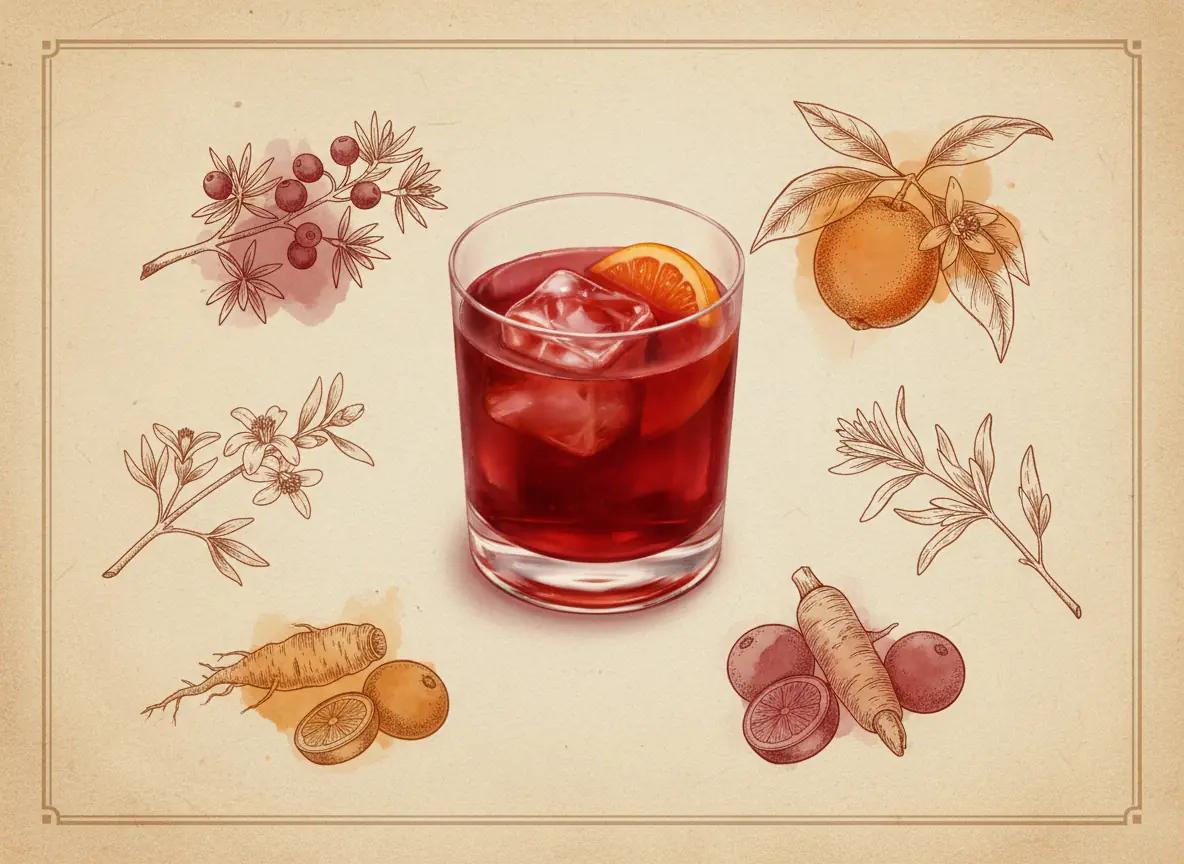
A Mezcal Negroni is 30ml each of mezcal, Campari and sweet vermouth, stirred with ice for 20 to 30 seconds and strained over fresh ice in a rocks glass, with an orange peel expressed over the top. About 2.4 UK units. The measures and the method are the Negroni’s; only the spirit changes. It is a substitution rather than an invention: Punch asked bartenders who might have made it first, and none claimed it. The Negroni’s equal-parts frame has always taken swaps, and mezcal is one of the more successful. Gin sits inside Campari’s bitterness. Mezcal pushes back, with roasted agave and smoke in a register Campari does not occupy, so the two hold each other in check and the vermouth binds them. The result is darker and drier on the finish than the gin original. A joven espadín with moderate smoke is the bottle to pour.
Glassware: Rocks Glass
Garnish: Orange peel
Ingredients
30ml
A joven espadín at around 40% ABV with moderate smoke. It has to hold its own against the Campari without swamping the vermouth.
30ml
At 25% ABV, the strength LWC lists in the UK, the bitter constant of every Negroni. Here it meets a spirit that is loud in a different way, so neither hides the other.
30ml
A Torino-style sweet vermouth at our working figure of 16% ABV. It is a third of the glass and binds the smoke to the bitterness. We keep it in the fridge once opened.
Instructions
Fill a rocks glass with large cubed ice.
Add the mezcal, Campari and sweet vermouth to a mixing glass.
Fill with ice and stir for 20 to 30 seconds.
Strain over the fresh ice in the rocks glass.
Express a strip of orange peel over the surface and rest it in the glass.
Our version
Punch finds no single originator. Ours follows the Negroni exactly, 30ml each, stirred and strained over fresh ice with an orange peel, and changes only the spirit, to a joven espadín mezcal.
Source: our own specification. Last checked 10 October 2026.
Expert Tip
Pour a joven espadín with moderate smoke. A heavily smoked bottle takes over the glass at a third of the volume, and a rare-agave mezcal is wasted under Campari. Treat the vermouth as wine. It is a third of the drink, so a bottle left open at room temperature for months makes the whole thing taste flat. We keep it in the fridge once opened and finish it within about four weeks. Stir in a mixing glass for 20 to 30 seconds and strain over fresh ice, as for a Negroni. There is no citrus, so chilling and dilution are the whole of the method, and a measured stir controls both.
Behind the Mezcal Negroni
Flavour Profile
Where It Comes From
The Negroni is equal parts gin, Campari and sweet vermouth, and its frame has always invited swaps: the Boulevardier puts bourbon in it. The Mezcal Negroni puts mezcal in it. Punch asked several bartenders who made the first, and none claimed it.
Why Mezcal Argues Well
Campari flattens quiet spirits. Its bitter orange and gentian take the whole room. Mezcal’s smoke, roasted agave and green, vegetal edge are loud in a different way, so the two stand side by side rather than one burying the other, and the vermouth sits between them.
That is the rule behind any good Negroni swap. In our view the new spirit has to differ from Campari in kind, rather than only in strength. Bourbon works in the Boulevardier for the same reason: barrel spice is another axis.
Why Mezcal and Not Tequila
Blanco tequila brings pepper and green agave, and Campari rolls over both because they sit in the same bright register. The drink is good and quiet, with little of the spirit left by the finish. Mezcal’s smoke stays in view to the end.
How Smoky Is Too Smoky
A joven espadín, made from the agave most mezcal comes from, carries moderate smoke over clear agave sweetness. That is the working choice. Intensely smoked bottles stop arguing and start dominating at a third of the glass, and the vermouth cannot bind two ingredients that are both shouting. If in doubt, pour something you would drink neat but would not call challenging.
One Frame, Three Spirits
The Negroni, the Mezcal Negroni and the Rosita
Spirit
- Negroni
- 30ml gin
- Mezcal Negroni
- 30ml mezcal
- Rosita
- 45ml reposado tequila
Campari
- Negroni
- 30ml
- Mezcal Negroni
- 30ml
- Rosita
- 22.5ml
Vermouth
- Negroni
- 30ml sweet
- Mezcal Negroni
- 30ml sweet
- Rosita
- 15ml sweet, 15ml dry
Bitters
- Negroni
- None
- Mezcal Negroni
- None
- Rosita
- A dash of Angostura
Serve
- Negroni
- Stirred, over fresh ice
- Mezcal Negroni
- Stirred, over fresh ice
- Rosita
- Stirred, over one large cube
Units (UK), roughly
- Negroni
- 2.4
- Mezcal Negroni
- 2.4
- Rosita
- 2.9
| Element | Negroni | Mezcal Negroni | Rosita |
|---|---|---|---|
| Spirit | 30ml gin | 30ml mezcal | 45ml reposado tequila |
| Campari | 30ml | 30ml | 22.5ml |
| Vermouth | 30ml sweet | 30ml sweet | 15ml sweet, 15ml dry |
| Bitters | None | None | A dash of Angostura |
| Serve | Stirred, over fresh ice | Stirred, over fresh ice | Stirred, over one large cube |
| Units (UK), roughly | 2.4 | 2.4 | 2.9 |
How to Serve It
Before dinner, over fresh ice in a rocks glass, with the orange peel expressed and rested in the glass. The smoke does not change when to drink it.
For mezcal in an Old Fashioned, try the Oaxacan Old Fashioned; for mezcal with Chartreuse, Aperol and lime, the Naked and Famous.
Make it at home
The Spirit
MezcalMezcal is distilled in Mexico from cooked agave hearts, always 100% agave under Mexico’s standard, NOM-070, at 35 to 55% ABV, and counted at 40% in our recipes. Artisanal mezcal, cooked in pit or masonry ovens, is where the smoke usually comes from. Espadín is the common agave, poured from a split base under tequila in an Oaxacan Old Fashioned to a full 60ml in a Mezcal Margarita.
Master the Techniques
More to explore
Frequently Asked Questions
What is in a Mezcal Negroni?
Who invented the Mezcal Negroni?
What mezcal should I use in a Negroni?
How does it compare with a gin Negroni?
Can I split the base with gin?
Can I use tequila instead?
How strong is a Mezcal Negroni?
Sources.
Correct as of 19 October 2026.
- Punch, “Where did the mezcal Negroni come from?” (secondary source: asked Misty Kalkofen, Phil Ward and Joaquín Simó, none claimed it; “Possibly, the mezcal Negroni doesn’t have a single originator”; Simó: an organic evolution of the late 2000s; “By 2009 … hard-wired into the bartender zeitgeist”).
- LWC, “Campari 70cl” (UK wholesaler listing: Alcohol By Volume 25%).
You Might Also Like
Negroni
A Negroni is 30ml each of gin, Campari and sweet vermouth, stirred with ice for 20 to 30 seconds and strained over fresh ice in a rocks glass, with an orange peel expressed over the top. About 2.4 UK units. The measures are the IBA’s; the IBA builds the drink in the glass and garnishes it with half an orange slice. Difford’s Guide gives the most widely reported account: Florence in 1919, at the Casoni Bar, where the bartender Fosco Scarselli is said to have replaced the soda in Count Camillo Negroni’s Americano with gin. The Oxford Companion has the drink named in a surviving letter of October 1920 and then absent under that name until 1947. A French book of 1929 by Alimbau and Milhorat, in the Internet Archive’s scan, gives equal parts of the three as the Campari Mixte. Each third has a job. Gin gives strength and juniper, the red bitter gives bitterness and orange, and the vermouth gives body and sugar. With no juice or soda in the glass, a tired vermouth shows at once.
Oaxacan Old Fashioned
An Oaxacan Old Fashioned is 45ml of reposado tequila, 15ml of mezcal, 5ml of agave syrup and two dashes of Angostura bitters, built in a rocks glass over one large ice cube and stirred for 15 to 20 seconds, with a flamed orange twist. About 2.5 UK units. Punch dates it to 2007, at Death & Co. in Manhattan, with the bartender Phil Ward and the owner David Kaplan. It keeps the shape of the Old Fashioned, spirit, sugar, bitters and orange, and moves each part it can to agave. Splitting the spirit is the whole idea. Reposado brings body and a little oak for the sugar and bitters to sit on; 15ml of mezcal lays smoke over the top without taking over. Ward’s recipe, as Punch prints it, is built and stirred in the glass, and that is how we give it.
Naked and Famous
A Naked and Famous is 22.5ml each of mezcal, yellow Chartreuse, Aperol and fresh lime juice, shaken hard for 10 to 12 seconds and double strained into a chilled coupe, with no garnish. About 2.1 UK units. These are the IBA’s measures. Difford’s Guide says it was adapted from a recipe Joaquín Simó created in 2011 and is best known for its early appearance at Death & Co in New York. It takes the shape of the Last Word, four equal parts with fresh citrus, and shares Aperol with the Paper Plane. VinePair says Phil Ward’s Division Bell, which predates it, had already put mezcal with Aperol. Each part has one job. Mezcal brings smoke, yellow Chartreuse sweetness and spice, Aperol a soft bitter orange and lime the acid. Use yellow Chartreuse, not green: Chartreuse’s own pages give 43% ABV against 55%, so yellow is gentler, and the balance depends on it.
Where this one sits
Recipe by Jerry Can Spirits · Updated 19 October 2026