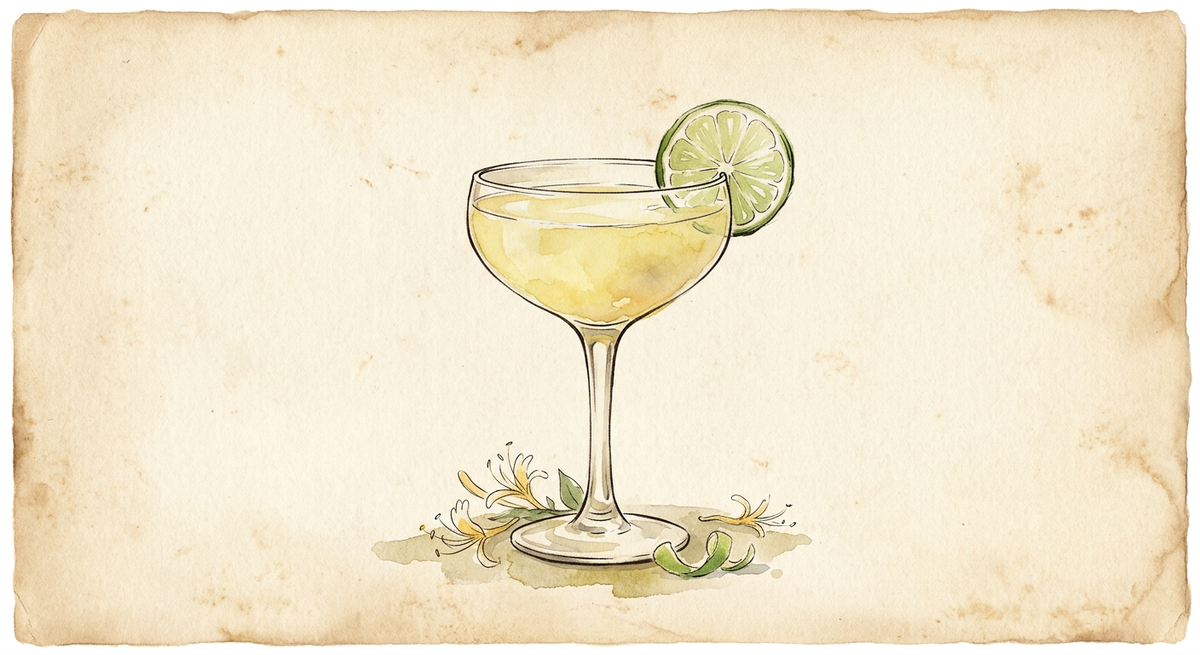
Honeysuckle
A Honeysuckle is 60ml of white rum, 22.5ml of fresh lime juice and 22.5ml of honey syrup (two parts honey, one part warm water), shaken hard for 10 to 12 seconds and double strained into a chilled coupe, with a lime wheel. About 2.4 UK units. It is a daiquiri sweetened with honey instead of sugar. Honey has a floral smell and a waxy weight that sugar lacks, so the drink comes out rounder and more golden than a Daiquiri, and the honey rather than the lime is what you notice first. The name is older than our recipe. It is usually traced to David Embury’s The Fine Art of Mixing Drinks of 1948, where the Honeysuckle is a Bee’s Knees made with rum, and so with lemon. We use lime, which keeps it in the daiquiri family.
Glassware: Coupe Glass
Garnish: Lime wheel
Ingredients
60ml
A clean, light white rum at 40% ABV. Honey is easily buried, so a heavy, funky rum takes the drink over.
22.5ml
Squeezed the same day, ideally within a few hours. The honey rounds the acid without hiding it, so a tired lime shows as flatness.
22.5ml
Two parts honey to one part warm water, stirred until it pours, then cooled. We keep it a month in the fridge. The jar you choose changes the drink more than the rum does.
Instructions
Chill a coupe and squeeze the lime juice the same day.
For the honey syrup, stir two parts runny honey into one part warm water until it pours, then let it cool.
Add the white rum, lime juice and honey syrup to a shaker.
Fill with cubed ice and shake hard for 10 to 12 seconds.
Double strain into the chilled coupe and float a lime wheel on top.
Our version
Embury’s Honeysuckle of 1948 is a Bee’s Knees made with rum, so with lemon; ours uses lime in daiquiri measures, 60ml white rum to 22.5ml each of lime and two-to-one honey syrup.
Source: our own specification. Last checked 10 October 2026.
Expert Tip
Use honey syrup, never neat honey. Mix two parts runny honey with one part warm water and the syrup pours and measures easily. Neat honey turns stiff when it meets cold rum and ice, and stays stuck in the shaker. The honey decides the drink. Acacia or a mild wildflower honey keeps it bright and lets the lime through; heather or chestnut makes it darker and almost savoury. Choose the jar on purpose. Squeeze the lime the same day and shake hard. Honey syrup is thicker than sugar syrup and needs the full 10 to 12 seconds to mix in and chill.
Behind the Honeysuckle
Flavour Profile
A Daiquiri Sweetened With Honey
Take the IBA Daiquiri, 60ml of white rum, 20ml of lime and two bar spoons of sugar, and replace the sugar with honey syrup. That is the Honeysuckle. Equal measures of lime and honey syrup, 22.5ml each, balance it, the same ratio as our Gold Rush, which uses bourbon and lemon.
Rum, lime and honey also meet in the Canchánchara, which the IBA lists among its New Era cocktails as Cuban aguardiente with honey and lime. The Honeysuckle is the shaken, strained version of the same idea.
What Honey Adds
Sugar syrup only sweetens. Honey sweetens and brings a flavour of its own: flowers, wax and sometimes something resinous. It also adds body, so the drink sits heavier on the tongue than a Daiquiri does.
That weight is why a light rum suits it. A heavy Jamaican rum brings weight of its own, and the two together crowd out the lime.
Embury, and the Bee’s Knees
The Honeysuckle is usually traced to David Embury’s The Fine Art of Mixing Drinks of 1948, where it is the Bee’s Knees with rum in place of gin; Difford’s Guide adapts its Honeysuckle Daiquiri from that recipe. Embury’s Bee’s Knees is gin, lemon and honey, so his Honeysuckle uses lemon too.
Difford’s Guide says the Bee’s Knees was long thought to be an American Prohibition drink, thanks to Embury, but originated in Paris: it finds a Brooklyn newspaper of 22 April 1929 and Cocktails de Paris of 1929, credited to Frank Meier of the Ritz. Our Honeysuckle uses lime instead of lemon, which pulls it back towards the Daiquiri.
The Honeysuckle Beside Its Relatives
The Honeysuckle beside the Daiquiri, the Bee’s Knees and the Gold Rush; the Daiquiri and Bee’s Knees rows are the IBA’s, the Gold Rush row is our own recipe
Honeysuckle (ours)
- Spirit
- 60ml white rum
- Citrus
- 22.5ml lime
- Sweetener
- 22.5ml honey syrup
- Serve
- Up, in a coupe
- UK units
- About 2.4
Daiquiri (IBA)
- Spirit
- 60ml white rum
- Citrus
- 20ml lime
- Sweetener
- Two bar spoons caster sugar
- Serve
- Up, in a coupe
- UK units
- About 2.4
Bee’s Knees (IBA)
- Spirit
- 52.5ml gin
- Citrus
- 22.5ml lemon, 22.5ml orange
- Sweetener
- Two teaspoons honey syrup
- Serve
- Up, in a coupe
- UK units
- About 2.1
Gold Rush
- Spirit
- 60ml bourbon
- Citrus
- 22.5ml lemon
- Sweetener
- 22.5ml honey syrup
- Serve
- On one large cube
- UK units
- About 2.4
| Drink | Spirit | Citrus | Sweetener | Serve | UK units |
|---|---|---|---|---|---|
| Honeysuckle (ours) | 60ml white rum | 22.5ml lime | 22.5ml honey syrup | Up, in a coupe | About 2.4 |
| Daiquiri (IBA) | 60ml white rum | 20ml lime | Two bar spoons caster sugar | Up, in a coupe | About 2.4 |
| Bee’s Knees (IBA) | 52.5ml gin | 22.5ml lemon, 22.5ml orange | Two teaspoons honey syrup | Up, in a coupe | About 2.1 |
| Gold Rush | 60ml bourbon | 22.5ml lemon | 22.5ml honey syrup | On one large cube | About 2.4 |
How to Serve It
Very cold, in a coupe taken from the freezer, with a lime wheel floating on top. Honey drinks turn heavy as they warm, so this one is at its best in the first few minutes. For a round, chill the glasses before you start shaking.
With gin, lemon and orange, a Bee’s Knees; with bourbon and lemon, a Gold Rush; with sugar instead of honey, a Daiquiri.
Make it at home
The Spirit
White RumWhite rum is clear rum, usually bottled at 40% ABV, either unaged or rested in oak and then charcoal-filtered back to clear. It is the light, dry rum of the Daiquiri, the Mojito and the Cuba Libre, and the rum most of our recipes mean when they want rum that sits under lime rather than over it.
Master the Techniques
More to explore
Frequently Asked Questions
What is in a Honeysuckle?
Is a Honeysuckle just a honey Daiquiri?
Where does the name come from?
Should I use lemon or lime?
Which honey should I use?
How does it compare with the Gold Rush and the Airmail?
How strong is a Honeysuckle?
Sources.
Correct as of 19 October 2026.
- Difford’s Guide, “Honeysuckle Daiquiri” (secondary source: adapted from a recipe in David A. Embury’s 1948 Fine Art of Mixing Drinks; a Daiquiri with honey in place of sugar, or a Bee’s Knees with rum in place of gin).
- Difford’s Guide, “Bees Knees” (secondary source: long thought American, Prohibition-era; Cocktails de Paris (1929, Frank Meier, Ritz) and the Standard Union of 22 April 1929).
- IBA, “Bee’s Knees” (official specification: 52.5ml dry gin, 2 teaspoons honey syrup, 22.5ml lemon, 22.5ml orange juice).
- IBA, “Daiquiri” (official specification: 60ml white Cuban rum, 20ml lime juice, 2 bar spoons superfine sugar).
- IBA, “Canchanchara” (official New Era specification: 60ml Cuban aguardiente, 15ml lime juice, 15ml raw honey, 50ml water).
You Might Also Like
Gold Rush
A Gold Rush is 60ml bourbon, 22.5ml fresh lemon juice and 22.5ml honey syrup, made with twice as much honey as warm water. Shake it hard for 10 to 12 seconds, strain it onto a single big cube in a rocks glass and finish with a lemon twist. About 2.4 UK units. Punch credits T.J. Siegal, at Milk & Honey in New York, with the idea sometime in 2000, and VinePair dates the drink to 2001. T.J. Siegal, a friend of the owner, Sasha Petraske, ordered his usual Whiskey Sour and asked for it without the egg white and with honey syrup in place of sugar. The change stuck, and the drink became a modern standard. Honey does more than sweeten. It tastes faintly of flowers and wax, gives the drink weight that sugar syrup cannot, and sits comfortably with the vanilla and caramel in bourbon. With no egg and no bitters, the Gold Rush is plainer and heavier than a Whiskey Sour, and quicker to make.
Bee’s Knees
A Bee’s Knees is 52.5ml of London Dry gin, 22.5ml each of fresh lemon and orange juice and two teaspoons (10ml) of honey syrup, made with two parts honey to one of warm water. Shake it hard for 10 to 12 seconds and double strain it into a chilled coupe, with a strip of lemon peel. About 2.1 UK units. The measures are the IBA’s. The orange is the part most recipes leave out. The oldest printings are gin, lemon and honey alone; David Embury suggested a little orange juice as a variation in 1948, and the IBA built it in. Orange softens the lemon, which is why two teaspoons of honey syrup are enough. The drink is often filed under American Prohibition, with honey and lemon covering for bathtub gin. Difford’s Guide, a secondary source, says the earliest printing tells a different story: Cocktails de Paris, published in 1929, credits it to Frank Meier of the Ritz in Paris, and Meier claimed it again in his own book in 1936.
Daiquiri
A Daiquiri is 60ml white rum, 20ml fresh lime juice and two bar spoons of caster sugar. Stir the sugar into the rum and lime in the shaker until it dissolves, then add ice, shake hard for 10 to 12 seconds and double strain into a chilled coupe. About 2.4 UK units. Those are the IBA’s measures, and its method dissolves the sugar first too. The name belongs to Daiquirí, an iron-mining district and beach near Santiago de Cuba. Difford’s Guide credits Jennings Stockton Cox, an American engineer who led one of the first mining parties into Cuba’s iron-ore country after the Spanish-American War of 1898; the Oxford Companion has him making or supervising the first Daiquiri in 1896, and a Santiago bartender naming it in 1908. Difford’s says Constantino Ribalaigua Vert of Havana’s El Floridita made the frozen version famous. With three ingredients and no liqueur or bitters, the Daiquiri hides nothing. A flat rum, tired lime or undissolved sugar shows in the first sip.
Where this one sits
Recipe by Jerry Can Spirits · Updated 19 October 2026