Gold Rush
A Gold Rush is 60ml bourbon, 22.5ml fresh lemon juice and 22.5ml honey syrup, made with twice as much honey as warm water. Shake it hard for 10 to 12 seconds, strain it onto a single big cube in a rocks glass and finish with a lemon twist. About 2.4 UK units. Punch credits T.J. Siegal, at Milk & Honey in New York, with the idea sometime in 2000, and VinePair dates the drink to 2001. T.J. Siegal, a friend of the owner, Sasha Petraske, ordered his usual Whiskey Sour and asked for it without the egg white and with honey syrup in place of sugar. The change stuck, and the drink became a modern standard. Honey does more than sweeten. It tastes faintly of flowers and wax, gives the drink weight that sugar syrup cannot, and sits comfortably with the vanilla and caramel in bourbon. With no egg and no bitters, the Gold Rush is plainer and heavier than a Whiskey Sour, and quicker to make.
Glassware: Rocks Glass
Garnish: Lemon twist
Ingredients
60ml
A bourbon at 40% ABV or a little stronger, with clear vanilla and caramel for the honey to sit on. A better bottle shows, but an ordinary one still makes a good drink.
22.5ml
Squeezed the same day. Matched measure for measure with the syrup, it is all the sharpness the drink gets, and the honey needs every drop.
22.5ml
Two parts runny honey to one of warm water, by weight, stirred until it pours, then cooled. In our kitchen it keeps a month in the fridge.
Instructions
Add the bourbon, lemon juice and honey syrup to a shaker.
Fill with cubed ice and shake hard for 10 to 12 seconds.
Strain into a rocks glass over one large cube.
Express a lemon twist over the surface and drop it in.
Expert Tip
Make the honey syrup first and let it cool. Use twice as much runny honey as warm water and stir until it pours. Honey from the jar goes stiff the moment it meets cold lemon and ice, clinging to the tin, and a one-to-one syrup is too thin to give the drink its weight. Taste your honey before you choose it. Pale wildflower honey gives a bright glass. Chestnut or heather is darker and slightly bitter, and wants a bourbon with some weight behind it. Serve it over one large cube rather than up. The honey opens as the drink slowly dilutes, and a big cube keeps that dilution slow.
Behind the Gold Rush
Flavour Profile
The Origin
Punch says the Gold Rush was one of the early breakout successes at Milk & Honey, opened in 1999 by Sasha Petraske, and that T.J. Siegal, Petraske’s childhood friend, came up with it sitting at the bar sometime in 2000. VinePair dates the drink to 2001 and tells it as the story goes: Siegal ordered his usual Whiskey Sour, omitted the egg white and asked for honey syrup in place of simple syrup. Punch says it is now served around the world.
The Honey Syrup
Two parts honey to one of warm water, by weight, stirred and cooled. That ratio carries the honey’s weight into the drink and still shakes clean. Honey straight from the jar seizes against cold lemon and ice, and a one-to-one syrup thins it towards plain sugar.
The honey you pick changes the glass. Wildflower keeps it bright; heather and chestnut are darker, less sweet and slightly bitter, and push the drink towards autumn.
Gold Rush, Honey Sour and Penicillin compared
Gold Rush
- Whisky
- 60ml bourbon
- Lemon
- 22.5ml
- Honey syrup
- 22.5ml
- Extras
- None
- UK units
- 2.4
Honey Sour
- Whisky
- 60ml bourbon
- Lemon
- 25ml
- Honey syrup
- 15ml
- Extras
- Optional egg white, Angostura
- UK units
- 2.4
Penicillin
- Whisky
- 60ml blended Scotch
- Lemon
- 22.5ml
- Honey syrup
- 22.5ml
- Extras
- Fresh ginger, 7.5ml Islay malt float
- UK units
- 2.7
| Drink | Whisky | Lemon | Honey syrup | Extras | UK units |
|---|---|---|---|---|---|
| Gold Rush | 60ml bourbon | 22.5ml | 22.5ml | None | 2.4 |
| Honey Sour | 60ml bourbon | 25ml | 15ml | Optional egg white, Angostura | 2.4 |
| Penicillin | 60ml blended Scotch | 22.5ml | 22.5ml | Fresh ginger, 7.5ml Islay malt float | 2.7 |
Against the Bee’s Knees
The Bee’s Knees, gin with lemon and honey, is in our view the Gold Rush’s nearest ancestor, and Difford’s Guide finds it in Paris, in the Standard Union of 22 April 1929. They share a structure and taste nothing alike.
Juniper sits against honey as a contrast, and the gin drink stays light. Bourbon’s vanilla and caramel agree with honey, so the Gold Rush is rounder and heavier.
Which Bourbon
Any sound bourbon at 40% ABV or a little stronger works. A higher-strength bottle gives a bolder drink that the honey still balances, so there is no need to save the good bourbon for sipping.
Why It Travelled
It has three ingredients, and most bars already keep honey syrup for other drinks. It needs nothing beyond a hard shake, and it works on an ordinary pour as well as a good one. Those qualities let a recipe move to bars that never saw the original.
How to Serve It
On a single big cube in a rocks glass, a lemon twist squeezed over it and dropped in. The cube slows dilution while the honey opens up.
Make it at home
The Spirit
Whiskey (Bourbon)Under the US standard 27 CFR 5.143, bourbon is an American whiskey whose mash is at least 51% corn, matured in fresh charred oak barrels and bottled at 40% ABV or higher, the figure our recipes use. The fresh charred wood gives it its vanilla, caramel and colour, and the corn gives a rounder, sweeter spirit than rye. It is the base of 26 of our recipes, more than any other whiskey.
More to explore
Frequently Asked Questions
What is the difference between a Gold Rush and a Whiskey Sour?
How strong is a Gold Rush?
How do I make honey syrup for a Gold Rush?
Who invented the Gold Rush?
How does it relate to the Penicillin?
Gold Rush or Honey Sour?
Which honey works best in a Gold Rush?
Sources.
Correct as of 19 October 2026.
- Punch, “Gold Rush” (secondary source: T.J. Siegel, Milk & Honey, opened in 1999 by Sasha Petraske; Siegal came up with the Gold Rush sitting at the bar “sometime in 2000”; now served around the world).
- VinePair, “The Gold Rush Recipe” (secondary source: “In 2001, the Gold Rush cocktail was developed at … Milk & Honey. As the story goes, … T.J. Siegal … came by one evening to order his usual Whiskey Sour … omitted the egg white from his cocktail and asked to replace the standard simple syrup with honey syrup”).
- Difford’s Guide, “Penicillin” (secondary source: adapted from a 2005 recipe created by Sam Ross at Milk & Honey in Manhattan; 60ml blended Scotch, 22.5ml lemon juice, 22.5ml honey and ginger syrup, 7.5ml Islay single malt).
- Difford’s Guide, “Bee’s Knees” (secondary source: originated in Paris; the Standard Union of 22 April 1929 reports it (Jared Brown); not American Prohibition as Embury thought).
You Might Also Like
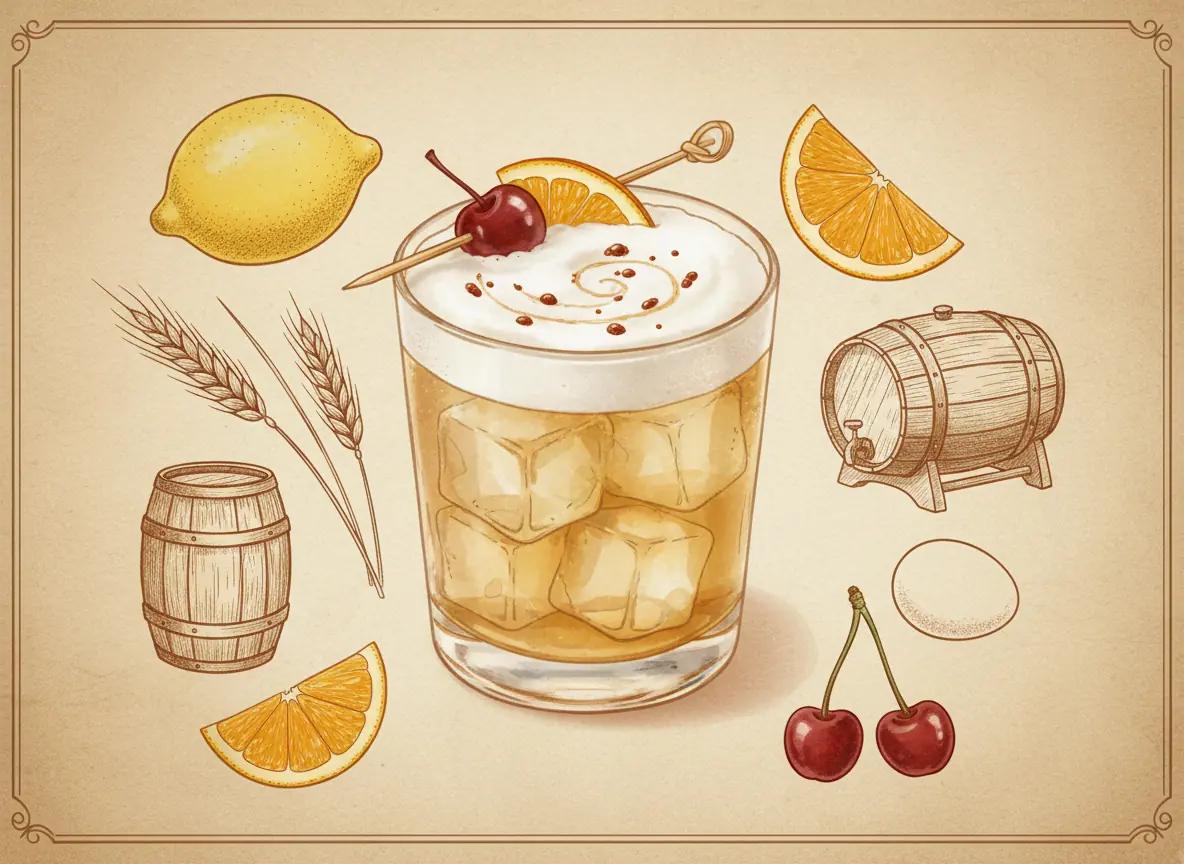
Whiskey Sour
A Whiskey Sour is 45ml of bourbon, 25ml of fresh lemon juice and 20ml of sugar syrup, shaken hard with ice, then poured through a strainer onto fresh cubes in a rocks glass, with half an orange slice and a cherry. Add 15ml of egg white, dry shaken first, and dot the foam with Angostura. About 1.8 UK units. The measures are the IBA’s. The IBA’s egg white is optional and only a few drops; we use 15ml, about half a white, because that is what a full foam takes. The bitters are not in the IBA recipe, and they only go on when there is foam to hold them. The name is in print by 1870, in a Wisconsin newspaper, and the sour is older still: Jerry Thomas printed brandy, gin and rum sours in 1862. Difford’s Guide lists a Boston Sour as bourbon soured with lemon juice and smoothed by egg white.
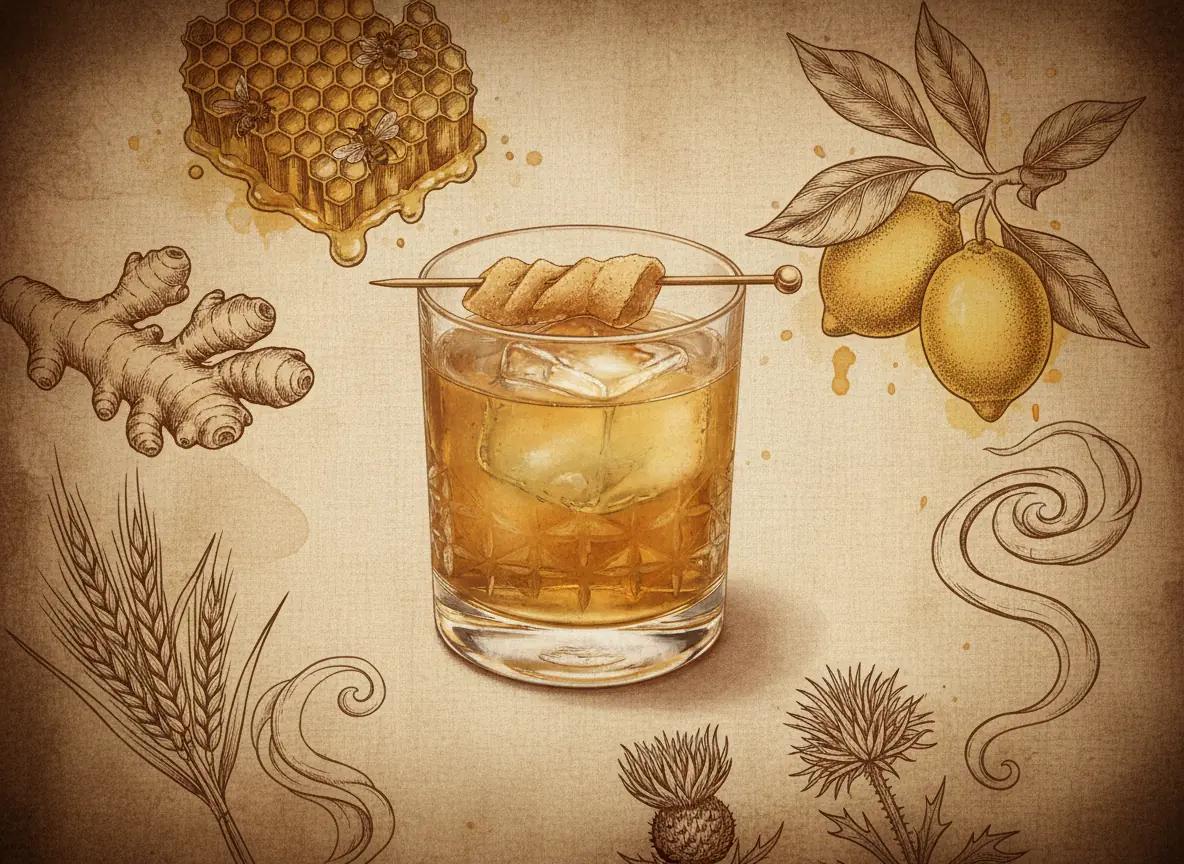
Penicillin
A Penicillin is 60ml blended Scotch, 22.5ml honey syrup, 22.5ml fresh lemon juice and two or three thin slices of fresh ginger, shaken hard and double strained over one large cube, with 7.5ml of Lagavulin 16 floated on top and candied ginger on the rim. That is the IBA specification, at about 2.7 UK units. Difford’s Guide, a secondary source, dates it to 2005 and credits Sam Ross with creating it at Milk & Honey in Manhattan; Chilled Magazine calls Ross an Australian bartender. Chilled says Ross described the name as a tongue-in-cheek reference to the drink’s cure-all properties, and that a nod to the antibiotic discovered by the Scottish scientist Alexander Fleming may have been a factor. It is a whisky sour in structure. The ginger gives it heat, and the smoky malt on top reaches the nose before the first sip.
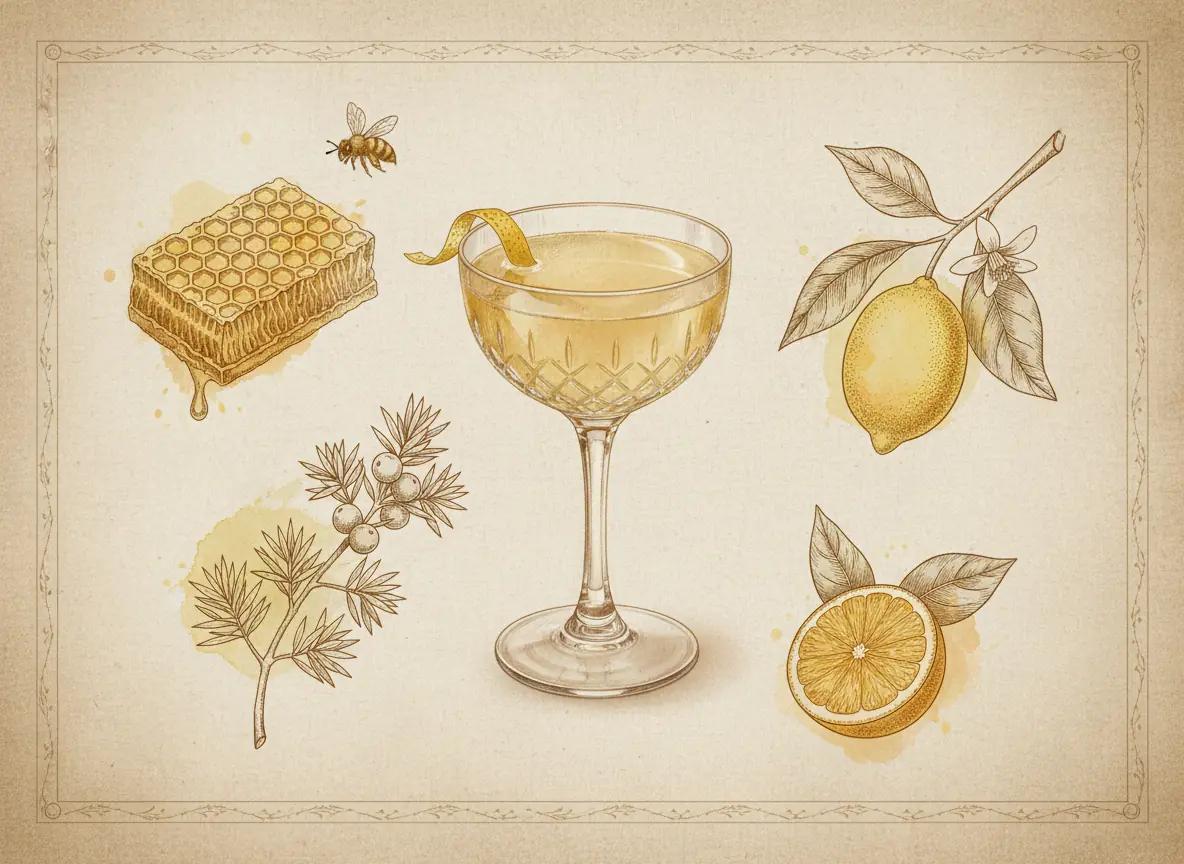
Bee’s Knees
A Bee’s Knees is 52.5ml of London Dry gin, 22.5ml each of fresh lemon and orange juice and two teaspoons (10ml) of honey syrup, made with two parts honey to one of warm water. Shake it hard for 10 to 12 seconds and double strain it into a chilled coupe, with a strip of lemon peel. About 2.1 UK units. The measures are the IBA’s. The orange is the part most recipes leave out. The oldest printings are gin, lemon and honey alone; David Embury suggested a little orange juice as a variation in 1948, and the IBA built it in. Orange softens the lemon, which is why two teaspoons of honey syrup are enough. The drink is often filed under American Prohibition, with honey and lemon covering for bathtub gin. Difford’s Guide, a secondary source, says the earliest printing tells a different story: Cocktails de Paris, published in 1929, credits it to Frank Meier of the Ritz in Paris, and Meier claimed it again in his own book in 1936.
Where this one sits
Recipe by Jerry Can Spirits · Updated 19 October 2026