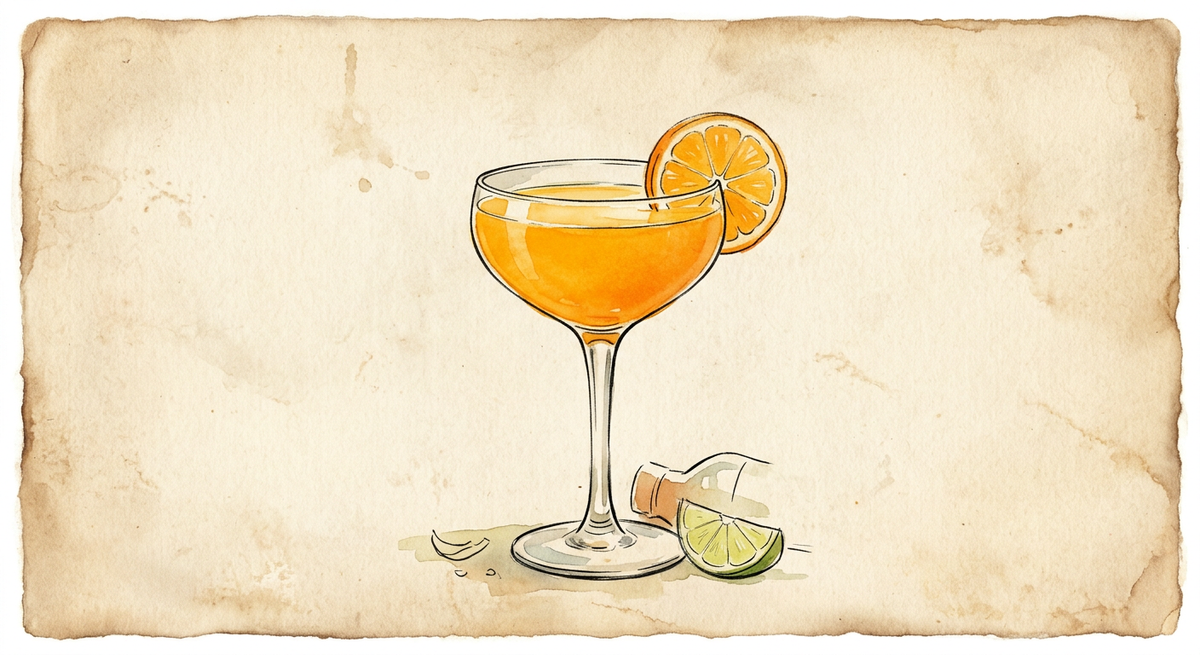
Orange Daiquiri
An Orange Daiquiri is 50ml of white rum, 30ml of fresh orange juice, 10ml of fresh lime juice and 10ml of simple syrup. Shake it hard for 10 to 12 seconds and double strain it into a chilled coupe, with an orange slice on the rim. About 2.0 UK units. It is our own variation on the Daiquiri rather than a recorded classic. Orange takes the place of most of the lime and gives the drink its colour, its smell and much of its sweetness. Orange has far less acid than lime, though, so 10ml of lime stays in to hold the drink up, and the syrup is cut to suit the fruit’s own sugar. The result is softer and rounder than a Daiquiri. It suits anyone who finds the classic too sharp.
Glassware: Coupe Glass
Garnish: Orange slice on the rim
Ingredients
50ml
A lightly aged white rum at 40% ABV with some character, as for a Daiquiri. A very neutral rum leaves only juice; an aged or funky one covers the orange.
30ml
Squeezed the same day, about half a large orange. It brings the colour, the perfume and much of the sweetness, but little acid.
10ml
Squeezed within three hours. Half the lime of a Daiquiri, there for structure rather than flavour.
10ml
Sugar and warm water, 1:1 by weight. Ten millilitres suits an average orange; cut it for a very sweet one. Syrup rather than the Daiquiri’s caster sugar, because it is easier to adjust by taste.
Instructions
Chill a coupe.
Squeeze the orange and lime juice, and use the lime within three hours.
Add the white rum, orange juice, lime juice and simple syrup to a shaker.
Fill with cubed ice and shake hard for 10 to 12 seconds.
Double strain into the chilled coupe.
Cut a slit in an orange slice and seat it on the rim.
Our version
Our own variation on the Daiquiri: 50ml white rum with 30ml orange and 10ml lime, sweetened with 10ml simple syrup.
Source: our own specification. Last checked 10 October 2026.
Expert Tip
Keep the lime in. Orange alone does not have the acid to hold a daiquiri together, and without it the drink tastes like rum and orange juice. Ten millilitres is too little to taste as lime and enough to give the drink shape. Squeeze both fruits yourself. Carton orange juice is pasteurised, which dulls the smell of fresh orange, and that smell is most of the point here. Use the lime within three hours of squeezing, which is Difford’s Guide’s rule for the Daiquiri. Taste the orange juice before you build. Oranges vary in sugar through the year, and a very sweet one may need only half the syrup.
Behind the Orange Daiquiri
Flavour Profile
Orange in the Daiquiri’s Frame
The Daiquiri is rum, lime and sugar. This version keeps the structure and moves most of the citrus from lime to orange. Orange brings colour, a strong perfume and its own sugar; what it does not bring is much acid, which is why 10ml of lime stays in.
It is our own variation. Orange turns up in plenty of rum sours, but no single Orange Daiquiri with fixed measures has come down from the Havana bars, so the proportions here are ours.
The Citrus Split
Lime juice is several times as acidic as orange juice. At 30ml of orange to 10ml of lime, the orange decides the flavour and the lime decides the balance. Take the lime out and the drink goes slack; double it and the orange stops leading.
Because the orange is already sweet, the syrup comes down to 10ml, and the rum to 50ml so the fruit is not buried.
Fresh Fruit, the Same Day
There is nowhere in this drink to hide a poor juice. Squeeze the oranges yourself; carton juice has been pasteurised and has lost most of the smell of fresh fruit. Use the lime within three hours of squeezing; Difford’s Guide says lime juice more than three hours old should not be used, particularly in a Daiquiri.
The Orange Daiquiri Beside Its Relatives
The Orange Daiquiri beside the Daiquiri and two other variations
Orange Daiquiri (ours)
- Rum
- 50ml white rum
- Citrus
- 30ml orange, 10ml lime
- Sweetener
- 10ml simple syrup
- UK units
- About 2.0
Daiquiri (IBA)
- Rum
- 60ml white rum
- Citrus
- 20ml lime
- Sweetener
- Two bar spoons caster sugar
- UK units
- About 2.4
Passion Fruit Daiquiri
- Rum
- 50ml white rum
- Citrus
- 15ml lime, the pulp of one passion fruit
- Sweetener
- 15ml passion fruit syrup
- UK units
- About 2.0
Honeysuckle
- Rum
- 60ml white rum
- Citrus
- 22.5ml lime
- Sweetener
- 22.5ml honey syrup
- UK units
- About 2.4
| Drink | Rum | Citrus | Sweetener | UK units |
|---|---|---|---|---|
| Orange Daiquiri (ours) | 50ml white rum | 30ml orange, 10ml lime | 10ml simple syrup | About 2.0 |
| Daiquiri (IBA) | 60ml white rum | 20ml lime | Two bar spoons caster sugar | About 2.4 |
| Passion Fruit Daiquiri | 50ml white rum | 15ml lime, the pulp of one passion fruit | 15ml passion fruit syrup | About 2.0 |
| Honeysuckle | 60ml white rum | 22.5ml lime | 22.5ml honey syrup | About 2.4 |
How to Serve It
Up, in a coupe from the freezer, double strained so no pulp reaches the surface, with an orange slice seated on the rim for the smell of the peel. Drink it soon. It has less acid than a Daiquiri, so it loses its edge sooner as it warms.
For the original, a Daiquiri; for the same frame with fresh fruit pulp, a Passion Fruit Daiquiri.
Make it at home
The Spirit
White RumWhite rum is clear rum, usually bottled at 40% ABV, either unaged or rested in oak and then charcoal-filtered back to clear. It is the light, dry rum of the Daiquiri, the Mojito and the Cuba Libre, and the rum most of our recipes mean when they want rum that sits under lime rather than over it.
Master the Techniques
More to explore
Frequently Asked Questions
What is in an Orange Daiquiri?
Why keep lime in an Orange Daiquiri?
How does it differ from a classic Daiquiri?
Can I use carton orange juice?
How fresh does the lime need to be?
Is the Orange Daiquiri a classic?
How strong is an Orange Daiquiri?
Sources.
Correct as of 19 October 2026.
- Difford’s Guide, “Daiquiri: the best recipe” (secondary source: lime juice that is more than three hours old should not be used, particularly in a Daiquiri).
- IBA, “Daiquiri” (official specification: 60ml white Cuban rum, 20ml lime juice, 2 bar spoons superfine sugar).
You Might Also Like
Daiquiri
A Daiquiri is 60ml white rum, 20ml fresh lime juice and two bar spoons of caster sugar. Stir the sugar into the rum and lime in the shaker until it dissolves, then add ice, shake hard for 10 to 12 seconds and double strain into a chilled coupe. About 2.4 UK units. Those are the IBA’s measures, and its method dissolves the sugar first too. The name belongs to Daiquirí, an iron-mining district and beach near Santiago de Cuba. Difford’s Guide credits Jennings Stockton Cox, an American engineer who led one of the first mining parties into Cuba’s iron-ore country after the Spanish-American War of 1898; the Oxford Companion has him making or supervising the first Daiquiri in 1896, and a Santiago bartender naming it in 1908. Difford’s says Constantino Ribalaigua Vert of Havana’s El Floridita made the frozen version famous. With three ingredients and no liqueur or bitters, the Daiquiri hides nothing. A flat rum, tired lime or undissolved sugar shows in the first sip.
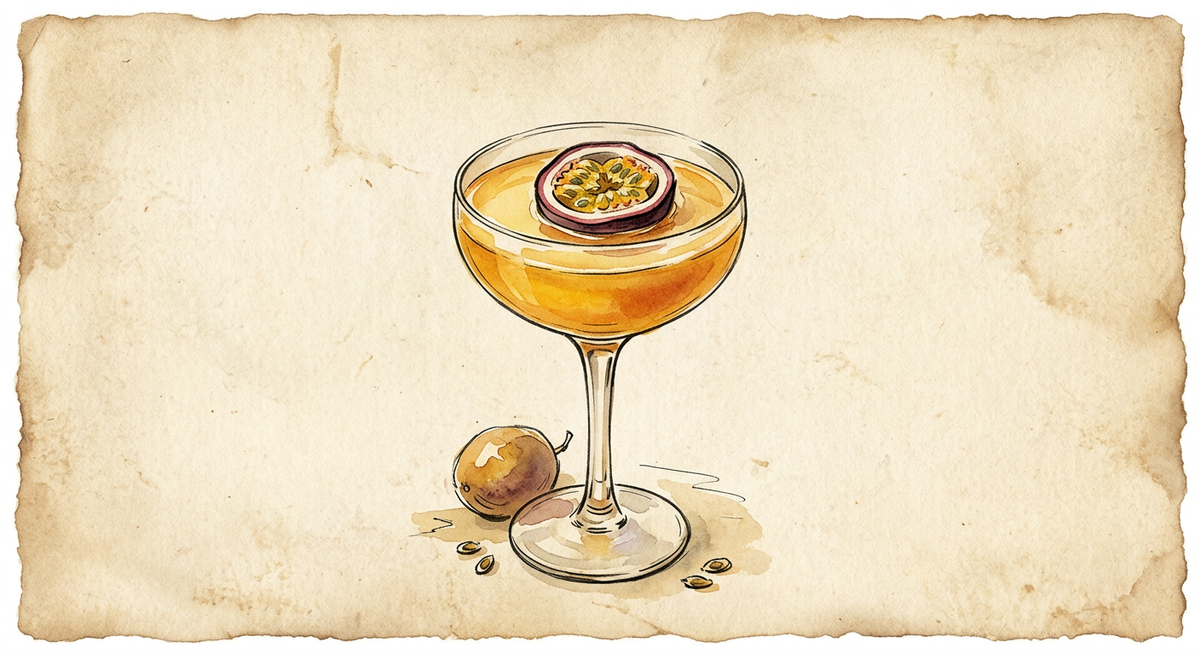
Passion Fruit Daiquiri
A Passion Fruit Daiquiri is 50ml of white rum, the pulp of one ripe passion fruit, 15ml of passion fruit syrup and 15ml of fresh lime juice, shaken hard for 10 to 12 seconds and double strained into a chilled coupe, with half the empty shell floated on top. About 2.0 UK units. It is one of the fruit versions of the Daiquiri, and unlike most of them it is shaken rather than blended, because passion fruit has enough acid of its own to hold a sour together. The fruit comes in twice. The fresh pulp brings scent and sharpness; the syrup brings sweetness with the same flavour, so the lime can stay at 15ml. Ripeness decides the drink: a wrinkled fruit is ready, a smooth one is not.
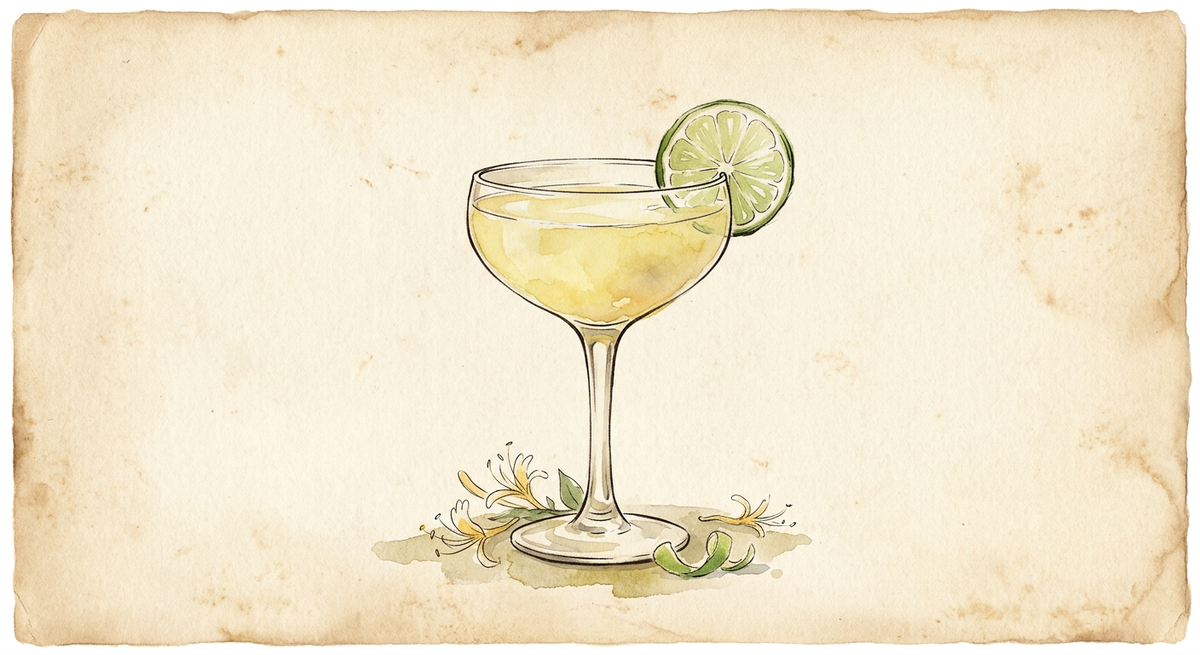
Honeysuckle
A Honeysuckle is 60ml of white rum, 22.5ml of fresh lime juice and 22.5ml of honey syrup (two parts honey, one part warm water), shaken hard for 10 to 12 seconds and double strained into a chilled coupe, with a lime wheel. About 2.4 UK units. It is a daiquiri sweetened with honey instead of sugar. Honey has a floral smell and a waxy weight that sugar lacks, so the drink comes out rounder and more golden than a Daiquiri, and the honey rather than the lime is what you notice first. The name is older than our recipe. It is usually traced to David Embury’s The Fine Art of Mixing Drinks of 1948, where the Honeysuckle is a Bee’s Knees made with rum, and so with lemon. We use lime, which keeps it in the daiquiri family.
Where this one sits
Recipe by Jerry Can Spirits · Updated 19 October 2026