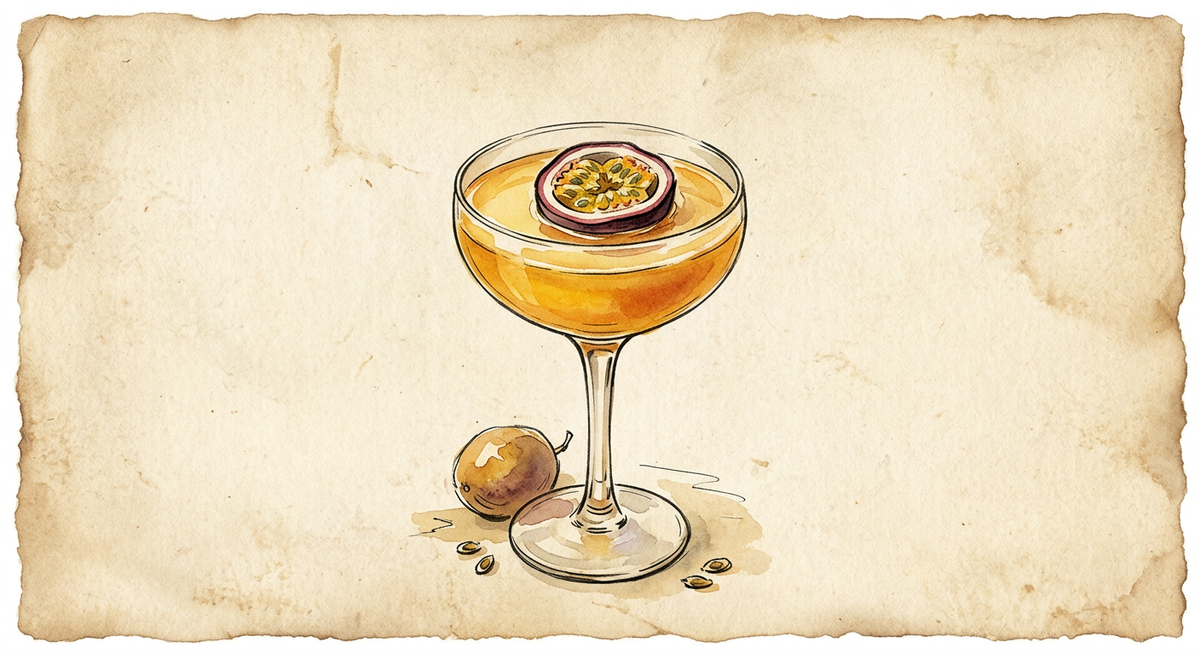
Passion Fruit Daiquiri
A Passion Fruit Daiquiri is 50ml of white rum, the pulp of one ripe passion fruit, 15ml of passion fruit syrup and 15ml of fresh lime juice, shaken hard for 10 to 12 seconds and double strained into a chilled coupe, with half the empty shell floated on top. About 2.0 UK units. It is one of the fruit versions of the Daiquiri, and unlike most of them it is shaken rather than blended, because passion fruit has enough acid of its own to hold a sour together. The fruit comes in twice. The fresh pulp brings scent and sharpness; the syrup brings sweetness with the same flavour, so the lime can stay at 15ml. Ripeness decides the drink: a wrinkled fruit is ready, a smooth one is not.
Glassware: Coupe Glass
Garnish: Half a passion fruit shell floated cut side up
Ingredients
50ml
A light white rum at 40% ABV with some cane character. It carries the fruit; a very neutral rum disappears under it, and an aged one covers the scent.
1, ripe
Wrinkled skin, heavy for its size. The pulp and seeds go into the shaker; the empty half shell becomes the garnish.
15ml
Fresh passion fruit has scent and acid but little sugar, so the syrup supplies the sweetness without bringing in another flavour.
15ml
Squeezed within three hours. Kept to 15ml because the fruit brings acid of its own.
Instructions
Squeeze the lime juice within three hours of shaking.
Halve the passion fruit and scoop the pulp into a shaker, keeping one empty half shell.
Add the rum, passion fruit syrup and lime juice.
Fill with cubed ice and shake hard for 10 to 12 seconds.
Double strain into a chilled coupe, or strain through the shaker alone to keep the seeds.
Float the empty half shell on top, cut side up.
Our version
Recipes vary widely. Ours uses the fresh pulp and a passion fruit syrup together and keeps the lime to 15ml, because the fruit brings acid of its own.
Source: our own specification. Last checked 9 October 2026.
Expert Tip
Buy the fruit a few days early. A smooth, glossy passion fruit is unripe and tastes thin and green; leave it on the counter until the skin wrinkles, then use it. Squeeze the lime within three hours of shaking, the same rule as for a classic Daiquiri. At 15ml it is a small measure, and stale lime shows in a drink this light. Double strain for a smooth drink, or strain through the shaker alone to keep the seeds in for crunch. Either is right, and the floated shell puts seeds on the table regardless.
Behind the Passion Fruit Daiquiri
Flavour Profile
Where It Comes From
It belongs with the many fruit versions of the Daiquiri; Difford’s Guide lists a banana daiquiri and a strawberry daiquiri among them.
Pairing fresh pulp with passion fruit syrup is the modern way to make it, and the same idea runs through the Pornstar Martini.
Why It Shakes
Most fruit daiquiris go into a blender. Banana, strawberry and mango are sweet and low in acid, and they need the blender’s ice and dilution to become drinkable.
Passion fruit is sharp enough to lead a sour on its own, so a hard shake is all it needs. That keeps the drink closer to the original Daiquiri than its blended relations.
Fruit Twice
The pulp brings scent, acid and texture, and very little sugar. Passion fruit is among the less sweet tropical fruits, which is why it suits a sour.
Passion fruit syrup supplies the sweetness and keeps the flavour in one place. Plain sugar syrup would work, with a weaker fruit flavour.
Choosing the Fruit
A smooth, glossy skin means the fruit is not ready. As it ripens the skin wrinkles and dimples, the fruit grows more fragrant, and the pulp is at its most scented.
Ripen them at room temperature rather than in the fridge. A fruit that looks past its best is often right.
Three Daiquiris Side by Side
The Passion Fruit Daiquiri against two other daiquiris
Passion Fruit Daiquiri (ours)
- Rum
- 50ml white
- Fruit
- One ripe passion fruit, 15ml lime
- Sweetener
- 15ml passion fruit syrup
- Method
- Shaken, double strained
Daiquiri
- Rum
- White
- Fruit
- Lime
- Sweetener
- Sugar syrup
- Method
- Shaken
Hemingway Daiquiri
- Rum
- White
- Fruit
- Lime and grapefruit
- Sweetener
- Maraschino
- Method
- Shaken
| Drink | Rum | Fruit | Sweetener | Method |
|---|---|---|---|---|
| Passion Fruit Daiquiri (ours) | 50ml white | One ripe passion fruit, 15ml lime | 15ml passion fruit syrup | Shaken, double strained |
| Daiquiri | White | Lime | Sugar syrup | Shaken |
| Hemingway Daiquiri | White | Lime and grapefruit | Maraschino | Shaken |
How to Serve It
Up, in a chilled coupe, with the empty half shell floated cut side up.
For the plain original, make a Daiquiri; for passion fruit with vanilla vodka and a glass of fizz on the side, a Pornstar Martini.
Make it at home
The Spirit
White RumWhite rum is clear rum, usually bottled at 40% ABV, either unaged or rested in oak and then charcoal-filtered back to clear. It is the light, dry rum of the Daiquiri, the Mojito and the Cuba Libre, and the rum most of our recipes mean when they want rum that sits under lime rather than over it.
Master the Techniques
More to explore
Frequently Asked Questions
How do I know a passion fruit is ripe?
Why both pulp and syrup?
Seeds in or out?
Why is this one shaken when other fruit daiquiris are blended?
Can I use passion fruit purée or juice?
How strong is a Passion Fruit Daiquiri?
Sources.
Correct as of 19 October 2026.
- Difford’s Guide, “Banana Daiquiri” (secondary source: a banana daiquiri, Harry K. Yee credited as the first to add banana at the Hawaiian Village Hotel).
- Difford’s Guide, “Strawberry Daiquiri” (secondary source: a strawberry daiquiri, muddled strawberries, rum and lime).
You Might Also Like
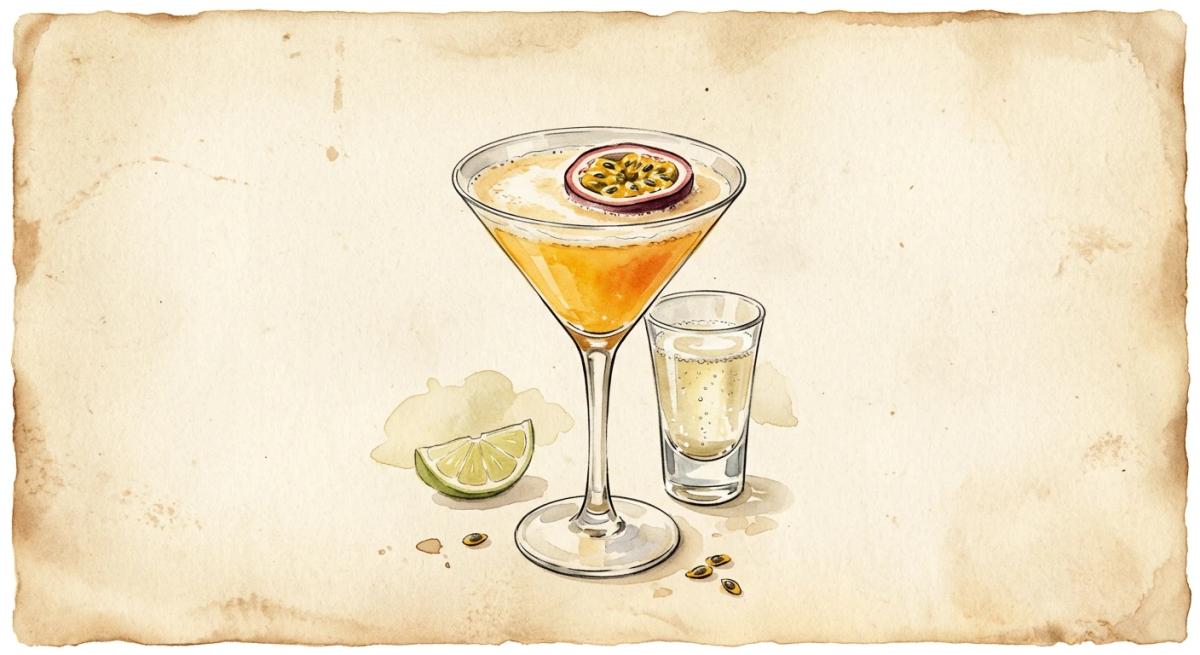
Pornstar Martini
A Pornstar Martini is 50ml vanilla vodka, 20ml passion fruit liqueur, 50ml passion fruit purée and 10ml vanilla syrup, shaken, double strained and served in a chilled martini glass with half a passion fruit floating on top. A 50ml shot of chilled Champagne is served alongside. About 2.2 UK units in the glass and 2.8 with the Champagne. Douglas Ankrah created it in 2002 at Townhouse, his bar in Knightsbridge, by Difford’s Guide’s account, which says he first called it the Maverick Martini after a Cape Town nightclub; his 2004 book, as Difford’s quotes it, headed the recipe Maverick Martini or Porn Star Martini. In November 2018 the Morning Advertiser reported CGA figures that put it first among UK cocktails by share of serves in managed outlets. Passion fruit does the work. The purée gives sharpness and body, the liqueur sweetness and perfume, and the vanilla rounds both. The Champagne is a separate drink, sipped alongside or after.
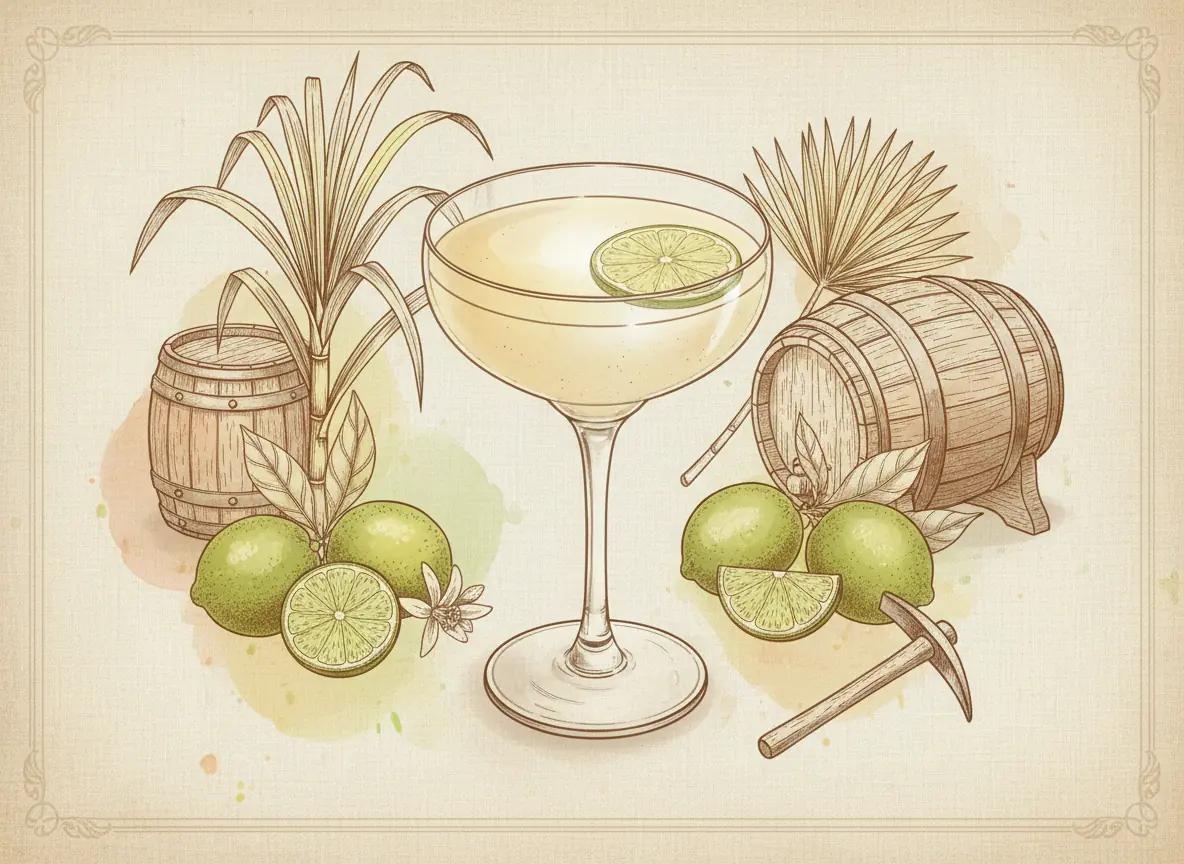
Daiquiri
A Daiquiri is 60ml white rum, 20ml fresh lime juice and two bar spoons of caster sugar. Stir the sugar into the rum and lime in the shaker until it dissolves, then add ice, shake hard for 10 to 12 seconds and double strain into a chilled coupe. About 2.4 UK units. Those are the IBA’s measures, and its method dissolves the sugar first too. The name belongs to Daiquirí, an iron-mining district and beach near Santiago de Cuba. Difford’s Guide credits Jennings Stockton Cox, an American engineer who led one of the first mining parties into Cuba’s iron-ore country after the Spanish-American War of 1898; the Oxford Companion has him making or supervising the first Daiquiri in 1896, and a Santiago bartender naming it in 1908. Difford’s says Constantino Ribalaigua Vert of Havana’s El Floridita made the frozen version famous. With three ingredients and no liqueur or bitters, the Daiquiri hides nothing. A flat rum, tired lime or undissolved sugar shows in the first sip.
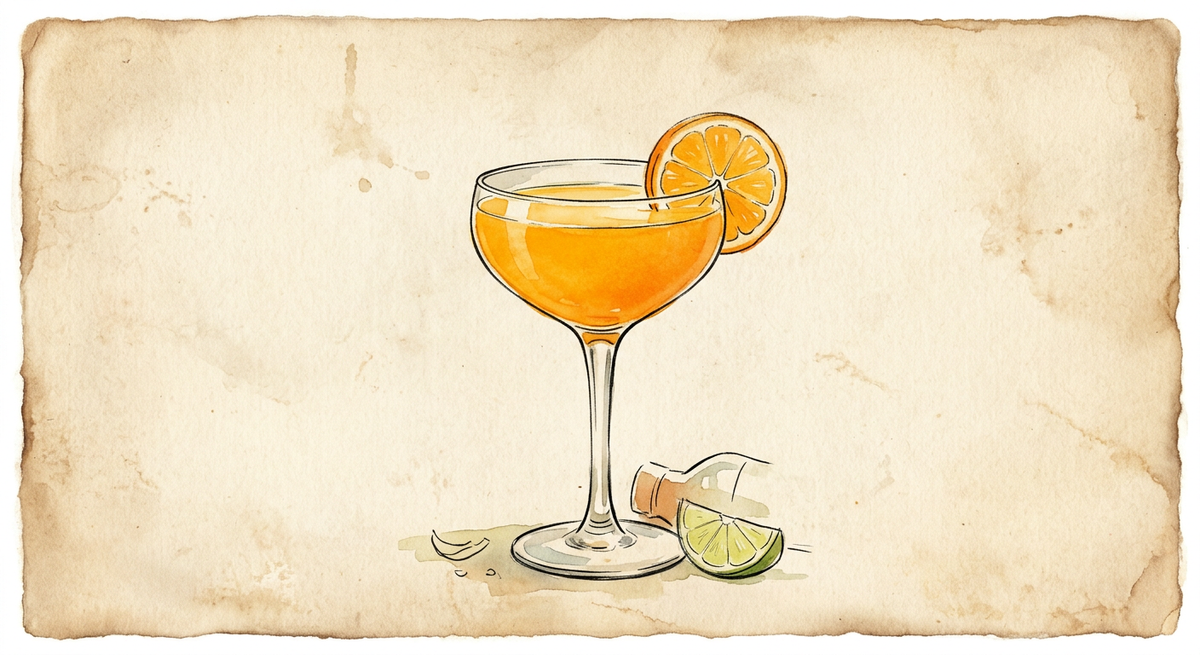
Orange Daiquiri
An Orange Daiquiri is 50ml of white rum, 30ml of fresh orange juice, 10ml of fresh lime juice and 10ml of simple syrup. Shake it hard for 10 to 12 seconds and double strain it into a chilled coupe, with an orange slice on the rim. About 2.0 UK units. It is our own variation on the Daiquiri rather than a recorded classic. Orange takes the place of most of the lime and gives the drink its colour, its smell and much of its sweetness. Orange has far less acid than lime, though, so 10ml of lime stays in to hold the drink up, and the syrup is cut to suit the fruit’s own sugar. The result is softer and rounder than a Daiquiri. It suits anyone who finds the classic too sharp.
Where this one sits
Recipe by Jerry Can Spirits · Updated 19 October 2026