Poet’s Dream
A Poet’s Dream is 45ml of London Dry gin, 22.5ml of dry vermouth, 22.5ml of Bénédictine and two dashes of orange bitters, stirred over ice for 20 to 30 seconds and strained into a chilled coupe, with a lemon twist expressed and dropped in. About 3.2 UK units. Bénédictine usually goes into a drink by the bar spoon or a 7.5ml pour, as background. Here it matches the vermouth and supplies all of the drink’s sweetness, so its honey, spice and herbs come through clearly. Difford’s Guide, which reproduces it, says the recipe was first published in Albert Stevens Crockett’s Old Waldorf-Astoria Bar Days of 1931: a third each of Bénédictine, French vermouth and dry gin, with lemon peel squeezed on top. In our view equal thirds is sweet by current taste, so ours doubles the gin against the other two and adds orange bitters.
Glassware: Coupe Glass
Garnish: Lemon twist
Ingredients
45ml
A London Dry at 40% ABV with clear juniper. Its dryness balances the liqueur; a soft gin lets the drink turn sweet.
22.5ml
Dry vermouth around 18% ABV, French in style. It meets the Bénédictine’s herbs with its own and keeps the drink dry. We keep it in the fridge once open.
22.5ml
The French herbal liqueur from Fécamp, at 40% ABV, sweet with honey and spice. At 22.5ml it is a principal ingredient, not a seasoning.
2 dashes
Two dashes. Orange peel lifts the top of the drink; Angostura’s clove would pile onto the spice already in the Bénédictine.
Instructions
Chill a coupe.
Add the gin, dry vermouth, Bénédictine and orange bitters to a mixing glass.
Fill with cubed ice and stir for 20 to 30 seconds.
Strain into the chilled coupe.
Express a lemon twist over the surface and drop it in.
Our version
Crockett’s 1931 equal thirds of Bénédictine, French vermouth and dry gin, as Difford’s Guide reproduces them, with the gin doubled to 45ml against 22.5ml each of the others and two dashes of orange bitters added.
Source: our own specification. Last checked 10 October 2026.
Expert Tip
Measure the Bénédictine. At 22.5ml it is the drink’s only sweetener, and a few millilitres over turns it syrupy. Use a London Dry with clear juniper. A soft, floral gin gives the liqueur nothing to push against. Do not skip the twist. Bénédictine is honeyed and low in acid, and the lemon oil is the sharpest thing on the drink.
Behind the Poet’s Dream
Flavour Profile
The Waldorf-Astoria Recipe
Difford’s Guide traces the Poet’s Dream to Albert Stevens Crockett’s Old Waldorf-Astoria Bar Days, published in 1931. Crockett gives a third each of Bénédictine, French vermouth and dry gin, with lemon peel squeezed on top.
Difford’s Guide says the recipe is repeated in the 1949 edition of Esquire’s Handbook for Hosts, again as equal thirds.
Bénédictine as a Main Ingredient
Most drinks that use Bénédictine use very little of it. The Ford takes three dashes; the Vancouver and the Bobby Burns take 7.5ml. At that level it adds a rounded, honeyed depth that few drinkers would name.
At 22.5ml it is named on the first sip. Honey comes first, then warm baking spice, then a herbal bitterness at the back. If you own a bottle and have only used it a spoonful at a time, this shows you what it tastes like.
Why the Frame Stays Dry
Everything sweet in the glass is Bénédictine, so the gin and dry vermouth both work against it. Juniper gives the liqueur a firm edge to meet. Dry vermouth adds its own herbs and a mineral finish without adding sugar.
Change either and the balance goes. Sweet vermouth in place of dry turns it towards dessert. Crockett’s equal thirds, with less gin, does the same more gently, which is why ours gives the gin twice the measure of each of the others.
Three Bénédictine Martinis
Our Ford, Poet’s Dream and Vancouver compared
Gin
- Ford
- 45ml Old Tom
- Poet’s Dream
- 45ml London Dry
- Vancouver
- 45ml gin
Vermouth
- Ford
- 45ml dry
- Poet’s Dream
- 22.5ml dry
- Vancouver
- 22.5ml sweet
Bénédictine
- Ford
- Three dashes
- Poet’s Dream
- 22.5ml
- Vancouver
- 7.5ml
Bitters
- Ford
- Three dashes orange
- Poet’s Dream
- Two dashes orange
- Vancouver
- Two dashes orange
Twist
- Ford
- Orange
- Poet’s Dream
- Lemon
- Vancouver
- Lemon
UK units
- Ford
- About 2.8
- Poet’s Dream
- About 3.2
- Vancouver
- About 2.5
| Element | Ford | Poet’s Dream | Vancouver |
|---|---|---|---|
| Gin | 45ml Old Tom | 45ml London Dry | 45ml gin |
| Vermouth | 45ml dry | 22.5ml dry | 22.5ml sweet |
| Bénédictine | Three dashes | 22.5ml | 7.5ml |
| Bitters | Three dashes orange | Two dashes orange | Two dashes orange |
| Twist | Orange | Lemon | Lemon |
| UK units | About 2.8 | About 3.2 | About 2.5 |
How to Serve It
Stirred for 20 to 30 seconds over cubed ice and strained into a chilled coupe. Express the lemon twist over the surface, where its oil cuts the honey on the nose, and drop it in. It is strong for its size, so serve it small and cold before dinner.
For three dashes of Bénédictine in an Old Tom drink, make a Ford; for sweet vermouth and a smaller pour, a Vancouver.
Make it at home
The Spirit
GinGin is a spirit flavoured with juniper berries. Under the retained Regulation (EC) 110/2008, juniper must lead the taste, the floor is 37.5% ABV, and the route the flavour takes sets the grade: plain gin, distilled gin or London gin. Our recipes count it at 40%, and it carries the Martini, the Negroni and the Gin and Tonic.
Master the Techniques
More to explore
Frequently Asked Questions
What is in a Poet’s Dream?
Where does the Poet’s Dream come from?
Why is there more gin than in the original?
How is it related to the Ford?
And the Vancouver?
Is a Poet’s Dream sweet?
How strong is a Poet’s Dream?
Sources.
Correct as of 19 October 2026.
- Difford’s Guide, “Poet’s Dream” (secondary source: “A Prohibition-era cocktail first published in Albert Stevens Crockett’s 1931 book, Old Waldorf-Astoria Bar Days” (one-third Benedictine, one-third French vermouth, one-third dry gin, lemon peel squeezed on top); repeated in the 1949 edition of Esquire’s Handbook for Hosts).
- Bénédictine, “Bénédictine D.O.M” (producer’s product page: 40 % alc/vol).
You Might Also Like
Ford Cocktail
The Ford Cocktail is 45ml Old Tom gin and 45ml dry vermouth, with three dashes of Bénédictine and three dashes of orange bitters, stirred over ice for 20 to 30 seconds, strained into a chilled coupe and finished with a twist of orange peel. About 2.8 UK units. The recipe is George Kappeler’s, from Modern American Drinks, published in 1895, in the Internet Archive’s scan: half a jigger each of Tom gin and French vermouth, three dashes of each seasoning, and a twisted piece of orange peel. The entry gives no reason for the name. Equal parts makes it a wine-forward drink. In our view the lightly sweetened Old Tom meets the vermouth on level terms, the Bénédictine adds a sweet herbal note, and the orange bitters and peel lift the top. Anyone who finds a modern dry Martini severe should try this first.
Vancouver
A Vancouver is 45ml of gin, 22.5ml of sweet vermouth, 7.5ml of Bénédictine and two dashes of orange bitters, stirred over ice for 20 to 30 seconds and served up in a chilled Nick & Nora under a twist of lemon. About 2.5 UK units. It is named for the city and linked by tradition to the Sylvia Hotel on English Bay, which opened in 1913 as an apartment block and, by the hotel’s own history page, opened Vancouver’s first cocktail lounge on 2 July 1954. The link is local tradition: Scout Magazine, an opinion piece, reports an undated Vancouver booklet, About Town, from between 1928 and 1942 that lists the drink with French vermouth, and no recipe we have read fixes when or where it was first mixed. Structurally it is a Hanky Panky with Bénédictine where the Fernet-Branca would be: the same gin and sweet vermouth, seasoned with honey and herbs instead of menthol and bitterness. A barspoon is enough, and the drink is gentler and rounder for it.
Martini
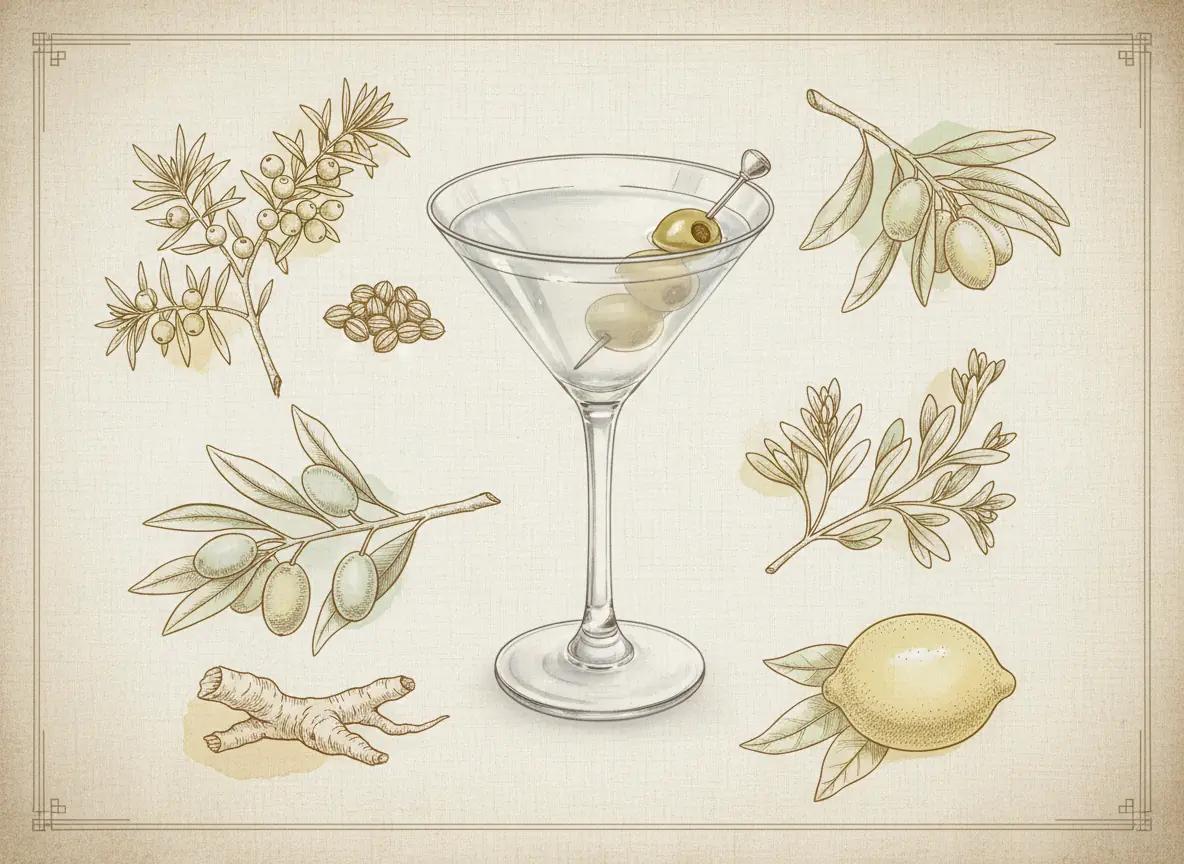
A Martini is 60ml of gin and 10ml of dry vermouth, stirred over ice for 20 to 30 seconds and strained into a chilled Martini glass, with oil from a strip of lemon peel expressed over the top, or green olives if you prefer them. That is the IBA’s Dry Martini, a six-to-one build, and about 2.6 UK units. At six to one the vermouth stops being a partner and becomes a seasoning: a dry wine note and a rounder finish under the juniper. Older recipes were far wetter, and the drink has been poured at every ratio from equal parts to a bare rinse. Nothing in a Martini is sweet or sour: it is gin, vermouth, cold and water. The stir supplies the last two, so it shapes the result as surely as the gin.
Where this one sits
Recipe by Jerry Can Spirits · Updated 19 October 2026