Jigger
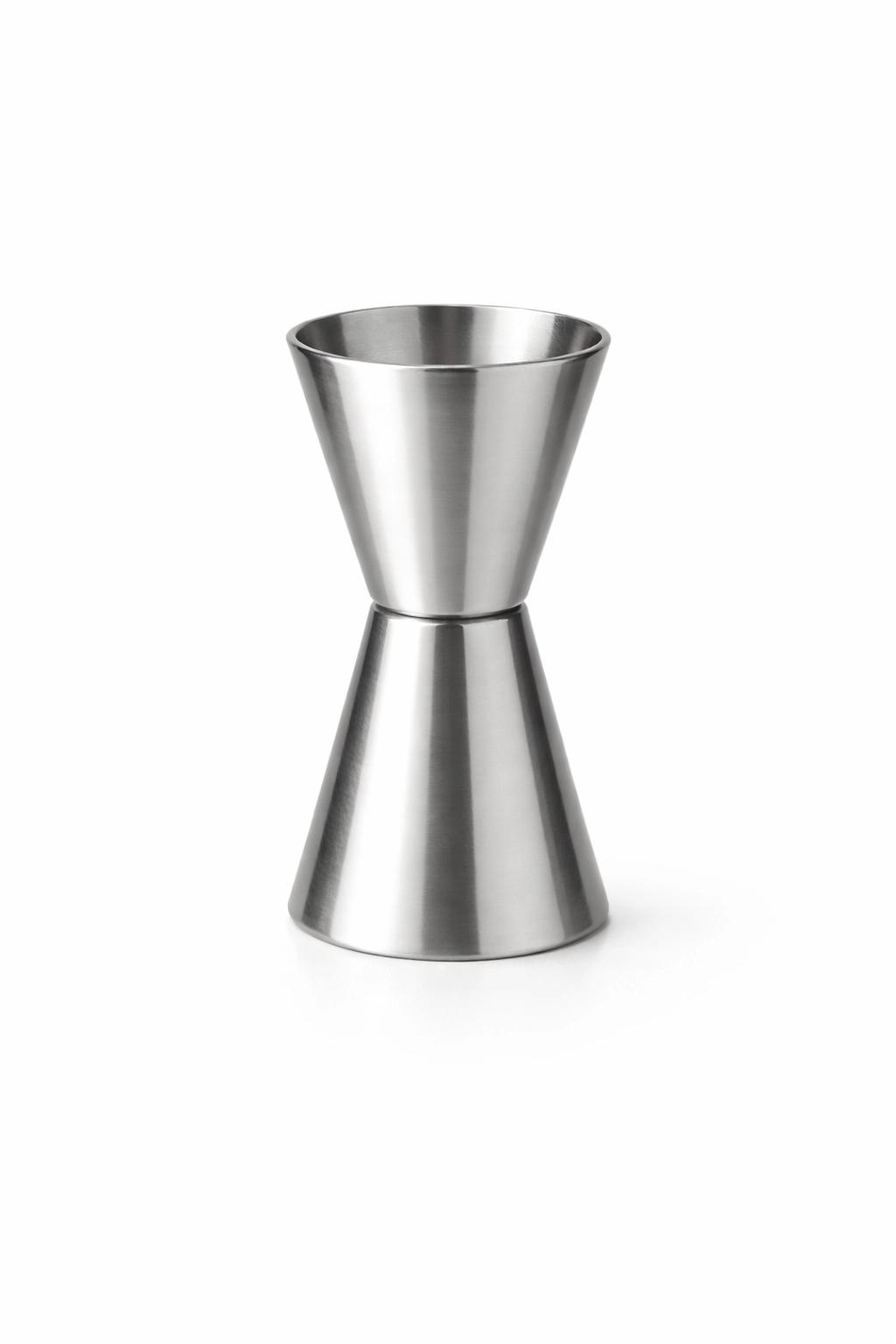
A jigger is a double-ended measure: two cups of different sizes joined at the waist, each filled to the brim for an exact pour. Our shop’s jigger measures 25ml and 50ml, the pub single and double, while a 30/45ml jigger such as Urban Bar’s own Mr Slim fits recipes that move in 15ml steps. It measures the spirit, juice and syrup in nearly every shaken or stirred drink.
Essential Equipment
Recommended for every home bar
About the Jigger
We Make One
Our double jigger in food-grade stainless steel, measuring 25ml and 50ml, the British single and double. Silver, gold, gunmetal or copper.
Stainless Steel Jigger, 25ml/50mlTwo Cups, Two Exact Measures
A jigger is exact in one place: the brim. Fill either cup level with the rim and you have its stated measure; anything in between needs an inner line.
The two common shapes measure the same way. A bell jigger is short and wide, and a Japanese jigger is tall and slim, which makes its inner lines easier to read.
British Pubs Pour 25ml or 35ml
That is why our jigger is 25/50ml. A 35/70ml jigger serves a bar that pours the larger single.
Jigger sizes and what they suit
25/50ml
- Pours at the brim
- A UK single and double on the 25ml system
- Suits
- Pub measures, and recipes written in 25ml steps
35/70ml
- Pours at the brim
- A UK single and double on the 35ml system
- Suits
- Bars that pour the larger single
30/45ml
- Pours at the brim
- 30ml and 45ml, often with a 15ml line
- Suits
- Recipes in 15ml steps, which is most of ours
30/60ml
- Pours at the brim
- 30ml and 60ml
- Suits
- Drinks built on 60ml of spirit
| Jigger | Pours at the brim | Suits |
|---|---|---|
| 25/50ml | A UK single and double on the 25ml system | Pub measures, and recipes written in 25ml steps |
| 35/70ml | A UK single and double on the 35ml system | Bars that pour the larger single |
| 30/45ml | 30ml and 45ml, often with a 15ml line | Recipes in 15ml steps, which is most of ours |
| 30/60ml | 30ml and 60ml | Drinks built on 60ml of spirit |
Our Recipes Run in 15ml Steps
Most of our measures are 15, 22.5, 30, 45 or 60ml. The Paper Plane is four 30ml parts, and the Tom Collins is built on 60ml, 30ml and 15ml, so a 30/45ml jigger with a 15ml line pours both.
Smaller amounts need a line or a spoon. The Vesper takes 7.5ml of Lillet Blanc, and a guess at that size easily comes out at twice the measure.
Fill to the Brim and Read at Eye Level
Keep pouring until the liquid reaches the rim. Stopping a little short on each ingredient leaves the drink both small and out of balance, because the shortfall is rarely the same twice.
For an inner line, stand the jigger on the counter and bring your eye down to it. Seen from over the top, a cone looks fuller than it is.
Using the Jigger
Usage
Measuring spirits, liqueurs, juice and syrup for cocktails. A 25/50ml jigger gives the British single and double; a 30/45ml one suits most of our recipes, which run in 15ml steps, and inner lines cover 15ml and 22.5ml.
Pro Tip
Measure the cheaper ingredients first. If a pour goes wrong, you tip away lemon juice rather than the spirit.
Professional Tips
- Fill each cup until the liquid is level with the rim.
- Hold it over the shaker tin while you fill, so any spill lands in the drink.
- Check an inner line with the jigger standing on the counter and your eye level with it.
- Measure thin ingredients before sticky ones, so syrup does not short the next pour.
Alternatives
Budget Alternative
An unplated stainless jigger with its sizes stamped on. For amounts under 25ml, kitchen measuring spoons are more accurate than a guess in a cone.
Premium Option
A heavier jigger with etched inner lines at 15ml and 22.5ml. The lines save a second tool; the weight only makes it steadier to hold.
Specifications
Material
Stainless steel, sometimes plated
Capacity
25/50ml (our shop’s jigger); Urban Bar’s own listings run 20/40ml, 25/50ml, 30/45ml and 30/60ml, with inner lines at 10, 15, 20, 25, 30 or 45ml depending on the model
Details
Two cups joined at the waist: the bell pattern short and wide, the Japanese pattern tall and slim
More to explore
Common Questions
What size is a jigger in the UK?
What are the UK pub measures for spirits?
How do you use a jigger accurately?
How many ml is a jigger?
Is a shot glass accurate enough to measure with?
Why measure instead of free pouring?
How do you measure 7.5ml?
What is a Japanese jigger?
Sources.
Checked between 18 October and 20 October 2026.
- Jerry Can Spirits shop, “Stainless Steel Jigger, 25ml/50ml”.
- Urban Bar, “Mr Slim Jigger 30/45ml” (30ml and 45ml to the brim; interior lines at 10, 20, 15 and 30ml).
- Urban Bar, “Mr Slim Jigger 30/60ml” (interior line at 45ml).
- legislation.gov.uk, “The Weights and Measures (Intoxicating Liquor) Order 1988, article 3” (gin, rum, vodka and whisky in 25ml or 35ml, or multiples, one quantity per premises).
- The Oxford Companion to Spirits and Cocktails (David Wondrich), “jigger” (secondary source: purpose-made jiggers from the 1870s; the double jigger by the end of the nineteenth century; the size slipping from two ounces to an ounce and a half in the twentieth century).
- Google Patents, “Design for a jigger, US design patent 22,768 (C. P. Dungan, 5 September 1893)” (primary: “two hollow cones cut off at a short distance from their points and placed point to point”).
Made with the Jigger
Used In These Cocktails
Related Equipment
Updated 20 October 2026