Japanese Jigger
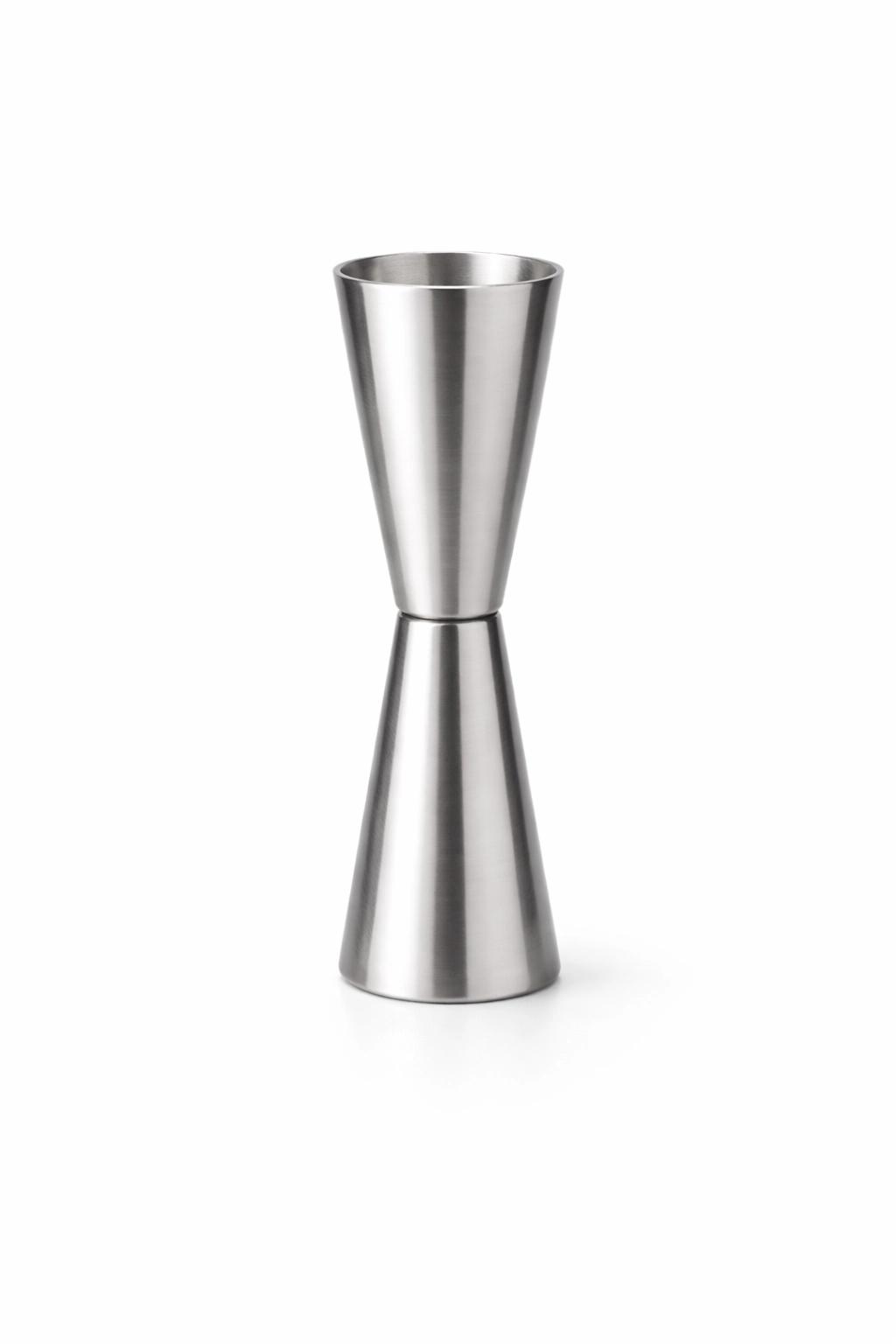
A Japanese jigger is a slim double-cone measure with a small cup at one end and a larger one at the other: 30ml and 45ml is the pairing of Urban Bar’s own Mr Slim, and 25ml and 50ml versions such as its Ginza match British pub measures. Its narrow cups are taller than a bell jigger's for the same volume, and many carry inner lines at 15ml or 22.5ml. It measures every liquid in a shaken or stirred drink, from the four 22.5ml parts of a Last Word to the 45ml base of a sour.
About the Japanese Jigger
We Make One
A slim double-cone jigger in silver, gold, gunmetal or copper, measuring 25ml and 50ml: the British single and double.
Stainless Steel Jigger, 25ml/50mlA Narrow Cup Reads More Precisely
The same 30ml stands taller in a slim cone than in a squat one. Each millimetre of height then holds less liquid, so a small error at the rim costs less of the drink.
That only helps if you fill it. Pour until the surface is level with the rim and slightly domed, then stop.
Halfway Up Is Not Half
Each cup is a cone, wider at the rim than at the waist. Filled to half its height, it holds well under half its volume, which is why a 22.5ml measure guessed in a 45ml cup comes out short.
Inner lines solve that. Stand the jigger upright on the counter and read the line at eye level.
Which jigger suits which measures
Japanese 30/45ml
- Cups
- 30ml and 45ml; Urban Bar’s Mr Slim has lines at 10, 15, 20 and 30ml
- Pours easily
- 15ml, 22.5ml, 30ml, 45ml
- Suits
- Recipes in 15ml steps, which is most of ours
Japanese 25/50ml
- Cups
- 25ml and 50ml
- Pours easily
- A UK single and double
- Suits
- British measures, and our 25ml and 50ml pours
Japanese 30/60ml
- Cups
- 30ml and 60ml; Urban Bar’s Mr Slim has a line at 45ml
- Pours easily
- Up to a 60ml base
- Suits
- Martinis and other drinks built on 60ml
Bell jigger
- Cups
- 25/50ml in our shop’s jigger, on a wider cone
- Pours easily
- Its two brim measures
- Suits
- A first jigger; harder to read part-filled
| Jigger | Cups | Pours easily | Suits |
|---|---|---|---|
| Japanese 30/45ml | 30ml and 45ml; Urban Bar’s Mr Slim has lines at 10, 15, 20 and 30ml | 15ml, 22.5ml, 30ml, 45ml | Recipes in 15ml steps, which is most of ours |
| Japanese 25/50ml | 25ml and 50ml | A UK single and double | British measures, and our 25ml and 50ml pours |
| Japanese 30/60ml | 30ml and 60ml; Urban Bar’s Mr Slim has a line at 45ml | Up to a 60ml base | Martinis and other drinks built on 60ml |
| Bell jigger | 25/50ml in our shop’s jigger, on a wider cone | Its two brim measures | A first jigger; harder to read part-filled |
British Measures and Ours Differ
In a British pub, gin, rum, vodka and whisky sold by the glass come in 25ml or 35ml, or multiples of one of them, and each bar uses one. A 25/50ml jigger pours the 25ml system exactly.
Our recipes are mostly written in 15ml steps: 15, 22.5, 30, 45 and 60ml. A 30/45ml jigger with inner lines covers those without arithmetic, and the Last Word, split four ways at 22.5ml, is the test of it.
Hold It at the Waist
Grip the band where the cones meet between first and second fingers, with the cup over the tin. A turn of the wrist empties it in one movement.
Pour decisively. A slow tip leaves a film inside, and in a narrow cup that film is a noticeable share of a small measure.
Using the Japanese Jigger
Usage
Measuring spirits, juice and syrup for shaken and stirred drinks. A 30/45ml jigger suits recipes written in 15ml steps, which is most of ours; a 25/50ml one pours the British single and double, and the 25ml and 50ml measures some of our recipes use.
Pro Tip
Fill each cup over the shaker tin, not beside it. A brim-full jigger spills as soon as it moves, and over the tin the spill lands in the drink instead of on the bar.
Professional Tips
- Fill until the surface domes slightly over the rim. That is the full measure.
- Read an inner line at eye level, never looking down into the cup.
- Hold it at the waist between first and second fingers, and empty it with a turn of the wrist.
- Measure syrup last, or rinse the cup before the next ingredient.
Alternatives
Budget Alternative
A plain stainless double jigger with no inner lines, paired with a set of measuring spoons for the 5ml, 10ml and 15ml amounts. Together they pour every measure our recipes ask for.
Premium Option
A heavier jigger with etched inner lines and a weighted waist. The weight steadies the hand; it does not make the measure any more exact.
Specifications
Material
Stainless steel, sometimes plated gold, copper or black
Capacity
30/45ml (lines at 10, 15, 20 and 30ml) and 30/60ml (line at 45ml) in Urban Bar’s own Mr Slim; its Ginza pattern comes in 25/50ml to match UK measures
Details
Two narrow cones joined at the waist, often with a raised band to grip and a rolled rim
More to explore
Common Questions
What size is a Japanese jigger?
Is a Japanese jigger more accurate than a bell jigger?
Which jigger suits UK measures?
How do you measure 22.5ml?
How do you hold a Japanese jigger?
Can a jigger go in the dishwasher?
Sources.
Correct as of 18 October 2026.
- Urban Bar, “Mr Slim Jigger 30/45ml” (30ml and 45ml to the brim; interior lines at 10, 20, 15 and 30ml).
- Urban Bar, “Mr Slim Jigger 30/60ml” (interior line at 45ml).
- Urban Bar, “Ginza Stainless Steel Jigger 25ml/50ml”.
Master the Technique
Made with the Japanese Jigger
Used In These Cocktails
Related Equipment
Updated 18 October 2026