Cantaritos
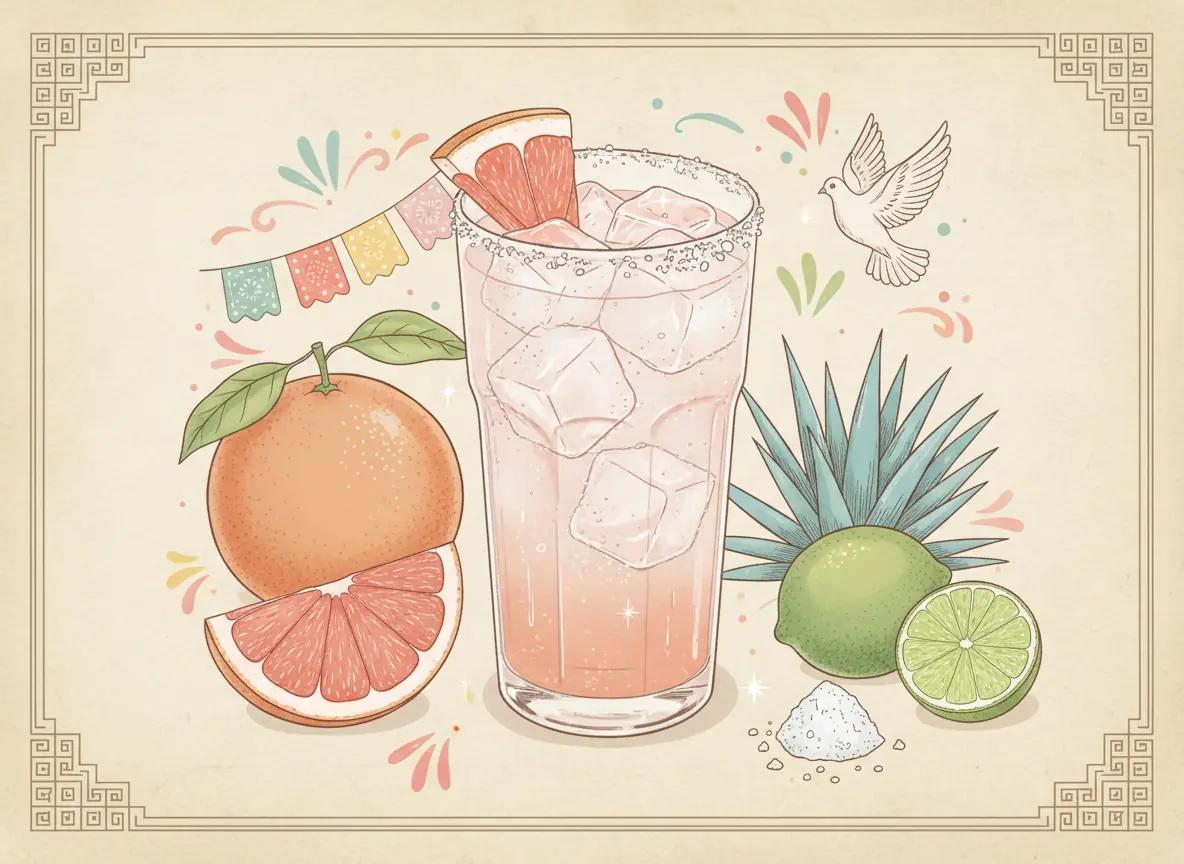
Cantaritos is 50ml of blanco tequila with 30ml of fresh orange juice, 15ml of fresh lime juice and 30ml of fresh grapefruit juice, built over ice in a soaked clay cup with half the rim salted, topped with 90ml of grapefruit soda and finished with a lime wheel. About 2.0 UK units. The name comes from the cup. Difford’s Guide describes it as made in the bars, cafés and roadside stalls of Jalisco and served in a clay pot that helps keep it cold, and InsideHook describes a roadside venue in Amatitán, Jalisco, pouring it into large clay pots for groups. We have found no source that names an inventor, and the measures vary; these are ours. It is a Paloma with more fruit. Orange brings the sweetness, lime the sharpness and grapefruit the bitter edge, which the soda then repeats.
Glassware: Copper Mug
Garnish: Half salt rim and Lime wheel
Ingredients
50ml
Unaged, at our working 40% ABV. Its pepper and raw agave hold their own against three juices and a soda; an aged tequila softens into the background.
30ml
Squeezed the same day. The sweetness in the glass: with no syrup in the build, the orange and the soda carry all of it.
15ml
Squeezed the same day. Half the measure of the other juices, because lime is the sharpest of the three and more would flatten them.
30ml
Squeezed the same day. The bitter edge, which the soda then repeats; between them grapefruit is the loudest thing in the cup.
90ml
Cold and freshly opened. The Oxford Companion traces the Paloma to a 1950 Squirt brochure; a drier soda keeps the drink sharper.
Instructions
Soak a clay cantarito in cold water, or chill a copper mug.
Squeeze the orange, lime and grapefruit juice the same day.
Run a lime wedge around half the outer rim and dip it in flaky salt.
Fill with cubed ice and add the tequila and the three juices.
Top with the grapefruit soda and stir once.
Garnish with a lime wheel.
Our version
Cantaritos is a roadside drink with no fixed recipe; the measures vary from stand to stand. Ours pours 50ml of blanco, 30ml each of orange and grapefruit, 15ml of lime and 90ml of grapefruit soda.
Source: our own specification. Last checked 9 October 2026.
Expert Tip
Soak the clay cup in cold water before you build in it. Unglazed clay holds the water, and as it evaporates from the outside it draws heat from the drink. A dry cup does none of that. Without clay, use a copper mug or the coldest glass you have. The drink does not depend on the cup; it is simply colder in one. Salt half the rim. In our experience salt dulls bitterness and lifts sweetness, and with three juices in the glass a mouthful with salt and a mouthful without taste different. Keep the salt on the outside of the rim so none falls in.
Behind the Cantaritos
Flavour Profile
Where It Comes From
InsideHook describes a roadside venue in Amatitán, Jalisco, an hour outside Guadalajara, where staff pour bottles of soda, juice and tequila into giant clay pots shared among large groups.
It is a regional folk drink. InsideHook quotes Lunazul’s master distiller as saying it is not possible to say who invented it, and that it was apparently born in Jalisco during the Mexican Revolution; we have found no document for that, and the recipe varies.
InsideHook calls the clay cup a little pitcher, and the drink is named for it.
Three Fruits, Three Jobs
Most tequila highballs use one fruit: grapefruit in a Paloma, lime in a Ranch Water. Cantaritos uses three, each for a different job.
Orange carries the sweetness, with no syrup anywhere in the build. Lime brings sharpness, at half the measure of the others. Grapefruit brings bitterness, and the soda doubles it.
The Clay Cup
Unglazed clay is porous. Soaked, it holds water, and as that water evaporates from the outer surface it takes heat with it, so the drink inside gets colder. Difford’s Guide describes the same effect in a traditional Cantaritos pot.
None of it is needed for a good drink. If you can get a cantarito, though, soak it and use it.
Salt and Bitterness
Salt on the rim changes the taste of what follows it. In our experience it dulls bitterness and lifts sweetness, which suits a drink built on grapefruit twice over.
Salt only half the rim, so each sip is a choice. Use flaky salt, and wet only the outside of the rim so none drops into the drink.
Cantaritos Beside the Paloma
Cantaritos beside two tequila highballs with a salted rim; all three are our recipes
Cantaritos (ours)
- Tequila
- 50ml blanco
- Juice
- 30ml orange, 15ml lime, 30ml grapefruit
- Top
- 90ml grapefruit soda
- Rim
- Half salted
Paloma
- Tequila
- Blanco
- Juice
- Lime
- Top
- Grapefruit soda
- Rim
- Salted
Batanga
- Tequila
- Blanco
- Juice
- Lime
- Top
- Cola
- Rim
- Salted
| Drink | Tequila | Juice | Top | Rim |
|---|---|---|---|---|
| Cantaritos (ours) | 50ml blanco | 30ml orange, 15ml lime, 30ml grapefruit | 90ml grapefruit soda | Half salted |
| Paloma | Blanco | Lime | Grapefruit soda | Salted |
| Batanga | Blanco | Lime | Cola | Salted |
How to Serve It
Over plenty of ice in a soaked clay cup or a cold copper mug, with half the rim salted and a lime wheel.
It is a drink for a hot afternoon and a group.
For grapefruit soda and lime alone, make a Paloma; for cola in place of the soda, a Batanga.
Make it at home
The Spirit
TequilaTequila is a Mexican spirit distilled from the blue agave plant, made, the Oxford Companion says, only in Jalisco and municipalities of four other states; our recipes use 40% ABV. A label reading 100% agave means every sugar came from the plant, where plain tequila needs only 51%. Most of our 26 tequila recipes ask for 100% agave blanco.
More to explore
Frequently Asked Questions
What is a cantarito?
Is Cantaritos just a Paloma with orange?
What if I have no clay cup?
Why three different citrus juices?
Which grapefruit soda should I use?
How strong is Cantaritos?
Can I make Cantaritos for a group?
Sources.
Correct as of 19 October 2026.
- Difford’s Guide, “Cantarito” (secondary source: commonly made in bars, cafés and roadside stalls of Jalisco; Cantaritos clay pots; wetting the porous clay lets water evaporate from the outside and keeps the contents cold; fresh orange, grapefruit and lime juice, tequila and grapefruit soda).
- InsideHook, “The Cantarito Is the Most Fun Drink I’ve Ever Had” (secondary source: a roadside venue in Amatitán, an hour outside Guadalajara, pouring soda, juice and tequila into giant clay pots; origins murky, apparently born in Jalisco during the Mexican Revolution (Lunazul’s master distiller); a clay “little pitcher”; the clay keeps the drink cool longer (the same speaker)).
- The Oxford Companion to Spirits and Cocktails (David Wondrich), “The Paloma” (secondary source: tequila and grapefruit soda from a 1950 Squirt brochure; Squirt launched in Mexico in 1955; in Tlaquepaque the Paloma evolved into the Cantarito, in an earthenware cazuela).
You Might Also Like
Paloma
A Paloma is 50ml of blanco tequila, 5ml of fresh lime juice and a pinch of salt over ice in a highball, topped with 100ml of pink grapefruit soda and stirred gently once. Those are the IBA’s measures. We salt half the rim and add a grapefruit slice and a lime wheel. About 2.0 UK units. Paloma is Spanish for dove. The Oxford Companion traces the tequila and grapefruit soda combination to 1950, when a brochure for Squirt suggested mixing it with tequila, with Squirt launched in Mexico in 1955, and says it is unknown who adapted the combination to Mexican tastes. The soda does most of the work. It brings the grapefruit, the sugar and the fizz in one pour, so the recipe needs no syrup and only a little lime. The pinch of salt in the drink softens the grapefruit’s bitter edge and lets the agave through.
Batanga
A Batanga is 50ml of blanco tequila and 120ml of cola over ice in a highball with half the rim salted, with half a lime squeezed in and its shell dropped after it, stirred once. About 2.0 UK units. At La Capilla, the bar it comes from, the stir is done with the knife that cut the limes. Punch reports that Don Javier Delgado Corona kept post behind the bar at La Capilla in the town of Tequila for almost 70 years, and he is credited with it. Garden & Gun has him opening La Capilla in 1961, and the Oxford Companion calls the Batanga a 1950s drink; Punch puts it in the late 1950s or early 1960s and says no one remembers exactly. He died in 2020, at 95, Punch says. It is a Cuba Libre with tequila in place of rum and salt on the rim. The salt does real work: it dulls the bitterness of the cola and lets the pepper of the agave through, so the glass drinks drier than tequila and cola sound.
Tequila Sunrise
A Tequila Sunrise is 45ml of blanco tequila and 90ml of fresh orange juice over ice in a highball, with 15ml of grenadine added last, which sinks and shades the glass from red to orange. It is served unstirred, with a straw. About 1.8 UK units. Those are the IBA’s measures. Difford’s Guide credits the version most people know to Bobby Lozoff, then a 22-year-old bartender at the Trident in Sausalito, California, who created it in 1970. At a party there to open the Rolling Stones’ 1972 American tour, Difford’s says, Mick Jagger loved the one Lozoff made him. An older Tequila Sunrise, created around 1930 at the Agua Caliente resort in Tijuana by the Oxford Companion’s account, was a different drink. Fresh orange juice and a grenadine made from pomegranate turn it from a sweet party drink into a bright, simple long one.
Where this one sits
Recipe by Jerry Can Spirits · Updated 19 October 2026