Tequila Sunrise
A Tequila Sunrise is 45ml of blanco tequila and 90ml of fresh orange juice over ice in a highball, with 15ml of grenadine added last, which sinks and shades the glass from red to orange. It is served unstirred, with a straw. About 1.8 UK units. Those are the IBA’s measures. Difford’s Guide credits the version most people know to Bobby Lozoff, then a 22-year-old bartender at the Trident in Sausalito, California, who created it in 1970. At a party there to open the Rolling Stones’ 1972 American tour, Difford’s says, Mick Jagger loved the one Lozoff made him. An older Tequila Sunrise, created around 1930 at the Agua Caliente resort in Tijuana by the Oxford Companion’s account, was a different drink. Fresh orange juice and a grenadine made from pomegranate turn it from a sweet party drink into a bright, simple long one.
Glassware: Highball Glass
Garnish: Orange slice and Maraschino cherry
Ingredients
45ml
A blanco made from 100% agave, at about 40% ABV. Its pepper and green agave stand up to the juice, where a cheap mixto tastes harsh against it.
90ml
Squeezed the same day, from about two oranges. It is twice the tequila and sets the taste of the whole drink.
15ml
Made from pomegranate juice and sugar. It is denser than the juice, which is what lets it sink, and it brings a tart fruit edge as well as colour. Bright red syrups sink the same way and taste only of sugar.
Instructions
Fill a highball glass with cubed ice.
Pour in the tequila, then the orange juice.
Pour the grenadine slowly over the back of a bar spoon held against the inside of the glass, and let it sink.
Garnish with an orange slice and a cherry, and serve with a straw. Do not stir.
Source: the IBA (IBA measures and method; we add a cherry to the garnish). Last checked 10 October 2026.
Expert Tip
Pour the grenadine last and leave it. It is heavier than the juice, so it sinks and the colour fades upward through the glass. Stir it and the sunrise is gone. Run the grenadine slowly down the back of a bar spoon held against the inside of the glass. Poured straight in, it punches through the juice and mixes on the way down. Squeeze the oranges yourself. At 90ml the juice is most of the drink, and carton juice makes it flat and sweet.
Behind the Tequila Sunrise
Flavour Profile
The Trident, Sausalito
By Difford’s Guide’s account, Bobby Lozoff was a 22-year-old rookie bartender at the Trident in Sausalito, north of San Francisco, when he created the drink in 1970. The Oxford Companion says that at the Trident, as was the custom of the house, he simply made his own version, tequila and grenadine rounded out with a good deal of orange juice and, in the earliest published recipe, a splash of gin.
Difford’s Guide says the Trident, normally closed on a Monday, hosted an intimate Rolling Stones tour kick-off party one night in June 1972. Jagger, waiting for the Margarita he had ordered, was asked by Lozoff whether he had tried a Tequila Sunrise, and loved it. The Companion says the band adopted it, minus the gin, as its semi-official drink for the tour. Difford’s adds that the drink was printed on the back label of Jose Cuervo bottles, and that the Eagles released their song Tequila Sunrise in April 1973.
The Arizona Original
There was an earlier Tequila Sunrise. The Oxford Companion says it was created around 1930 at the Agua Caliente racetrack, hotel, spa and casino in Tijuana, Mexico, where it was promoted as a hangover cure: a variation on the Daisy with tequila, lime juice, crème de cassis, grenadine and soda water. Tales of the Cocktail notes that the Arizona Biltmore also claims to have created the drink at around the same time.
The two drinks share a name and a spirit and little else. The Sausalito version swapped the cassis for grenadine and the lime for orange.
Why the Grenadine Sinks
Grenadine is a sugar syrup, and syrup is denser than orange juice. Poured last and slowly, it settles at the base and fades upward, so the glass shades from red to orange without any layering by hand.
Juice and Syrup Decide It
With three ingredients and no bitters or liqueur, the drink tastes of what goes in. Fresh orange juice is bright and slightly sharp; carton juice is flat and sweet. Pomegranate grenadine is tart; a bright red syrup adds sugar and colour only.
Two Sunrises and a Relative
The Tequila Sunrise beside the Arizona original and El Diablo
Tequila Sunrise (IBA)
- Tequila
- 45ml blanco
- Mixer
- 90ml fresh orange juice
- Sweetener
- 15ml grenadine, sunk
- UK units
- About 1.8
Arizona Biltmore original
- Tequila
- Tequila
- Mixer
- Lime juice and soda water
- Sweetener
- Crème de cassis
- UK units
- Measures not recorded
El Diablo
- Tequila
- 45ml blanco
- Mixer
- 15ml lime, 90ml ginger beer
- Sweetener
- 15ml crème de cassis
- UK units
- About 2.0
| Drink | Tequila | Mixer | Sweetener | UK units |
|---|---|---|---|---|
| Tequila Sunrise (IBA) | 45ml blanco | 90ml fresh orange juice | 15ml grenadine, sunk | About 1.8 |
| Arizona Biltmore original | Tequila | Lime juice and soda water | Crème de cassis | Measures not recorded |
| El Diablo | 45ml blanco | 15ml lime, 90ml ginger beer | 15ml crème de cassis | About 2.0 |
How to Serve It
Tall, over plenty of ice, with a straw and the colours untouched. The IBA garnishes with half an orange slice or orange zest; we add a cherry. For a group, mix the tequila and orange in a jug, pour it over ice and add the grenadine glass by glass, because the gradient cannot be batched.
For tequila with crème de cassis, as in the Arizona original, make an El Diablo; for tequila with grapefruit, a Paloma.
Make it at home
The Spirit
TequilaTequila is a Mexican spirit distilled from the blue agave plant, made, the Oxford Companion says, only in Jalisco and municipalities of four other states; our recipes use 40% ABV. A label reading 100% agave means every sugar came from the plant, where plain tequila needs only 51%. Most of our 26 tequila recipes ask for 100% agave blanco.
More to explore
Frequently Asked Questions
What is in a Tequila Sunrise?
How do you get the sunrise effect?
Who invented the Tequila Sunrise?
What is the Rolling Stones connection?
Should I stir a Tequila Sunrise?
Does the grenadine matter?
How strong is a Tequila Sunrise?
Sources.
Correct as of 19 October 2026.
- Difford’s Guide, “Tequila Sunrise” (secondary source: created in 1970 by Bobby Lozoff, a 22-year-old rookie bartender at the Trident, Sausalito; June 1972 Rolling Stones tour kick-off party; Jagger; Keith Richards’ Life (2010); on the back label of Jose Cuervo bottles; the Eagles, April 1973).
- The Oxford Companion to Spirits and Cocktails (David Wondrich), “The Tequila Sunrise” (secondary source: two drinks sharing a name; the Agua Caliente version around 1930; Lozoff at the Trident in 1970; served to Mick Jagger in 1972; the band’s semi-official drink).
- Tales of the Cocktail (quoting David Wondrich), “The Rock ’n Roll History of the Tequila Sunrise” (trade body: Agua Caliente, Tijuana; the Arizona Biltmore also claims the original; the Trident; the Rolling Stones, 1972).
- IBA, “Tequila Sunrise” (official specification: 45 ml tequila, 90 ml fresh orange juice, 15 ml grenadine syrup; pour tequila and juice over ice, add the grenadine, do not stir; half orange slice or zest).
You Might Also Like
Paloma
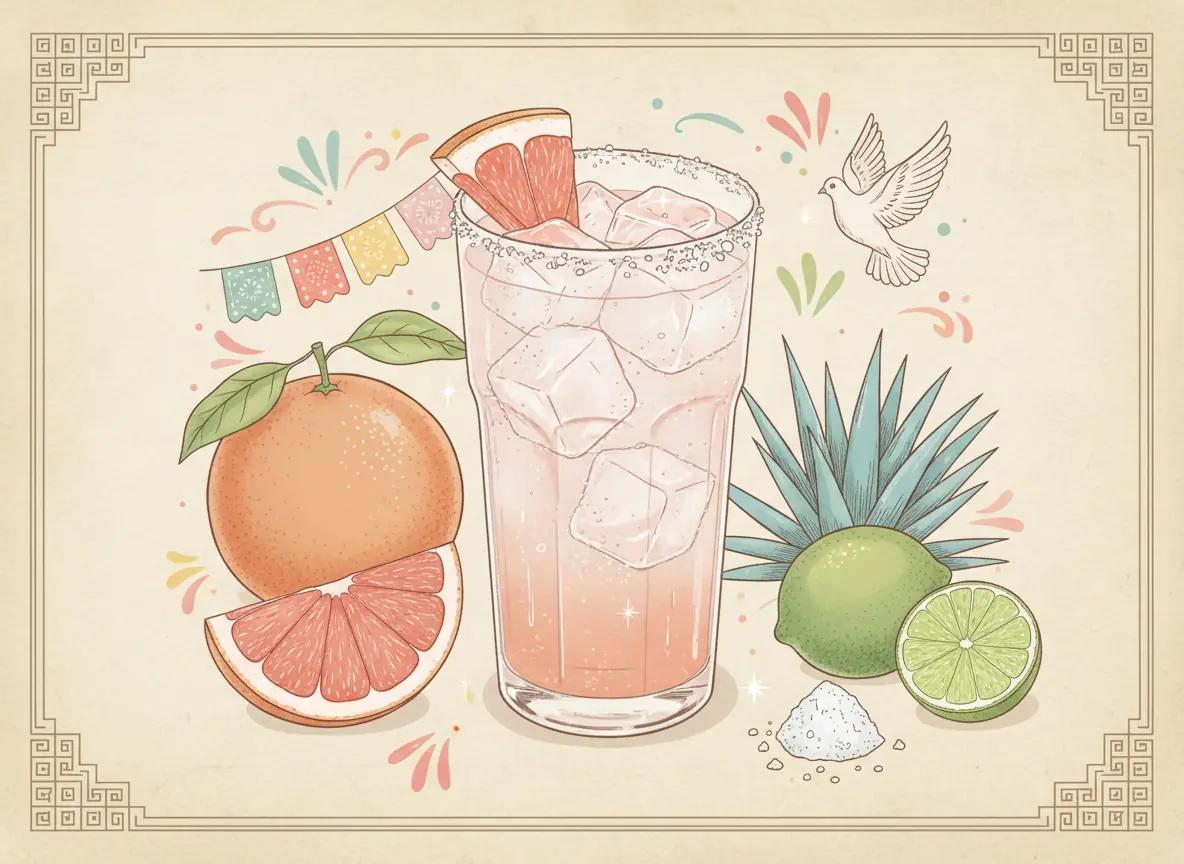
A Paloma is 50ml of blanco tequila, 5ml of fresh lime juice and a pinch of salt over ice in a highball, topped with 100ml of pink grapefruit soda and stirred gently once. Those are the IBA’s measures. We salt half the rim and add a grapefruit slice and a lime wheel. About 2.0 UK units. Paloma is Spanish for dove. The Oxford Companion traces the tequila and grapefruit soda combination to 1950, when a brochure for Squirt suggested mixing it with tequila, with Squirt launched in Mexico in 1955, and says it is unknown who adapted the combination to Mexican tastes. The soda does most of the work. It brings the grapefruit, the sugar and the fizz in one pour, so the recipe needs no syrup and only a little lime. The pinch of salt in the drink softens the grapefruit’s bitter edge and lets the agave through.
El Diablo
El Diablo is 45ml of blanco tequila, 15ml of crème de cassis and 15ml of fresh lime juice, stirred over ice in a highball and topped with 90ml of chilled ginger beer, with the spent lime shell dropped in. About 2.0 UK units. Its earliest known printing is in Trader Vic’s Book of Food and Drink of 1946, as the Mexican El Diablo, which the book marks as a Trader Vic original. That version was topped with ginger ale. Ginger beer is the usual choice now, and ours: its heat stands up to the cassis, where ginger ale lets the drink turn sweet. Cassis is French blackcurrant liqueur. It turns the glass deep red, sweetens it and adds dark fruit, so the tequila’s pepper, the ginger and the lime all have something to push against.
Tommy’s Margarita
A Tommy’s Margarita is 60ml blanco tequila made from 100% agave, 30ml fresh lime juice and 30ml agave syrup, shaken hard and strained into a rocks glass of fresh ice, with a lime wheel. The agave syrup is nectar cut one to one with water. There is no orange liqueur. About 2.4 UK units. Difford’s Guide says Julio Bermejo created it, dating it to circa 1987 or 1988, at his family’s Tommy’s Mexican Restaurant in San Francisco, whose name the drink carries; Punch places it in the early ’90s. The IBA includes it in its New Era category with 60ml of 100% agave tequila, 30ml of lime and 30ml of agave nectar; we cut the nectar one to one with water. Without triple sec, the sweetener comes from the same plant as the spirit, and the tequila stands at the front of the drink. It is the plainest way to taste whether a bottle is any good.
Where this one sits
Recipe by Jerry Can Spirits · Updated 19 October 2026