Death Flip
A Death Flip is 30ml of blanco tequila, 15ml of yellow Chartreuse, 15ml of Jägermeister, a dash of simple syrup and one whole egg, shaken with ice, strained into a sour glass and finished with freshly grated nutmeg. About 2.4 UK units, counting the tequila at 40% ABV, the Chartreuse at 43% and the Jägermeister at 35%. Chris Hysted-Adams created it at the Black Pearl in Melbourne. Punch says it first appeared on the menu there in 2010 with no ingredients listed. It contains raw egg, so it carries an allergen warning for eggs.
Glassware: Coupe Glass
Garnish: Freshly grated nutmeg grated over the foam
Ingredients
15ml
Punch prints half an ounce, which is 15ml. Our ingredient page lists it at 43% ABV.
15ml
Half an ounce, or 15ml, of a German herbal liqueur. Counted at 35% ABV, the figure on a UK wholesaler’s listing and on Difford’s Guide.
1
A raw egg. Contains egg: an allergen. Use a British Lion egg or one from the Laid in Britain scheme.
Instructions
Chill a coupe or sour glass.
Add the tequila, Chartreuse, Jägermeister, syrup and the whole egg to a shaker with ice.
Shake hard for 10 to 12 seconds.
Strain into the chilled glass.
Grate fresh nutmeg over the foam.
Source: its creator's published specification (Chris Hysted-Adams, Black Pearl, Melbourne, published at Punch (punchdrink.com/recipes/death-flip/); measures, method and garnish as printed there (1 ounce blanco tequila, 1/2 ounce yellow Chartreuse, 1/2 ounce Jägermeister, 1 dash simple syrup, 1 whole egg, shaken with ice, strained into a sour glass, freshly grated nutmeg); ounces converted to 30ml and 15ml). Last checked 1 November 2026.
Expert Tip
Crack the egg into a small cup first. If a piece of shell gets in, you can lift it out before it reaches the shaker. Shake harder than for a standard sour. The whole egg needs the extra energy to make foam. Grate the nutmeg at the last moment. Pre-ground nutmeg has lost most of its aroma.
Behind the Death Flip
Flavour Profile
A drink that arrived with no ingredient list
Punch credits Chris Hysted-Adams of the Black Pearl in Melbourne, Australia. It says the drink first appeared on the bar’s menu in 2010 with no ingredients listed, and that the bartender would not say what was in it. The only clue was a warning that you would not want to meet this cocktail in a dark alley.
Punch says plenty of people tried it anyway and many liked it, which would be less likely if the menu had named a tequila, a herbal liqueur, a German digestif and a whole egg. It files the drink as a modern classic and a flip.
Why tequila, Chartreuse and Jägermeister work
Blanco tequila is the base, clean and peppery. Yellow Chartreuse adds honey and herbs. Jägermeister adds bitter spice and a dark, medicinal note. Our complete guide to tequila and the guide to tequila and mezcal cover the base.
A whole egg is the point of a flip. The yolk and white together give the drink a rich, thick body and a pale foam. A dash of simple syrup is the only sweetener. Nutmeg on top adds warmth.
Raw egg and who can have it
The Death Flip contains a whole raw egg. The NHS advises that hen eggs with the British Lion stamp, or produced under the Laid in Britain scheme, can be eaten raw or partly cooked, and that eggs without them should not be eaten raw. Eggs are an allergen, so tell anyone you serve. Use fresh eggs, keep them in the fridge and discard any that are cracked.
The Death Flip beside three egg drinks
Death Flip
- Base
- Blanco tequila with two liqueurs
- Egg
- Whole egg
- Also in the glass
- Nothing else
- Glass
- Nutmeg
Eggnog
- Base
- Brandy and dark rum
- Egg
- Yolk and white
- Also in the glass
- Milk and cream
- Glass
- Rocks glass
Porto Flip
- Base
- Tawny port and brandy
- Egg
- Yolk
- Also in the glass
- Nothing else
- Glass
- Coupe
Ramos Gin Fizz
- Base
- Gin
- Egg
- White
- Also in the glass
- Cream and soda
- Glass
- Highball
| Drink | Base | Egg | Also in the glass | Glass |
|---|---|---|---|---|
| Death Flip | Blanco tequila with two liqueurs | Whole egg | Nothing else | Nutmeg |
| Eggnog | Brandy and dark rum | Yolk and white | Milk and cream | Rocks glass |
| Porto Flip | Tawny port and brandy | Yolk | Nothing else | Coupe |
| Ramos Gin Fizz | Gin | White | Cream and soda | Highball |
The Eggnog and the Porto Flip are the classic relatives.
Make it at home
The Spirit
TequilaTequila is a Mexican spirit distilled from the blue agave plant, made, the Oxford Companion says, only in Jalisco and municipalities of four other states; our recipes use 40% ABV. A label reading 100% agave means every sugar came from the plant, where plain tequila needs only 51%. Most of our 26 tequila recipes ask for 100% agave blanco.
More to explore
Frequently Asked Questions
Who created the Death Flip?
Does the Death Flip contain raw egg?
Is the Death Flip an allergen risk?
How strong is a Death Flip?
What does a Death Flip taste like?
Why is it called a flip?
Can I use something other than blanco tequila?
Can I prepare it for a group?
Sources.
Correct as of 1 November 2026.
- Punch, “Death Flip” (recipe and origin: Chris Hysted-Adams, Black Pearl, Melbourne; on the menu in 2010 with no ingredients listed; 1 oz blanco tequila, 1/2 oz yellow Chartreuse, 1/2 oz Jägermeister, 1 dash simple syrup, 1 whole egg, sour glass, nutmeg).
- NHS, “Foods to avoid in pregnancy” (British Lion and Laid in Britain eggs can be eaten raw or partly cooked; other hen eggs should not be eaten raw).
- NHS, “Calculating alcohol units” (the 14-units-a-week guidance and the units calculation).
You Might Also Like
Eggnog
This Eggnog is made by the glass: 30ml of brandy, 15ml of dark rum, one egg separated, 60ml of whole milk, 30ml of cream and 20ml of sugar syrup. The yolk is whisked with the syrup until pale, then everything is dry shaken for 10 to 15 seconds, shaken hard with ice for 10 to 12 and strained into a chilled double rocks glass, with nutmeg grated over. About 1.8 UK units. It is uncooked. The egg is raw, and the drink contains milk and cream. The NHS says hen eggs with the British Lion stamp can be eaten raw, including in pregnancy; drink it as soon as it is made. The Oxford Companion calls eggnog an American invention of the mid-Atlantic region in the late colonial era, with the first printed references in New Jersey and Pennsylvania newspapers in 1788. It is often said to descend from the posset, which the Companion describes as a medieval drink of curdled milk or cream and wine or ale, warmed and often thickened with eggs; we have found no primary record of that line.
Porto Flip
A Porto Flip is 45ml of tawny port, 15ml of brandy and 10ml of egg yolk, dry shaken for 10 to 15 seconds, shaken hard with ice for 10 to 12 and double strained into a chilled coupe, with nutmeg grated over the top. About 1.5 UK units by our calculation. The measures are the IBA’s; the dry shake is ours. The yolk is raw. Use British Lion eggs, which the NHS says can be eaten raw, including in pregnancy, and leave the drink out for anyone allergic to egg. Port is a fortified wine and contains sulphites. A flip takes the whole egg or the yolk rather than the white alone, so the drink is emulsified and silky rather than foamed. Tawny port brings nut, dried fig and caramel, the brandy gives it backbone, and fresh nutmeg lifts what would otherwise sit heavy. It is one short glass after dinner.
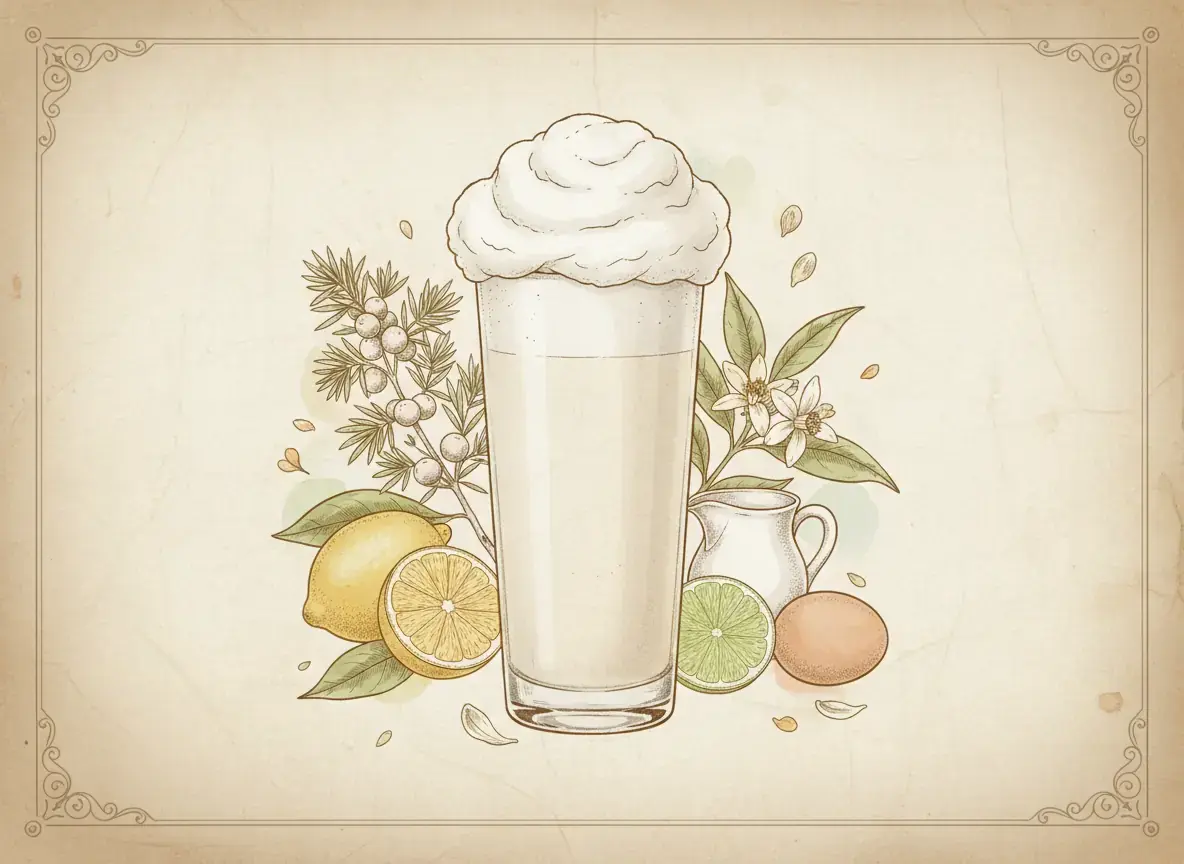
Ramos Gin Fizz
A Ramos Gin Fizz is 45ml of London Dry gin, 15ml each of fresh lemon and lime juice, 30ml of sugar syrup, 30ml of egg white, 60ml of double cream, three dashes of orange flower water and two drops of vanilla extract, shaken long and hard, strained into a chilled highball with no ice and lifted with 60ml of soda water. About 1.8 UK units. It contains raw egg and dairy. Difford’s Guide, a secondary source, says Henry C. Ramos created it in 1888 at the Imperial Cabinet Saloon in New Orleans; the IBA gives the same year but a different bar. The Oxford Companion says the drink’s precise origins are unknown, that the earliest definite notice in print is from 1895, and that the likeliest period is 1892 to 1894. Difford’s quotes Stanley Clisby Arthur on 35 shaker boys at Ramos’s later bar, the Stag, during the 1915 Mardi Gras. The measures are the IBA’s. The shake is the work: cream and egg white need time to whip into a foam dense enough for the soda to push up out of the glass.
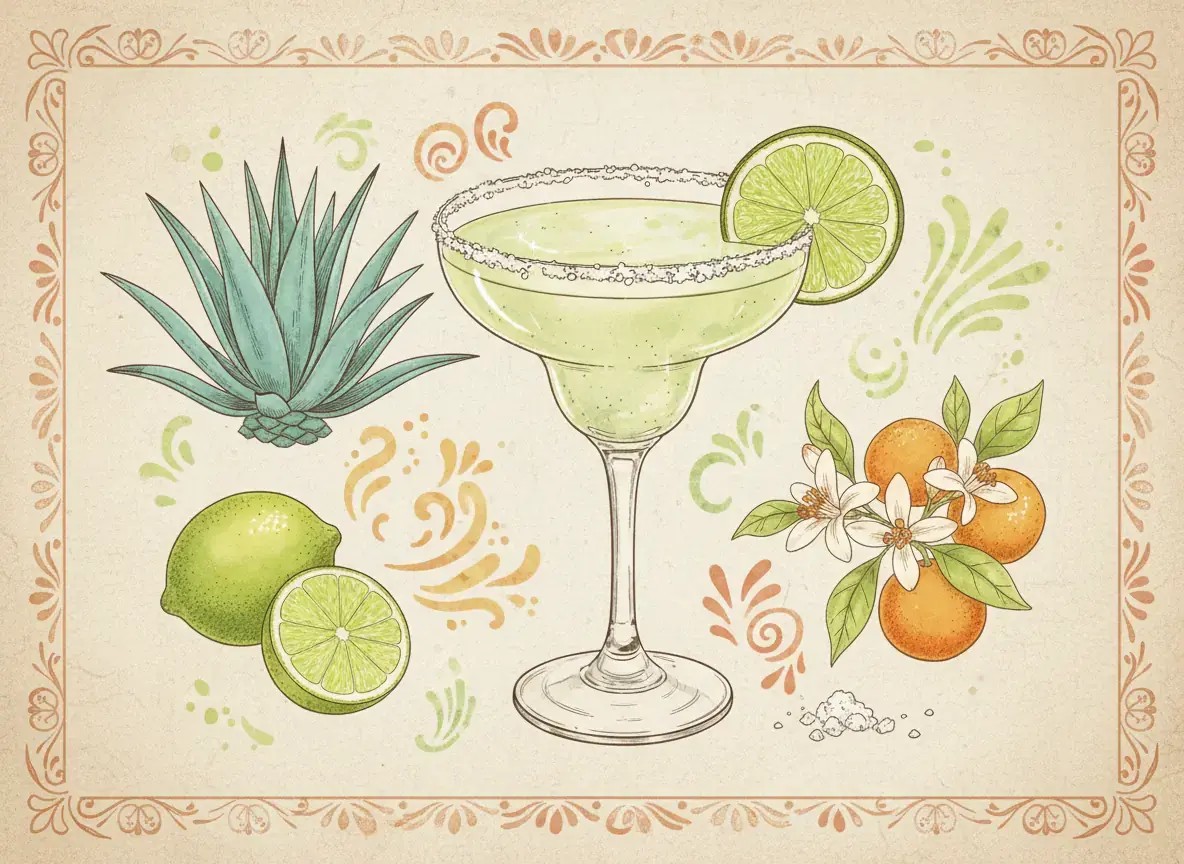
Margarita
A Margarita is 50ml of 100% agave blanco tequila, 20ml of triple sec and 15ml of fresh lime juice, shaken hard for 10 to 12 seconds and double strained into a chilled coupe with half the rim salted, with a lime wheel. About 2.8 UK units. Strained over fresh ice in a rocks glass, it is the same drink, longer and cooler. These are the IBA’s measures. The lime is the smallest pour, so the agave leads and the orange liqueur rounds it: the drink tastes of tequila first and sour second. The Oxford Companion to Spirits and Cocktails, in an entry by David Wondrich, calls the origins of the Margarita one of cocktail history’s most notorious swamps, with at least half a dozen plausible claimants, among them Carlos Herrera at Rancho La Gloria in 1947, Margarita Sames in Acapulco in 1948 and the bartender Santos Cruz in Galveston in the same year. It finds the drink under the name Margarita in print in September 1953, in a California newspaper column, followed soon after by Esquire.
Where this one sits
Recipe by Jerry Can Spirits · Updated 1 November 2026