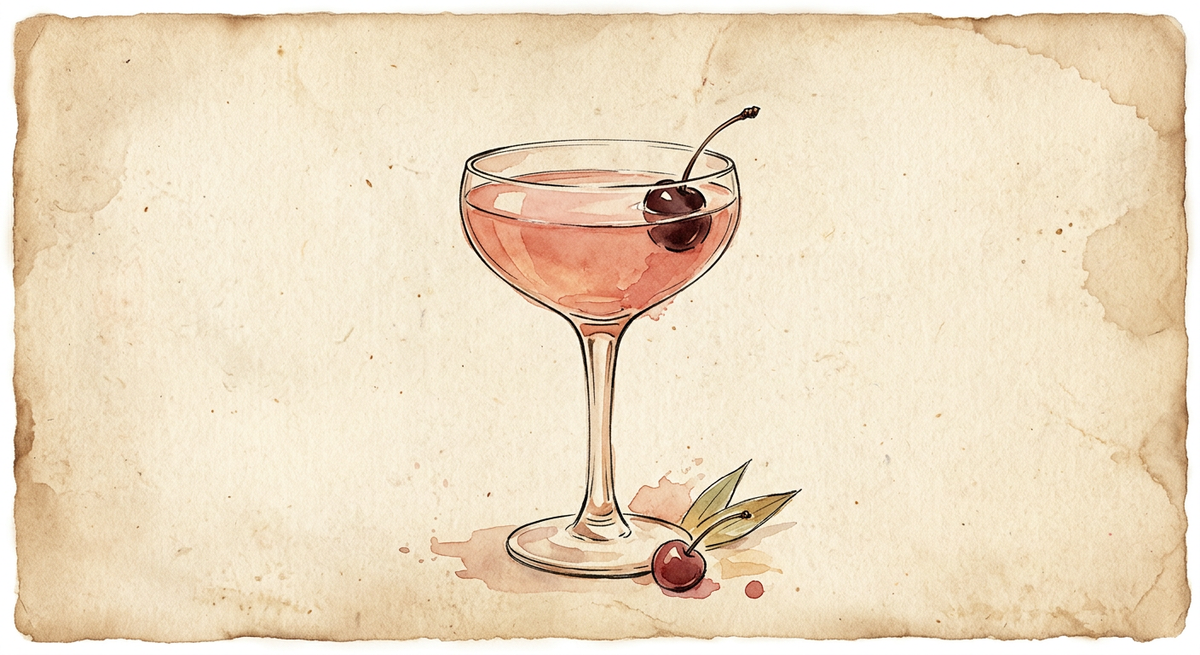
Mary Pickford
A Mary Pickford is 45ml of white rum, 45ml of fresh pineapple juice, 7.5ml of maraschino liqueur and 5ml of grenadine, shaken hard for 10 to 12 seconds and double strained into a chilled coupe, with a cherry; the measures are the IBA’s. About 2.0 UK units. It is named for Mary Pickford, the silent film star, and Basil Woon’s When It’s Cocktail Time in Cuba (1928), which we read in the Internet Archive scan, says Fred Kaufman invented it during her visit to Havana. The Oxford Companion says newspaper accounts confirm she vacationed there in December 1922, when Kaufman, at the Hotel Sevilla-Biltmore, most likely created it. Half the drink is pineapple, so the juice decides it. Fresh juice shakes up with a fine pale foam and a sharper edge; carton juice gives a flat, sweet drink. The maraschino and grenadine are small measures with clear jobs: depth and colour.
Glassware: Coupe Glass
Garnish: Maraschino cherry
Ingredients
45ml
A light white rum at around 40% ABV, in the Cuban style the drink comes from. An aged rum competes with the fruit rather than carrying it.
45ml
Fresh, pressed or blended the same day. At 45ml it is half the drink, and it gives the foam that carton juice cannot.
5ml
Real grenadine, made from pomegranate. At 5ml it tints the drink pink and adds a little tartness; the bright red bottles of coloured syrup add only sugar.
7.5ml
Clear maraschino at around 32% ABV, made from marasca cherries, stones and all. At 7.5ml it gives a faintly bitter depth that keeps the drink from tasting only of fruit.
Instructions
Chill a coupe in the freezer.
Add the rum, pineapple juice, maraschino and grenadine to a shaker with cubed ice.
Shake hard for 10 to 12 seconds.
Double strain into the chilled coupe.
Drop in a cherry.
Source: the IBA (Official IBA specification; a cherry where the IBA gives no garnish; method ours). Last checked 9 October 2026.
Expert Tip
Use fresh pineapple juice. Half the drink is pineapple, and in our view fresh juice shakes to a fine foam with a sharpness that carton juice, heated for shelf life, has lost. Press or blend it the same day and shake to order. Keep the small measures small. Grenadine at 5ml gives colour and a little tartness; maraschino at 7.5ml gives depth. Double either and the drink tips: too much grenadine and it is fruit punch, too much maraschino and its bitter edge covers the pineapple. Double strain. Fresh pineapple carries fibre, and the drink should reach the glass smooth.
Behind the Mary Pickford
Flavour Profile
Where It Comes From
The Oxford Companion calls the Mary Pickford a Prohibition-era cocktail, and says it was purportedly one of the three most ordered cocktails in Cuba then, after the Daiquiri and the El Presidente.
Basil Woon wrote in 1928 that the screen favourite’s visit to Havana gave the drink its name and that Fred Kaufman invented it. The Companion places Kaufman at the Hotel Sevilla-Biltmore and says newspaper accounts confirm Pickford vacationed in Havana in December 1922. Two older Cuban bar books are in the Internet Archive. Pujol and Muñiz’s Manual del Cantinero of 1924 prints a “Mari Pickford” of Gordon gin, pineapple juice, maraschino and grenadine, and El Arte de Hacer un Cocktail y Algo Más, a customer giveaway of 1927, prints a Mary Pickford of pineapple juice, maraschino, grenadine and egg white, though its scan is too garbled to read the spirit.
The Two Seasonings
Grenadine and maraschino are small measures with opposite jobs. Grenadine, at 5ml, is colour and a little tartness. Maraschino, at 7.5ml, is depth: faintly bitter, landing under the fruit rather than on top of it.
Leave either out and the gap shows. Without grenadine the drink is pale and plainer. Without maraschino it is pretty and hollow, sweet at the front with nothing holding the finish.
The Pineapple Standard
In our view fresh pineapple juice is sharper, more perfumed and less sweet than carton juice, which is heated for shelf life and tastes of it.
It also carries proteins that whip into a fine, stable foam under a hard shake, a pale collar on a pink drink. Carton juice gives a thin layer of bubbles that is gone before the glass reaches the table.
Where We Follow the IBA
The Mary Pickford, IBA and house side by side
White rum
- IBA
- 45ml
- Ours
- 45ml
Fresh pineapple juice
- IBA
- 45ml
- Ours
- 45ml, pressed or blended the same day
Maraschino liqueur
- IBA
- 7.5ml Luxardo
- Ours
- 7.5ml
Grenadine
- IBA
- 5ml
- Ours
- 5ml, made from pomegranate
Method
- IBA
- Shaken with ice, strained
- Ours
- Shaken hard 10 to 12 seconds, double strained
Glass
- IBA
- Chilled cocktail glass
- Ours
- Chilled coupe
Garnish
- IBA
- None
- Ours
- A cherry
UK units
- IBA
- About 2.0
- Ours
- About 2.0
| Element | IBA | Ours |
|---|---|---|
| White rum | 45ml | 45ml |
| Fresh pineapple juice | 45ml | 45ml, pressed or blended the same day |
| Maraschino liqueur | 7.5ml Luxardo | 7.5ml |
| Grenadine | 5ml | 5ml, made from pomegranate |
| Method | Shaken with ice, strained | Shaken hard 10 to 12 seconds, double strained |
| Glass | Chilled cocktail glass | Chilled coupe |
| Garnish | None | A cherry |
| UK units | About 2.0 | About 2.0 |
Against the Hotel Nacional
The Hotel Nacional is the closest relation: white rum and pineapple again, with apricot brandy and lime in the supporting seat.
That makes the Nacional sharper and more obviously a sour, and the Pickford rounder. Made side by side, the two show how far the second fruit moves a drink.
For apricot and lime with the same rum and pineapple, see the Hotel Nacional; for white rum stirred with vermouth and curaçao, the El Presidente.
How to Serve It
Up, in a chilled coupe, double strained, with a cherry. Drink it while the foam stands.
For a group, press or blend the pineapple ahead but shake each drink to order; juice that has stood for an hour has lost its foam.
Make it at home
The Spirit
White RumWhite rum is clear rum, usually bottled at 40% ABV, either unaged or rested in oak and then charcoal-filtered back to clear. It is the light, dry rum of the Daiquiri, the Mojito and the Cuba Libre, and the rum most of our recipes mean when they want rum that sits under lime rather than over it.
Master the Techniques
More to explore
Frequently Asked Questions
Who was the Mary Pickford cocktail named after?
Is a Mary Pickford sweet?
What is the difference from a Hotel Nacional?
Does the grenadine really matter?
Is the Mary Pickford an IBA cocktail?
Which cherry should I use?
How strong is a Mary Pickford?
Sources.
Correct as of 19 October 2026.
- The Oxford Companion to Spirits and Cocktails (Jeff Berry), “Mary Pickford” (secondary source: Prohibition-era cocktail named for the silent film star; Basil Woon 1928 credits Fred Kaufman of the Hotel Sevilla-Biltmore; Pickford vacationed in Havana in December 1922; one of the three most ordered cocktails in Cuba then).
- Basil Woon (1928), Internet Archive, “When It’s Cocktail Time in Cuba” (primary source: the Mary Pickford invented during the screen favourite’s visit to Havana by Fred Kaufman, two-thirds pineapple juice and one-third Bacardi, with a dash of grenadine).
- León Pujol and Oscar Muñiz (1924), Internet Archive, “Manual del Cantinero” (primary source: “Mari Pickford”, a small glass of Gordon gin, a teaspoon of pineapple juice, half a teaspoon each of maraschino and grenadine).
- Compañía Cervecera Internacional (1927), Internet Archive, “El Arte de Hacer un Cocktail y Algo Más” (primary source: a customer giveaway; Mary Pickford with pineapple juice, maraschino, grenadine and egg white (the spirit line is garbled in the scan)).
You Might Also Like
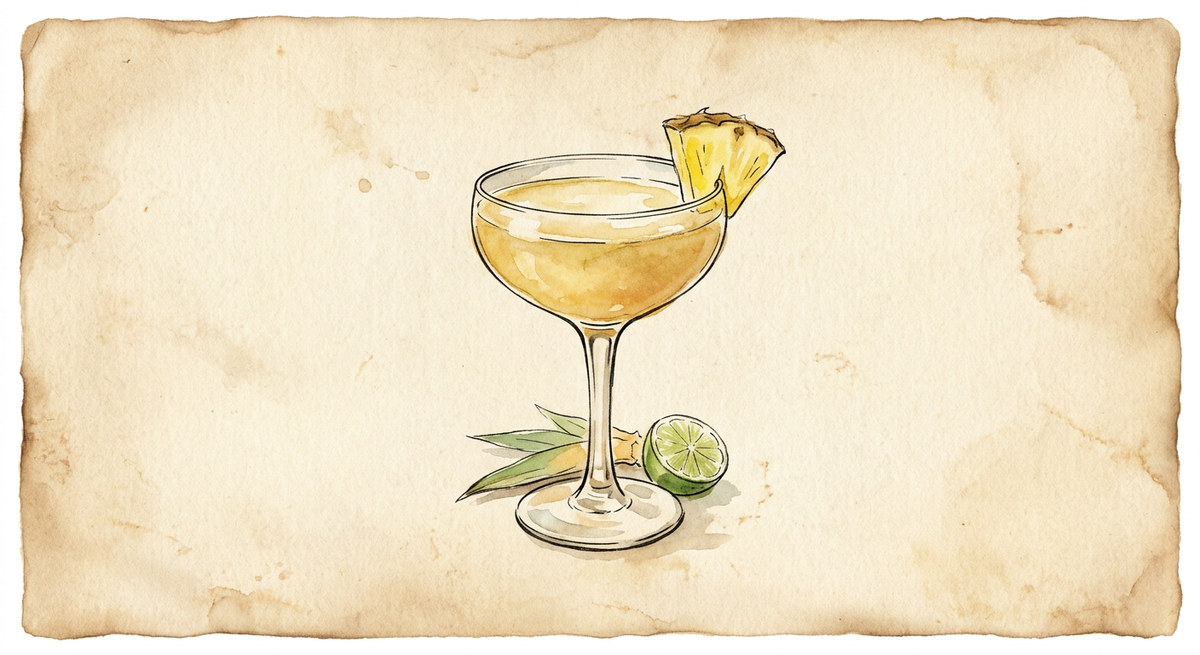
Hotel Nacional
A Hotel Nacional is 45ml of gold rum, 45ml of fresh pineapple juice, 15ml of fresh lime juice and 5ml of dry apricot brandy, shaken hard with cracked ice for 10 to 12 seconds and strained into a chilled coupe. It is Charles H. Baker’s 1939 recipe, with his jigger taken as 45ml, his teaspoon as 5ml and the juice of half a lime as 15ml. About 2.0 UK units. It is a pineapple daiquiri with a trace of stone fruit underneath, and no sugar but the pineapple’s own. The dry apricot brandy is a teaspoon, a kernel note under the fruit rather than a flavour in front of it. The lime keeps it a sour rather than a fruit cup. The name is the Hotel Nacional de Cuba’s, which the Oxford Companion calls Havana’s grandest luxury resort when it opened in 1930, and Difford’s Guide lists the drink as the Hotel Nacional Special. Baker credits Wil P. Taylor, the hotel’s manager from 1931 to 1933; Difford’s adds that Eddie Woelke and Fred Kaufman have been credited too.
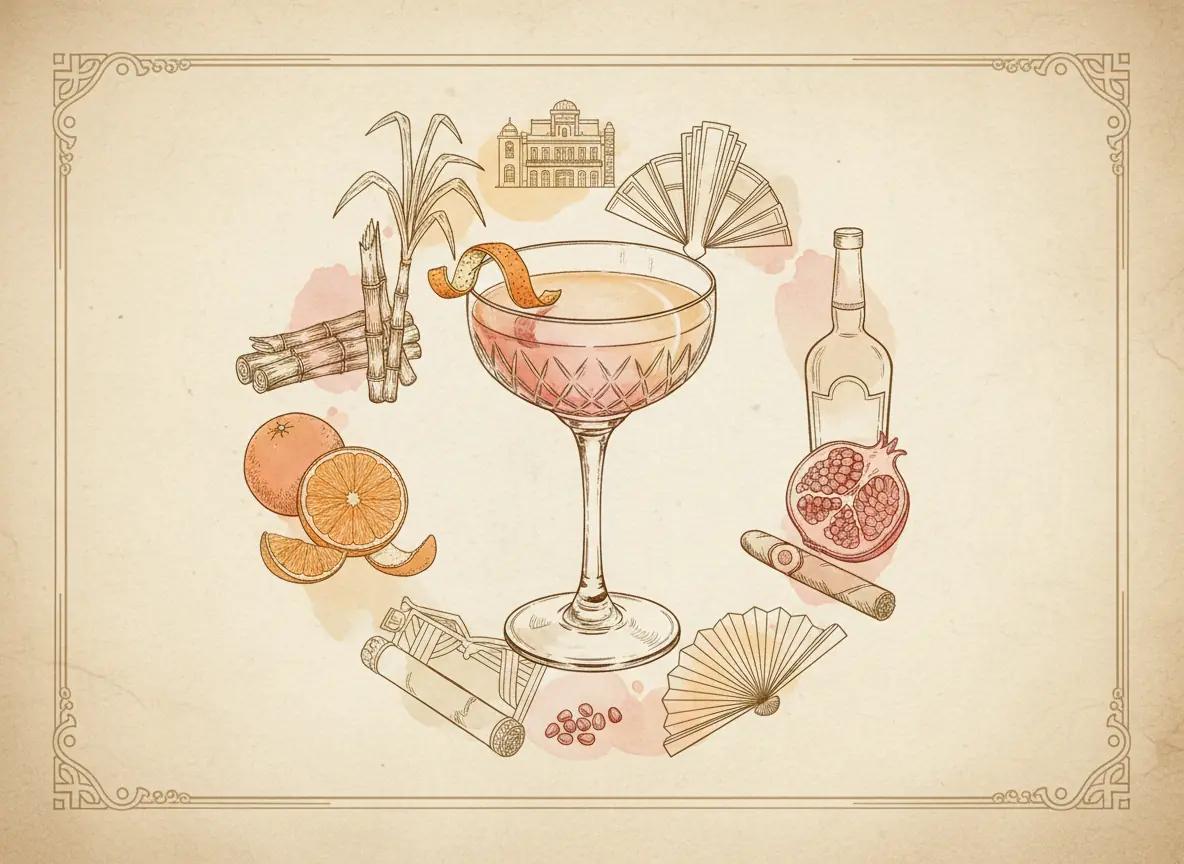
El Presidente
El Presidente is a stirred Cuban rum drink: 45ml white rum, 22.5ml dry vermouth, 10ml orange curaçao and 7.5ml grenadine, stirred for 20 to 30 seconds over ice and strained into a chilled coupe, finished with an expressed orange peel. It drinks like a light rum Manhattan, dry and aromatic, with a pale pink colour from the grenadine. Basil Woon’s 1928 book on Cuba calls it one of the two cocktails most in demand in Havana. Who created it and which president it honours are both disputed: the Floridita’s own 1939 book prints a 1937 report crediting Constante Ribalaigua, and Bar Vademecum reports David Wondrich naming Mario García Menocal, president from 1913 to 1921; Bar Vademecum adds that the story of a drink named for Gerardo Machado cannot be right for the earliest recipes, since Machado was not elected until 1925. Older recipes use Chambéry, a blanc vermouth sweeter than dry: two parts to one of rum in Escalante’s 1915 manual, half and half in Basil Woon’s 1928 account. Ours uses dry at two to one with a little more curaçao. Each one comes to about 2.6 UK units.
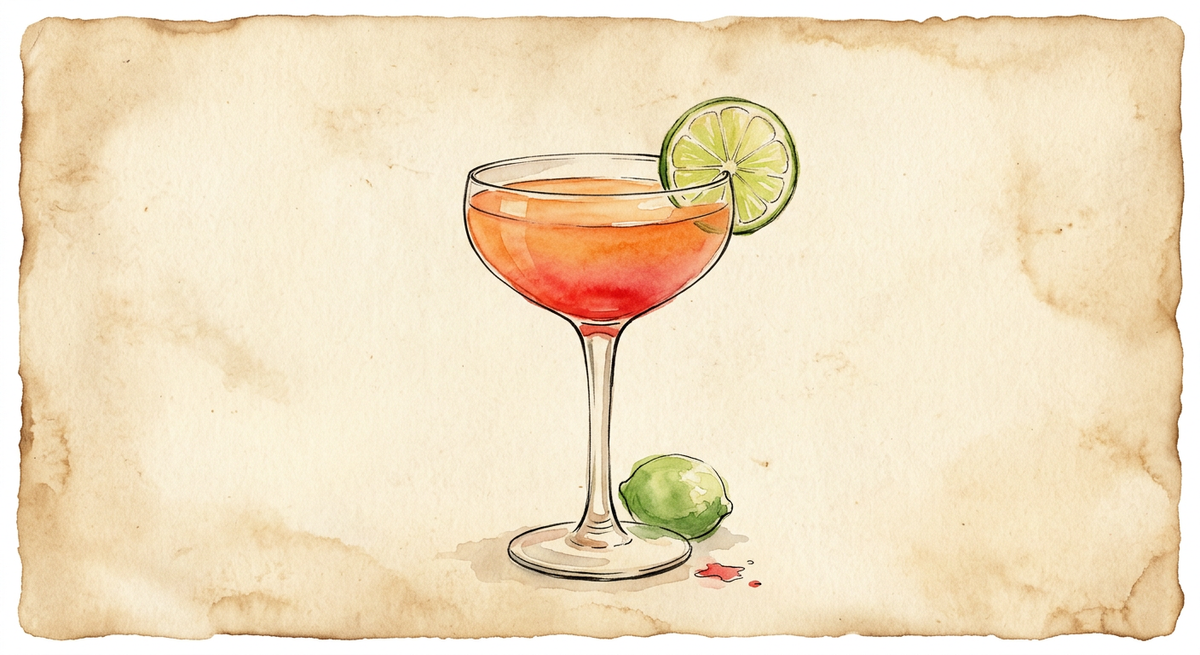
Bacardi Cocktail
A Bacardi Cocktail is 50ml of Bacardi Carta Blanca, 20ml of fresh lime juice, 10ml of grenadine and 5ml of sugar syrup, shaken hard and double strained into a chilled coupe, with a lime wheel. About 1.9 UK units. It is a daiquiri coloured and partly sweetened with grenadine. The name is tied to Bacardi’s trade mark, by Difford’s Guide’s account. Difford’s says Bacardi took the Barbizon-Plaza Hotel and the Wivel Restaurant in New York to court over Bacardi Cocktails made with other rums, and Bacardi Limited’s own account dates the ruling to 28 April 1936: a drink listed as a Bacardi cocktail must contain Bacardi rum. Difford’s Guide says opinion divides on whether the original had grenadine, and that the vintage books listing a Bacardi Cocktail without it favour grenadine being a later addition; the Oxford Companion says it may originally have been nothing more than a Daiquiri made with Bacardi rum. A grenadine made from pomegranate keeps it tart.
Where this one sits
Recipe by Jerry Can Spirits · Updated 19 October 2026