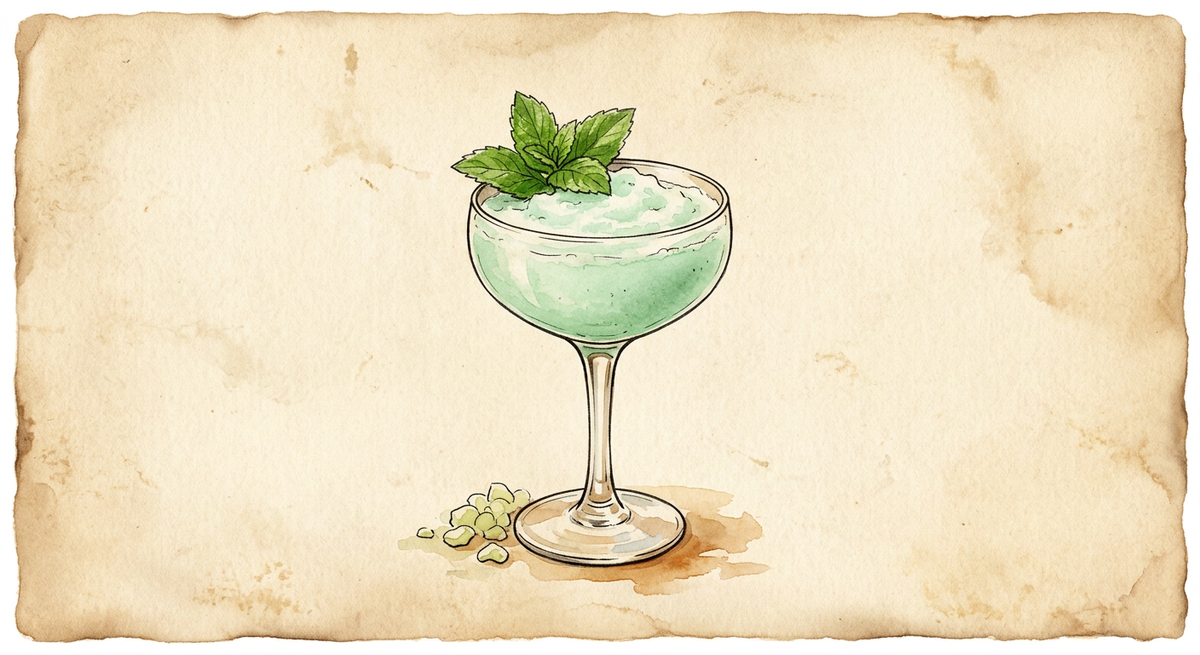
Missionary’s Downfall
The Missionary’s Downfall is 30ml of white rum, 15ml of peach liqueur, 15ml of fresh lime juice, 20ml of honey syrup, three or four chunks of fresh pineapple and ten mint leaves, blended with a cup of crushed ice for up to 20 seconds and poured into a chilled coupe, with a mint sprig. About 1.5 UK units. VinePair places it at Don the Beachcomber, Donn Beach’s Hollywood bar, in the late 1930s, and says Jeff Berry points to 1937. Punch reports that Berry unearthed and de-coded the recipe in his Grog Log of 1998. Beach’s recipes were coded, so what is made today is Berry’s reconstruction, and our measures follow his. It reads as a blended Daiquiri with a garden in it. The blender pulls the oil and colour from the mint and purees the pineapple into the body, so the drink comes out pale green and thicker than its ingredients suggest. Drink it at once.
Glassware: Coupe Glass
Garnish: Mint sprig
Ingredients
30ml
A clean, light white rum at 40% ABV; a heavy, funky one takes over. At 30ml it supports the fruit rather than leading it.
15ml
At around 20% ABV. Berry’s recipe calls it peach brandy; we pour a peach liqueur made with real fruit, such as a crème de pêche. A thin, synthetic one turns the drink sweet and hollow.
15ml
Squeezed the same day. It sits under the honey syrup, which keeps this a gentle glass rather than a sour, and it is still the only sharp thing in it.
20ml
Two parts honey to one of warm water, stirred until it runs clear. It carries about the honey of Berry’s 30ml of equal-parts honey mix, with less water. Honey rounds the mint and peach in a way plain sugar does not, and a syrup blends where neat honey seizes.
3 to 4 chunks
Fresh, not juice: the blender purees the fruit into the body of the drink. Use a pineapple ripe enough to smell at arm’s length.
10 leaves
Ten leaves for the blender, which pulls out their oil and colour more completely than a muddler. The pale green in the glass is the mint itself.
Instructions
Add the rum, peach liqueur, lime juice and honey syrup to a blender.
Add the pineapple chunks, then the mint leaves.
Add a cup of crushed ice.
Blend at high speed for up to 20 seconds, stopping as soon as the drink is smooth and pale green.
Pour into a chilled coupe, garnish with a mint sprig and serve at once.
Source: Beachbum Berry's reconstructions (Grog Log (1998), where the honey is 30ml of a one-to-one honey mix; ours is 20ml of a two-to-one syrup for about the same honey; ml conversions and blending order ours). Last checked 10 October 2026.
Expert Tip
Blend short. Twenty seconds at high speed is the most it needs, and the moment it turns smooth and evenly pale green is the moment to stop. Every second past that trades texture for water. Load the jug in order: liquids first, then pineapple, then mint, with the ice last. The blades reach the mint through moving liquid and shred it evenly. Honey goes in as a syrup. Mix two parts honey with one of warm water ahead of time; neat honey seizes into a lump as soon as it meets cold liquid, and the blender will not break it up.
Behind the Missionary’s Downfall
Flavour Profile
The Origin
Donn Beach built the menu at Don the Beachcomber, his Hollywood bar, on rum, layered syrups and strength. VinePair reports that Jeff Berry points to 1937 for the Missionary’s Downfall. Beach’s recipes were coded: Punch reports that Berry unearthed and de-coded this one, and the version made today is his reconstruction, first published in his Grog Log in 1998.
Why it carries the name is not recorded. VinePair reports one source tying it to European missionaries in Africa and Asia who were detained or expelled during the Second World War, a theory that does not line up with a drink dated to 1937.
It looks little like the rest of the menu. There is no float, no layered syrup and no fire. Thirty millilitres of rum is a small measure for a Beachcomber drink, and the produce does the rest.
The Blender Method
Order matters: liquids first, then pineapple, then mint, with the ice last, so the blades reach the mint through moving liquid and shred it evenly. Berry blends at high speed for 20 seconds. Stop sooner if the drink is already smooth and evenly pale green, because every extra second trades texture for water.
What the Blender Actually Does
Here the blender extracts as well as chills.
Mint holds its oil in glands on the leaf surface. A muddler ruptures some of them and tears the leaf. Blades moving fast through liquid shred every leaf evenly, which pulls out more oil and more colour, and the drink comes out a clean pale green.
The pineapple gets the same treatment. Chunks of fresh fruit are pureed into the body of the drink, which is a different thing from adding juice: the fibre stays in and gives the drink weight, so it pours thicker than its ingredients suggest without ever being a smoothie.
Beside the Daiquiri and the Mojito
The Missionary’s Downfall beside our Daiquiri and Mojito
White rum
- Missionary’s Downfall
- 30ml
- Daiquiri
- 60ml
- Mojito
- 45ml
Lime
- Missionary’s Downfall
- 15ml fresh
- Daiquiri
- 20ml fresh
- Mojito
- 20ml fresh
Sweetener
- Missionary’s Downfall
- 20ml honey syrup
- Daiquiri
- Two bar spoons caster sugar
- Mojito
- Two teaspoons cane sugar
Fruit and herb
- Missionary’s Downfall
- Fresh pineapple, peach liqueur, ten mint leaves
- Daiquiri
- None
- Mojito
- Six sprigs of mint
Method
- Missionary’s Downfall
- Blended with crushed ice
- Daiquiri
- Shaken
- Mojito
- Built, topped with soda
UK units
- Missionary’s Downfall
- About 1.5
- Daiquiri
- About 2.4
- Mojito
- About 1.8
| Element | Missionary’s Downfall | Daiquiri | Mojito |
|---|---|---|---|
| White rum | 30ml | 60ml | 45ml |
| Lime | 15ml fresh | 20ml fresh | 20ml fresh |
| Sweetener | 20ml honey syrup | Two bar spoons caster sugar | Two teaspoons cane sugar |
| Fruit and herb | Fresh pineapple, peach liqueur, ten mint leaves | None | Six sprigs of mint |
| Method | Blended with crushed ice | Shaken | Built, topped with soda |
| UK units | About 1.5 | About 2.4 | About 1.8 |
The Daiquiri is the frame: rum, lime and sugar. The Mojito adds mint and soda and keeps it long. The Missionary’s Downfall halves the Daiquiri’s rum, swaps the sugar for honey, and lets the blender turn pineapple and mint into the body of the drink.
How to Serve It
In a chilled coupe, with a single mint sprig, served the moment it pours. It holds its texture for about a minute. Make it to order rather than ahead, because neither the mint’s colour nor the pineapple’s body survives waiting.
For the shaken frame, make a Daiquiri; for rum, mint and lime served long, a Mojito.
Make it at home
The Spirit
White RumWhite rum is clear rum, usually bottled at 40% ABV, either unaged or rested in oak and then charcoal-filtered back to clear. It is the light, dry rum of the Daiquiri, the Mojito and the Cuba Libre, and the rum most of our recipes mean when they want rum that sits under lime rather than over it.
More to explore
Frequently Asked Questions
What is a Missionary’s Downfall?
Who created the Missionary’s Downfall?
Why is it called the Missionary’s Downfall?
Can I make it without a blender?
What peach liqueur should I use?
Why honey syrup rather than sugar?
How strong is a Missionary’s Downfall?
Sources.
Correct as of 18 October 2026.
- VinePair, “The Story Behind The Missionary’s Downfall” (Beach, late 1930s, Hollywood; Berry points to 1937 in Beachbum Berry Remixed; the WWII missionaries theory does not line up with 1937).
- Punch, “Mastering the Missionary’s Downfall With Scotty Schuder” (a Don the Beachcomber original dating back to 1937; unearthed and de-coded by Berry in his 1998 Grog Log).
You Might Also Like
Mojito
A Mojito is 45ml of white rum, 20ml of fresh lime juice, two teaspoons of white cane sugar and six sprigs of mint, built in a highball. The mint is pressed gently with the sugar, the glass is filled with cubed ice, the rum and lime go in, and 75 to 100ml of chilled soda water tops it. About 1.8 UK units. Those are the IBA’s measures. The IBA only says to top up with soda, so the 75 to 100ml is ours. Press the mint once or twice and stop. Torn leaves make the drink bitter and grassy, and that, more often than the rum, is why a Mojito disappoints. The sugar grains help: they bruise the surface of the leaf as you press, and the lime then carries the oil through the glass.
Painkiller
A Painkiller is 60ml of Pusser’s Rum, 120ml of pineapple juice, 30ml of fresh orange juice and 30ml of cream of coconut, given a hard 10 to 12 second shake and strained onto cubed ice in a tiki mug or a big glass, with fresh nutmeg grated on top. About 2.4 UK units. Cream of coconut is coconut and sugar, usually with no dairy, but check the label. The name belongs to Pusser’s. Pusser’s prints the name with the registered symbol on its own Painkiller page, and the Oxford Companion says the company owns the trademark for the Pusser’s Painkiller cocktail. The recipe here is its own: four parts pineapple, one of cream of coconut and one of orange, with Pusser’s to suit. Difford’s Guide says it trademarked the name in the United States and the UK in 2003 and in 2010 forced a New York bar called Painkiller to rename itself PKNY. Pusser’s traces the drink to Daphne Henderson’s Soggy Dollar Bar on Jost Van Dyke, in the British Virgin Islands.
Daiquiri
A Daiquiri is 60ml white rum, 20ml fresh lime juice and two bar spoons of caster sugar. Stir the sugar into the rum and lime in the shaker until it dissolves, then add ice, shake hard for 10 to 12 seconds and double strain into a chilled coupe. About 2.4 UK units. Those are the IBA’s measures, and its method dissolves the sugar first too. The name belongs to Daiquirí, an iron-mining district and beach near Santiago de Cuba. Difford’s Guide credits Jennings Stockton Cox, an American engineer who led one of the first mining parties into Cuba’s iron-ore country after the Spanish-American War of 1898; the Oxford Companion has him making or supervising the first Daiquiri in 1896, and a Santiago bartender naming it in 1908. Difford’s says Constantino Ribalaigua Vert of Havana’s El Floridita made the frozen version famous. With three ingredients and no liqueur or bitters, the Daiquiri hides nothing. A flat rum, tired lime or undissolved sugar shows in the first sip.
Where this one sits
Recipe by Jerry Can Spirits · Updated 18 October 2026