Tiki
21 recipes
This Field Manual holds 21 recipes in the tiki family. Tiki drinks blend more than one rum, more than one citrus and at least one syrup.
The rums are layered on purpose: a light rum for the body, an aged or dark one for depth, sometimes an overproof float that sits on top and is tasted first. Orgeat and falernum are structural, not sweeteners, and swapping either for simple syrup collapses the drink. Crushed ice is part of the specification because dilution is doing work here, which is why a mai tai served over cubes tastes wrong within a minute.
Base Spirit
Difficulty Level
Bahama Mama
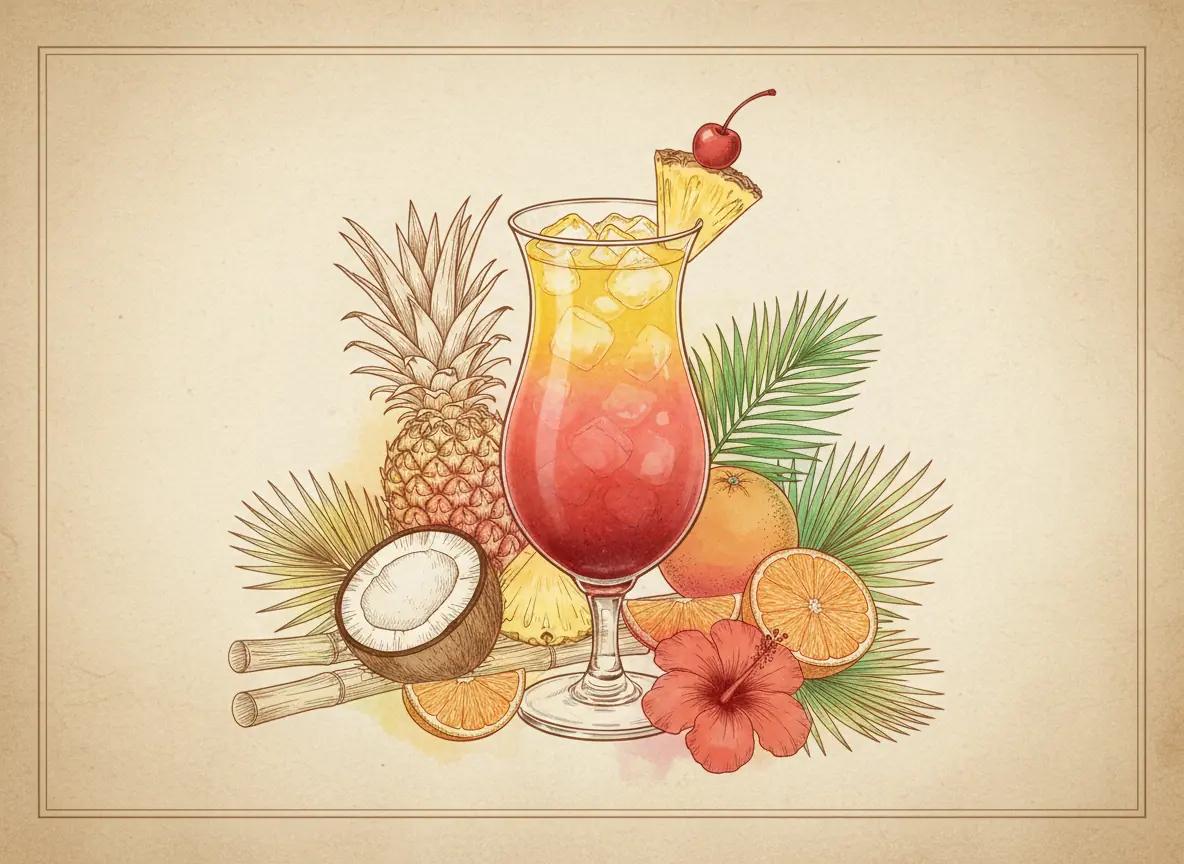
The Bahama Mama has no single documented origin and no named creator. It emerged from the tiki and Caribbean bar culture of the mid-twentieth century and spread through resort bars, hotel pools and beachside venues to become one of the most-ordered rum drinks in the world. Ubiquity has not been kind to it: the premixed, artificially sweetened versions poured in tourist bars carry the name and almost nothing else. Three rums do the work. Dark rum brings molasses depth and structural backbone; coconut rum brings tropical sweetness and the Caribbean character the name promises; overproof rum brings proof, aromatic intensity and the useful knowledge that the drink is stronger than it tastes. Fresh pineapple and orange define the fruit, fresh lime supplies the acid that stops the sweetness becoming undrinkable halfway down, and real grenadine adds colour and a faint pomegranate depth. In a drink this fruit-forward, every one of those choices is audible.
Banana Daiquiri
The Banana Daiquiri is the frozen daiquiri’s tropical firstborn, blended in the Caribbean resort era and built on the one fruit that blends thicker than ice cream. It is the drink the blender was waiting for. A mountaintop bar on St Thomas holds the most persistent claim, dating it to the 1950s, and has been pouring it to cruise traffic ever since. The modern spec doubles the banana. Fresh ripe fruit supplies the body and the honeyed sweetness, a measure of proper banana liqueur supplies the cooked depth and the proof, and each covers what the other lacks. Lime holds the daiquiri’s citizenship, and without it the drink is simply a milkshake with rum in it. Ripeness is the entire quality question, and it is not a close-run thing. A freckled banana makes velvet and a green one makes regret, and that single choice matters more than anything else in the build.
Doctor Funk
The Doctor Funk is the only drink in the tiki canon named after a real physician. Dr Bernard Funk practised in Samoa in the late nineteenth century, where his patients included Robert Louis Stevenson, and his standing prescription against the tropical heat was a mix of absinthe, lime and soda water. It was medicine by the standards of the day, and better company than most of it. When Don the Beachcomber opened his Hollywood bar in 1934 he added rum and grenadine to the doctor’s formula and put it on his first menu, which makes the Doctor Funk older than the word tiki itself: a genuine South Seas artefact smuggled into a genre that otherwise invented its own mythology. The absinthe is the drink; everything else is the delivery system. Lime and lemon keep it honest, grenadine tints it rather than sweetens it, and the soda stretches it into a long, dry, faintly mysterious cooler that drinks nothing like its neighbours on the menu.
Don's Special Daiquiri
Don's Special Daiquiri is what Donn Beach did to a daiquiri, which is to say he split the rum, added two sweeteners instead of one, and blended it with crushed ice until it arrived cold enough to hurt. It is a tiki drink in the strict sense — Don the Beachcomber, Hollywood, the 1930s — and it is considerably more sophisticated than the format's reputation allows. Thirty millilitres of gold Jamaican rum against fifteen of Cuban is the split that defines it: the Jamaican brings funk and fruit, the Cuban brings clean body underneath. Passion fruit syrup and honey syrup then do the sweetening between them, and lime supplies the only acid. Two sweeteners in one drink sounds like a mistake and is the whole design. Neither could produce this alone, and that principle runs through everything Beach built.
Fog Cutter
The Fog Cutter is Trader Vic’s second most famous creation after the Mai Tai, and his own menu note remains the best description it has ever had: “Fog Cutter, hell. After two of these, you won’t even see the stuff.” Three spirits from three different shelves go into the shaker, which by every sensible rule of drink-building should produce a mess. It does not, because underneath the bravado the structure is a careful citrus sour. The orange and lemon juices and the orgeat do the balancing, the white rum provides the engine, and the gin and cognac read as botanical and oaky seasoning rather than competing bases. The amontillado float is the actual genius. A dry, nutty roof over a tropical drink, it makes the first moment of every sip start savoury before the citrus catches up. If one drink can explain why sherry belongs behind a bar, it is this one.
Hurricane
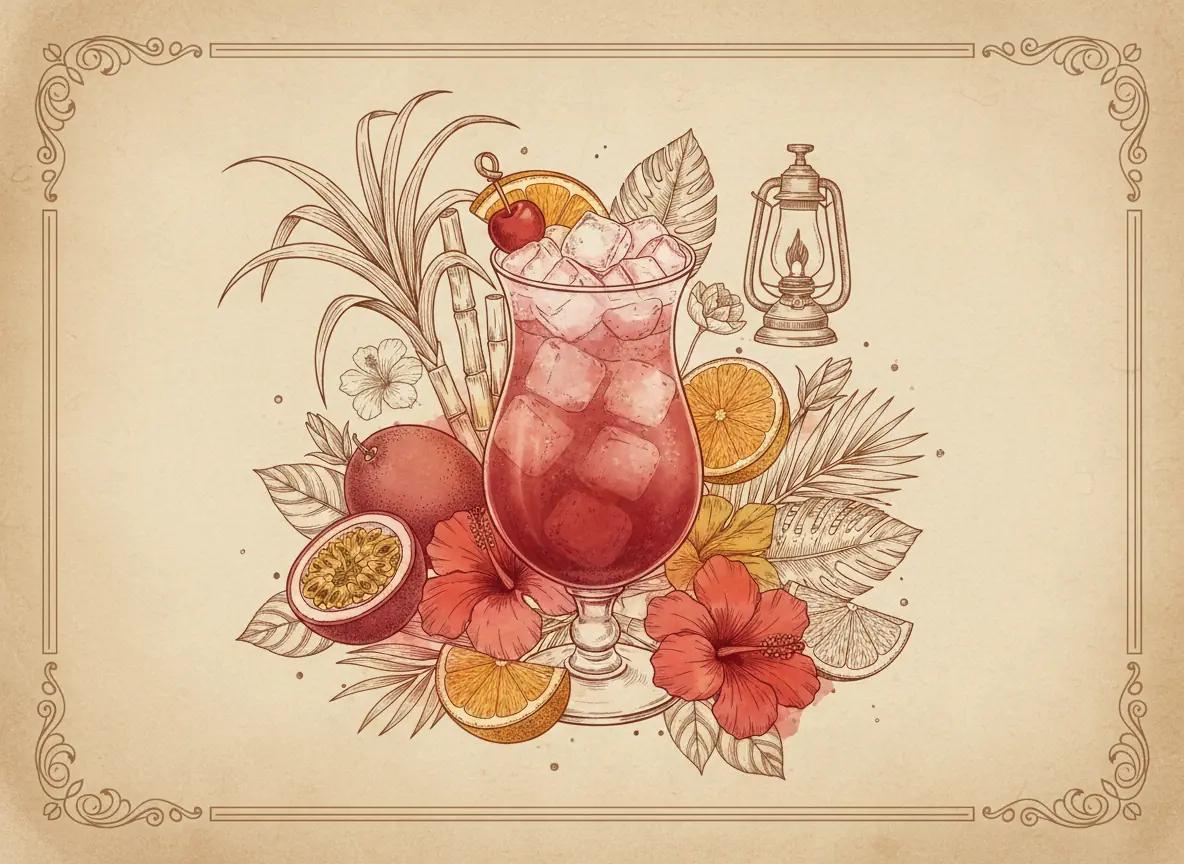
The Hurricane is Pat O'Brien's New Orleans drink from the 1940s: dark and white rum, passion fruit syrup, fresh lime and orange, and grenadine, over crushed ice in a glass shaped like a hurricane lamp. It exists because of a wartime supply problem. Whiskey was scarce, and distributors required bar owners to buy large allocations of rum, plentiful from Caribbean producers, before releasing any whiskey at all. O'Brien's answer was a drink strong enough, fruity enough and visually striking enough that people would order rum deliberately rather than as a substitute. It worked completely, and then its own fame ruined it. As the drink became attached to New Orleans tourism, premixed concentrate in souvenir glasses became the standard serve. What is documented here is the original structure: two rums, fresh juice squeezed to order, passion fruit syrup with real fruit in it. The Hurricane is a serious drink that has been treated carelessly for a very long time.
IBA Tiki
The IBA Tiki is the newest and most elaborate drink on the official list: nine ingredients, two rums, three sweetened modifiers and a slice of fresh ginger muddled in the base. It is a competition cocktail in origin and it reads like one, which is not a criticism — every one of those ingredients is doing something, and the drink is considerably more balanced than the list suggests. Two Havana Club expressions split the base thirty and thirty, one deep and one smoky. Amaretto and Frangelico supply nut and roundness in fifteen and five millilitres respectively, five drops of maraschino sit underneath them, and passion fruit, pineapple and lime handle the fruit and the acid. It is a long drink built to be sipped over pebble ice, and the ginger is what keeps nine ingredients from collapsing into fruit punch.
Jet Pilot
The Jet Pilot was created at The Luau in Beverly Hills in 1958, a jet-age rebuild of Don the Beachcomber's wartime Test Pilot. The rename tells you everything about the era: tiki was Hollywood's playground, propellers were giving way to jets, and the drink kept pace by getting stronger. The spec is pure Don DNA even though he did not build this version. Cinnamon syrup, grapefruit and falernum are the fingerprint of his secret numbered mixes, the pre-batched blends he used to stop rival bars poaching his recipes, and here they are laid out in the open: his code, decrypted. The absinthe and Angostura push the drink darker than nearly anything else in the canon. Three rums, eight ingredients and no garnish: the Jet Pilot carries no decoration because it needs none. It is among the strongest drinks in the whole tiki canon, and it is meant to be, so treat it as a destination rather than a round.
Jungle Bird
The Jungle Bird was created in 1978 at the Aviary Bar of the Kuala Lumpur Hilton, reportedly as a welcome drink for arriving guests, which makes it one of the last true classics the tiki canon ever produced. It then vanished for the better part of three decades, until cocktail historians dug the recipe out of a 1989 collection and New York bartenders rebuilt it around blackstrap rum. That version spread through the craft revival, and the drink now sits on more serious bar menus than almost anything else wearing a paper umbrella. What makes it work is the Campari. Bitterness has no natural home in tiki, and dropping an Italian aperitivo into pineapple juice should not work. It does, because pineapple is one of the few juices with the body and sweetness to carry Campari's bite without flinching. The result drinks closer to a Negroni on holiday than to a beach cooler: tropical on the nose, grown-up on the finish, and the only drink in the genre you could reasonably serve before dinner.
Mai Tai
Victor "Trader Vic" Bergeron mixed the first Mai Tai in Oakland in 1944, and the story goes that his Tahitian guests took one sip and declared it maita'i roa ae: roughly, out of this world. The name stuck, the drink conquered the world, and the recipe has been argued about ever since, not least because Don the Beachcomber claimed he had invented it a decade earlier. History has largely sided with Vic. The original was built on a seventeen-year-old Jamaican rum from J. Wray and Nephew that no longer exists, and every serious Mai Tai since has been an attempt to reconstruct that flavour. What the recipe never contained was pineapple or orange juice. The fluorescent hotel-pool version of the 1970s buried one of the great cocktails under a fruit salad, and the modern revival has been a decades-long rescue operation. Properly made it is nearly a rum sour: dry, almond-rich and rum-forward, with the spent lime shell adding a bitter aromatic edge and the slapped mint doing the perfume. Crushed ice and real orgeat are not negotiable.
Missionary’s Downfall
Don the Beachcomber’s menu was built on rum and thunder, and then there is this: fresh mint, pineapple and peach blended into something so green and gentle it barely seems related. The name is the joke, and it is a good one, the drink so innocent-looking that even a missionary would fall. It matters because it is the counter-argument to everything tiki gets accused of. No heavy syrups, no rum floats, no fire: just fresh produce doing the work, with the blender performing real extraction on the mint in a way no muddler can match. It is closer to a frozen garden than a beach bar. Two things keep it honest. Honey syrup rather than raw honey, which seizes on contact with cold; and a short blend, because the drink is at its best the moment it turns smooth and starts losing character within the minute. Make it last in the round, drink it first.
Navy Grog
Grog is the oldest rum serve there is. In 1740 Admiral Edward Vernon ordered the Royal Navy's daily rum ration cut with water and lime juice to keep his sailors upright, and the mixture took its name from his grogram cloak. Two centuries later Don the Beachcomber dressed the ration up with three rums, honey and grapefruit, sold it to Hollywood, and the Navy Grog became a fixture: famously Frank Sinatra's order, and one of the most copied drinks of the tiki era. The build is a lesson in rum blending. White rum for brightness, aged rum for the mid-palate, dark rum for the bass, with grapefruit and honey doing the work that plain sugar and lime did aboard ship. It is drier and more grown-up than its tiki-menu neighbours, which is exactly why it survived the era's excesses with its dignity intact. Then there is the ice cone: a hollow spike of crushed ice frozen around a straw, standing in the glass like a snow-capped mast. It is tiki's most famous piece of theatre, and it can be faked in a home freezer with a mould and two hours of patience.
Painkiller
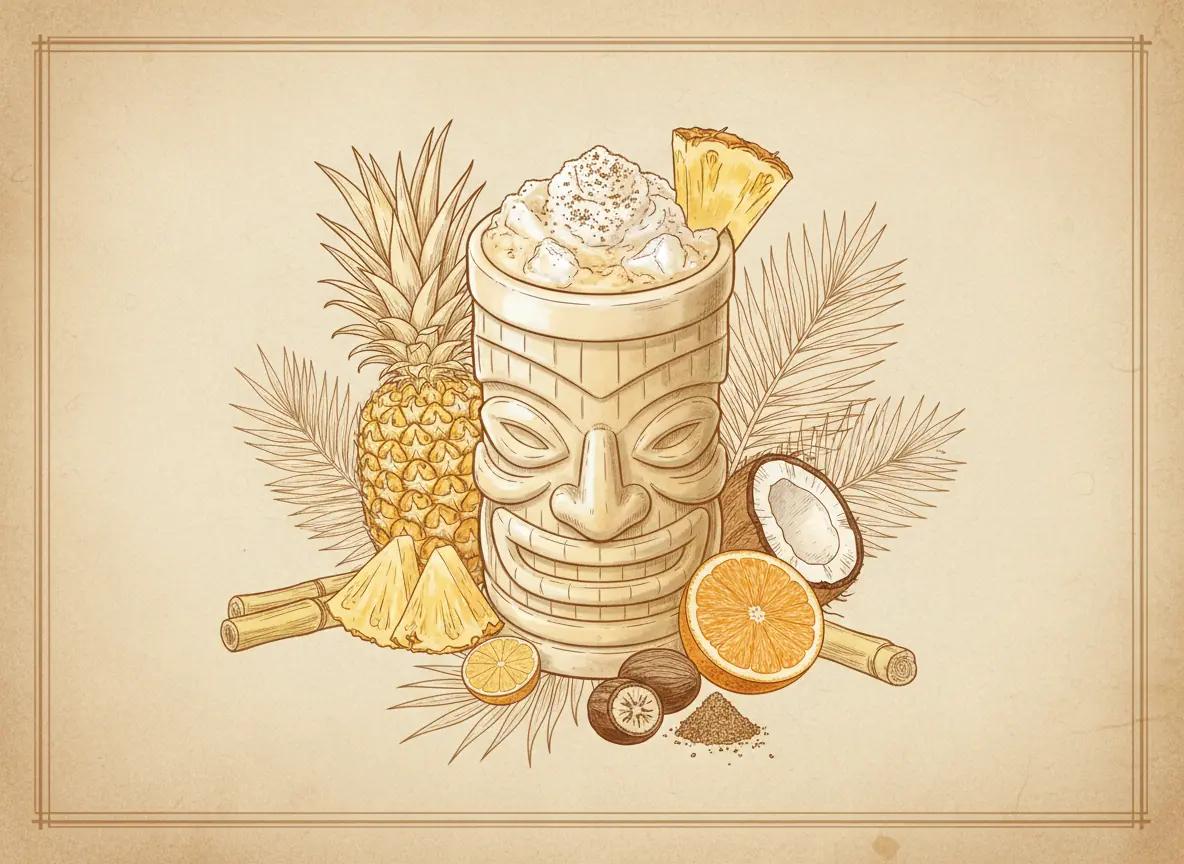
The Painkiller was created at the Soggy Dollar Bar on Jost Van Dyke in the British Virgin Islands in the 1970s, a bar named for the fact that arriving boats had no dock and customers swam ashore with their cash in hand. Daphne Henderson built the drink for those wet-pocketed arrivals, and it became one of the most enduring tiki-adjacent cocktails of the modern era. Pusser's trademarked the name in the 1980s, insisting an authentic Painkiller must use their rum: a commercially motivated claim, though their navy rum does perform exceptionally well in the format. It sits in the same family as the Piña Colada and is considerably more interesting. Where the Colada blends rum, pineapple and coconut into a single smooth result, the Painkiller is served over ice and adds fresh orange juice, which introduces an acid note the Colada lacks entirely. Freshly grated nutmeg is not optional. Pre-ground has lost the volatile oils that make it worth adding at all.
Pearl Diver
The Pearl Diver is Don the Beachcomber at his most baroque: a drink whose secret weapon, hidden for decades inside the coded “gardenia mix”, turned out to be butter. Honey, cinnamon syrup, allspice dram and softened butter, whisked warm into an emulsion, then flash-blended with gold rums and citrus until the whole thing pours like liquid velvet. The butter is texture, not flavour. Blended properly it never tastes dairy-rich; it simply rounds every edge in the glass, carrying the honey and spice across the palate in a way no syrup alone can manage. It is the same trick fat-washing rediscovered fifty years later, performed live in a 1930s blender. The drink vanished with the tiki empires and was resurrected by the historians who cracked Don’s codes, and it has since become a benchmark: if a bar makes a proper Pearl Diver, the rest of its tiki list can be trusted. The same logic applies at home.
Piña Colada
The Piña Colada is Puerto Rico’s gift to the pleasure principle, created, by the strongest of the competing claims, by Ramón “Monchito” Marrero at the Caribe Hilton in San Juan in 1954, after months of testing rum against the newly invented cream of coconut. A rival claim belongs to Barrachina in Old San Juan, the island argues the point enthusiastically, and in 1978 Puerto Rico settled the only question that matters by declaring it the national drink. It is also the most abused recipe in the tropical canon: decades of pre-mixes, syrups and slush machines buried a genuinely balanced drink under a reputation for sugar. The real thing is three ingredients in proportion, rum, fresh pineapple and true cream of coconut, blended briefly with good ice, and it drinks like a holiday with structure: creamy, yes, but bright, cold and finished with real rum presence. The cream of coconut is the make-or-break: the proper sweetened coconut cream the drink was invented around, not coconut milk and not dessert syrup. Give it that, fresh juice and a light hand on the blender, and the most mocked drink of the twentieth century quietly reveals itself as one of the best-engineered.
Rum Runner
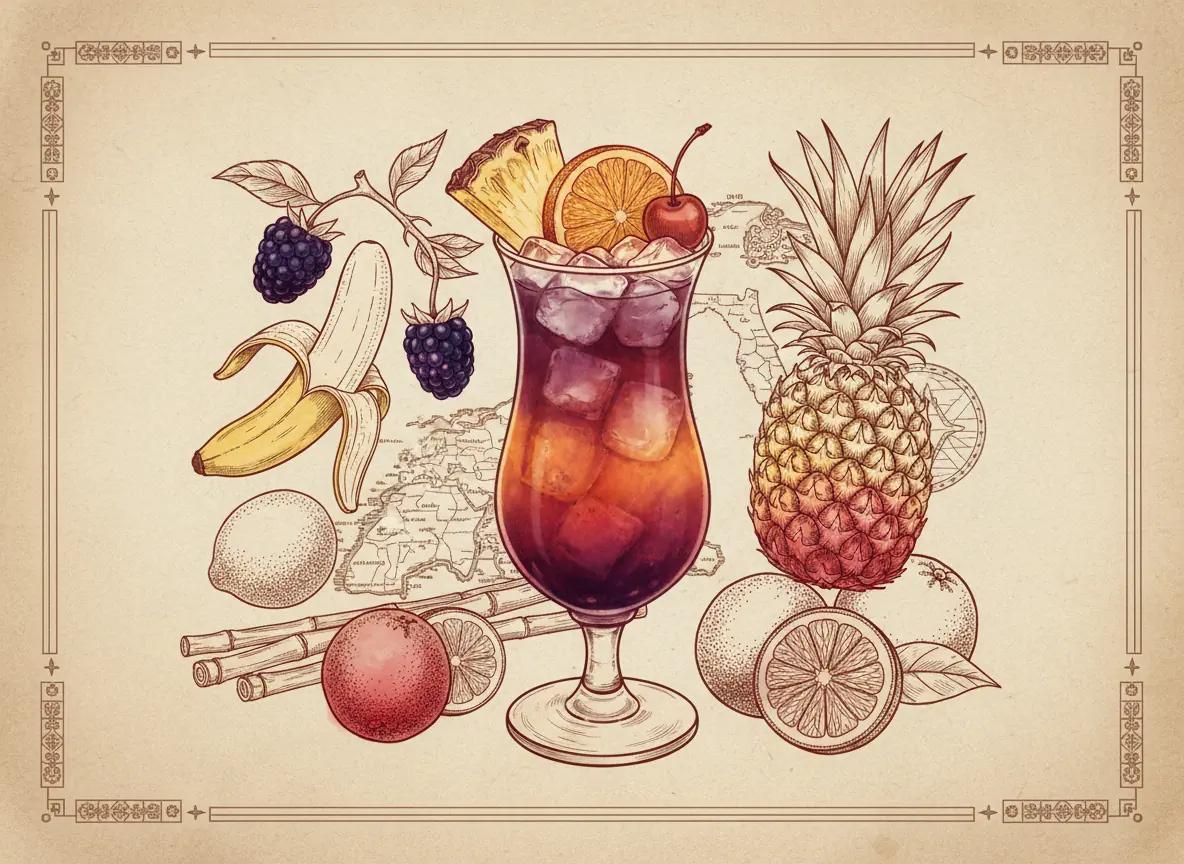
The Rum Runner was born from necessity and named for outlaws. In the early 1970s, John "Tiki John" Elber, manager of the Tiki Bar at the Holiday Isle in Islamorada, Florida Keys, faced a bartender's dilemma: too much stock and a new shipment on the way. Rather than let good booze go to waste, he threw together what he had, rum, blackberry brandy, banana liqueur, grenadine, and lime juice, and created what would become the signature drink of the Keys. He named it after the region's real rum runners: the smugglers who used the maze of Florida waterways to transport Caribbean rum to thirsty speakeasies during Prohibition. The original recipe contained no fruit juices, just spirits, liqueurs, and lime. Over the decades, pineapple and orange juice crept in, transforming it into the tropical fruit bomb most bars serve today. Served over crushed ice or blended frozen, the Rum Runner is unapologetically sweet, fruity, and dangerously easy to drink. It tastes like vacation: messy, fun, and best enjoyed with sand between your toes.
Scorpion
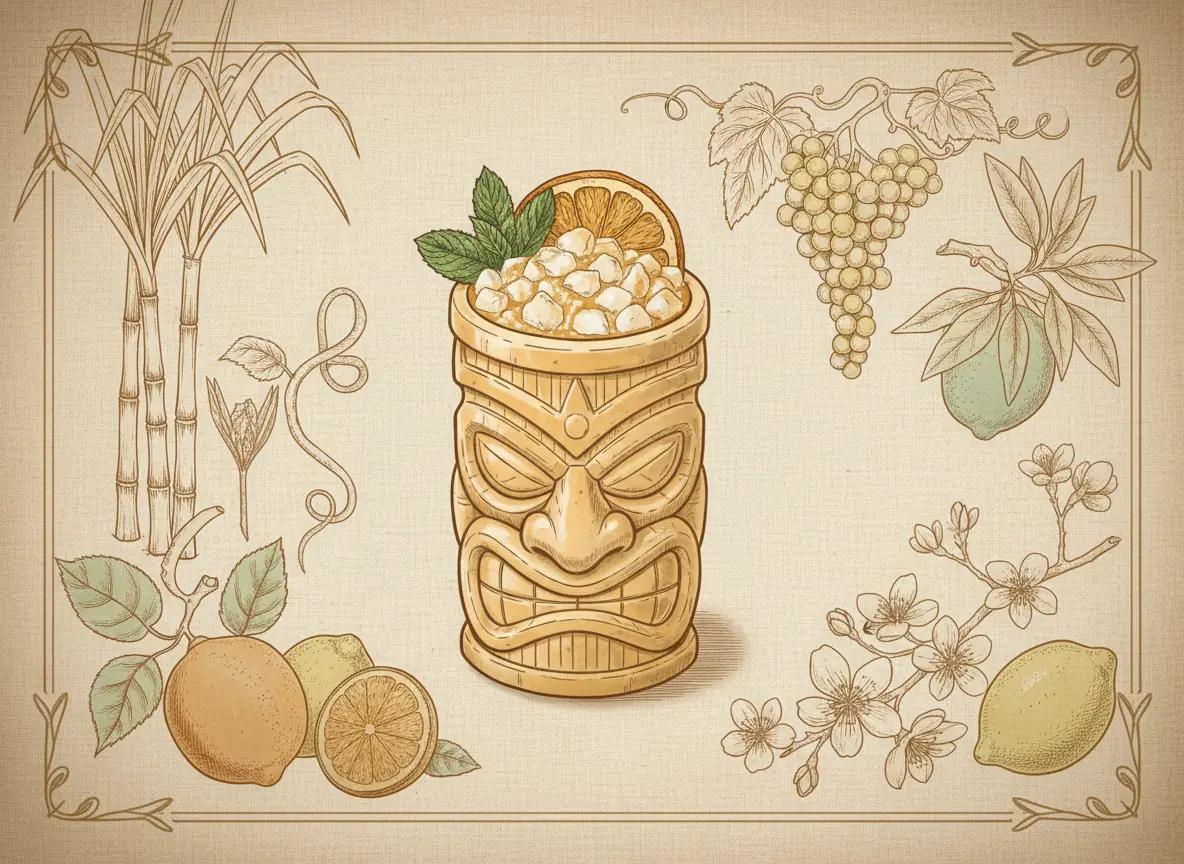
The Scorpion is one of Trader Vic's most enduring creations, developed at his Oakland bar in the early 1950s and built around a principle that defined the tiki movement at its best: complexity through balance rather than complexity through volume. Rum and cognac share the base. Fresh orange and lemon juice provide the acid backbone. Orgeat pulls everything together with sweetness and texture that simple syrup cannot replicate. It is a drink that rewards precision. The citrus must be fresh, squeezed immediately before building. The orgeat must be quality. The shake must be committed. Cut any of those corners and the Scorpion becomes exactly what tiki cocktails are unfairly accused of being: sweet, muddled, and forgettable. Trader Vic served it as a communal bowl drink, often for two to four people, with long straws and elaborate garnish. The single-serve format presented here strips that back to the essential structure. The drink holds its own without the theatre.
Strawberry Daiquiri
The Strawberry Daiquiri is the most ordered frozen cocktail on earth and the most casually ruined. It is the resort-era blend of the Cuban classic with summer’s berry, built honestly from fresh fruit and dishonestly from a machine’s red slush, and fifty years of the latter have obscured how good the former is. The honest spec is fruit-bowl simple: ripe strawberries blended with white rum, lime and a short measure of syrup, with the berries supplying the colour, the body and most of the sweetness whenever the season cooperates. Frozen fruit makes the drink year-round and colder. The machine mix makes it the punchline it never deserved. Unlike most fruit daiquiris, it is ordered by name rather than described at the bar, which makes it an institution in its own right across every warm latitude on earth. What it has never had is a written standard: five ripe berries, a proper white rum and fresh lime, blended short and poured immediately. That is the whole recipe, and it is better than its reputation by a distance.
Three Dots and a Dash
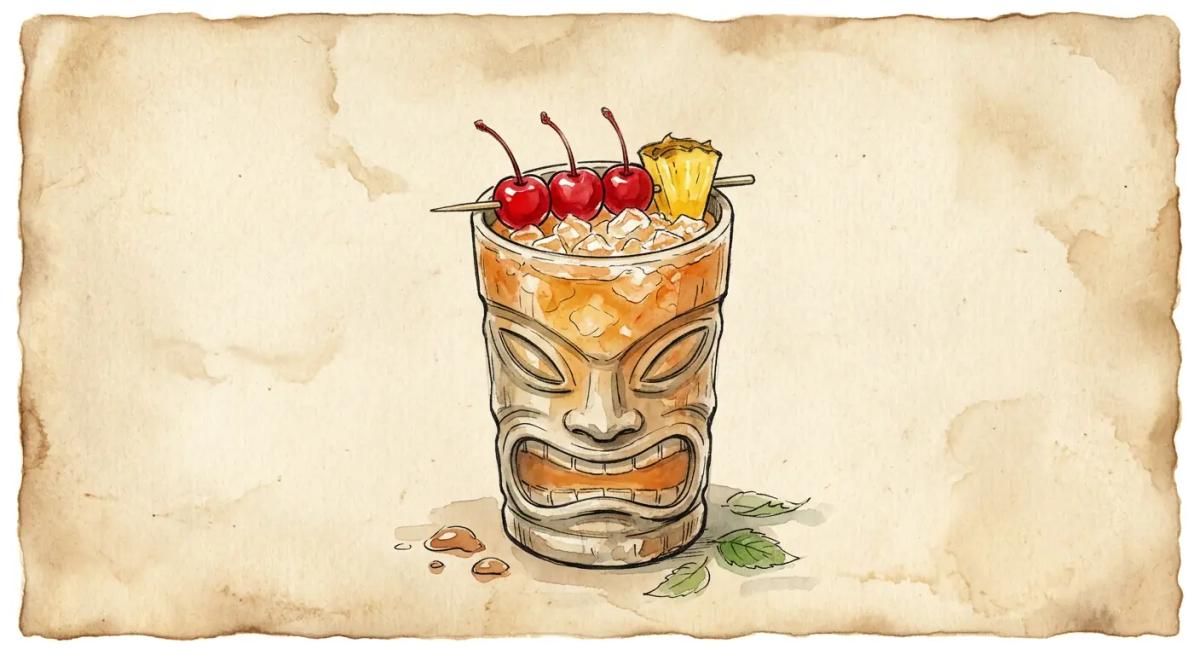
Three Dots and a Dash was created by Donn Beach at Don the Beachcomber in 1944 and named after the Morse code signal for the letter V, the Allied symbol for victory during the Second World War. The drink was Beach’s tribute to American military service, and the garnish states the name directly: three cherries as the dots, a single pineapple chunk as the dash. The structure is a complex tiki build. Aged rum and rhum agricole as a split base give a depth and a grassy character neither could deliver alone; fresh orange and lime give a layered citrus structure; and honey syrup, falernum and Angostura supply the aromatic complexity that connects it to Beach’s wider repertoire. The rhum agricole is the defining structural choice. Produced from fresh cane juice, it brings a vegetal character entirely distinct from molasses rum, sitting at the top of the profile while the aged rum anchors the depth beneath it.
Tia Mia
The Tia Mia is the Mai Tai crossing the border. Ivy Mix built it at Leyenda, her pan-Latin cocktail bar in Brooklyn, by splitting the sacred base between Jamaican rum and mezcal so that Trader Vic’s 1944 masterpiece picks up Oaxacan smoke. The name puns Mai Tai into Spanish, tía mía, my aunt, and honours a regular of the bar. Everything else is left exactly where Vic put it. Lime, orgeat and orange curaçao in their classic measures, crushed ice, an unstrained pour, the spent lime shell sunk in the glass and a slapped sprig of mint on top. The only revolution is the passport. It works because smoke and funk turn out to be related. Jamaican rum’s esters and espadín mezcal’s ember are both wild and both loud, and the orgeat referees them exactly as it referees a blend of rums in the parent. It is now the standard pour for anyone who thinks the Mai Tai stopped evolving in 1944.
Zombie
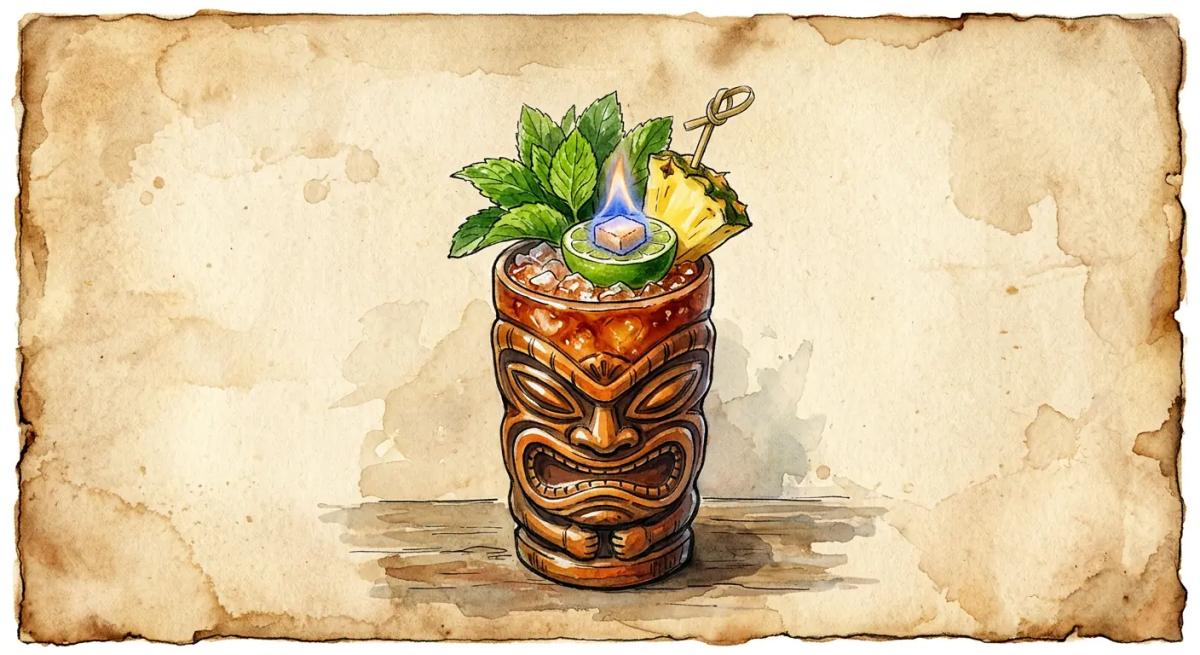
The Zombie was created by Donn Beach at Don the Beachcomber in Hollywood in 1934 and became the most infamous drink in the tiki canon almost immediately. Beach kept the recipe encoded for decades, forcing rivals into inferior imitations that gave the Zombie its reputation for being more alcohol than intention, and the original was not reconstructed with confidence until Jeff Berry published Sippin' Safari in 2007. Beach called it a mender of broken dreams and limited his customers to two per sitting. Both descriptions remain accurate. The official build splits three rums across the palate rather than stacking four: Jamaican for aroma and fruit, gold Puerto Rican for body through the middle, and Demerara for smoke and weight underneath. Lime, falernum and a dash of grenadine frame them. What makes it the Zombie rather than a rum punch is Donn's Mix — grapefruit juice cut with cinnamon syrup — and six drops of Pernod. Both were part of the coded recipe, both were missing from every version poured between 1934 and 2007, and their absence is exactly why the drink spent seventy years with a reputation for brute strength.