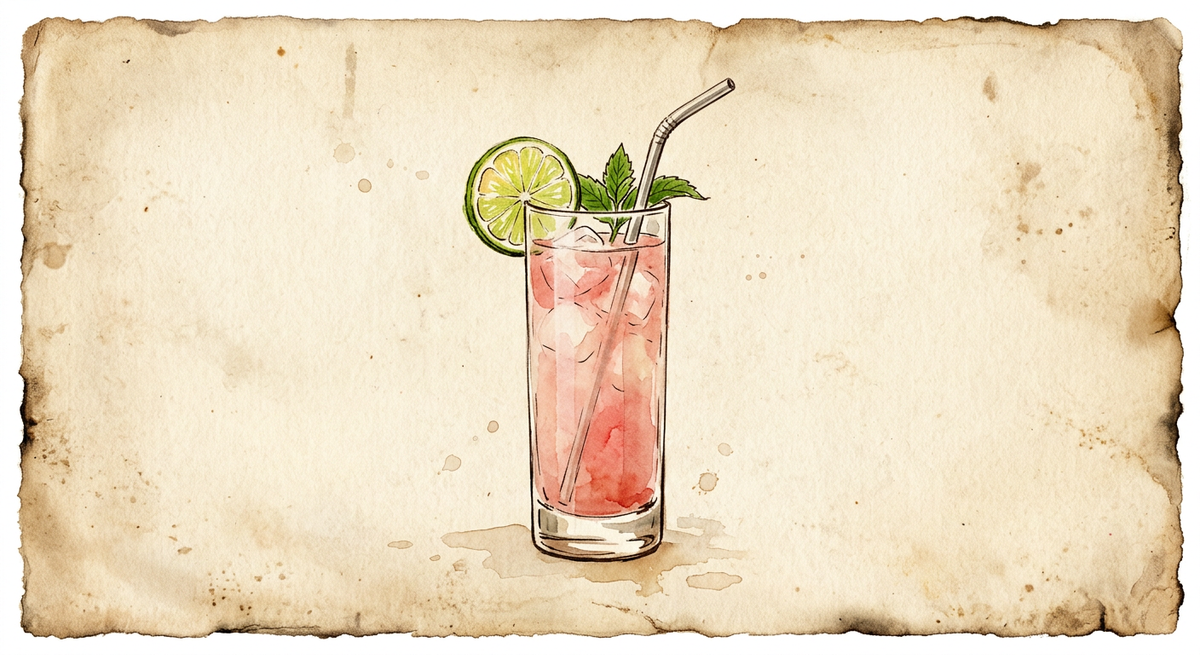
Doctor Funk
A Doctor Funk is a long rum drink seasoned with absinthe: 60ml white rum, 22.5ml fresh lime juice, 15ml fresh lemon juice, 10ml grenadine, 10ml sugar syrup and 7.5ml absinthe, shaken hard, strained over fresh ice in a collins glass and topped with 60ml soda water and a lime wheel. The result is dry, sharp, faintly aniseed and pale pink. It is named after Dr Bernhard Funk, a German doctor in Samoa and, as Frederick O’Brien wrote in 1921, physician to Robert Louis Stevenson. Frederick O’Brien’s 1921 book Mystic Isles of the South Seas describes the doctor’s drink: absinthe, a dash of grenadine, the juice of two limes and half a pint of siphon water. Don the Beachcomber later added rum, a change Difford’s Guide dates to the early 1950s. A glass holds about 2.9 UK units, more than its length suggests.
Glassware: Collins Glass
Garnish: Lime wheel
Ingredients
60ml
Crisp white rum, 40% ABV, our choice so the absinthe leads. Many published versions use dark rum, which makes a heavier, sweeter drink.
22.5ml
Squeezed the same day; the doctor’s drink used lime, and its sharpness suits the aniseed, and at 22.5ml it carries most of the acid.
15ml
A second, rounder acid. It keeps the middle of the drink bright once the soda has diluted it.
10ml
Pomegranate syrup at 10ml, for colour and a dark fruit note more than sweetness. The doctor’s drink had a dash of it too.
7.5ml
Measured at 7.5ml. Absinthe is usually 45 to 74% ABV (we assume 68%) and strongly flavoured; a verte adds herbal depth, a blanche is cleaner. The drink is built around this small dose.
10ml
Plain syrup, 1:1 by weight. Ten millilitres softens the citrus without making the drink sweet.
60ml
Cold, at 60ml, added after the shake. It lengthens the drink, as the siphon water did in the doctor’s version.
Instructions
Squeeze the lime and lemon juice the same day.
Add the rum, lime juice, lemon juice, grenadine, absinthe and sugar syrup to a shaker.
Fill with cubed ice and shake hard for 10 to 12 seconds.
Strain into a collins glass filled with fresh ice.
Top with the soda water and stir once.
Garnish with a lime wheel.
Our version
Published versions differ. Difford’s Guide gives 70ml dark rum, 5ml absinthe, 10ml grenadine, 7.5ml syrup, 15ml lemon and 7.5ml lime over crushed ice. Ours uses 60ml white rum and 7.5ml absinthe, served long with 60ml soda.
Source: our own specification. Last checked 9 October 2026.
Expert Tip
Measure the absinthe. At 7.5ml it supplies the aniseed spine; poured freely, a spirit at 45 to 74% ABV takes over and no amount of soda brings the drink back. Choose pomegranate grenadine. Ten millilitres gives colour and a dark fruit note; a bright commercial grenadine tastes of cherry sweets, and a drink this dry shows it. Shake everything except the soda, hard, for 10 to 12 seconds. Strain over fresh ice, top with the soda and stir once: shaken soda goes flat, and one stir lifts the drink without losing the bubbles.
Behind the Doctor Funk
Flavour Profile
The Doctor’s Drink
Dr Bernhard Funk was a German physician who arrived in Samoa in 1880 and left for Germany in 1911, dying in a Berlin hospital that April, by Difford’s Guide’s account. He was Robert Louis Stevenson’s doctor during the writer’s last years on the island.
His drink appears in Frederick O’Brien’s 1921 book Mystic Isles of the South Seas: a portion of absinthe, a dash of grenadine, the juice of two limes and half a pint of siphon water. It was offered as a tonic against the heat.
Don the Beachcomber’s Rum
Don the Beachcomber added rum to it. Difford’s Guide places the change in the early 1950s, at his restaurant in Palm Springs; some accounts date it earlier, and none settles it. Unlike most tiki drinks, its South Seas origin can be traced to a printed source.
The Doctor Funk, then and now; the 1921 row follows O’Brien’s Mystic Isles of the South Seas
Dr Funk, as O’Brien described it in 1921
- Rum
- None
- Absinthe
- A portion
- Citrus
- Juice of two limes
- Sweetener
- A dash of grenadine
- Lengthener
- Half a pint of siphon water
Difford’s Guide
- Rum
- 70ml dark rum
- Absinthe
- 5ml
- Citrus
- 7.5ml lime, 15ml lemon
- Sweetener
- 10ml grenadine, 7.5ml syrup
- Lengthener
- Crushed ice, no soda
Ours
- Rum
- 60ml white rum
- Absinthe
- 7.5ml
- Citrus
- 22.5ml lime, 15ml lemon
- Sweetener
- 10ml grenadine, 10ml syrup
- Lengthener
- 60ml soda
| Version | Rum | Absinthe | Citrus | Sweetener | Lengthener |
|---|---|---|---|---|---|
| Dr Funk, as O’Brien described it in 1921 | None | A portion | Juice of two limes | A dash of grenadine | Half a pint of siphon water |
| Difford’s Guide | 70ml dark rum | 5ml | 7.5ml lime, 15ml lemon | 10ml grenadine, 7.5ml syrup | Crushed ice, no soda |
| Ours | 60ml white rum | 7.5ml | 22.5ml lime, 15ml lemon | 10ml grenadine, 10ml syrup | 60ml soda |
The Absinthe
At 7.5ml, absinthe is the smallest measure in the glass, and it decides the drink. A verte brings herbal depth and a faint green; a blanche is cleaner and lets the grenadine’s pink show. Pour more than a measured dose and aniseed is all you taste.
Two Citrus
Lime is the doctor’s citrus and carries most of the acid. Lemon is rounder and keeps the drink bright once the soda goes in. All lime makes it sharper; all lemon, softer.
The doctor’s version used lime alone, the juice of two fruit to a portion of absinthe. Lemon came in later, and it suits a drink stretched with soda, where a single sharp citrus can thin out.
A Dry Tiki Drink
Most tiki drinks are built on several rums and fruit, and arrive sweet. The Doctor Funk has one rum, 20ml of sweeteners against 37.5ml of citrus, and soda on top. It is long and dry, nearer a highball than a Zombie, which makes it a good first drink of an evening.
How Strong It Is
Counting the rum at 40% ABV and the absinthe at 68%, one Doctor Funk comes to about 2.9 UK units. It is long and tastes light, so it is easy to underestimate.
Make it at home
The Spirit
White RumWhite rum is clear rum, usually bottled at 40% ABV, either unaged or rested in oak and then charcoal-filtered back to clear. It is the light, dry rum of the Daiquiri, the Mojito and the Cuba Libre, and the rum most of our recipes mean when they want rum that sits under lime rather than over it.
More to explore
Frequently Asked Questions
Who was Doctor Funk?
What is in a Doctor Funk?
How strong is a Doctor Funk?
When was rum added to the Doctor Funk?
Should I use white rum or dark rum?
Can I leave out the absinthe?
Sources.
Correct as of 18 October 2026.
- Difford’s Guide, “Doctor Funk” (secondary source: Funk in Samoa 1880 to 1911, died 8 April 1911 in Berlin; Stevenson’s physician; Don Beach’s rum version, Palm Springs, early 1950s; the 70ml dark rum recipe).
- Frederick O’Brien, on Project Gutenberg, “Mystic Isles of the South Seas (1921)” (primary: “a portion of absinthe, a dash of grenadine … the juice of two limes, and half a pint of siphon water. Dr. Funk of Samoa, who had been a physician to Robert Louis Stevenson”).
You Might Also Like
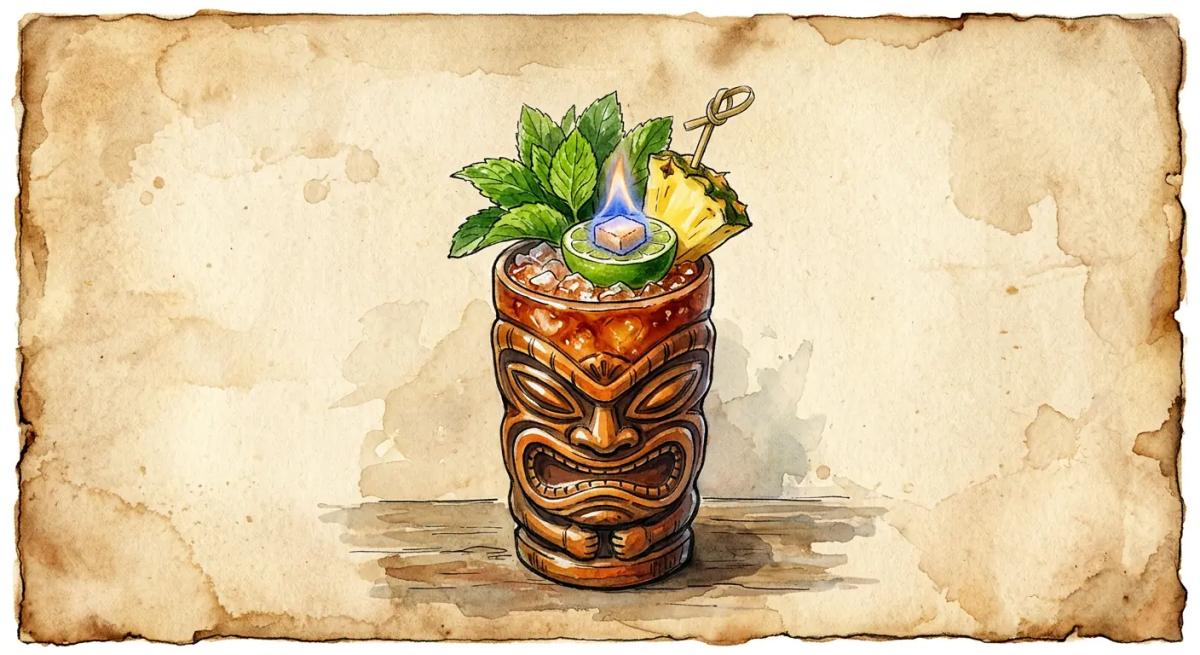
Zombie
A Zombie is 45ml Jamaican dark rum, 45ml gold Puerto Rican rum and 30ml Demerara rum with 20ml fresh lime juice, 15ml falernum, 15ml Donn’s Mix, a teaspoon of grenadine, a dash of Angostura and six drops of Pernod, flash blended with cracked ice and poured into a zombie glass with mint. Those are the IBA’s measures. About 5.0 UK units in one glass. The Oxford Companion says Donn Beach created it in 1934 at Don the Beachcomber’s in Hollywood, and refused to serve more than two to a customer. Difford’s Guide says his recipes were notated in a secret code of numbered bottles and elusive mixes, and the Companion says Jeff Berry found the original formula in 2006 in the notebook of a former Beachcomber’s headwaiter, Richard Santiago. Donn’s Mix, two parts grapefruit juice to one of cinnamon syrup, is what separates it from a strong rum punch.
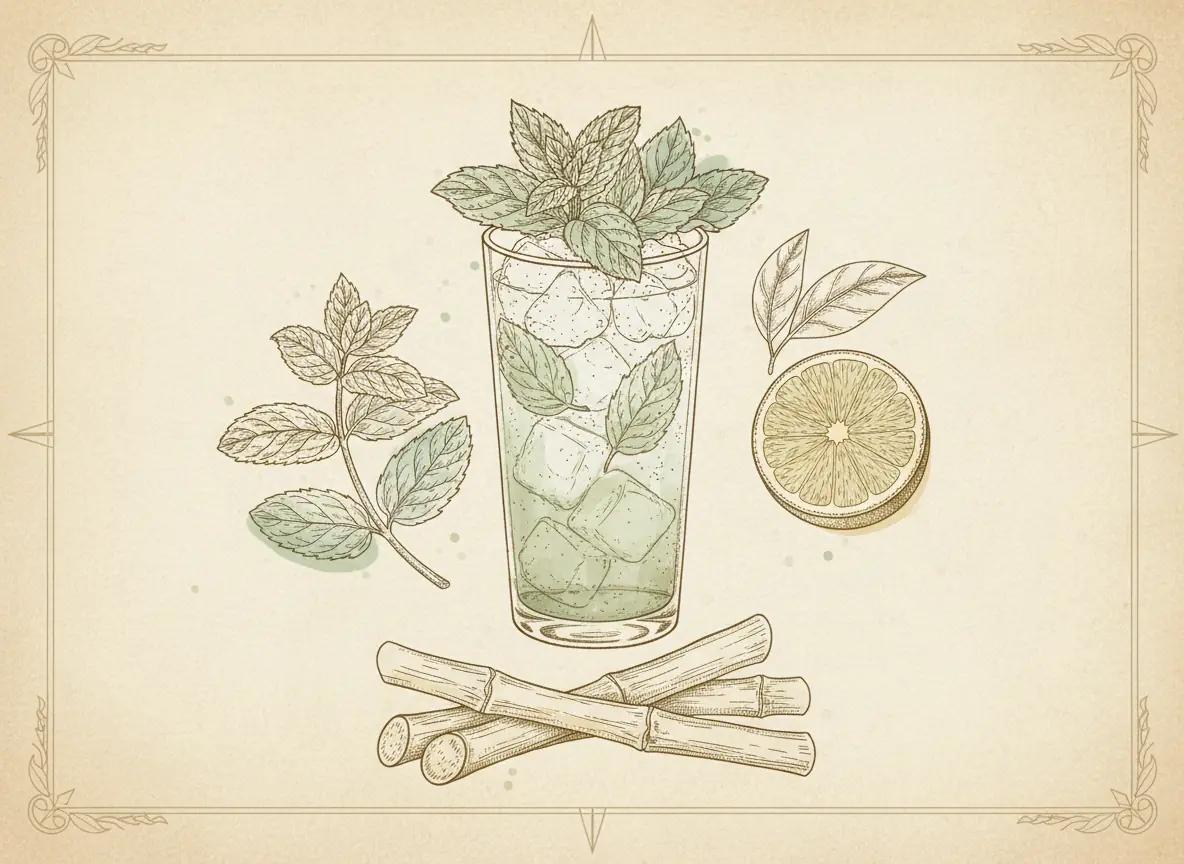
Mojito
A Mojito is 45ml of white rum, 20ml of fresh lime juice, two teaspoons of white cane sugar and six sprigs of mint, built in a highball. The mint is pressed gently with the sugar, the glass is filled with cubed ice, the rum and lime go in, and 75 to 100ml of chilled soda water tops it. About 1.8 UK units. Those are the IBA’s measures. The IBA only says to top up with soda, so the 75 to 100ml is ours. Press the mint once or twice and stop. Torn leaves make the drink bitter and grassy, and that, more often than the rum, is why a Mojito disappoints. The sugar grains help: they bruise the surface of the leaf as you press, and the lime then carries the oil through the glass.
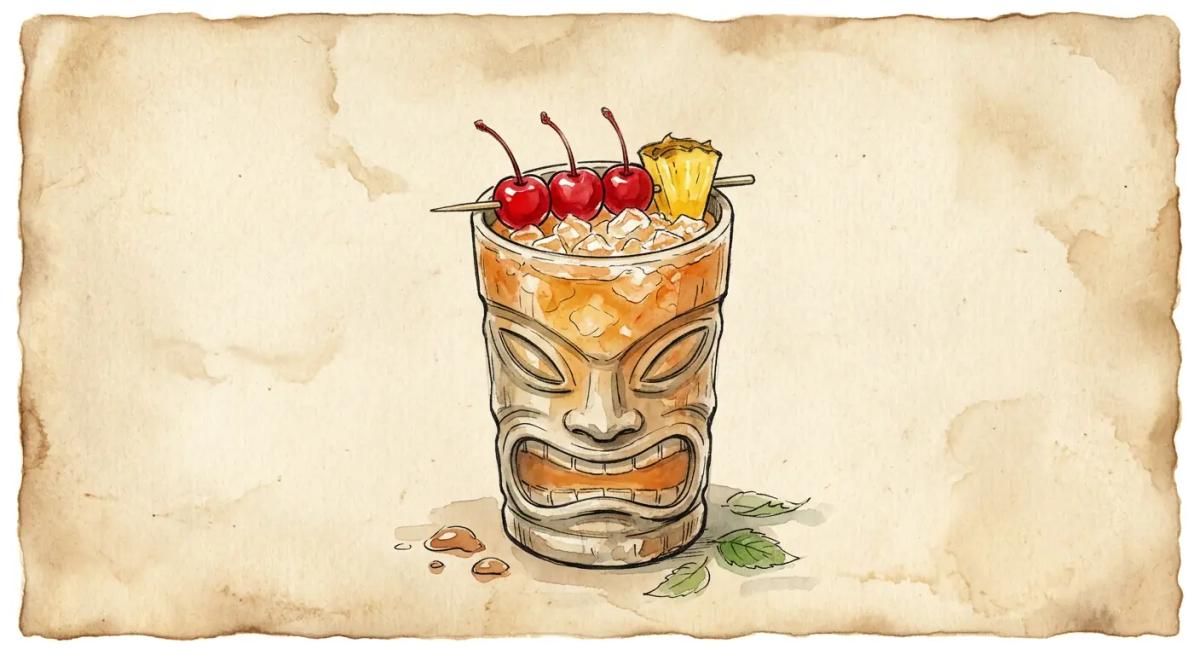
Three Dots and a Dash
Three Dots and a Dash is 45ml of rhum agricole, 15ml of aged rum, 15ml each of fresh lime juice, fresh orange juice and honey syrup, 7.5ml each of falernum and allspice dram, and two dashes of Angostura bitters. Shake it hard for 10 to 12 seconds and strain it over crushed ice in a tiki mug, then lay three cherries and a pineapple chunk across the top on one skewer. About 3.2 UK units. The measures are the IBA’s, from its New Era list; the IBA flash blends where we shake. The drink is credited to Donn Beach at Don the Beachcomber in Hollywood during the Second World War. The name is Morse code: three dots and a dash spell V, the Allied sign for victory, and the garnish spells it again. The agricole leads. Made from fresh-pressed cane juice, it tastes grassy and green, and at three times the aged rum it sets the tone. The falernum contains almond.
Where this one sits
Recipe by Jerry Can Spirits · Updated 18 October 2026