Pisco Sour
A Pisco Sour is 60ml of pisco, 30ml of fresh lemon juice, 20ml of sugar syrup and one egg white, dry shaken for 10 to 15 seconds, then shaken hard with ice for 10 to 12 seconds and double strained into a chilled coupe, with three drops of Angostura on the foam. About 2.4 UK units. The egg white is raw. The measures are the IBA’s. The Oxford Companion says the drink was first served at Morris’ Bar in Lima, which Victor Morris operated from 1916 to 1929, that the first known recipe appeared in a Lima cookbook in 1924 without egg white or bitters, and that one theory has Mario Bruiget, a young pupil of Morris’s, modifying it at the Maury Hotel in Lima before 1928. The Companion says a similar recipe was published in Santiago, Chile, in 1930, again without egg white or bitters, and that many regions of Chile still mix it closer to that formula. In Peru it is mixed with local lemons, which the Companion says taste between lemons and limes; the IBA lists lemon. The Companion adds that Pisco Sour Day is celebrated in Peru on the first Saturday of February.
Variations
Glassware: Coupe Glass
Garnish: Angostura bitters three drops on the foam
Ingredients
60ml
Peruvian pisco, at our working figure of 40% ABV. The Oxford Companion says Peruvian pisco is a single distillation in a pot still, with no water added, and in our view its grape aroma carries through the egg white.
30ml
What the IBA lists. Peru uses its own small lime, which is sharper; that version is under variants. Squeeze it the same day.
20ml
One to one, by weight. Against 30ml of lemon it keeps the drink sour while giving the foam some body.
1 (about 30ml)
One white, as the IBA lists it. It builds the foam the bitters rest on. Raw. Following the FSA, British Lion-mark eggs are safe raw, including for vulnerable groups and in pregnancy; pasteurised carton white is the alternative. Eating out, where the mark cannot be checked, the FSA advises vulnerable people to have their eggs thoroughly cooked. Contains egg: leave it out, or use aquafaba, for anyone allergic.
3 drops
Three drops on the settled foam, for aroma, at the 44.7% on DrinkSupermarket’s listing. The IBA names Amargo bitters; Angostura is easier to find in Britain.
Instructions
Squeeze the lemon juice the same day.
Add the pisco, lemon juice, sugar syrup and egg white to a shaker.
Dry shake without ice for 10 to 15 seconds.
Add cubed ice and shake hard for 10 to 12 seconds.
Double strain into a chilled coupe and let the foam settle for half a minute.
Drop three drops of Angostura onto the foam.
Source: the IBA (Official IBA specification; method, glass and bitters ours). Last checked 10 October 2026.
Expert Tip
Dry shake first, then shake with ice. Ten to 15 seconds without ice unfolds the egg proteins and traps air; the 10 to 12 seconds with ice that follow chill and dilute the drink. Ice from the start gives a thinner foam that collapses sooner. Let the foam settle for half a minute before the bitters go on. Dropped onto a surface that is still moving, they sink and disappear. Leave the drops on top. They are there for the nose, so the aroma arrives a moment before the drink does. Stirred through, they only darken the foam.
Behind the Pisco Sour
Flavour Profile
Morris’ Bar, Lima
The Oxford Companion says Victor Vaughan Morris, born in Salt Lake City, Utah, ran a flower shop with his brother, left in 1903 for a clerical job with the Cerro de Pasco Railroad Company, which was building a railway to a copper mine in the Peruvian Andes, and in 1916 moved to Lima and opened Morris’ Bar in the heart of the city’s business district. It says the many foreign travellers who visited his bar spread the drink’s fame worldwide.
The Companion’s entry on the Pisco Sour says the first known recipe, and the only one published while Morris’ Bar was in operation, appeared in a Lima cookbook in 1924 within the entry for Whisky Sour: the Pisco Sour “is prepared the same way”, with no egg white or bitters. The Companion adds that a recipe for a drink that was the Pisco Sour in everything but name was already circulating in Lima in 1903, so Morris may equally have come up with his version independently.
One theory in the Companion has Mario Bruiget, a young pupil of Morris’s who later worked at the Maury Hotel in Lima for fifty years, modifying the recipe there to its present form, with egg white and bitters. If so, the Companion says, it must have been before 1928, when an American traveller in Lima met the drink made with egg whites.
Two Countries, One Name
Peru and Chile both make pisco and both claim the sour. The Oxford Companion says that in Peru pisco must be the product of a single distillation in a pot still, with no water added, and that Peruvian pisco cannot be aged in wood.
The drinks differ too. The Companion says a Chilean recipe of 1930 leaves out the egg white and bitters, and that many regions of Chile still mix it closer to that formula; in our view it comes out sharper and clearer. The Peruvian one, with egg and bitters, is the version the IBA records.
Lemon or Lime
The IBA lists lemon. Peru squeezes its own small lime, sharper and more fragrant than a British supermarket lemon, and many Peruvian recipes call for it. Because it carries more acid, the measure comes down: 25ml of lime does the work of 30ml of lemon.
The Foam and the Drops
Egg white foams best warm and undiluted, which is why the shake without ice comes first. The second shake chills the drink and adds the water it needs. Double straining catches the strands of white, leaving a smooth, matte surface.
The bitters are placed, not mixed. Three drops on settled foam, drawn into a pattern with a cocktail stick if you like, give the aroma that meets you first.
The IBA’s Recipe and Ours
The IBA Pisco Sour and ours
Pisco
- IBA
- 60ml
- Ours
- 60ml
Fresh lemon juice
- IBA
- 30ml
- Ours
- 30ml
Sugar syrup
- IBA
- 20ml
- Ours
- 20ml
Egg white
- IBA
- One, raw
- Ours
- One, raw
Method
- IBA
- Shaken with ice and strained
- Ours
- Dry shaken 10 to 15 seconds, shaken with ice 10 to 12, double strained
Glass
- IBA
- Chilled goblet
- Ours
- Chilled coupe
Bitters
- IBA
- A few dashes of Amargo on top
- Ours
- Three drops of Angostura on top
UK units
- IBA
- About 2.4
- Ours
- About 2.4
| Element | IBA | Ours |
|---|---|---|
| Pisco | 60ml | 60ml |
| Fresh lemon juice | 30ml | 30ml |
| Sugar syrup | 20ml | 20ml |
| Egg white | One, raw | One, raw |
| Method | Shaken with ice and strained | Dry shaken 10 to 15 seconds, shaken with ice 10 to 12, double strained |
| Glass | Chilled goblet | Chilled coupe |
| Bitters | A few dashes of Amargo on top | Three drops of Angostura on top |
| UK units | About 2.4 | About 2.4 |
How to Serve It
Straight from the shaker into a chilled coupe, drops on, and drunk within a few minutes while the foam is at its best.
For the same frame on bourbon, make a Whiskey Sour; for pisco with pineapple and lemon, a Pisco Punch.
Make it at home
The Spirit
PiscoPisco is a grape brandy made in Peru and Chile, usually unaged and about 40% ABV, and the UK protects the name for both countries. Peruvian pisco is distilled once to bottling strength and never meets wood or added water; Chilean pisco may be diluted and aged in oak. Our Pisco Sour and Pisco Punch are built on its floral grape scent.
More to explore
Frequently Asked Questions
What is in a Pisco Sour?
Who invented the Pisco Sour?
Is the Pisco Sour Peruvian or Chilean?
Lemon or lime in a Pisco Sour?
Is the egg white raw?
Why has my foam collapsed?
Why the drops of bitters on top?
How strong is a Pisco Sour?
Sources.
Correct as of 19 October 2026.
- The Oxford Companion to Spirits and Cocktails (Guillermo L. Toro-Lira), “Pisco Sour” (secondary source: first served at Morris’ Bar, Lima, 1916 to 1929; first known recipe in a Lima cookbook of 1924 without egg white or bitters; the Bruiget theory; a Santiago recipe of 1930; Pisco Sour Day on the first Saturday of February).
- The Oxford Companion to Spirits and Cocktails (David Wondrich), “pisco” (secondary source: Peruvian pisco a single pot-still distillation with no water added; cannot be aged in wood).
- IBA, “Pisco Sour” (official specification: 60 ml pisco, 30 ml fresh lemon juice, 20 ml simple syrup, 1 raw whole egg white; shake with ice and strain into a chilled goblet; few dashes of Amargo bitters on top).
- DrinkSupermarket, “Angostura Aromatic Bitters 200ml” (retailer listing: Strength (ABV)% 44.7).
- The Oxford Companion to Spirits and Cocktails (Guillermo L. Toro-Lira), “Morris, Victor Vaughan” (secondary source: 1873 to 1929; born in Salt Lake City; left in 1903 for the Cerro de Pasco Railroad Company; opened Morris’ Bar in Lima in 1916; widely credited with the Pisco Sour).
You Might Also Like
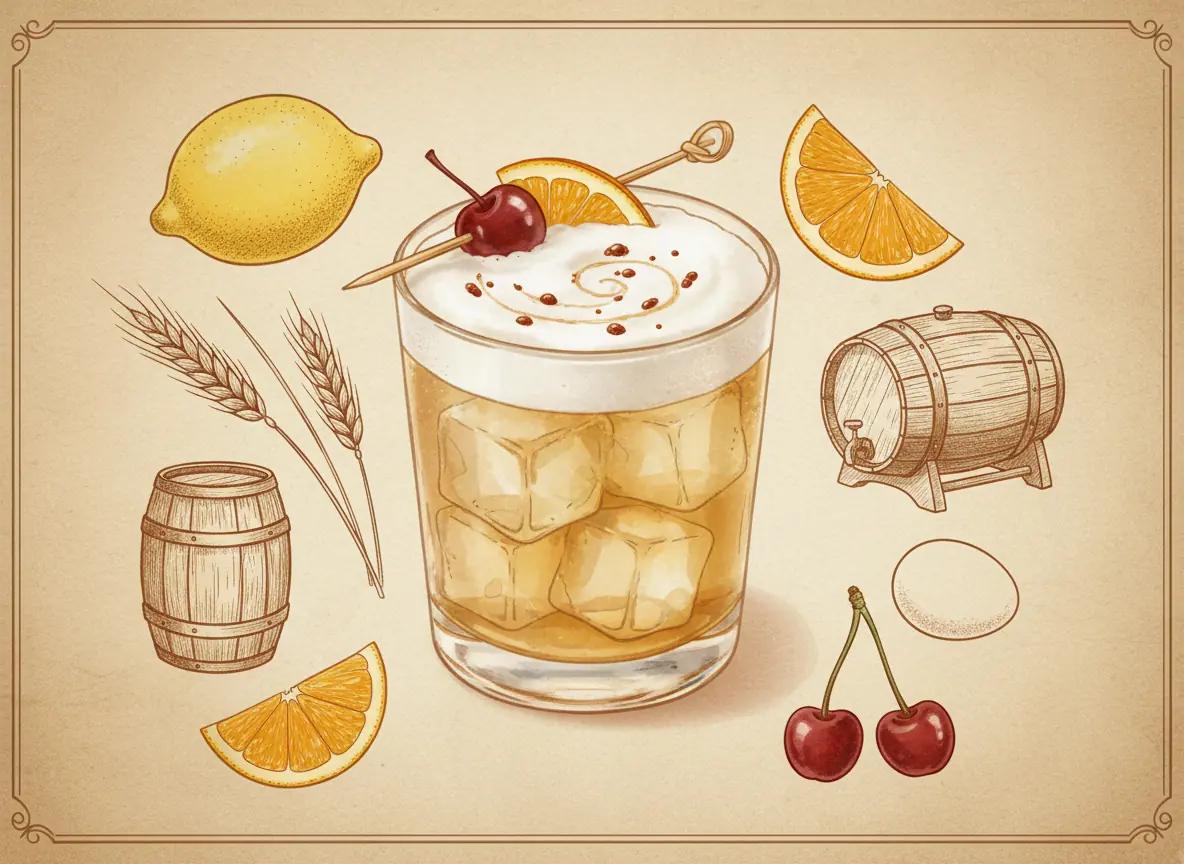
Whiskey Sour
A Whiskey Sour is 45ml of bourbon, 25ml of fresh lemon juice and 20ml of sugar syrup, shaken hard with ice, then poured through a strainer onto fresh cubes in a rocks glass, with half an orange slice and a cherry. Add 15ml of egg white, dry shaken first, and dot the foam with Angostura. About 1.8 UK units. The measures are the IBA’s. The IBA’s egg white is optional and only a few drops; we use 15ml, about half a white, because that is what a full foam takes. The bitters are not in the IBA recipe, and they only go on when there is foam to hold them. The name is in print by 1870, in a Wisconsin newspaper, and the sour is older still: Jerry Thomas printed brandy, gin and rum sours in 1862. Difford’s Guide lists a Boston Sour as bourbon soured with lemon juice and smoothed by egg white.
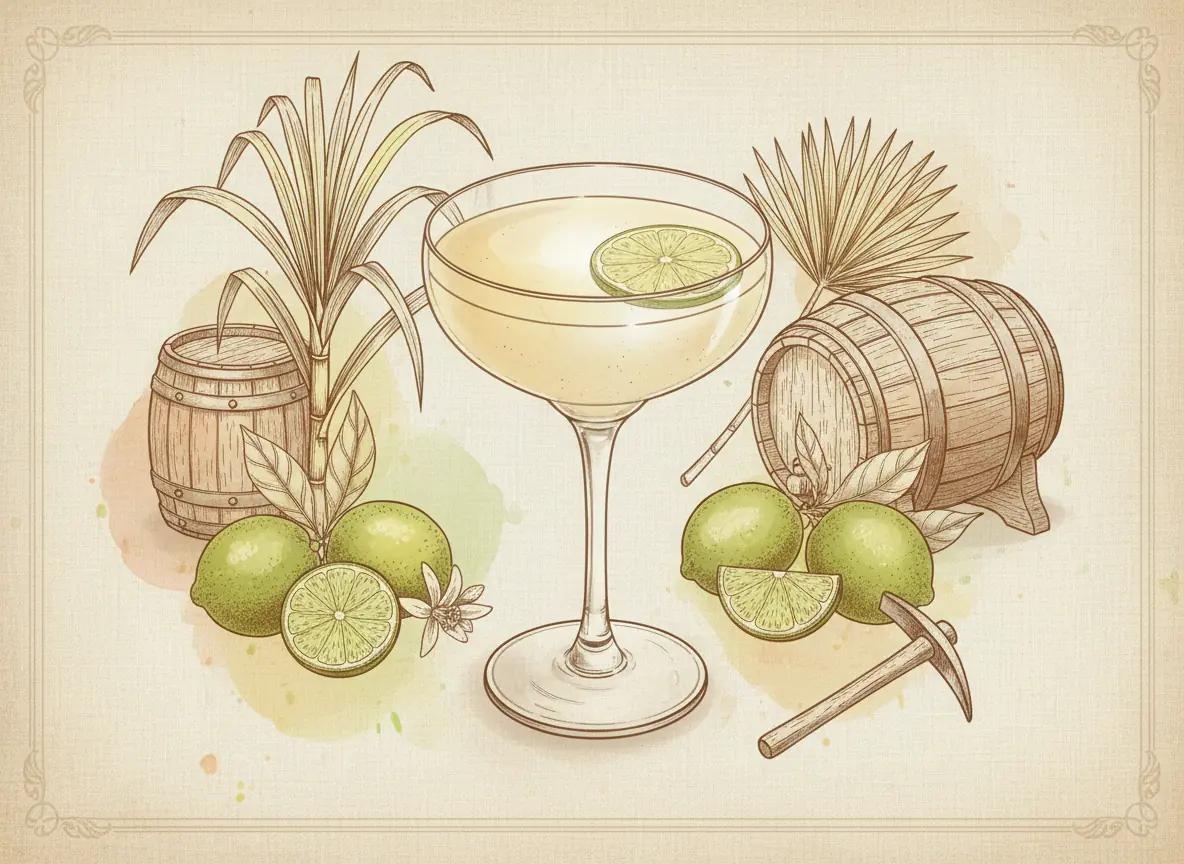
Daiquiri
A Daiquiri is 60ml white rum, 20ml fresh lime juice and two bar spoons of caster sugar. Stir the sugar into the rum and lime in the shaker until it dissolves, then add ice, shake hard for 10 to 12 seconds and double strain into a chilled coupe. About 2.4 UK units. Those are the IBA’s measures, and its method dissolves the sugar first too. The name belongs to Daiquirí, an iron-mining district and beach near Santiago de Cuba. Difford’s Guide credits Jennings Stockton Cox, an American engineer who led one of the first mining parties into Cuba’s iron-ore country after the Spanish-American War of 1898; the Oxford Companion has him making or supervising the first Daiquiri in 1896, and a Santiago bartender naming it in 1908. Difford’s says Constantino Ribalaigua Vert of Havana’s El Floridita made the frozen version famous. With three ingredients and no liqueur or bitters, the Daiquiri hides nothing. A flat rum, tired lime or undissolved sugar shows in the first sip.
Pisco Punch
A Pisco Punch is 60ml of pisco, 22.5ml of fresh pineapple juice, 15ml of fresh lemon juice and 15ml of simple syrup, shaken hard over three cloves mashed into the syrup, double strained into a large wine glass and finished with 30ml of dry white wine stirred in gently. About 2.8 UK units. The measures are the IBA’s; the pineapple chunk on the rim is ours. The drink belongs to the Bank Exchange, the saloon in San Francisco’s Montgomery Block that opened in 1853 and closed in 1919 under Prohibition, the Oxford Companion says. Duncan Nicol, its sole proprietor by 1896, took his recipe to the grave, so every Pisco Punch poured now is a reconstruction. This one is scented rather than sharp. The grape perfume of the pisco meets the pineapple, the clove sits underneath, and the wine draws it out into a punch.
Where this one sits
Recipe by Jerry Can Spirits · Updated 19 October 2026