Tuxedo
A Tuxedo is 30ml of Old Tom gin and 30ml of dry vermouth with 2.5ml of maraschino, 1.25ml of absinthe and three dashes of orange bitters, stirred over ice for 20 to 30 seconds and strained into a chilled Nick and Nora glass with a lemon twist and a cherry. About 1.9 UK units. Those are the IBA’s measures, with its half and quarter bar spoons written in millilitres. It is a martini of the old equal-parts kind, with three seasonings measured almost in drops. The drink shares its name with the Tuxedo Club, near Tuxedo Park, New York, which Difford’s Guide says opened on 30 May 1886 and where the dinner jacket acquired its American name. The Hoffman House Bartender’s Guide of 1905 prints a Tuxedo Cocktail on Old Tom gin; Straub’s 1913 manual and the Savoy Cocktail Book of 1930 print versions on dry gin, and they do not all agree. The Old Tom matters. It is a lightly sweetened gin, and against an equal measure of dry vermouth, with almost no other sugar in the glass, that sweetness keeps the drink from turning sharp.
Glassware: Nick & Nora Glass
Garnish: Lemon twist and Maraschino cherry
Ingredients
30ml
Old Tom, a lightly sweetened gin style, at our working 40% ABV. A London Dry leaves the drink sharper and thinner.
30ml
French-style dry vermouth, at our working 18% ABV, which we open within the month and keep cold. At half the drink, a tired bottle shows at once.
2.5ml
Half a bar spoon. Luxardo is the one the IBA names. It adds cherry stone and a little sweetness, never a flavour you could pick out.
1.25ml
A quarter bar spoon, or a rinse of the glass. Strengths vary a great deal between bottles, so measure it rather than dashing it from the bottle.
Instructions
Chill a Nick and Nora glass in the freezer.
Add the Old Tom gin, dry vermouth, maraschino, absinthe and orange bitters to a mixing glass.
Fill with cubed ice and stir for 20 to 30 seconds.
Strain into the chilled glass.
Express a lemon twist over the drink, drop it in and add a cherry.
Source: the IBA (Official IBA specification; absinthe stirred in or as a rinse; method ours). Last checked 9 October 2026.
Expert Tip
Measure the maraschino and the absinthe. At 2.5ml and 1.25ml they are seasonings, and a free pour from the bottle can easily double them. Double the maraschino and the drink tastes of cherry; double the absinthe and anise covers everything else. Use dry vermouth opened within the month and kept in the fridge. It is half the drink, and an oxidised bottle makes the whole glass taste flat and faintly sour. For a lighter touch of anise, rinse the chilled glass with the absinthe and tip out the excess instead of stirring it in. The anise then meets you at the nose and fades, rather than running through every sip.
Behind the Tuxedo
Flavour Profile
The Origin
Difford’s Guide says the drink takes its name from the Tuxedo Club, a private country club and gated estate near the town of Tuxedo Park, 40 miles north-west of New York, which opened on 30 May 1886, and that it is widely presumed to have originated there in the late 1890s. The club is also where the dinner jacket’s American name originated, and Difford’s finds the first documented Tuxedo recipe in Harry Johnson’s 1900 Bartenders’ Manual.
The drink borrowed the same name. The Hoffman House Bartender’s Guide of 1905 prints a Tuxedo Cocktail of Old Tom gin and French vermouth with a dash each of maraschino and absinthe and three dashes of orange bitters, stirred. Straub’s 1913 manual and the Savoy Cocktail Book of 1930 print versions on dry gin, and the Savoy gives two. The IBA’s version, Old Tom and dry vermouth in equal parts, is the one used here.
The Quieter Twin
The Turf Club uses the same five bottles at a higher pitch: more of each spirit, and twice the maraschino and absinthe. The Tuxedo halves the seasonings, so the gin and vermouth lead and the cherry and anise stay underneath.
Make the two side by side once. The Turf Club tastes of its seasonings; the Tuxedo tastes of gin and wine. The Martini goes further and drops the seasonings altogether.
Why Old Tom
Old Tom is a gin style older than London Dry, lightly sweetened, and in this drink it does a job.
An equal measure of dry vermouth brings acidity and very little sugar, and the maraschino is too small to balance it. Old Tom’s sweetness fills that gap. With a London Dry the vermouth’s sharpness comes forward and the drink reads thinner.
Ours Against the IBA
The Tuxedo as the IBA writes it and as we make it
Old Tom gin
- IBA
- 30ml
- Ours
- 30ml
Dry vermouth
- IBA
- 30ml
- Ours
- 30ml
Maraschino
- IBA
- Half a bar spoon of Luxardo
- Ours
- 2.5ml
Absinthe
- IBA
- A quarter bar spoon
- Ours
- 1.25ml, or a rinse of the glass
Orange bitters
- IBA
- Three dashes
- Ours
- Three dashes
Method
- IBA
- Stirred with ice cubes
- Ours
- Stirred for 20 to 30 seconds
Glass
- IBA
- Chilled martini cocktail glass
- Ours
- Chilled Nick and Nora glass
Garnish
- IBA
- Cherry and lemon zest
- Ours
- Lemon twist and a cherry
| Element | IBA | Ours |
|---|---|---|
| Old Tom gin | 30ml | 30ml |
| Dry vermouth | 30ml | 30ml |
| Maraschino | Half a bar spoon of Luxardo | 2.5ml |
| Absinthe | A quarter bar spoon | 1.25ml, or a rinse of the glass |
| Orange bitters | Three dashes | Three dashes |
| Method | Stirred with ice cubes | Stirred for 20 to 30 seconds |
| Glass | Chilled martini cocktail glass | Chilled Nick and Nora glass |
| Garnish | Cherry and lemon zest | Lemon twist and a cherry |
How to Serve It
Up and cold in a small glass from the freezer, with a lemon twist and a cherry together, the double garnish of the period.
With no citrus juice and almost no sugar, the drink depends on its temperature. Stir the full 20 to 30 seconds, pour it small, and finish it while it is still cold.
Make it at home
The Spirit
Old Tom GinOld Tom is gin with a little sugar added, counted at 40% ABV in our recipes, and rounder and softer than London Dry. The retained Regulation (EC) 110/2008 gives the name no definition: it is sold as gin, and because it is sweetened it cannot be labelled dry. Four of our recipes ask for it, the Tuxedo, the Turf Club, the Casino and the Ford Cocktail, where its sugar balances vermouth or lemon.
Master the Techniques
More to explore
Frequently Asked Questions
What is a Tuxedo cocktail?
Where does the name come from?
How strong is a Tuxedo?
Why Old Tom rather than London Dry?
Should the absinthe be a rinse or stirred in?
How is it different from a Turf Club?
Sources.
Correct as of 19 October 2026.
- Charles S. Mahoney (1905), Internet Archive, “The Hoffman House Bartender’s Guide” (primary source: Tuxedo Cocktail. One dash maraschino, one dash absinthe, three dashes orange bitters, one-half wine-glass French Vermouth, one-half wine-glass Old Tom gin. Stir, strain, cherry, lemon peel).
- Jacques Straub (1913), Internet Archive, “Straub’s Manual of Mixed Drinks” (primary source: Tuxedo Cocktail, dry gin, French vermouth, a dash each of maraschino and absinthe, Angostura bitters, a barspoon of sherry; stir well (the OCR garbles the amounts)).
- Harry Craddock (1930), Internet Archive, “The Savoy Cocktail Book” (primary source: TUXEDO COCKTAIL (No. 1) French vermouth, dry gin, 2 dashes absinthe, lemon peel; (No. 2) dry gin, French vermouth, maraschino, absinthe, orange bitters, cherry; shake).
- Difford’s Guide, “Tuxedo Cocktail: Original Recipe and Variations” (secondary source: named for the Tuxedo Club near Tuxedo Park, opened 30 May 1886, cocktail widely presumed to date from the late 1890s there; the dinner jacket’s American name came from the club; first documented recipe in Harry Johnson’s 1900 Bartenders’ Manual).
- IBA, “Tuxedo” (official specification: 30 ml Old Tom gin, 30 ml dry vermouth, 1/2 bar spoon Maraschino Luxardo, 1/4 bar spoon absinthe, 3 dashes orange bitters; stir with ice cubes, strain into a chilled martini cocktail glass; garnish cherry and lemon zest).
You Might Also Like
Turf Club
A Turf Club is 45ml of Old Tom gin and 45ml of dry vermouth with 5ml of maraschino, 2.5ml of absinthe and two dashes of orange bitters, stirred over ice for 20 to 30 seconds and strained into a chilled Nick and Nora glass under an expressed lemon twist. About 3.0 UK units. It is a martini of the old equal-parts kind. Difford’s Guide reproduces Harry Johnson’s 1900 recipe on the same pattern: half a wine glass each of Plymouth gin and French vermouth, two or three dashes each of orange bitters and maraschino, and two dashes of absinthe. Difford’s says his editions of 1882 and 1888 do not list it, and Punch dates the first known printed formula to 1884, with Old Tom gin, sweet vermouth and bitters. Ours keeps Johnson’s shape with a softer gin. The Tuxedo uses the same five bottles at smaller measures.
Martini
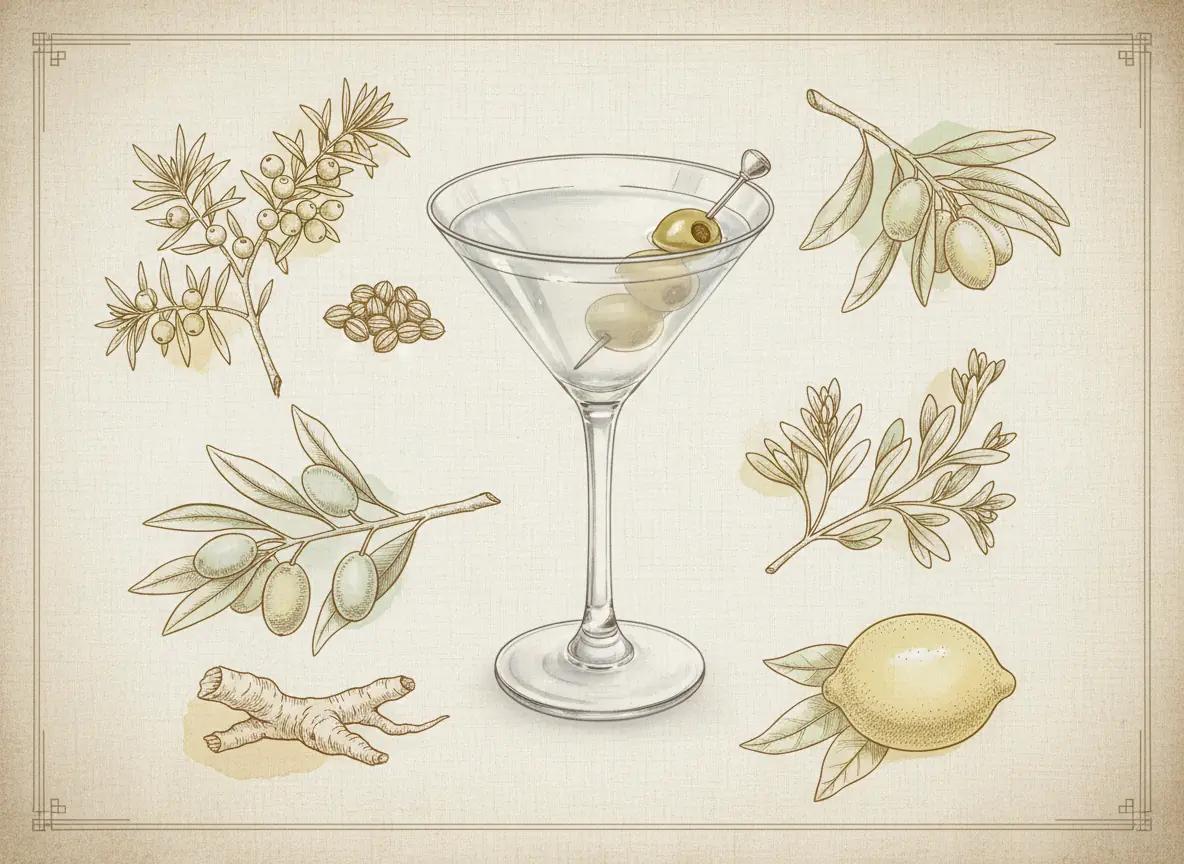
A Martini is 60ml of gin and 10ml of dry vermouth, stirred over ice for 20 to 30 seconds and strained into a chilled Martini glass, with oil from a strip of lemon peel expressed over the top, or green olives if you prefer them. That is the IBA’s Dry Martini, a six-to-one build, and about 2.6 UK units. At six to one the vermouth stops being a partner and becomes a seasoning: a dry wine note and a rounder finish under the juniper. Older recipes were far wetter, and the drink has been poured at every ratio from equal parts to a bare rinse. Nothing in a Martini is sweet or sour: it is gin, vermouth, cold and water. The stir supplies the last two, so it shapes the result as surely as the gin.
Ford Cocktail
The Ford Cocktail is 45ml Old Tom gin and 45ml dry vermouth, with three dashes of Bénédictine and three dashes of orange bitters, stirred over ice for 20 to 30 seconds, strained into a chilled coupe and finished with a twist of orange peel. About 2.8 UK units. The recipe is George Kappeler’s, from Modern American Drinks, published in 1895, in the Internet Archive’s scan: half a jigger each of Tom gin and French vermouth, three dashes of each seasoning, and a twisted piece of orange peel. The entry gives no reason for the name. Equal parts makes it a wine-forward drink. In our view the lightly sweetened Old Tom meets the vermouth on level terms, the Bénédictine adds a sweet herbal note, and the orange bitters and peel lift the top. Anyone who finds a modern dry Martini severe should try this first.
Where this one sits
Recipe by Jerry Can Spirits · Updated 19 October 2026