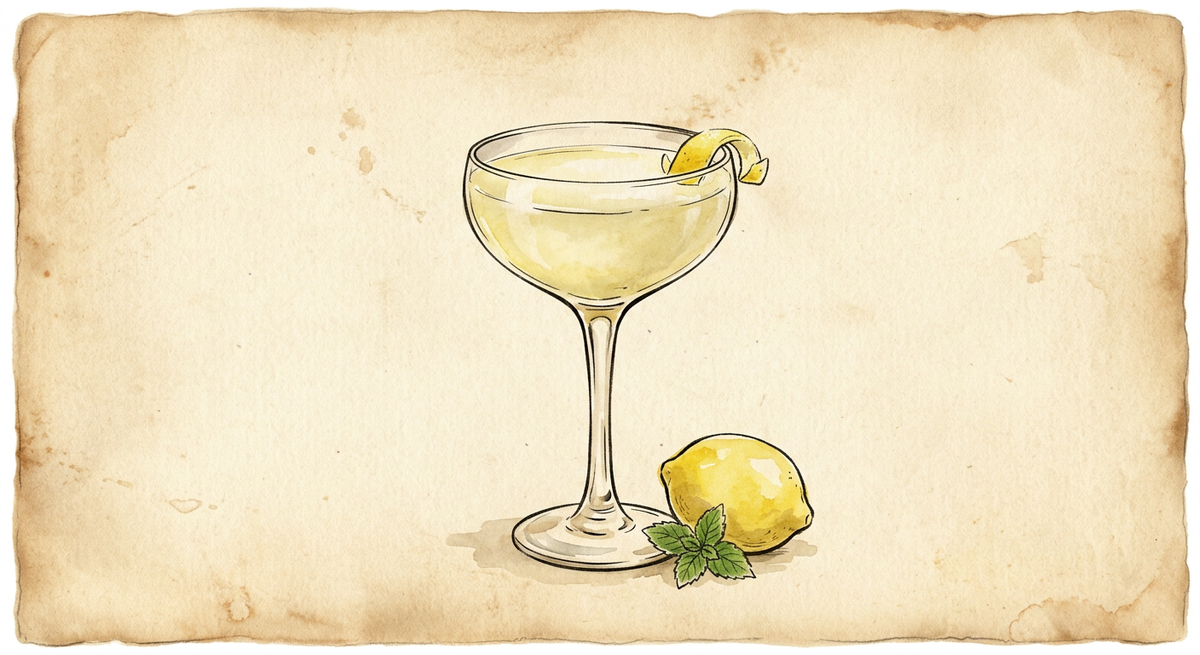
20th Century
A 20th Century is 45ml of London Dry gin, 22.5ml of Lillet Blanc, 15ml of white crème de cacao and 22.5ml of fresh lemon juice, shaken hard for 10 to 12 seconds and double strained into a chilled coupe, with a lemon twist. About 2.5 UK units. Difford’s Guide, a secondary source, has it first printed in London in 1937, in the Café Royal Cocktail Book compiled by William J. Tarling, and credited there to C.A. Tuck. Tarling gave two parts gin to one each of Kina Lillet, white crème de cacao and lemon. We keep his gin, wine and lemon and pour a little less cacao, so the lemon stays in front. The cacao is the surprise. The white kind tastes of vanilla and cocoa butter rather than dark chocolate, so against lemon it reads as a lemon tart more than a chocolate drink. Kina Lillet was reformulated in 1986, and accounts differ on whether the quinine was reduced: Difford’s Guide says it was, DrinkBoy says it was not. Lillet Blanc, which Pernod Ricard lists at 17%, makes a softer drink; Cocchi Americano, which its maker says is infused with gentian, wormwood and cinchona bark, makes a more bitter one.
Glassware: Coupe Glass
Garnish: Lemon twist
Ingredients
45ml
A London Dry at 40% ABV with clear juniper. It is the largest pour and keeps the cacao and the wine in their place.
22.5ml
A Bordeaux aromatised wine at 17% ABV on Pernod Ricard’s Lillet page, standing in for the Kina Lillet of 1937. Cocchi Americano, which Cocchi says is infused with cinchona bark, makes a more bitter drink.
15ml
The clear kind, at about 24% ABV, our working figure, tasting of vanilla and cocoa butter. Dark crème de cacao muddies the colour and pushes the drink towards dessert.
22.5ml
Squeezed the same day. A quarter of the drink and its only acid, set against two sweet ingredients.
Instructions
Chill a coupe and squeeze the lemon juice the same day.
Add the gin, Lillet Blanc, white crème de cacao and lemon juice to a shaker.
Fill with cubed ice and shake hard for 10 to 12 seconds.
Double strain into the chilled coupe.
Express a lemon twist over the surface and drop it in.
Our version
Tarling’s Café Royal proportions of 1937, two parts gin to one each of aperitif wine, white crème de cacao and lemon, with Lillet Blanc for the reformulated Kina Lillet and the cacao cut to 15ml.
Source: our own specification. Last checked 10 October 2026.
Expert Tip
White crème de cacao only. The dark kind is coloured and tastes of cocoa, so the drink turns muddy brown and the lemon loses the argument. Hold the cacao at 15ml. Tarling’s proportions would put it level with the lemon at 22.5ml, and at that level the vanilla starts to lead. Taste before you go up. Lillet Blanc is 17% ABV on Pernod Ricard’s page and Cocchi Americano 16.5% on Cocchi’s own. Cocchi says to drink an open bottle within a month; we keep one in the fridge and finish it within a few weeks, because a tired one tastes flat and the drink has little else to cover for it.
Behind the 20th Century
Flavour Profile
Tuck, Tarling and the Café Royal
Difford’s Guide finds the recipe first published in William J. Tarling’s 1937 Café Royal Cocktail Book, which credits the drink to C.A. Tuck. The Oxford Companion has Tarling joining the Café Royal as head barman in 1930 and, three years later, helping found the United Kingdom Bartenders Guild, and Difford’s Guide calls Tuck a noted London bartender who worked before the war at the Buttery Bar in the Hyde Park Hotel.
Difford’s Guide calls it bartending legend that the name comes from the 20th Century Limited, the express between New York and Chicago that ran from 1902 until 1967. Northwestern University Library dates the streamlined 20th Century Limited to 15 June 1938, a year after the drink was published, so if the story is right Tuck named it for the older train.
White Cacao Against Lemon
White crème de cacao is a clear liqueur of cacao beans and usually vanilla. It carries the scent of chocolate without the roasted bitterness, so against lemon it behaves more like vanilla than like cocoa. The comparison that helps is a lemon tart: sharp citrus with something soft and sweet underneath.
The gin keeps that from turning into pudding. At 45ml it is the largest pour, and its juniper gives the cacao and the wine something dry to sit against. The lemon then sets the pace. With equal measures of cacao and lemon, as in Tarling’s proportions, the vanilla comes forward; at 15ml it stays a finish.
Kina Lillet, Lillet Blanc and Cocchi
Tuck’s recipe called for Kina Lillet, which Difford’s Guide’s Lillet history says the Lillé brothers first produced in 1887, a Bordeaux aperitif wine with a pronounced quinine bitterness. Difford’s Guide says Kina Lillet became Lillet Blanc in 1986. Accounts differ on whether the quinine was reduced: Difford’s Guide says it was cut sharply, DrinkBoy says the level never changed.
That matters here because the wine was the drink’s bitter edge. Lillet Blanc gives a rounder, gentler 20th Century. Cocchi Americano, at 16.5% ABV on Cocchi’s own page and infused with cinchona bark, gives it more bite. The same choice comes up in the Corpse Reviver No. 2 and the Vesper, and the answer is the same: either is correct, and Cocchi gives the more bitter, quinine-led reading.
Tarling’s Proportions, Ours and the 21st Century
The 20th Century in the Café Royal Cocktail Book, as we make it, and Jim Meehan’s tequila 21st Century as Difford’s Guide gives it
Spirit
- Café Royal, 1937
- Gin, two parts
- 20th Century (ours)
- 45ml London Dry gin
- 21st Century
- 60ml blanco tequila
Aperitif wine
- Café Royal, 1937
- Kina Lillet, one part
- 20th Century (ours)
- 22.5ml Lillet Blanc
- 21st Century
- None
White crème de cacao
- Café Royal, 1937
- One part
- 20th Century (ours)
- 15ml
- 21st Century
- 22.5ml
Lemon juice
- Café Royal, 1937
- One part
- 20th Century (ours)
- 22.5ml
- 21st Century
- 22.5ml
Anise liqueur rinse
- Café Royal, 1937
- None
- 20th Century (ours)
- None
- 21st Century
- Glass rinse
UK units
- Café Royal, 1937
- Depends on the measure
- 20th Century (ours)
- About 2.5
- 21st Century
- About 3.0
| Element | Café Royal, 1937 | 20th Century (ours) | 21st Century |
|---|---|---|---|
| Spirit | Gin, two parts | 45ml London Dry gin | 60ml blanco tequila |
| Aperitif wine | Kina Lillet, one part | 22.5ml Lillet Blanc | None |
| White crème de cacao | One part | 15ml | 22.5ml |
| Lemon juice | One part | 22.5ml | 22.5ml |
| Anise liqueur rinse | None | None | Glass rinse |
| UK units | Depends on the measure | About 2.5 | About 3.0 |
How to Serve It
Straight up, in a frozen coupe; the double strain keeps the pale surface clear. Express the twist over the drink so the oil sits on top, then drop it in. Serve it as an aperitif, best before dinner rather than after it.
For the tequila version, make a 21st Century; for Lillet with gin, Cointreau and lemon in equal parts, a Corpse Reviver No. 2.
Make it at home
The Spirit
GinGin is a spirit flavoured with juniper berries. Under the retained Regulation (EC) 110/2008, juniper must lead the taste, the floor is 37.5% ABV, and the route the flavour takes sets the grade: plain gin, distilled gin or London gin. Our recipes count it at 40%, and it carries the Martini, the Negroni and the Gin and Tonic.
More to explore
Frequently Asked Questions
What is in a 20th Century cocktail?
Who created the 20th Century?
Why is it called the 20th Century?
Should I use Lillet Blanc or Cocchi Americano?
Does it taste of chocolate?
How does it compare with the 21st Century?
How strong is a 20th Century?
Sources.
Checked between 18 October and 19 October 2026.
- Difford’s Guide, “Twentieth Century” (secondary source: first published in Tarling’s 1937 Café Royal Cocktail Book, credited to C. A. Tuck; the train-name legend; Tuck at the Buttery Bar, Hyde Park Hotel).
- The Oxford Companion to Spirits and Cocktails (Anistatia R. Miller and Jared M. Brown), “Tarling, William James “Billy”” (secondary source: Tarling head barman at the Café Royal from 1930; with Craddock founded the United Kingdom Bartenders Guild three years later; his cocktail book of 1937).
- Northwestern University Library, “Fleets of modernism: the streamliner era and beyond” (library exhibition page: the New York Central debuted its streamlined 20th Century Limited, a Chicago to New York express, on 15 June 1938).
- Pernod Ricard, “Lillet” (owner’s brand page: Lillet Blanc 17% ABV).
- Cocchi, “Americano” (maker’s page: 16.5% vol.; gentian, wormwood, cinchona bark, bitter orange peel; drink within a month of opening).
- Difford’s Guide, “Kina Lillet” (secondary source: says the quinine was reduced in the 1986 reformulation).
- DrinkBoy, “Lillet blanc” (secondary source: says the quinine level never changed).
- Difford’s Guide, “21st Century (Jim Meehan’s recipe)” (secondary source: created by Jim Meehan in 2007 at Pegu Club; 60ml blanco tequila, 22.5ml white crème de cacao, 22.5ml lemon, Pernod rinse).
- Difford’s Guide, “Lillet: producer history” (secondary source: the Lillet Frères company formed in 1865 by Paul and Raymond Lillé; the brothers first produced Kina Lillet in 1887; the brand re-launched in 1986 with the name and recipe changed).
You Might Also Like
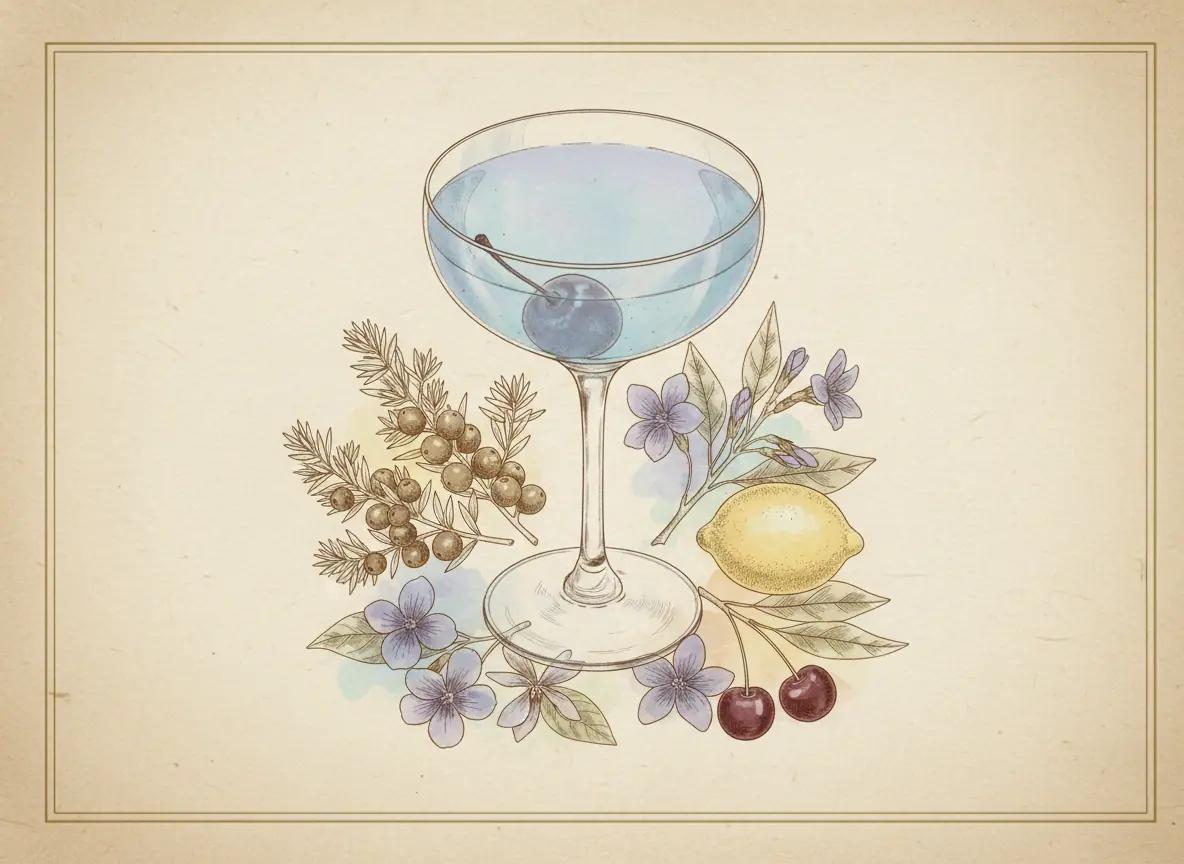
Aviation
An Aviation is gin, maraschino, lemon and a little crème de violette: 45ml gin, 15ml maraschino liqueur, 15ml fresh lemon juice and one bar spoon of crème de violette, shaken hard and double strained into a chilled coupe, with a cherry dropped in. The measures are the International Bartenders Association’s. The violette gives the drink its pale blue-violet colour. Hugo Ensslin, bar manager at the Wallick Hotel in New York, published the original formula for the classic Aviation in his 1916 Recipes for Mixed Drinks, the Oxford Companion says. In 1930 the Savoy Cocktail Book printed it without the violette, and many bartenders followed that version. Keep the violette to a bar spoon: more turns the drink soapy and purple. A glass holds about 2.4 UK units.
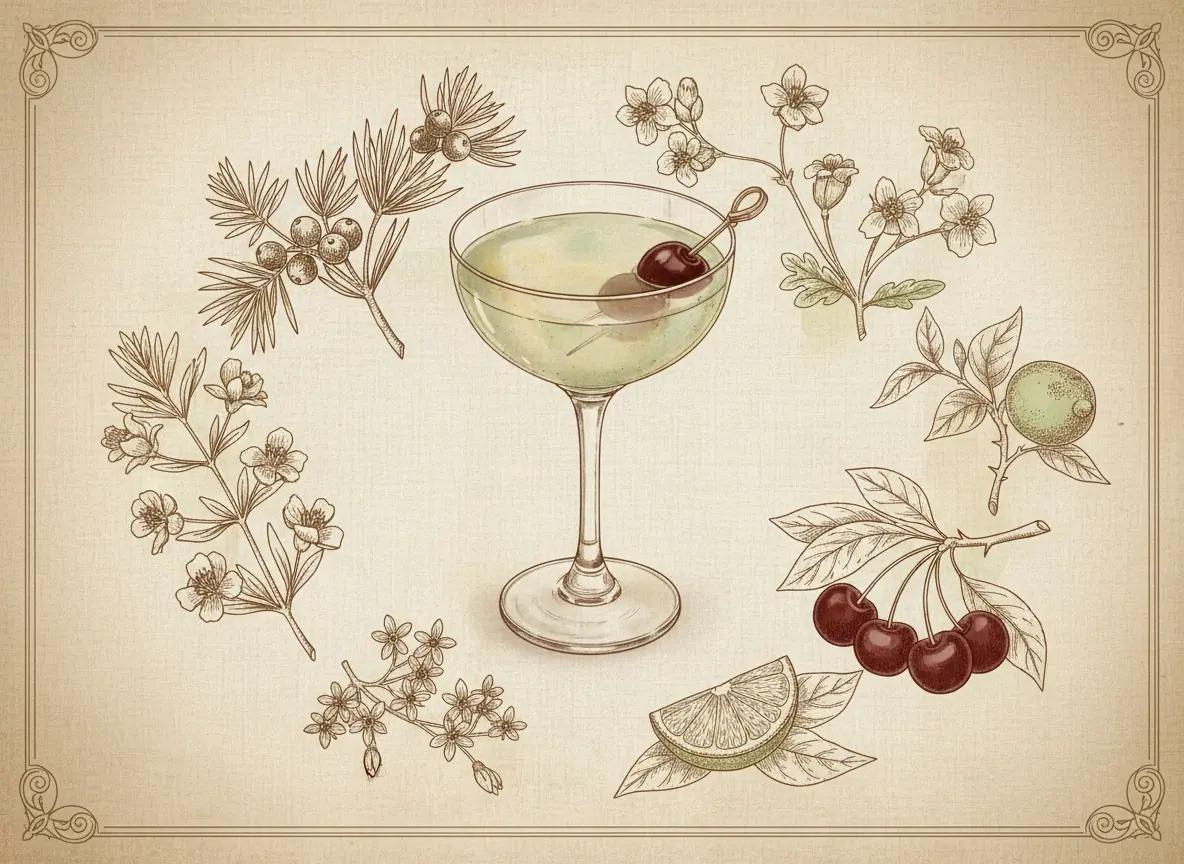
Last Word
A Last Word is 22.5ml each of gin, green Chartreuse, maraschino liqueur and fresh lime juice, shaken hard for 10 to 12 seconds and double strained into a chilled Nick & Nora or coupe. About 2.9 UK units. The measures are the IBA’s; the cherry or lime twist is ours. The Oxford Companion says the drink first appears in print in the Detroit Athletic Club News in 1916, on a menu at 35 cents, a high price then. Ted Saucier’s Bottoms Up of 1951 prints the recipe, quoting a club source who says Frank Fogarty, a vaudeville monologist, introduced it there about thirty years earlier. In 2003 Murray Stenson put it on the menu at the Zig Zag Café in Seattle, from where it spread, the Companion says. Four strong flavours at equal volume, and none takes over. Chartreuse brings herbs and heat, maraschino cherry and a bitter almond edge, lime the acid, and gin holds them together.
21st Century
The 21st Century is 60ml of blanco tequila, 22.5ml of fresh lemon juice and 22.5ml of white crème de cacao, shaken hard with ice for 10 to 12 seconds and double strained into a chilled coupe rinsed with absinthe. No garnish. About 2.9 UK units. Difford’s Guide, a secondary source, says Jim Meehan created it in 2007 during his time at the Pegu Club in New York, as a tequila answer to the 20th Century, a gin drink printed in W. J. Tarling’s Café Royal Cocktail Book of 1937. His recipe in The PDT Cocktail Book, as Difford’s Guide prints it, rinses the glass with Pernod; we use absinthe, which does the same job. The cacao sounds like a dessert and tastes like body. At an equal measure with the lemon it gives the drink a middle, while the tequila brings pepper and green agave and the rinse puts anise on the nose.
Where this one sits
Recipe by Jerry Can Spirits · Updated 19 October 2026