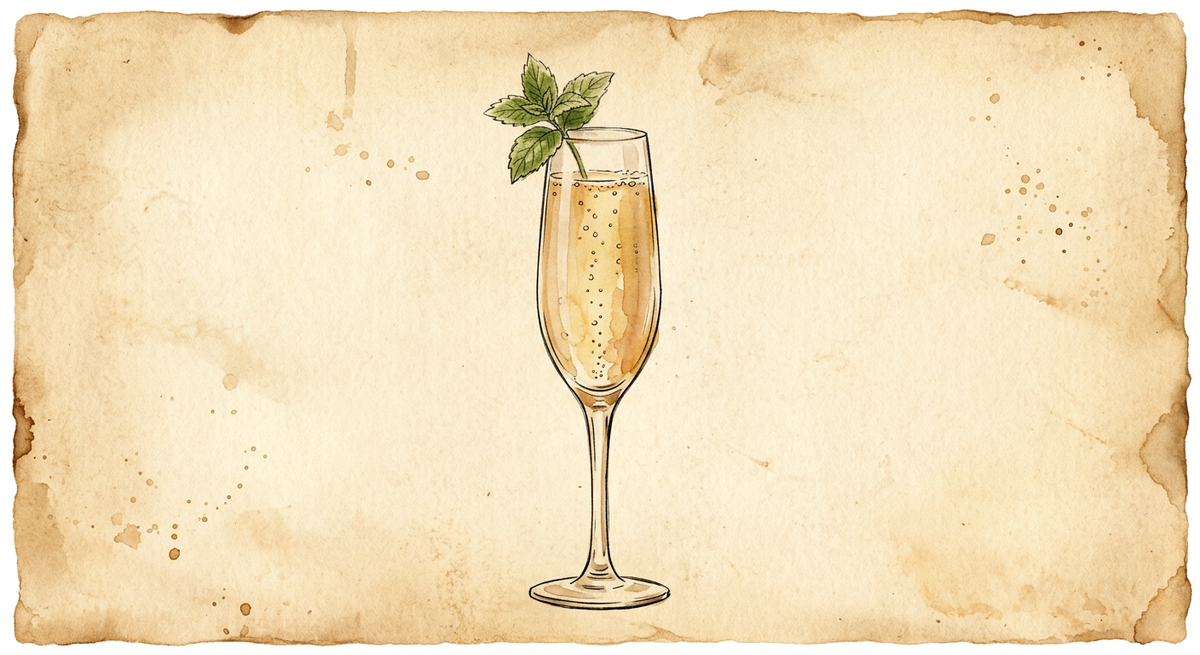
Airmail
An Airmail is 45ml of aged rum, 15ml of fresh lime juice and 15ml of honey syrup, shaken hard for 10 to 12 seconds, double strained into a chilled flute and topped with 60ml of cold, dry champagne, with a sprig of mint. About 2.5 UK units. Difford’s Guide says the name likely refers to airmail as the quickest way to get a letter from A to B, and that the drink probably dates to the early days of airmail, which began on 15 May 1918. It calls the earliest known reference a 1930s Bacardí pamphlet, and has W.C. Whitfield printing it in Here’s How in 1941. Its own recipe is 45ml of rum, 15ml each of lime juice and honey syrup, and 50ml of brut sparkling wine; ours has the same rum and 60ml of champagne. Under the bubbles it is a honey daiquiri. The honey gives the drink floral weight that plain syrup lacks, and it meets the caramel of an aged rum on common ground, so the core stays warm under a cold, dry top.
Glassware: Champagne Flute
Garnish: Mint sprig
Ingredients
45ml
At our working figure of 40% ABV, with oak and dried fruit that carry through the wine. Jamaican or Barbadian styles suit it. Difford’s Guide says the Bacardí leaflet calls for Bacardi Gold rum and Whitfield for “fine rum”; white makes a lighter, plainer drink.
15ml
Squeezed the same day. Fifteen millilitres is less than a Daiquiri takes, because the champagne brings acidity of its own.
15ml
Two parts honey to one part warm water. It gives the drink its body and floral note, and it is what separates the Airmail from a sparkling Daiquiri.
60ml
Brut and cold, at about 12% ABV. A dry crémant, cava or English traditional-method sparkling wine works as well. Like all wine, it contains sulphites.
Instructions
Squeeze the lime juice the same day.
Chill a flute of about 200ml.
Add the rum, lime juice and honey syrup to a shaker.
Fill with cubed ice and shake hard for 10 to 12 seconds.
Double strain into the chilled flute.
Top slowly with the champagne, poured down the side of the glass.
Garnish with a mint sprig.
Our version
Difford’s Guide gives 45ml of Cuban añejo rum, 15ml each of lime juice and honey syrup, and 50ml of brut sparkling wine, served over ice in a highball. Ours keeps the rum at 45ml and raises the champagne to 60ml, served up in a flute.
Source: our own specification. Last checked 9 October 2026.
Expert Tip
Make the honey syrup two parts honey to one part warm water, stirred until smooth, and we keep it in the fridge for up to a fortnight. Neat honey seizes on contact with ice and sticks to the tin. Double strain the shaken base, then pour the champagne slowly down the side of the flute. Poured fast into the middle, it foams over the rim and you lose both wine and fizz. Use a dry wine. A brut champagne, crémant or dry cava suits it; a demi-sec or a sweet prosecco piles sugar onto the honey, and there is no more acid in the glass to answer it.
Behind the Airmail
Flavour Profile
Where It Comes From
Difford’s Guide says the name likely refers to airmail as the quickest way to get a letter from A to B, and that the drink probably dates to the early days of airmail, which began on 15 May 1918.
Difford’s Guide gives the earliest known reference as a 1930s Bacardí promotional pamphlet, Bacardi and Its Many Uses. Difford’s says W.C. Whitfield published the recipe in Here’s How in 1941 with the comment “It ought to make you fly high”, and that the 1940s look like its heyday, with David Embury’s The Fine Art of Mixing Drinks in 1948 and Esquire’s Handbook for Hosts in 1949.
Why Honey
Swap the honey for sugar syrup and you have a sparkling Daiquiri, a good drink and a different one.
Honey brings floral weight and a little viscosity, and both count once the wine goes in. It also shares caramel and dried fruit with an aged rum. Take away the champagne and what is left is rum, lime and honey.
The Rum
Aged rum gives the drink a core the wine cannot bury. Look for oak and dried fruit: a Jamaican or Barbadian aged rum, or a softer Guatemalan one.
White rum makes a lighter and crisper drink. Overproof does not suit it: at 45ml under the wine, it reads hot rather than warm.
The Champagne Top
Sixty millilitres, dry and very cold, poured slowly down the inside of the flute once the shaken base is in. Difford’s tops its recipe with 50ml; the extra wine makes ours longer and drier.
Beside the French 75
The Airmail beside Difford’s recipe, and our French 75
Airmail (ours)
- Spirit
- 45ml aged rum
- Citrus
- 15ml lime
- Sweetener
- 15ml honey syrup
- Top
- 60ml champagne
- UK units
- About 2.5
Airmail, Difford’s Guide
- Spirit
- 45ml añejo rum
- Citrus
- 15ml lime
- Sweetener
- 15ml honey syrup
- Top
- 50ml brut sparkling wine
- UK units
- About 2.4
French 75
- Spirit
- 30ml gin
- Citrus
- 15ml lemon
- Sweetener
- 15ml sugar syrup
- Top
- 60ml champagne
- UK units
- About 1.9
| Drink | Spirit | Citrus | Sweetener | Top | UK units |
|---|---|---|---|---|---|
| Airmail (ours) | 45ml aged rum | 15ml lime | 15ml honey syrup | 60ml champagne | About 2.5 |
| Airmail, Difford’s Guide | 45ml añejo rum | 15ml lime | 15ml honey syrup | 50ml brut sparkling wine | About 2.4 |
| French 75 | 30ml gin | 15ml lemon | 15ml sugar syrup | 60ml champagne | About 1.9 |
How to Serve It
In a chilled flute, straight away, with a sprig of mint on top for the nose. Serve it where you would serve a French 75 and expect it to land warmer at the core.
For the gin original of the same idea, make a French 75; without the honey and the wine, a Daiquiri; for rum, lime, mint and champagne, an Old Cuban.
Make it at home
The Spirit
Aged RumAged rum is rum that has spent years in oak casks, usually ex-bourbon barrels, and taken on vanilla, caramel and dried fruit; our recipes count it at 40% ABV. In our recipes it is the rum for drinks where you should taste the spirit: the Old Cuban, the Mai Tai, the Rum Sour and the punch bowl.
More to explore
Frequently Asked Questions
What is an Airmail cocktail?
Why is it called the Airmail?
Where does the Airmail come from?
Do I need real champagne?
Can I use sugar syrup instead of honey?
Can I use white rum?
How strong is an Airmail?
Sources.
Correct as of 19 October 2026.
- Difford’s Guide, “Air Mail” (secondary source: the name likely refers to airmail as the quickest way to get a letter from A to B, which began on 15 May 1918; earliest known reference a 1930s promotional pamphlet, Bacardi and Its Many Uses; Whitfield’s Here’s How, 1941; Embury, 1948; Esquire’s Handbook for Hosts, 1949; 45ml añejo rum, 15ml lime, 15ml honey syrup, 50ml brut sparkling wine).
You Might Also Like
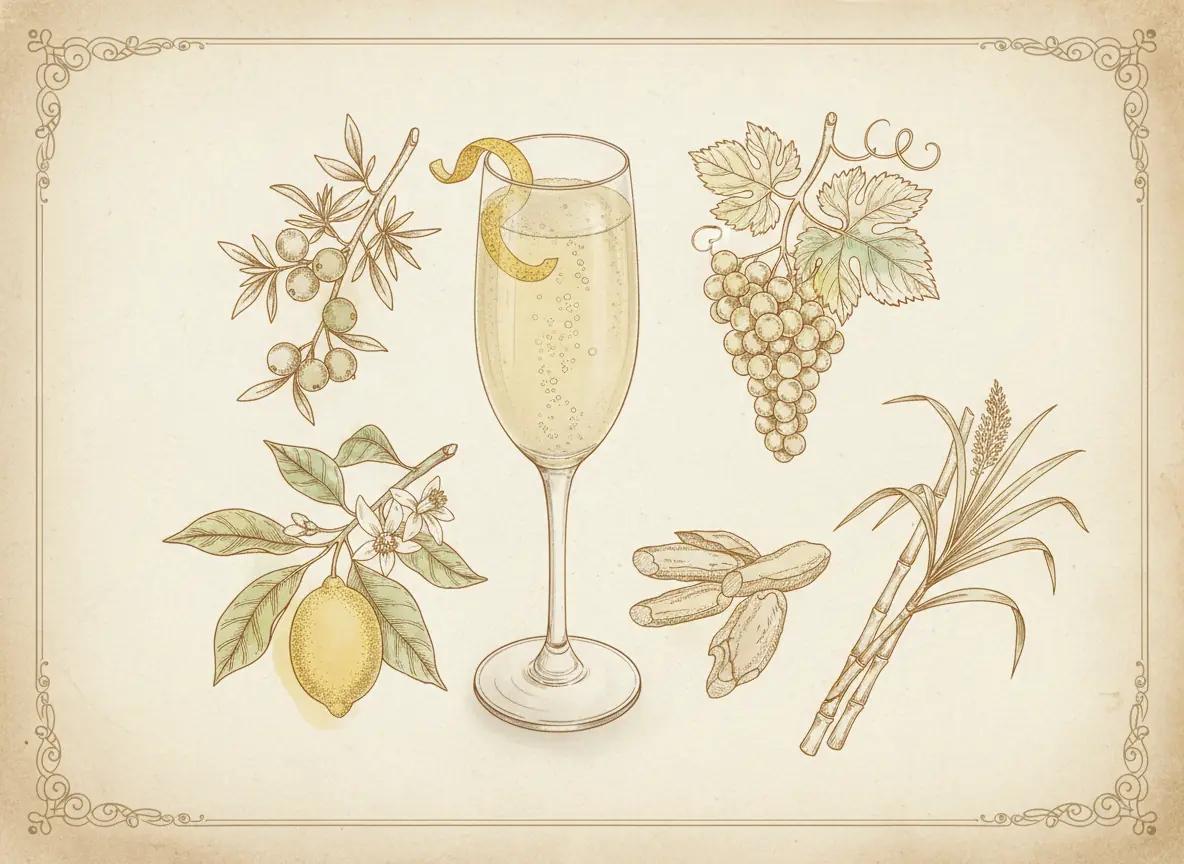
French 75
A French 75 is 30ml of London Dry gin, 15ml of fresh lemon juice and 15ml of sugar syrup, shaken hard for 10 to 12 seconds, double strained into a chilled flute and topped with 60ml of cold brut champagne, with a lemon twist. About 1.9 UK units. The measures are the IBA’s. The name is the French army’s 75mm field gun of the First World War. The drink is usually credited to Harry MacElhone and Harry’s New York Bar in Paris, often with the date 1915, but the printed record starts later. MacElhone’s ABC of Mixing Cocktails, published at the end of 1922 according to the Oxford Companion, has a ‘75’ of calvados, gin, grenadine and absinthe, as the Internet Archive’s scan of its second impression shows. The Companion, in an entry by David Wondrich, finds the gin, lemon, sugar and champagne formula and the French 75 name together first in Here’s How, a book put out by a New York humour magazine, in 1927. Built that way, it is a Tom Collins with champagne in place of soda: a short gin sour that the wine lengthens and lifts.
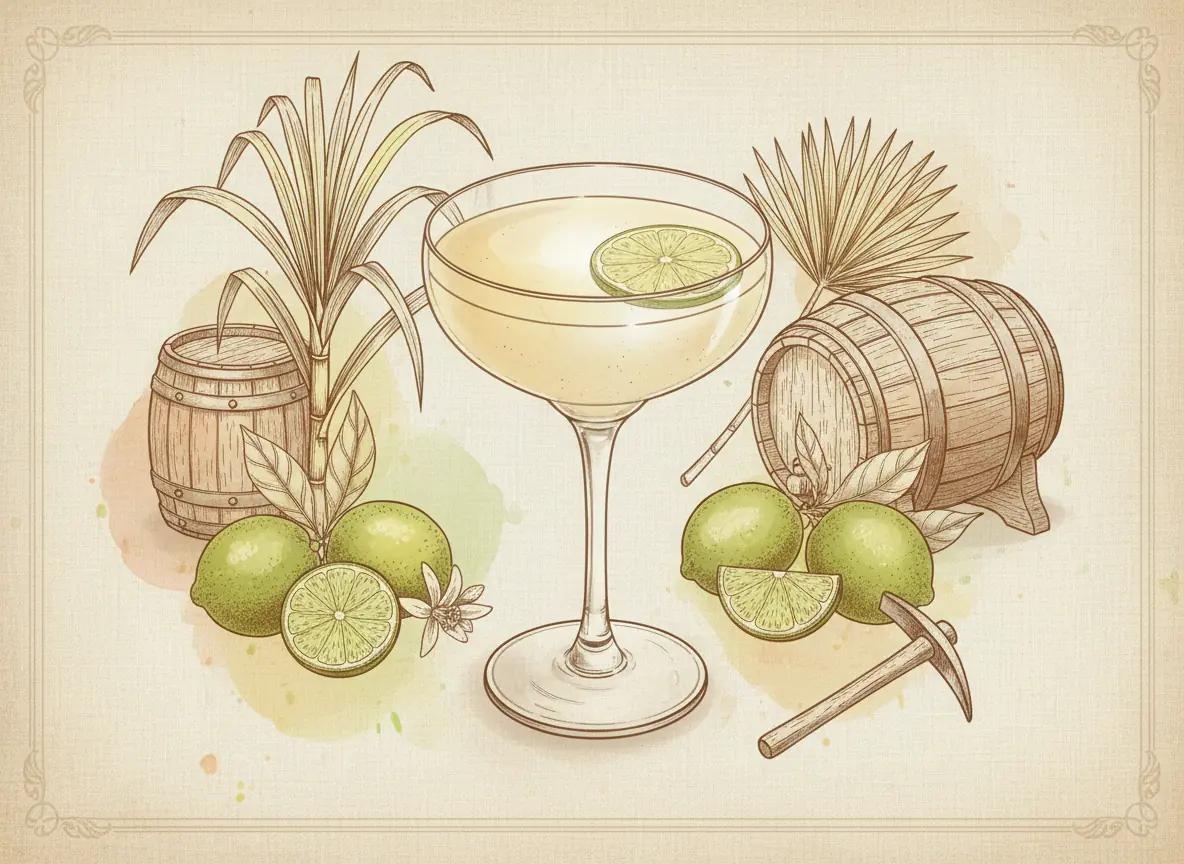
Daiquiri
A Daiquiri is 60ml white rum, 20ml fresh lime juice and two bar spoons of caster sugar. Stir the sugar into the rum and lime in the shaker until it dissolves, then add ice, shake hard for 10 to 12 seconds and double strain into a chilled coupe. About 2.4 UK units. Those are the IBA’s measures, and its method dissolves the sugar first too. The name belongs to Daiquirí, an iron-mining district and beach near Santiago de Cuba. Difford’s Guide credits Jennings Stockton Cox, an American engineer who led one of the first mining parties into Cuba’s iron-ore country after the Spanish-American War of 1898; the Oxford Companion has him making or supervising the first Daiquiri in 1896, and a Santiago bartender naming it in 1908. Difford’s says Constantino Ribalaigua Vert of Havana’s El Floridita made the frozen version famous. With three ingredients and no liqueur or bitters, the Daiquiri hides nothing. A flat rum, tired lime or undissolved sugar shows in the first sip.
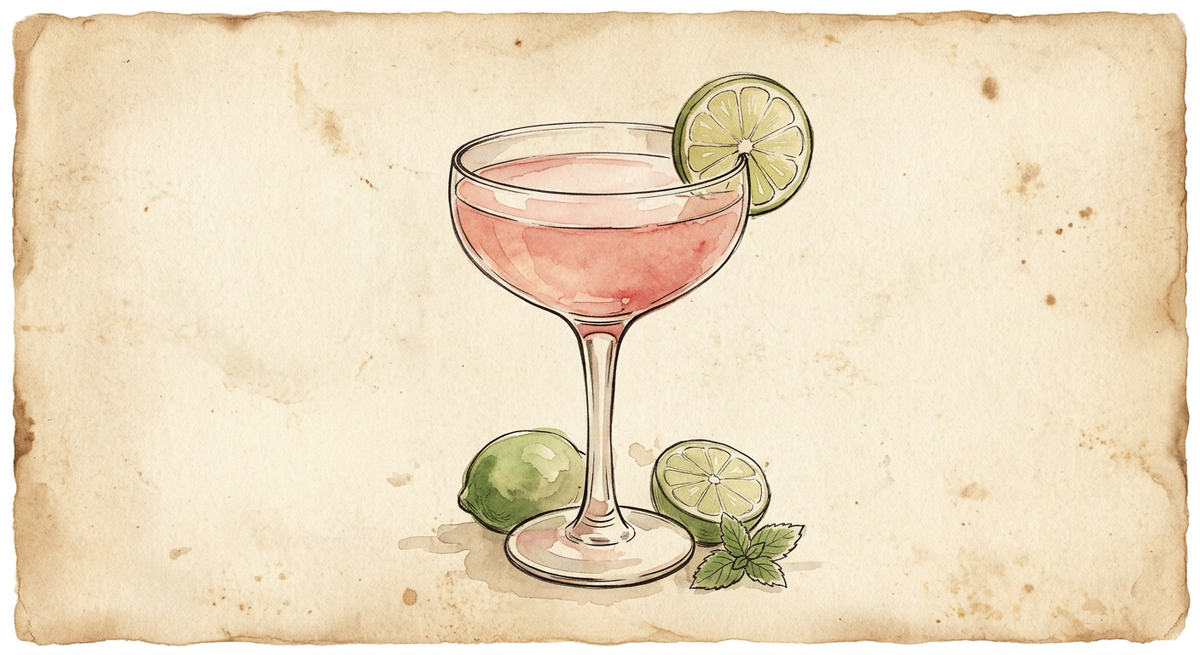
Hemingway Daiquiri
A Hemingway Daiquiri is 60ml white rum, 40ml fresh grapefruit juice, 15ml fresh lime juice and 15ml maraschino liqueur, shaken hard and double strained into a chilled coupe, with a lime wheel. The measures follow the IBA, which lists it as the Hemingway Special. There is no sugar syrup: the maraschino is the only sweetness. About 2.9 UK units. The Oxford Companion to Spirits and Cocktails says it is a version of the Daiquiri No. 3 from Havana’s Floridita bar, named for the writer who downed them there in volume. Difford’s Guide has Hemingway trying the Floridita’s standard frozen Daiquiri and saying he preferred it without sugar and with double rum, which became the Papa Doble, and says the head bartender Antonio Meilan later added maraschino and grapefruit juice to make the Hemingway Special. It is drier and more bitter than a classic Daiquiri, and the grapefruit decides how it tastes.
Where this one sits
Recipe by Jerry Can Spirits · Updated 19 October 2026