Boston Shaker
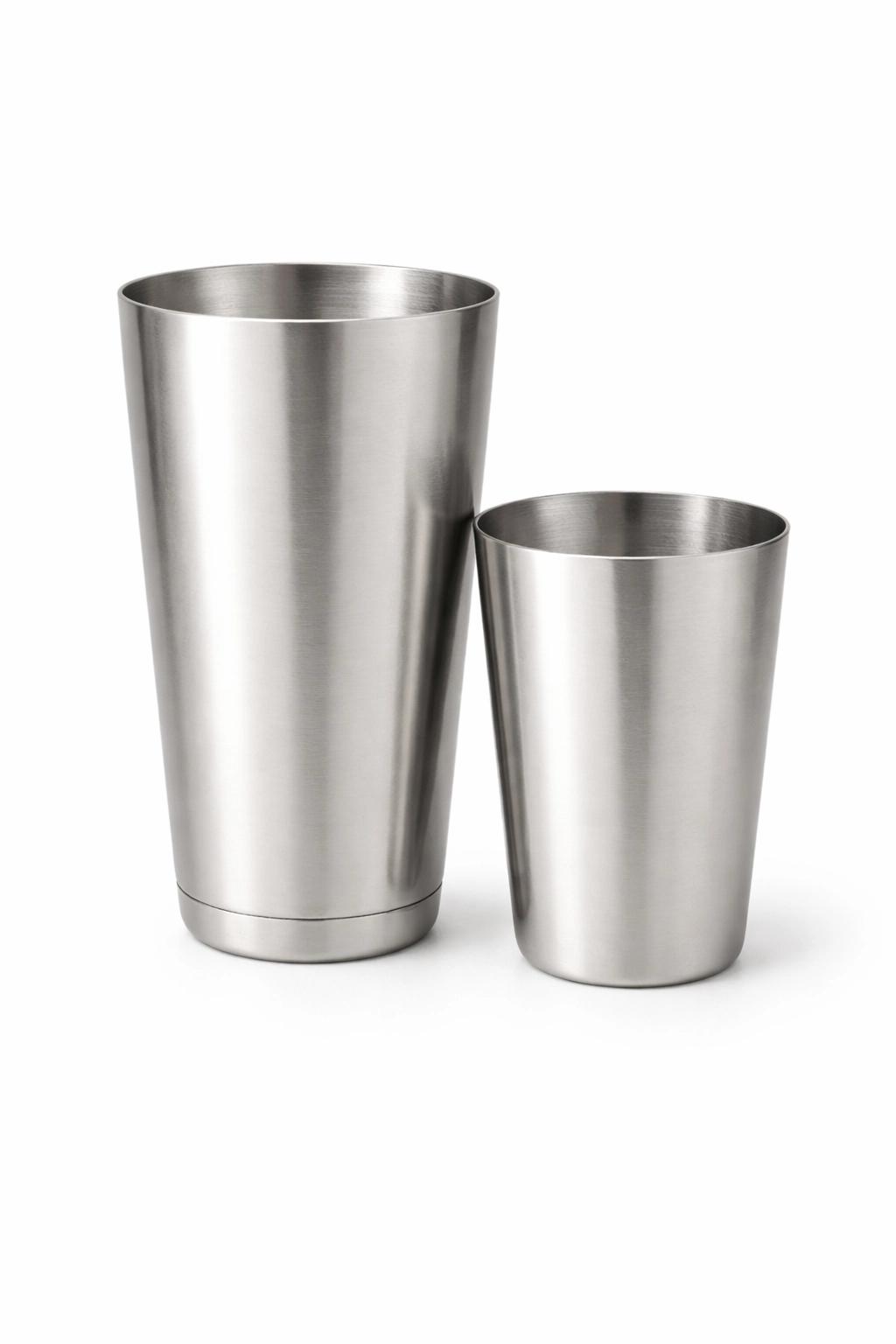
A Boston shaker is a large metal tin, 70 to 85cl in Urban Bar’s own tins, paired with a smaller tin or a mixing glass that seals inside it at an angle. It has no built-in strainer, so it pours through a Hawthorne strainer, and it holds enough for two or three drinks at once. Any shaken drink goes through it, from a Daiquiri to a Singapore Sling.
Essential Equipment
Recommended for every home bar
About the Boston Shaker
A Large Tin and a Smaller Partner
The large tin is open at the top and holds 70 to 85cl in Urban Bar’s own tins. Into it goes a smaller tin or a mixing glass, pushed in at an angle until the rims grip.
Neither piece has a strainer. That makes a Boston quick to fill, rinse and empty, and it is why one always needs a Hawthorne strainer beside it.
Boston, cobbler and Parisian shakers compared
Boston
- Pieces
- Two: a large tin with a smaller tin or glass
- Typical size
- Large tin 70 to 85cl (Urban Bar)
- Strainer
- Separate Hawthorne
- How it opens
- A sharp tap on the large tin
Cobbler
- Pieces
- Three: tin, strainer lid and cap
- Typical size
- 550ml (our shop); 50cl (Urban Bar)
- Strainer
- Built into the lid
- How it opens
- Lifting off the cap
Parisian
- Pieces
- Two, both metal
- Typical size
- Around 500 to 600ml (our guidance)
- Strainer
- Separate Hawthorne
- How it opens
- Twisting the cap
| Shaker | Pieces | Typical size | Strainer | How it opens |
|---|---|---|---|---|
| Boston | Two: a large tin with a smaller tin or glass | Large tin 70 to 85cl (Urban Bar) | Separate Hawthorne | A sharp tap on the large tin |
| Cobbler | Three: tin, strainer lid and cap | 550ml (our shop); 50cl (Urban Bar) | Built into the lid | Lifting off the cap |
| Parisian | Two, both metal | Around 500 to 600ml (our guidance) | Separate Hawthorne | Twisting the cap |
Seal at an Angle, Tap to Open
Measure everything into the small tin, fill it with cubed ice and cap it with the large tin at a slight angle. A firm tap on the base of the large tin seals the pair.
The cold tightens the seal as you shake. To open it, hold the shaker with the large tin underneath and strike it with the heel of your hand just under the rim, at the point where the small tin sits closest to its wall.
Shake Hard, Then Strain
Shake hard for 10 to 12 seconds, a hand on each piece. A drink with egg white is sealed and shaken empty of ice for 10 to 15 seconds before the ice goes in.
Pour through a Hawthorne strainer set in the large tin. Our Vesper and Paper Plane are double strained too, through a fine mesh strainer held over the glass.
Sized for a Round
A long shaken drink such as the Singapore Sling or the Rum Runner comes to about 200ml before any ice goes in. That crowds a small shaker, and an 800ml tin takes it with room to spare.
For one sour at home, a cobbler shaker or a Parisian shaker does the same job with less kit. The Boston pays off when you make two or more drinks at once.
Using the Boston Shaker
Usage
Every shaken drink: anything with juice, egg white, cream or fruit. Shake it hard for 10 to 12 seconds on cubed ice and pour it off through a Hawthorne strainer, adding a fine strainer when the recipe asks for a double strain. The large tin takes a round of two or three.
Pro Tip
If the tins will not part, turn the shaker a quarter turn and tap again at a fresh point. If it still holds, a few seconds of warm water round the joint loosens it.
Professional Tips
- Measure the drink into the small tin, add cubed ice and cap it with the large tin.
- Press the tins together at a slight angle, not square, and give the base of the large tin a firm tap to seal it.
- Keep a hand on each piece through the whole shake.
- To open, strike the large tin with the heel of your hand just under the rim, where the small tin sits closest to its wall.
Alternatives
Budget Alternative
A plain unweighted pair in stainless steel. A mixing glass you already own makes a Boston with a single large tin, though a glass can crack if it is struck hard to open.
Premium Option
A heavier weighted pair from one maker, made to seal together. Weight changes how it feels in the hand; it does not change the drink.
Specifications
Material
Stainless steel tins; the smaller piece is sometimes a toughened mixing glass
Capacity
Large tin 70 to 85cl and small tin 45 to 50cl in Urban Bar’s own listings
Details
Two open pieces that seal by friction when one is pressed into the other at an angle; no built-in strainer
More to explore
Common Questions
What is a Boston shaker?
What size is a Boston shaker?
Boston shaker or cobbler shaker?
How do you seal and open a Boston shaker?
Do you need a strainer with a Boston shaker?
How long should you shake a cocktail in a Boston shaker?
Tin and glass, or two tins?
Sources.
Checked between 18 October and 20 October 2026.
- The Oxford Companion to Spirits and Cocktails (David Wondrich), “The cocktail shaker” (secondary source: the glass-and-tin shaker first recorded in New York in 1850; “cobbler mixers” by 1851; at least twenty US patents between 1870 and 1920; Hauck’s of 1884).
- Urban Bar, “Octagonal Boston Shaker Tin 70cl”.
- Urban Bar, “Octagonal Boston Shaker Cup 50cl”.
- Urban Bar, “Yansheng Tin-on-Tin Stainless Steel Weighted Shaker 85cl”.
- Jerry Can Spirits shop, “Stainless Steel Cocktail Shaker, 550ml”.
- Urban Bar, “Coley Three Piece Shaker Polished 50cl”.
- The Oxford Companion to Spirits and Cocktails, “Boston shaker” (secondary source (no signature on the entry): the two-part tool of a mixing glass and mixing tin).
Master the Technique
Made with the Boston Shaker
Used In These Cocktails
Updated 20 October 2026