
Vodka Cocktails, page 2

36 recipes, page 2 of 2

Difficulty Level

Shaft

The Shaft is Canada’s iced-coffee ritual, and it arrives with a civic dispute attached. Vodka, coffee liqueur and Irish cream over cold espresso and ice, drunk through a straw as fast as the drinker can manage, with Victoria and Calgary both claiming the invention and Victoria holding the competitions. The build is the White Russian’s arithmetic served cold and sharpened. Three fifteen-millilitre pours of spirit, roast and cream over forty-five of genuine chilled espresso, and that last ingredient is what separates this from the sweet coffee-flavoured drinks it superficially resembles. Real coffee brings acidity and bitterness the liqueur cannot, and the drink needs both to stay upright. The straw is not a garnish. Drunk in one continuous pull the whole thing arrives at once, cold and bitter and creamy in the same second, which is the entire point of it. Sipped slowly it is a pleasant iced coffee. Raced, it is a Shaft.

Slow Comfortable Screw Against the Wall

The Slow Comfortable Screw Against the Wall has the longest name in the canon and the most complete crossword behind it. Slow is sloe gin. Comfortable is Southern Comfort. Screw is the Screwdriver’s orange juice. Against the Wall is the Harvey Wallbanger’s Galliano float. Every word is a bottle, and the drink is its own sentence performed. The 1970s built it one order at a time, each escalation adding a word and an ingredient, and the point was always partly the theatre of having to say the whole thing out loud to a stranger. Nobody claims authorship. The decade wrote it collectively. What is easy to miss underneath the joke is that it is a decent fruit highball. Sloe gin’s plum and Southern Comfort’s peach sit over vodka and fresh orange, and the Galliano float finishes it with vanilla and anise exactly as it finishes a Wallbanger. Built with squeezed orange, it is considerably better than the name suggests.
Spicy Fifty

Spicy Fifty

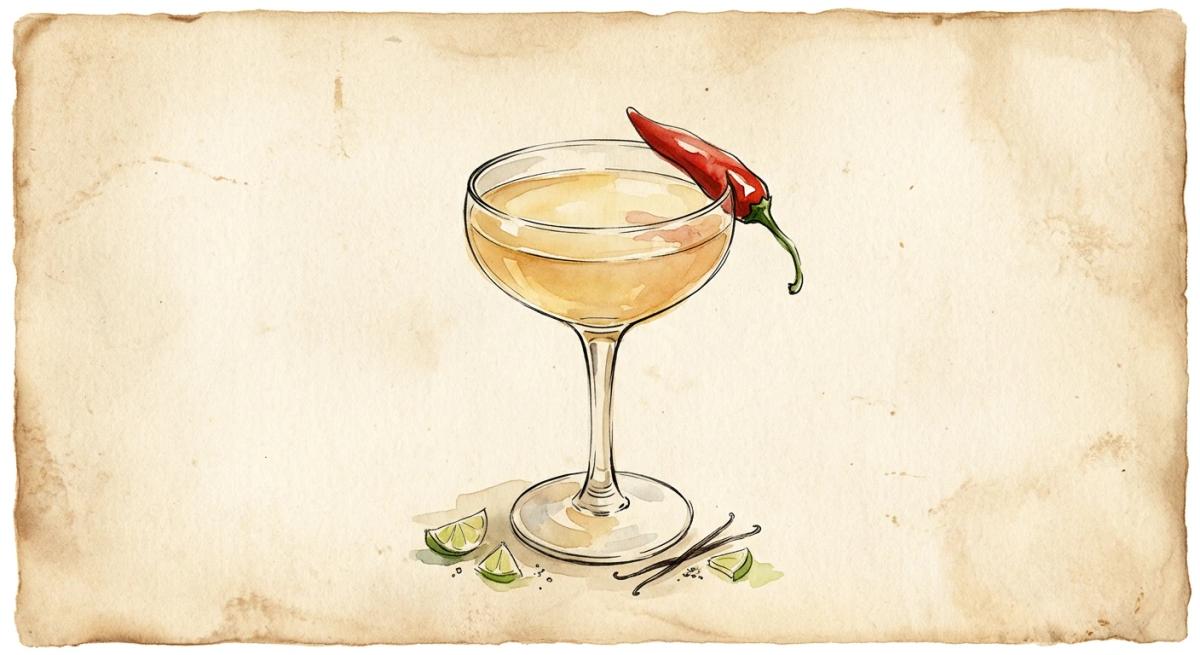
The Spicy Fifty was created by Salvatore Calabrese in 2004 for the opening menu of his London bar FIFTY, which opened in February 2005 and gave the drink its name. Calabrese, known throughout the industry as The Maestro, is one of the most influential bartenders of the modern era, and the drink was added to the IBA list of official cocktails in 2020 in the new era drink category, formal recognition of what serious bartenders had known for over a decade. The structure is a shaken sour. Vanilla vodka anchors the build with a soft sweetness; elderflower cordial brings the floral note that defined mid-2000s cocktail culture; honey syrup adds body; fresh lime juice provides the acid backbone; and red chilli pepper, sliced thin and shaken with the rest, provides the heat that gives the drink its name. An optional pinch of black pepper reinforces the warmth without adding capsaicin. The chilli heat is the variable most worth calibrating. Two thin slices, properly deseeded, give a present but pleasant heat that builds gradually through the drink; more chilli, or seeds left in, gives a considerably more aggressive result. Calibrate it to the drinker rather than serving a fixed heat level.

Tomatini

The Tomatini is the savoury martini rebuilt from the fruit bowl. Jimmy Barrat created it at La Petite Maison in Dubai in 2011 and carried it to the World Class bartending final in 2012 as his signature, muddling cherry tomatoes where a Bloody Mary reaches for the carton. The restaurant’s Niçoise kitchen is audible in every element of it. The build treats tomato as the fruit it botanically is: three cherry tomatoes muddled to liquid, vodka’s clean frame behind them, lemon and a short syrup balancing, with white balsamic and a saline dash seasoning it like a kitchen rather than a bar. Fine-strained to silk and dusted with black pepper, it drinks as a sweet-sour sipper carrying lunch’s depth: delicate, assertive and nothing whatever like its red cousin. It gives the savoury category its elegance, and it is the clearest proof available that umami belongs in a coupe rather than only in a highball.
Vietnamese Iced Coffee (Cocktail)

Vietnamese Iced Coffee (Cocktail)

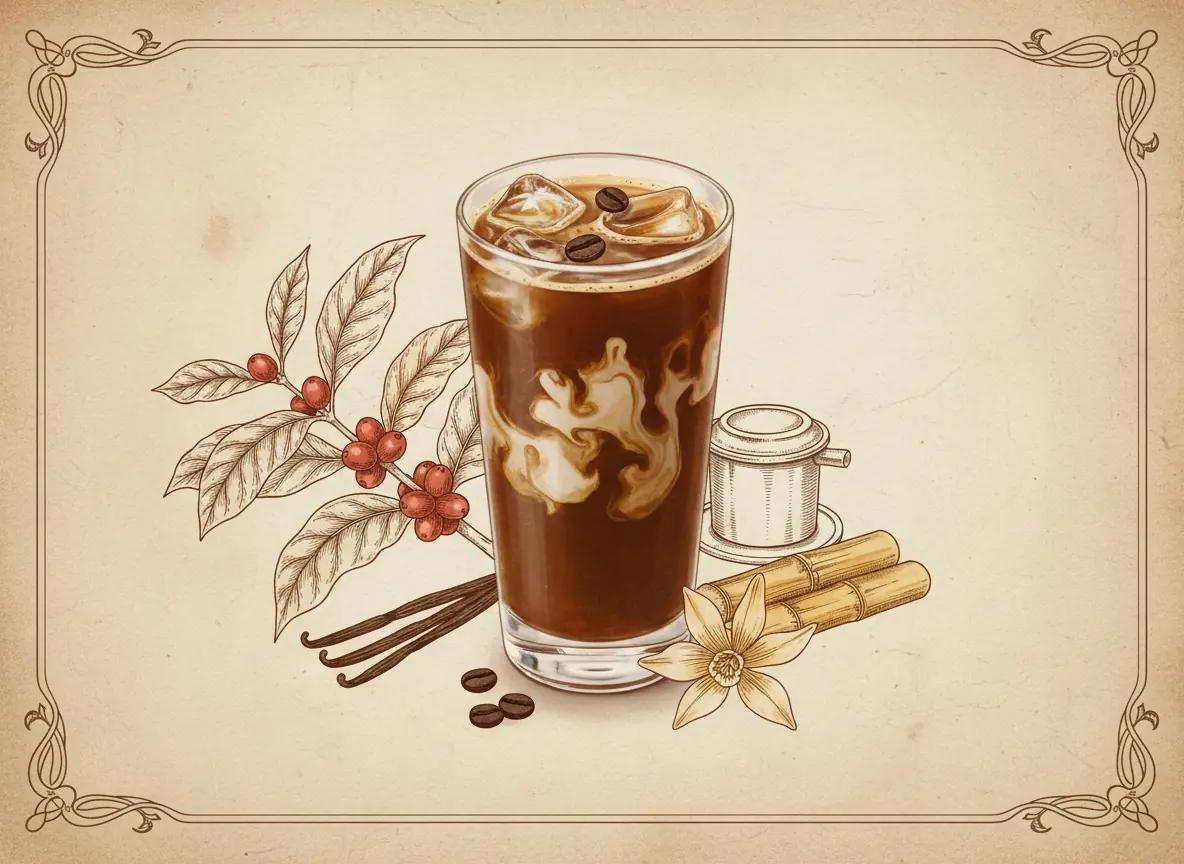
Cà Phê Sữa Đá is Vietnamese iced coffee, one of the most distinctive cold coffee drinks in the world, built on intensely brewed Robusta and sweetened condensed milk. It has been a fixture of Vietnamese café culture since coffee cultivation arrived with French missionaries in the nineteenth century. The name translates directly: cà phê is coffee, sữa is milk, đá is ice. The cocktail version adds vodka and coffee liqueur to that base without altering its fundamental character. The vodka carries the coffee and condensed milk without introducing competing flavour, and the coffee liqueur reinforces the coffee note while bridging the milk and the spirit. The result tastes unmistakably of the original while carrying enough structure to stand as a serious cocktail. The coffee decides everything else. A weak brew produces sweetened milk with a faint coffee note; a properly concentrated Robusta produces a drink with the depth and bitterness to hold its own against the condensed milk and the alcohol.

Vodka Collins

The Vodka Collins is the fourth passport in a family that has been reissuing them since Limmer’s Hotel. The formula never changes: spirit, lemon, sugar, soda, tall ice. Only the bottle in the first slot moves, and vodka took its turn as it took everything else in the post-war American well, without ceremony and without anybody writing it down. What the swap produces is the Collins architecture with nothing sitting on top of it. Genever gives you a John, Old Tom gives you a Tom, bourbon gives you the whiskey branch, and each of those spirits editorialises over the frame. Vodka does not. What you taste is lemon, sugar and carbonation at their own volume, over a great deal of ice, for a long time. That makes it the most useful glass in the family as well as the plainest. Pour it beside any of its siblings and the lesson about what a base spirit contributes teaches itself.

Vodka Gimlet

The Vodka Gimlet is what happened when the Gimlet emigrated to mid-century America. Vodka was the coming spirit of the 1950s, country clubs preferred their drinks clean and cold, and the naval original’s gin, with all its opinionated botanicals, was quietly asked to wait outside. What remained was the essential transaction: cold spirit, lime cordial, no argument. Losing the juniper changes the drink honestly rather than cheaply. With no botanicals to answer, the cordial steps forward and the whole thing becomes a study in preserved lime, smoother and more transparent than its parent, and colder-seeming at the same temperature. It asks more of both remaining ingredients, because there is nothing else on stage. It has its own place in the culture, ordered across decades of American fiction and film by characters who wanted something precise and unfussy and never a drink that needed explaining. That is still the job description, and it is a narrower brief than it sounds.

Vodka Martini

The Vodka Martini is vodka and a very small measure of dry vermouth, stirred and served extremely cold. It started life in the 1950s bar books under the name Kangaroo, which was not a compliment, and ended as the most ordered martini in the world. Take the juniper out of a martini and the vermouth becomes the only aromatic in the glass. That is why the modern spec runs drier than a gin martini rather than wetter: with nothing to converse with, the vermouth seasons instead. It is also why the garnish is promoted from decoration to ingredient, and why the choice of vodka matters here more than almost anywhere else. James Bond is the reason it is famous, though the association is looser than most people assume. Fleming's Bond drinks vodka martinis through the novels, but the drink he orders in Casino Royale is the Vesper, which is a different recipe. Shaken, not stirred belongs to the films.

Vodka Sour

The Vodka Sour is the sour template at its plainest bearing: spirit, lemon and sugar in the proportions the nineteenth-century guides codified, with the spirit contributing strength and nothing else. It is the version nobody writes about and a great many people order, which is roughly the relationship vodka has with the entire cocktail canon. The plainness is the point rather than a failing. A whiskey sour argues about barrels, a gin sour about botanicals, a daiquiri about cane. This one argues about none of them, so what you taste is the triangle itself: how much acid, how much sugar, how cold it is and how hard it was shaken. Everything the template does is visible, because nothing is standing in front of it. The egg white is optional and it is the only decision here with a real consequence. Without it the drink is bright and direct. With it, silk arrives over exactly the same balance.

Watermelon Martini

The Watermelon Martini is the fresh-fruit martini school’s summer graduation: the London style of the 1990s and 2000s that muddled real produce into vodka and called the result a martini by glassware alone, here applied to a fruit that is mostly juice already. The build is produce arithmetic. Ripe watermelon crushed wet, vodka framing it, lime truing the fruit’s watery sweetness, and a short syrup as insurance against an unripe slice. Season decides everything: an August melon needs almost nothing added, and a January one needs a different drink entirely. That is the school’s honest limitation and its best quality at once. Beside the Tomatini’s seasoned complexity, this is the fresh-fruit school stripped right back to its thesis: produce, spirit, acid, done. One fruit, one spirit, one shake, and the summer holiday the martini glass never knew it wanted. A liqueur-based version circulates under the same name and is an entirely different proposition, which is worth holding onto when ordering, because the two share nothing beyond a name and a colour.

White Russian

The White Russian is the Black Russian’s creamier child, appearing in print by 1965 as the era’s dinner-party update of the Brussels original: vodka, coffee liqueur and a float of cream, with dessert and nightcap negotiating in one rocks glass. It spent the health-conscious decades in exile, remembered as a period piece. Then 1998 happened. The Big Lebowski gave the drink to the Dude, who mixes White Russians with whatever is to hand throughout the film, and the cocktail became a cult object: ordered in his honour nightly ever since, half-ironically at first and then simply because it is very good. Built properly it justifies the devotion. The cream is floated rather than stirred, so the drink starts black and finishes white, marbling as it goes. It is the gentlest landing the coffee-vodka family offers, and the right call when an evening wants something that behaves like a dessert without quite being one.

Woo Woo

The Woo Woo is the 1980s stripped to essentials: vodka, peach schnapps and cranberry juice, three pours over ice with a name that is its own toast. It rode the same 1984 schnapps wave that produced the Fuzzy Navel and Sex on the Beach, and of the three it is the leanest, with no orange sunshine, just peach sweetness against cranberry sharpness at party speed. Its virtue is exactly that economy. The cranberry's acid does all the balancing a drink this simple needs, the schnapps needs no help from syrup, and the whole thing assembles in about the time it takes to say the name twice. Poured honestly, with decent vodka, an actual measure and cold cranberry, it remains what it always was: a drink with no ambitions beyond the next half hour, executed perfectly within them. That is a narrower brief than most cocktails set themselves, and one of the few that is met exactly.